

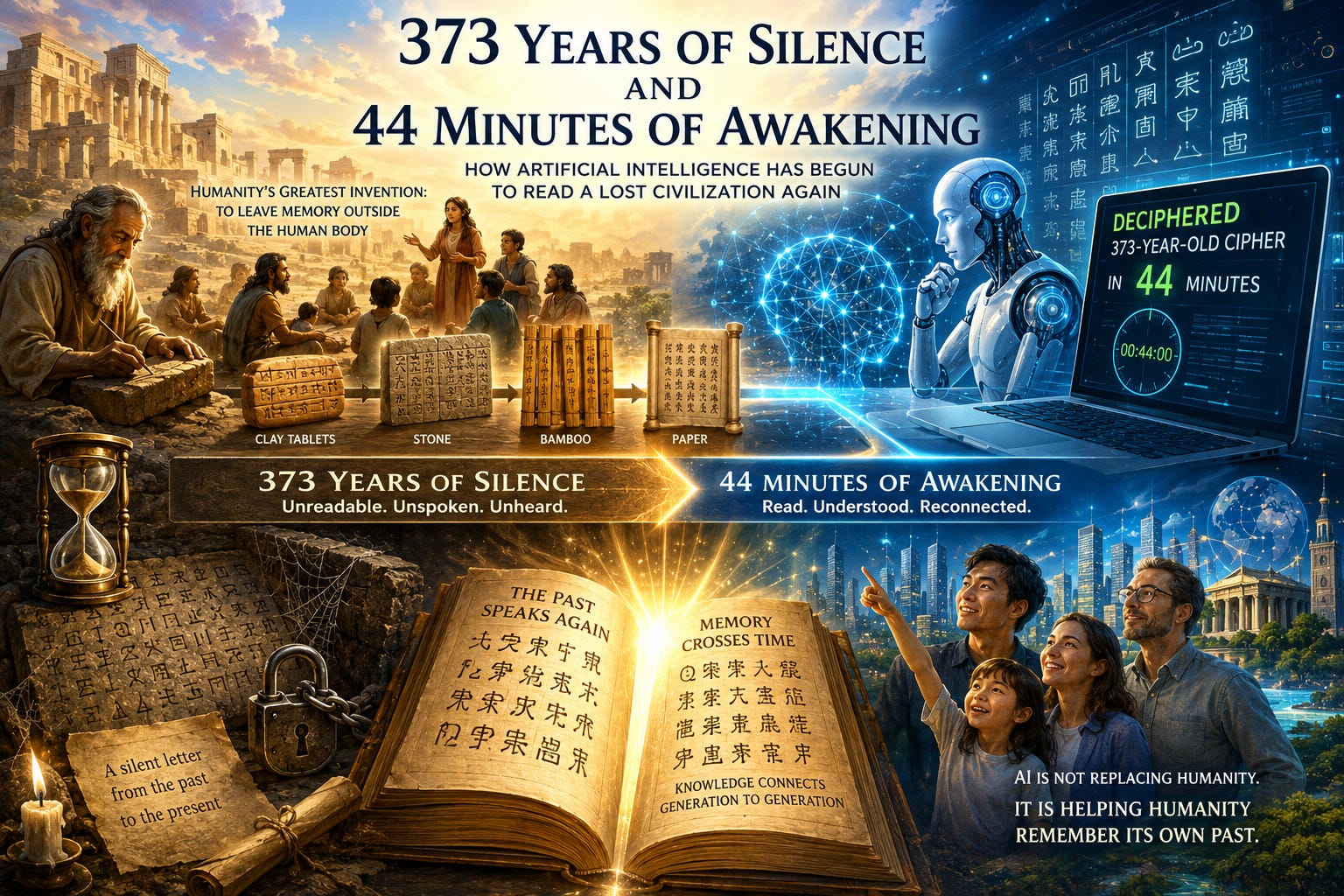
373 Years of Silence and 44 Minutes of Awakening
How Artificial Intelligence Has Begun to Read a Lost Civilization Again
One of the greatest inventions in the history of human civilization was not merely fire or the wheel. It was the ability to leave memory outside the human body. In the beginning, human beings remembered through stories. Parents passed knowledge to their children, teachers instructed their disciples, and communities preserved their experiences through songs and myths. Yet human memory was finite, and when one generation disappeared, countless experiences risked disappearing with it. The invention of writing transcended this limitation. Human beings began leaving their thoughts on clay tablets, stone, bamboo, and paper, and from that moment, memory was able to leave the individual body and travel through time. Civilization began, in a profound sense, to converse not only with the present but also with the future.
Yet the survival of records does not guarantee the survival of memory. Languages change, writing systems disappear, and words that were perfectly clear to one generation may become incomprehensible symbols to another. The countless inscriptions and documents discovered in ancient ruins today reveal precisely this paradox of civilization. Human beings created writing to preserve memory, yet over time they sometimes forgot how to read the very writing they had created. Civilization records to remember, but as records accumulate, the possibility of forgetting accumulates as well. An unreadable script is a memory that still exists but can no longer speak, while an undeciphered cipher is like a silent letter sent from the past to the present.
From this perspective, the 2026 story of a cipher reportedly unsolved for 373 years and allegedly deciphered by AI in only 44 minutes carries significance far beyond an ordinary technology news report. Naturally, the specific case must be rigorously verified through the original materials, the decipherment methodology, the AI model’s inputs and outputs, expert evaluation, and independent replication. It is also necessary to clarify what the figure of “373 years” measures and whether “44 minutes” refers solely to inference time or includes the entire research process. Yet regardless of how the factual details of this case are ultimately established, the civilizational question it raises remains. If machines begin to read the past in ways that human beings could not for centuries, at what turning point in the history of civilization do we now stand?
The First Revolution of Memory: When Writing Conquered Time
Human beings remembered long before the invention of writing. Yet memory depended upon living people. When the person who knew a story died, part of that story could disappear as well. Writing fundamentally changed this condition. The voices of the dead could now reach the living. A king who lived thousands of years ago could, in a sense, still command us today, while a letter written by an anonymous individual could carry emotion to someone centuries later.
Writing was humanity’s first technology of time travel. When we speak of technology today, we often think of spacecraft, the Internet, and artificial intelligence. Yet writing was perhaps the oldest information technology that enabled human beings to travel over time. It brought the past into the present and carried the present into the future. Civilization could accumulate knowledge because every generation no longer needed to rediscover everything that previous generations had already learned.
Yet writing contained one fundamental vulnerability: someone had to be able to read it. The existence of writing does not automatically guarantee the existence of meaning. Meaning comes alive only in the relationship between symbols and human beings who understand them. When a linguistic community disappears and its writing system is forgotten, a record may remain nothing more than a physical trace on paper or stone. Here civilization encounters a remarkable paradox. Human beings invented writing to overcome forgetting, yet writing itself could eventually produce a new form of forgetting.
Silent Civilizations: Unreadable Writing Is Not Dead
Ancient ciphers and forgotten scripts are often described as “dead writing.” Strictly speaking, however, the writing itself is not dead. What has disappeared is our ability to read it. This distinction is profoundly important.
The characters carved into stone still exist. The symbols pressed into clay tablets still exist. The ink on ancient documents may remain. What has disappeared is not necessarily the record itself, but the connection between the record and the human mind capable of understanding it. Civilization may survive materially while becoming silent semantically.
When Egyptian hieroglyphs and Mesopotamian cuneiform began to be read again, humanity did not merely decipher a few unfamiliar symbols. Lost worlds returned to human history. The names of kings, accounts of wars, religious beliefs, legal systems, stories of love and death, taxes, and labor began to speak again.
To decipher writing is not merely to discover information about the past. It is to encounter the humanity of the past once again. The same is true of ciphers. A cipher is not simply a hidden message. It is a thought that someone wishes to conceal for a particular reason, or knowledge intended to be communicated only to particular people. Within a cipher lie not only information but also power and fear, trust and distrust. To decipher a cipher, therefore, is not merely to solve a mathematical problem. It can also mean reading the invisible structures of human society.
Printing: When Memory Moved from the Hands of the Few to the World of the Many
If writing extends human memory across time, printing extended memory across society. After Gutenberg, knowledge no longer remained exclusively in monasteries, royal courts, or the hands of a small number of scholars. Books could be reproduced, ideas could travel, and knowledge could spread throughout a wider society. The printing revolution was not merely a technological revolution. It transformed the fundamental question of who could possess knowledge.
As books became more abundant, however, humanity encountered a new problem. In earlier times, information was scarce. After the printing revolution, information gradually became overwhelming. Libraries grew, academic disciplines became increasingly specialized, and it became progressively impossible for a single person to possess all available knowledge.
The age of AI may represent a new stage of the problem that began with printing. We no longer live in an age of information scarcity. The Internet and digital databases contain more information than any human being could read in a lifetime. The challenge is no longer simply finding information. It has become the challenge of discovering meaningful connections within an overwhelming ocean of information.
It is precisely at this point that AI enters the story.
Computer Expanded Calculation; AI Expands Exploration
The computers of the twentieth century dramatically expanded humanity’s capacity for calculation. Problems that might have required human beings’ years to calculate could be processed by machines in seconds. Yet computers generally operated within rules explicitly defined by human beings.
Artificial intelligence presents a somewhat different possibility. Even in situations where complete rules are not available, AI can search for patterns within enormous collections of data, explore relationships among different forms of information, and propose possible hypotheses. Rather than simply replacing human intelligence, AI represents a new technology capable of expanding humanity’s capacity for exploration.
This ability is particularly significant in decipherment. A cipher may contain a complex interweaving of letters and numbers, repetition and frequency, language and historical context. Human researchers must examine possible hypotheses one by one within the limits of time and memory. AI, by contrast, may be able to explore a far broader space of possibilities at remarkable speed.
The true revolution of AI, therefore, may not lie simply in the claim that it “thinks faster than humans.” The revolution of AI lies in its potential to explore possibilities that human beings may never have thought to examine.
The story of a 373-year-old cipher and 44 minutes of AI analysis may symbolize precisely this transformation. If human researchers had spent generations staring at a single door, AI may represent the possibility of knocking on thousands of other doors simultaneously.
Between Possibility and Truth, There Must Be a Bridge Called Verification
At this point, however, the most important problem emerges. AI can present possibilities. But possibility is not the same as truth. Generative AI can produce answers so plausible that they may sometimes be dangerous. Even when evidence is incomplete, it can construct natural sentences and fill gaps with narratives that appear logically coherent. Yet in historical research, a sentence that sounds natural is not necessarily a sentence that was written in the past. This is a new epistemological challenge of the AI age.
In the past, we asked, “Is there information?” During the Internet age, we increasingly asked, “Where is the information?” In the age of AI, however, we must ask a new question: “Where did this answer come from?”
If AI claims to have deciphered a cipher, we must examine the process before celebrating the result. What was the original source material? What data did the AI examine? Did it use Internet searches? Did it discover an interpretation that already existed, or did it identify a genuinely new rule? Can independent researchers reach similar results under the same conditions?
Science does not simply believe answers. It is a system for examining and verifying the processes through which answers are reached. For this reason, one of the most important technologies of the AI age may not be AI itself, but rather the human capacity to verify AI.
The Greatest Danger Is Not That AI Is Wrong, but That It Can Be Convincingly Wrong
Human beings are often more easily deceived by plausible stories than by obvious lies. This is precisely where the danger of the AI age lies. It is relatively safe when AI says, “I do not know.” The problem becomes far more serious when AI connects nonexistent sources with historical facts and produces an explanation that appears highly sophisticated and convincing.
This danger is especially significant in the study of history and civilization. Once a fabricated or inaccurate narrative is repeated through books, the Internet, videos, and educational materials, people may gradually begin to accept it as fact. Repetition can sometimes acquire the appearance of truth.
For this reason, the historian of the future must not only know how to use AI but also know how to question its conclusions. The scientist of the future may ask AI to generate hypotheses, but those hypotheses must still be tested experimentally. The citizen of the future must be able to read AI-generated explanations while simultaneously asking about the sources from which those explanations came.
AI literacy is not merely the ability to use AI effectively. It is also the ability to know when AI should not be trusted.
Human Beings Must Evolve from Calculators into Judges
Perhaps the greatest transformation demanded of human beings in the AI age will be a transformation of roles. In the past, human beings performed calculations directly. During the computer age, humans defined problems and machines performed calculations. In the age of AI, machines have begun to propose possible solutions to problems themselves.
What, then, should human beings do? Human beings must increasingly become not merely creatures who search for answers, but creatures who judge the meaning of answers.
AI may present thousands of possibilities. But which possibilities are historically significant? Which interpretations raise ethical concerns? Which conclusions are supported by evidence? And which technologies should not be used at all? These are not merely problems of calculation. They are questions of values and responsibility. AI may be able to read humanity’s past. But human beings must decide how the past discovered by AI should be interpreted and how it should be used in the present.
The essential human ability of the future, therefore, may not be the ability to memorize more information. It may be the ability to exercise wiser judgment amid an abundance of information.
The Conditions for a New Renaissance: Not More Answers, but Deeper Questions
The Renaissance was an age in which humanity rediscovered the knowledge of the past. Ancient texts were read again, and people began to observe nature and society with new eyes. Yet the true power of the Renaissance did not lie merely in reading old books again. It lay in asking new questions about old answers.
The age of AI may likewise become a new Renaissance. AI can reanalyze records that humanity has forgotten, discover relationships among countless documents, and reveal patterns that human beings may never have noticed.
Yet the progress of civilization cannot be measured by the number of answers we possess. More answers do not necessarily mean more wisdom. True wisdom may instead lie in knowing what questions should be asked in an age overflowing with answers.
Education in the AI era must therefore move in the same direction. We cannot merely teach students how to find correct answers more quickly. We must teach them how to determine which questions matter, what evidence is sufficient, and when conclusions should remain provisional. The education of the future must move from the education of answers to the education of judgment.
373 Years of Silence and 44 Minutes of Awakening
373 years and 44 minutes.
These two numbers symbolize more than a difference in time. They represent two different temporal worlds within human civilization. 373 years represent the slow time of humanity, the time in which one generation passes an unresolved problem to another, and countless people may study a question without finding a complete answer. Forty-four minutes represent the time of digital civilization, the time in which data can be analyzed almost instantly, countless possibilities can be explored simultaneously, and decades of human research may potentially be compressed into hours or minutes.
Yet here we encounter a profoundly important civilizational paradox. The faster technology becomes, the more carefully human beings must judge. The faster AI produces answers, the more patiently we must verify them. The more possibilities AI presents, the more rigorously we must examine the evidence. The more machines exceed the speed of human thought, the more humanity must strengthen its wisdom and responsibility.
Perhaps this is the most important balance of the AI age: The speed of machines and the reflection of human beings. The faster AI runs, the more urgent human beings must ask where we are going.
Artificial Intelligence Reads the Past, but Humanity Is Responsible for the Future
The story that AI allegedly deciphered a 373-year-old cipher in 44 minutes may become an important symbol of our time regardless of how its factual details are ultimately verified. It suggests that humanity may now be beginning to read the past in fundamentally new ways.
In the beginning, human beings created writing. Writing extended human memory through time. Printing extended knowledge throughout society. Computers expanded humanity’s capacity for calculation. And AI is now expanding humanity’s capacity for exploration and hypothesis generation.
Yet as technology expands, human responsibility must expand with it. AI may discover patterns hidden within a cipher. But human beings must verify whether those patterns are true. AI may reconstruct sentences from the past. But human beings must interpret what those sentences mean within human history. AI may predict countless possible futures. But human beings must decide which future to choose.
The most important question of the AI age, therefore, is not: “How much can AI do?” The real question is: “As the number of things AI can do continues to grow, for what must human beings assume greater responsibility?”
It may have taken only 44 minutes to break the silence of 373 years. Yet the most difficult cipher that human civilization must solve may still lie ahead. That cipher is this: How can human beings living alongside AI preserve truth, choose wisdom, and assume responsibility for civilization?
AI has begun to read the ciphers of the past. Now humanity must learn to read the new civilization called the AI age. And ultimately, the direction in which that civilization is written will depend on human choice.
373년의 침묵과 44분의 각성
인공지능은 잃어버린 문명을 어떻게 다시 읽기 시작했는가
인류 문명의 가장 위대한 발명 가운데 하나는 불이나 바퀴만이 아니다. 그것은 자신의 기억을 몸 밖에 남기는 능력이었다. 인간은 처음에는 이야기를 기억했다. 부모가 자녀에게 전하고, 스승이 제자에게 들려주며, 공동체는 노래와 신화 속에 자신의 경험을 보존했다. 그러나 인간의 기억은 유한했고, 한 세대가 사라지면 수많은 경험도 함께 사라질 위험이 있었다. 문자의 탄생은 바로 이 한계를 넘어선 사건이었다. 인간은 점토판과 돌, 대나무와 종이 위에 자신의 생각을 남기기 시작했고, 그 순간 기억은 개인의 몸을 떠나 시간 속으로 여행할 수 있게 되었다. 문명은 바로 이때부터 현재를 넘어 미래와 대화하기 시작했다.
그러나 기록이 남는다고 해서 기억이 영원히 살아 있는 것은 아니다. 언어는 변하고 문자는 사라지며, 한 시대에 너무나 명확했던 글이 다음 시대에는 이해할 수 없는 기호가 되기도 한다. 오늘날 우리가 고대 유적에서 발견하는 수많은 문자와 문서는 바로 그러한 문명의 역설을 보여준다. 인간은 기억을 보존하기 위해 문자를 만들었지만, 시간이 흐르면서 그 문자 자체를 읽는 방법을 잊어버렸다. 문명은 기억하기 위해 기록하지만, 기록이 많아질수록 망각의 가능성도 함께 축적한다. 읽히지 않는 문자는 존재하지만 말하지 못하는 기억이며, 해독되지 않은 암호는 과거가 현재에게 보내는 침묵의 편지와도 같다.
이러한 관점에서 373년 동안 풀리지 않았다고 알려진 암호문과 그것을 AI가 44분 만에 해독했다는 2026년의 이야기는 단순한 기술 뉴스 이상의 의미를 가진다. 물론 이 사례는 원본 자료와 해독 방법, AI 모델의 입력과 출력, 전문가 평가, 그리고 독립적인 재현 연구를 통해 엄밀히 검증되어야 한다. “373년”이라는 시간이 무엇을 기준으로 계산되었는지, “44분”이라는 시간이 실제 추론 시간인지 전체 연구 과정을 포함하는지도 확인할 필요가 있다. 그러나 이 사건의 구체적 사실관계가 최종적으로 어떻게 밝혀지든, 그것이 던지는 문명사적 질문은 사라지지 않는다. 인간이 수백 년 동안 읽지 못했던 과거를 기계가 새로운 방식으로 읽기 시작한다면, 우리는 지금 문명사의 어떤 전환점에 서 있는가?
기억의 첫 번째 혁명: 문자가 시간을 이겼을 때
문자가 등장하기 이전에도 인간은 기억했다. 그러나 그 기억은 살아 있는 인간에게 의존했다. 이야기를 알고 있는 사람이 죽으면 이야기의 일부도 사라졌다. 문자는 이 문제를 근본적으로 바꾸었다. 이제 죽은 사람의 목소리가 살아 있는 사람에게 전달될 수 있었다. 수천 년 전의 왕이 오늘날의 우리에게 명령을 내리고, 이름 없는 사람이 남긴 편지가 수백 년 후의 누군가에게 감정을 전달할 수 있게 되었다.
문자는 인간에게 최초의 시간 여행 기술이었다. 우리는 오늘날 기술을 말할 때 우주선과 인터넷, 인공지능을 떠올리지만, 문자야말로 인간이 시간을 넘어 이동할 수 있게 만든 가장 오래된 정보기술이었다. 문자는 과거를 현재로 불러왔고, 현재를 미래에 전달했다. 문명이 축적될 수 있었던 이유는 인간이 이전 세대가 발견한 모든 것을 다시 처음부터 배울 필요가 없었기 때문이다.
그러나 문자에는 한 가지 치명적인 약점이 있었다. 읽는 사람이 있어야 한다는 것이다. 문자가 존재한다고 해서 의미가 자동으로 존재하는 것은 아니다. 의미는 기호와 그것을 이해하는 인간 사이에서만 살아난다. 언어 공동체가 사라지고 문자 체계가 잊히면, 기록은 종이 위의 흔적일 뿐이다. 바로 여기에서 문명은 놀라운 역설과 마주한다. 인간은 망각을 극복하기 위해 문자를 만들었지만, 결국 문자는 새로운 형태의 망각을 만들어냈다.
침묵하는 문명: 읽을 수 없는 글은 죽은 것이 아니다
고대의 암호와 잊힌 문자는 종종 ‘죽은 문자’라고 불린다. 그러나 엄밀히 말하면 그 문자가 죽은 것은 아니다. 우리가 그것을 읽는 능력을 잃어버린 것이다. 이 차이는 매우 중요하다. 돌 위의 글자는 여전히 존재한다. 점토판의 기호도 여전히 존재한다. 오래된 문서의 잉크도 남아 있다. 사라진 것은 기록 자체가 아니라 기록과 인간 사이의 연결이다. 문명은 물질적으로 존재하지만 의미론적으로 침묵할 수 있다.
고대 이집트의 상형문자와 메소포타미아의 쐐기문자가 다시 읽히기 시작했을 때, 단순히 새로운 글자 몇 개가 해독된 것이 아니었다. 잃어버린 세계가 다시 인간의 역사 속으로 돌아왔다. 왕들의 이름과 전쟁, 종교와 법률, 사랑과 죽음, 세금과 노동에 관한 기록이 다시 말을 하기 시작했다.
문자를 해독한다는 것은 과거의 정보를 발견하는 것이 아니라, 과거의 인간성을 다시 만나는 일이다. 암호문 역시 마찬가지다. 그것은 단순히 숨겨진 메시지가 아니다. 누군가가 특정한 이유 때문에 감추고자 했던 생각이며, 특정한 사람에게만 전달하려 했던 지식이다. 암호에는 정보뿐 아니라 권력과 두려움, 신뢰와 불신이 들어 있다. 따라서 암호를 푼다는 것은 단순한 수학적 문제 해결이 아니라 인간 사회의 보이지 않는 구조를 읽는 일이기도 하다.
인쇄술: 기억이 소수의 손에서 대중의 세계로
문자가 인간의 기억을 시간 속으로 확장했다면, 인쇄술은 기억을 사회 전체로 확장했다. 구텐베르크 이후 지식은 더 이상 수도원과 궁정, 일부 학자의 손에만 머물지 않았다. 책은 복제되었고, 사상은 이동했으며, 지식은 더 넓은 사회로 퍼져 나갔다.
인쇄술은 단순한 기술 혁명이 아니었다. 그것은 누가 지식을 가질 수 있는가라는 질문을 바꾼 혁명이었다.
책이 많아지면서 인간은 새로운 문제를 만났다. 과거에는 정보가 부족했다. 그러나 인쇄술 이후에는 정보가 너무 많아지기 시작했다. 도서관은 커졌고, 학문은 세분화되었으며, 한 사람이 모든 지식을 소유하는 것은 점점 불가능해졌다.
오늘날 AI 시대는 어쩌면 인쇄술 이후 발생한 문제의 새로운 단계일 수 있다. 우리는 더 이상 정보 부족의 시대에 살지 않는다. 인터넷과 디지털 데이터베이스 속에는 인간이 평생 읽을 수 없는 양의 정보가 존재한다. 문제는 정보를 찾는 것이 아니라, 정보 속에서 의미 있는 연결을 발견하는 것이 되었다. 바로 이 지점에서 AI가 등장한다.
컴퓨터는 계산을 확장했고, AI는 탐색을 확장한다
20세기의 컴퓨터는 인간의 계산 능력을 극적으로 확장했다. 인간이 수년 동안 계산해야 할 문제를 기계는 몇 초 만에 처리할 수 있었다. 그러나 컴퓨터는 대체로 인간이 정의한 규칙 안에서 움직였다.
AI는 조금 다른 가능성을 보여준다. AI는 완전한 규칙이 없는 상황에서도 방대한 자료 속에서 패턴을 찾고, 서로 다른 정보 사이의 관계를 탐색하며, 가능한 가설을 제안할 수 있다. 이것은 인간의 지능을 대체한다기보다 인간의 탐색 능력을 확장하는 새로운 기술이다.
암호 해독에서 이 능력은 특히 중요하다. 암호문에는 문자와 숫자, 반복과 빈도, 언어와 역사적 맥락이 복잡하게 얽혀 있다. 인간 연구자는 제한된 시간과 기억 속에서 가능한 가설을 하나씩 검토해야 한다. 반면 AI는 훨씬 넓은 가능성의 공간을 빠르게 탐색할 수 있다.
따라서 AI의 진정한 혁명은 “인간보다 더 빨리 생각한다”는 데만 있지 않다. AI의 혁명은 인간이 생각해 보지 못했던 가능성까지 탐색할 수 있다는 데 있다. 373년의 암호와 44분의 AI라는 이야기가 상징하는 것도 바로 이러한 변화일 수 있다. 인간이 오랫동안 하나의 문을 바라보고 있었다면, AI는 수천 개의 다른 문을 동시에 두드려 볼 수 있는 존재가 될 가능성이 있다.
그러나 가능성과 진실 사이에는 검증이라는 다리가 필요하다
여기에서 가장 중요한 문제가 등장한다. AI는 가능성을 제시할 수 있다. 그러나 가능성이 곧 진실은 아니다.
생성형 AI는 특히 인간에게 위험할 정도로 그럴듯한 답을 만들 수 있다. 불완전한 자료 속에서도 자연스러운 문장을 구성하고, 빈 공간을 논리적으로 보이는 이야기로 채울 수 있다. 그러나 역사적 연구에서 자연스러운 문장이 반드시 실제 과거의 문장은 아니다. 이것이 AI 시대의 새로운 인식론적 위기다.
과거에는 우리가 “정보가 있는가?”라고 물었다. 인터넷 시대에는 “어디에 정보가 있는가?”라고 물었다. 그러나 AI 시대에는 새로운 질문이 필요하다. “이 답은 어디에서 왔는가?”
AI가 어떤 암호문을 해독했다고 한다면 우리는 결과보다 먼저 과정을 물어야 한다. 원본 자료는 무엇인가? AI는 어떤 데이터를 보았는가? 인터넷 검색을 사용했는가? 이미 존재하는 해석을 발견한 것인가, 아니면 새로운 규칙을 찾아낸 것인가? 다른 연구자가 같은 조건에서 같은 결과를 얻을 수 있는가?
과학은 답을 믿는 것이 아니라 답에 이르는 과정을 검증하는 제도다. 따라서 AI 시대의 가장 중요한 기술 중 하나는 AI 자체가 아니라 AI를 검증하는 능력이 될 것이다.
가장 위험한 것은 AI가 틀리는 것이 아니라, 너무 그럴듯하게 틀리는 것이다
인간은 명백한 거짓말보다 그럴듯한 이야기에 더 쉽게 속는다.
AI 시대의 위험은 바로 여기에 있다. AI가 “모르겠습니다”라고 말하는 것은 비교적 안전하다. 그러나 AI가 존재하지 않는 자료와 역사적 사실을 연결하여 매우 정교한 설명을 만들어낸다면 문제는 훨씬 심각해진다.
특히 역사와 문명 연구에서 이러한 위험은 크다. 한 번 만들어진 이야기가 책과 인터넷, 영상과 교육 자료를 통해 반복되면 사람들은 그것을 사실로 받아들이기 시작한다. 반복은 때때로 진실처럼 보인다.
그래서 미래의 역사학자는 AI를 사용할 수 있어야 할 뿐 아니라, AI가 만든 결과를 의심할 수도 있어야 한다. 미래의 과학자는 AI에게 가설을 요청할 수 있어야 하지만, 그 가설을 실험으로 검증해야 한다. 미래의 시민은 AI의 설명을 읽을 수 있어야 하지만, 동시에 그 설명의 출처를 물을 수 있어야 한다. AI 문해력은 AI를 잘 사용하는 능력만이 아니라, AI를 믿지 않아야 할 때를 아는 능력이다.
인간은 계산자에서 판단자로 진화해야 한다
AI 시대가 인간에게 요구하는 가장 큰 변화는 역할의 변화일 것이다.
과거 인간은 직접 계산했다. 컴퓨터 시대에는 인간이 문제를 정의하고 기계가 계산했다. AI 시대에는 기계가 문제의 가능한 해답까지 제시하기 시작했다. 그렇다면 인간은 무엇을 해야 하는가? 인간은 이제 단순히 답을 찾는 존재가 아니라, 답의 의미를 판단하는 존재가 되어야 한다.
AI는 수천 개의 가능성을 제시할 수 있다. 그러나 어떤 가능성이 역사적으로 중요한가? 어떤 해석이 윤리적으로 문제가 있는가? 어떤 결과가 증거에 의해 뒷받침되는가? 그리고 어떤 기술은 사용하지 않아야 하는가?
이 질문들은 단순한 계산의 문제가 아니다. 그것은 가치와 책임의 문제다. AI는 인간의 과거를 읽을 수 있을지 모른다. 그러나 AI가 발견한 과거를 어떻게 해석하고 현재에 어떻게 사용할 것인지는 인간이 결정해야 한다. 따라서 미래의 인간에게 필요한 능력은 더 많은 정보를 기억하는 능력이 아니라, 더 많은 정보 속에서 더 현명하게 판단하는 능력이다.
새로운 르네상스의 조건: 더 많은 답이 아니라 더 깊은 질문
르네상스는 과거의 지식을 다시 발견한 시대였다. 고대의 문헌이 다시 읽히고, 인간은 자연과 사회를 새로운 눈으로 바라보기 시작했다. 그러나 르네상스의 진정한 힘은 오래된 책을 다시 읽었다는 데만 있지 않았다.
그것은 기존의 답에 새로운 질문을 던졌다는 데 있었다. AI 시대 역시 새로운 르네상스가 될 수 있다. AI는 우리가 잊어버린 기록을 다시 분석하고, 수많은 문서 사이의 관계를 발견하며, 인간이 보지 못했던 패턴을 제시할 수 있다.
그러나 문명의 발전은 답의 숫자로 측정되지 않는다. 더 많은 답이 반드시 더 많은 지혜를 의미하지 않는다. 오히려 진정한 지혜는 답이 넘쳐나는 시대에 어떤 질문을 던져야 하는지를 아는 데 있다.
AI 시대의 교육도 바로 이 방향으로 변화해야 한다. 학생들에게 정답을 빨리 찾는 방법만 가르쳐서는 안 된다. 어떤 질문이 중요한지, 어떤 증거가 충분한지, 어떤 결론은 아직 유보해야 하는지를 가르쳐야 한다. 미래의 교육은 정답 교육에서 판단 교육으로 이동해야 한다.
373년의 침묵과 44분의 각성
373년과 44분.
이 두 숫자는 단순한 시간의 차이를 넘어 인간 문명의 두 시대를 상징한다. 373년은 인간의 느린 시간을 상징한다. 한 세대가 문제를 다음 세대에 넘기고, 수많은 사람이 연구했지만 완전한 답을 얻지 못하는 시간이다. 44분은 디지털 문명의 시간을 상징한다. 데이터가 순식간에 분석되고, 수많은 가능성이 동시에 탐색되며, 인간의 오랜 연구가 압축될 가능성이 생기는 시간이다.
그러나 여기에는 문명사적으로 매우 중요한 역설이 있다. 기술의 속도가 빨라질수록 인간의 판단은 더욱 신중해야 한다. AI가 빠른 답을 내놓을수록 우리는 더 느리게 검증해야 한다. AI가 수천 개의 가능성을 제시할수록 우리는 더 엄격하게 증거를 살펴야 한다. 기계가 인간의 사고 속도를 넘어설수록 인간은 자신의 지혜와 책임을 더욱 강화해야 한다.
어쩌면 이것이 AI 시대의 가장 중요한 균형일 것이다. 기계의 속도와 인간의 숙고. AI가 빠르게 달릴수록 인간은 어디로 가고 있는지를 물어야 한다.
인공지능은 과거를 읽고, 인간은 미래를 책임진다
373년 묵은 암호를 AI가 44분 만에 해독했다는 이야기는 사실 여부와 관계없이 우리 시대의 중요한 상징이 될 수 있다. 그것은 인간이 이제 새로운 방식으로 과거를 읽기 시작하고 있음을 보여주기 때문이다.
과거에는 인간이 문자를 만들었다. 문자는 인간의 기억을 시간 속으로 확장했다. 인쇄술은 지식을 사회 전체로 확장했다. 컴퓨터는 인간의 계산 능력을 확장했다. 그리고 AI는 이제 인간의 탐색 능력과 가설 생성 능력을 확장하고 있다.
그러나 기술이 확장될수록 인간의 책임도 함께 확장되어야 한다. AI는 암호 속에서 패턴을 발견할 수 있다. 그러나 그 패턴이 진실인지 검증하는 것은 인간이다. AI는 과거의 문장을 복원할 수 있다. 그러나 그 문장이 인간의 역사에서 무엇을 의미하는지 해석하는 것은 인간이다. AI는 수많은 미래를 예측할 수 있다. 그러나 어떤 미래를 선택할 것인지는 인간이 결정해야 한다.
그래서 AI 시대의 가장 중요한 질문은 “AI가 얼마나 많은 것을 할 수 있는가?”가 아니다. 진짜 질문은 이것이다. “AI가 할 수 있는 일이 많아질수록, 인간은 무엇에 대해 더 큰 책임을 져야 하는가?” 373년의 침묵을 깨는 데 44분이 걸렸을지 모른다. 그러나 인간 문명이 앞으로 풀어야 할 가장 어려운 암호는 아직 남아 있다. 그것은 바로 AI와 함께 살아가는 인간이 어떻게 진실을 지키고, 지혜를 선택하며, 문명의 책임을 감당할 것인가라는 문제다.
AI는 과거의 암호를 읽기 시작했다. 이제 인간은 AI 시대라는 새로운 문명을 읽어야 한다. 그리고 그 문명을 어떤 방향으로 써 내려갈 것인지는, 결국 인간의 선택에 달려 있다.
2026년 9월 3일
{솔티}

Prof. Dr. Young Choi (Editor in Chief) — Regent University
Young B. Choi is a Professor in the Department of Engineering & Computer Science at Regent University. He published 38 books with ‘Selected Readings in Cybersecurity’ (2018) (over 800 copies archived globally at university/college libraries around the world) and ‘Cybersecurity Applications and Artificial Intelligence’ (2023) available in seven major world languages. He proposed the world’s first global and universal telecommunications “Service Order Handling (SOH)” Model (T-SOH Model) (1995) with Dr. Adrian Tang. With this innovative research work, he received the IEEE NOMS ’96 Best Paper Award and became the first recipient of the Outstanding Contribution Award of the TeleManagement Forum in 1998. His research areas include Natural Language Processing-focused AI, AI-applied cybersecurity, network and telecom service management, and Korean studies on Gani Choi Rip’s Jeonggwan (靜觀: Quiet Contemplation) philosophy and Shilhak ( 實學: Practical Learning).
© K-GSP (K-Global Scholars and Professionals) Forum. All rights reserved. 2026.
Suggested Citation:
Choi, Y. B. (2026, September 3). 373 Years of Silence and 44 Minutes of Awakening: How Artificial Intelligence Has Begun to Read a Lost Civilization Again. K-GSP.