
College diplomas usually fade with time.
They end up framed on a wall or tucked away in a drawer, rarely taken out except on special occasions. Yet some diplomas become more valuable with each passing year—not because of the paper they are printed on, but because of the life the graduate chose to live.
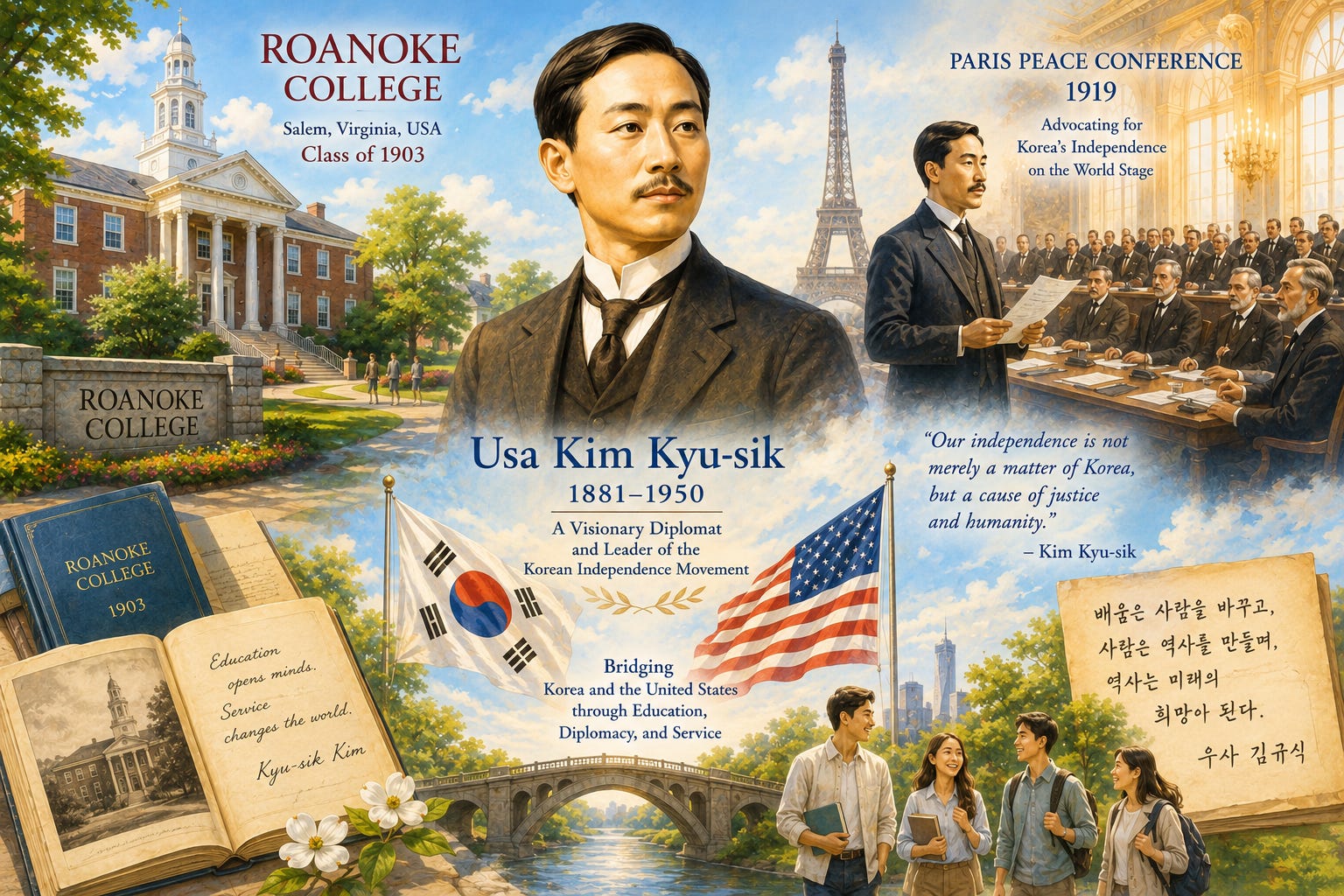
The diploma earned by Usa Kim Kyu-sik (1881–1950) is one of those rare exceptions.
When Kim graduated from Roanoke College in Virginia in 1903, he was simply another young Korean student pursuing an education in America. Few could have imagined that more than a century later he would be remembered as one of the college’s most distinguished alumni and one of Korea’s most respected independence leaders.
What makes one person’s life worthy of such lasting remembrance?
Kim Kyu-sik’s journey began with hardship rather than privilege.
After losing both of his parents at a young age, he became an orphan. For a boy growing up in Korea at the end of the nineteenth century, the future offered little reason for optimism. Yet he never abandoned his desire to learn. Through the support of missionaries, he was given the extraordinary opportunity to study in the United States, crossing the Pacific in pursuit of an education that would ultimately change not only his own life but also the future of his nation.
At Roanoke College, Kim gained much more than proficiency in English or an academic degree.
He acquired a global perspective.
He learned to understand different cultures, ideas, and political systems. More importantly, he developed the ability to communicate with the world.
Those lessons would later become his greatest weapon.
In 1919, after the First World War, world leaders gathered in Paris to shape a new international order at the Paris Peace Conference.
Representing the Provisional Government of the Republic of Korea, Kim Kyu-sik stood before the international community.
He possessed no army.
He represented no powerful nation.
Yet he carried something equally powerful—his command of language, his understanding of international law, and his unwavering belief that justice would ultimately prevail.
He appealed to the conscience of the world, arguing that the Korean people deserved freedom and national independence.
Although immediate independence was not achieved, his diplomatic efforts introduced Korea’s cause to the international community and secured an enduring place for the Korean independence movement in modern history.
Kim demonstrated that soldiers defend a nation with weapons, but diplomats can shape history with truth, reason, and moral conviction.
Today we live in an era defined by artificial intelligence, quantum computing, biotechnology, and unprecedented technological innovation.
Nations compete to develop faster computers and more powerful algorithms.
Yet Kim Kyu-sik’s life invites us to ask a different question.
What is more important than technology?
The answer is remarkably simple.
People.
No matter how advanced technology becomes, it cannot replace human character, integrity, wisdom, or compassion.
Technology becomes a blessing only when guided by ethical people.
One individual with vision, moral courage, and a commitment to serving others can influence countless lives—and sometimes even change the course of history.
That is why education remains humanity’s greatest investment.
Education is not merely the transfer of knowledge.
It is the discovery and development of human potential.
Perhaps this is why Roanoke College continues to honor Kim Kyu-sik more than a century after his graduation.
The college is not simply remembering a former student.
It is celebrating what education can accomplish when learning is joined with purpose, courage, and service.
Today thousands of Korean students study abroad in universities around the world.
Among them may be another Kim Kyu-sik.
Someone who appears to be an ordinary student today may one day become a scientist, diplomat, entrepreneur, educator, physician, or public servant whose work benefits humanity.
No one can predict where greatness will emerge.
That is why every student deserves encouragement.
That is why every educational opportunity matters.
More than a century ago, one young Korean crossed the Pacific in search of knowledge.
His decision transformed far more than his own future.
He strengthened Korea’s struggle for independence, helped build bridges between Korea and the United States, and continues to inspire new generations on both sides of the Pacific.
People often measure success by wealth, status, or professional achievement.
Kim Kyu-sik offers us a different definition.
Success is living a life that continues to inspire long after we are gone.
Success is opening doors for those who follow.
Success is transforming education into service and knowledge into hope.
More than one hundred years later, Kim Kyu-sik’s diploma still shines—not because the paper has endured, but because the graduate dedicated his life to a cause greater than himself.
One day, our own diplomas will also grow old.
The paper may fade.
The ink may yellow.
But the values we live by, the lives we touch, and the legacy we leave for future generations can continue to shine.
That is the greatest gift that Usa Kim Kyu-sik has left for all of us. +++
{Solti}
July 3, 2026
Reference
Remembering alumnus Kim Kyusik, leader of Korean independence movement, 100 years later
Source: https://www.roanoke.edu/news/kim_kyusik_korean_independence
February 28, 2019
Roanoke, College
100년이 지나도 빛나는 졸업장
우사 김규식이 우리에게 남긴 가장 위대한 유산
대학 졸업장은 시간이 흐르면 빛이 바랜다.
액자 속에 걸려 있거나 서랍 깊숙이 보관된 채, 특별한 날이 아니면 다시 펼쳐 볼 일도 드물다. 그러나 어떤 졸업장은 시간이 흐를수록 더욱 빛난다. 한 개인의 성공을 넘어 한 나라의 역사와 인류의 가치 속에서 새롭게 의미를 얻기 때문이다.
우사(尤史) 김규식 선생의 졸업장이 바로 그런 졸업장이었다.
1903년 미국 버지니아의 로어노크 칼리지(Roanoke College)를 졸업한 한 한국 청년은 당시만 해도 평범한 유학생 가운데 한 사람이었다. 그러나 100여 년이 흐른 오늘, 그의 이름은 대학 역사 속에서 가장 자랑스러운 동문 가운데 한 사람으로 기억되고 있다.
무엇이 한 사람을 이렇게 오래 기억하게 만들었을까?
김규식의 삶은 시작부터 순탄하지 않았다. 어린 나이에 부모를 모두 여의고 고아가 되었다. 당시 조선의 현실을 생각하면 그의 인생은 희망보다 절망이 더 가까웠다. 하지만 그는 배움을 포기하지 않았다. 선교사의 도움으로 미국 유학이라는 꿈같은 기회를 얻었고, 태평양을 건너 새로운 세상을 만났다.
그가 로어노크 칼리지에서 얻은 것은 단순한 영어 실력이나 학위가 아니었다. 그는 세계를 바라보는 시야를 얻었다. 서로 다른 문화와 사상을 이해하는 능력을 키웠고, 국제사회와 소통하는 방법을 배웠다.
그 배움은 훗날 조국을 위한 가장 강력한 무기가 되었다.
1919년, 제1차 세계대전이 끝난 뒤 세계의 지도자들이 프랑스 파리에 모였다. 승전국들은 새로운 국제질서를 논의했고, 약소국들은 자신의 운명을 바꾸기 위해 마지막 희망을 걸었다.
김규식은 대한민국임시정부를 대표하여 그 자리에 섰다.
그에게는 군대도 없었고, 강대국의 후원도 없었다. 그러나 그는 영어라는 언어와 국제법에 대한 이해, 그리고 정의를 향한 확고한 신념을 가지고 세계를 향해 한국의 독립을 호소했다.
비록 즉각적인 독립을 얻지는 못했지만, 그의 외교는 한국의 존재를 국제사회에 알렸고, 독립운동을 세계사 속에 기록하는 중요한 발걸음이 되었다.
총을 든 군인도 나라를 지키지만, 진실을 들고 세계를 설득하는 외교관도 역사를 만든다는 사실을 그는 몸소 보여 주었다.
오늘날 우리는 인공지능(AI), 우주산업, 양자컴퓨터, 바이오 혁명 등 기술의 시대를 살아간다. 세계는 더 빠른 컴퓨터와 더 뛰어난 알고리즘을 경쟁하고 있다.
하지만 김규식의 삶은 우리에게 조금 다른 질문을 던진다.
“기술보다 더 중요한 것은 무엇인가?”
그 답은 의외로 단순하다.
사람이다.
아무리 뛰어난 기술도 그것을 올바르게 사용하는 사람이 없다면 세상을 더 좋은 곳으로 만들 수 없다. 반대로 한 사람의 올바른 가치관과 국제적 안목은 수많은 사람의 삶을 바꾸고, 한 나라의 미래까지 바꿀 수 있다.
그래서 교육은 여전히 가장 중요한 투자이다.
교육은 지식을 전달하는 일이 아니라, 한 사람의 가능성을 발견하는 일이다.
로어노크 칼리지가 100년이 넘는 세월 동안 김규식 선생을 기억하는 이유도 여기에 있다. 학교는 단지 한 명의 졸업생을 기념하는 것이 아니다. 교육이 만들어 낸 위대한 가능성을 기억하고 있는 것이다.
오늘날 세계 곳곳에서 공부하는 한국의 젊은 유학생들을 바라보면 문득 김규식이 떠오른다.
그들 가운데 또 다른 김규식이 있을지도 모른다.
지금은 평범한 학생처럼 보이지만, 언젠가는 세계를 연결하는 외교관이 되고, 과학자가 되고, 기업가가 되고, 교육자가 되어 인류에 기여할 수도 있다.
그 가능성은 어느 누구도 미리 알 수 없다.
그래서 우리는 모든 학생을 소중히 여겨야 하고, 모든 교육의 기회를 귀하게 여겨야 한다.
100년 전 한 청년는 미국으로 건너와 배움을 선택했다.
그의 선택은 자신의 인생만 바꾸지 않았다.
대한민국의 독립운동에 힘을 보탰고, 한미 우호의 상징이 되었으며, 오늘날까지도 한국과 미국을 잇는 다리가 되고 있다.
사람들은 종종 성공을 높은 직위나 많은 재산으로 평가한다.
그러나 김규식은 다른 기준을 우리에게 보여 준다.
성공이란 자신이 떠난 뒤에도 사람들의 마음속에 살아 있는 것이다.
성공이란 후배들에게 길을 남기는 것이다.
성공이란 자신의 배움을 세상을 위한 봉사로 바꾸는 것이다.
100년이 지난 지금도 그의 졸업장이 빛나는 이유는 종이가 특별해서가 아니다.
그 졸업장을 받은 사람이 자신의 삶을 조국과 인류를 위한 사명으로 바꾸었기 때문이다.
오늘 우리의 졸업장도 언젠가는 낡아질 것이다.
그러나 우리가 남긴 가치와 섬김, 그리고 다음 세대를 향한 헌신은 시간이 흐를수록 더욱 빛날 것이다.
그것이 우사 김규식 선생이 우리 모두에게 남긴 가장 값진 유산이다.
{솔티}
2026년 7월 2일
참고문헌
Remembering alumnus Kim Kyusik, leader of Korean independence movement, 100 years later
Source: https://www.roanoke.edu/news/kim_kyusik_korean_independence
February 28, 2019
Roanoke, College

Prof. Dr. Young Choi (Editor in Chief) — Regent University
Young B. Choi is a Professor in the Department of Engineering & Computer Science at Regent University. He published 38 books with ‘Selected Readings in Cybersecurity’ (2018) (over 800 copies archived globally at university/college libraries around the world) and ‘Cybersecurity Applications and Artificial Intelligence’ (2023) available in seven major world languages. He proposed the world’s first global and universal telecommunications “Service Order Handling (SOH)” Model (T-SOH Model) (1995) with Dr. Adrian Tang. With this innovative research work, he received the IEEE NOMS ’96 Best Paper Award and became the first recipient of the Outstanding Contribution Award of the TeleManagement Forum in 1998. His research areas include Natural Language Processing-focused AI, AI-applied cybersecurity, network and telecom service management, and Korean studies on Gani Choi Rip’s Jeonggwan (靜觀: Quiet Contemplation) philosophy and Shilhak ( 實學: Practical Learning).