

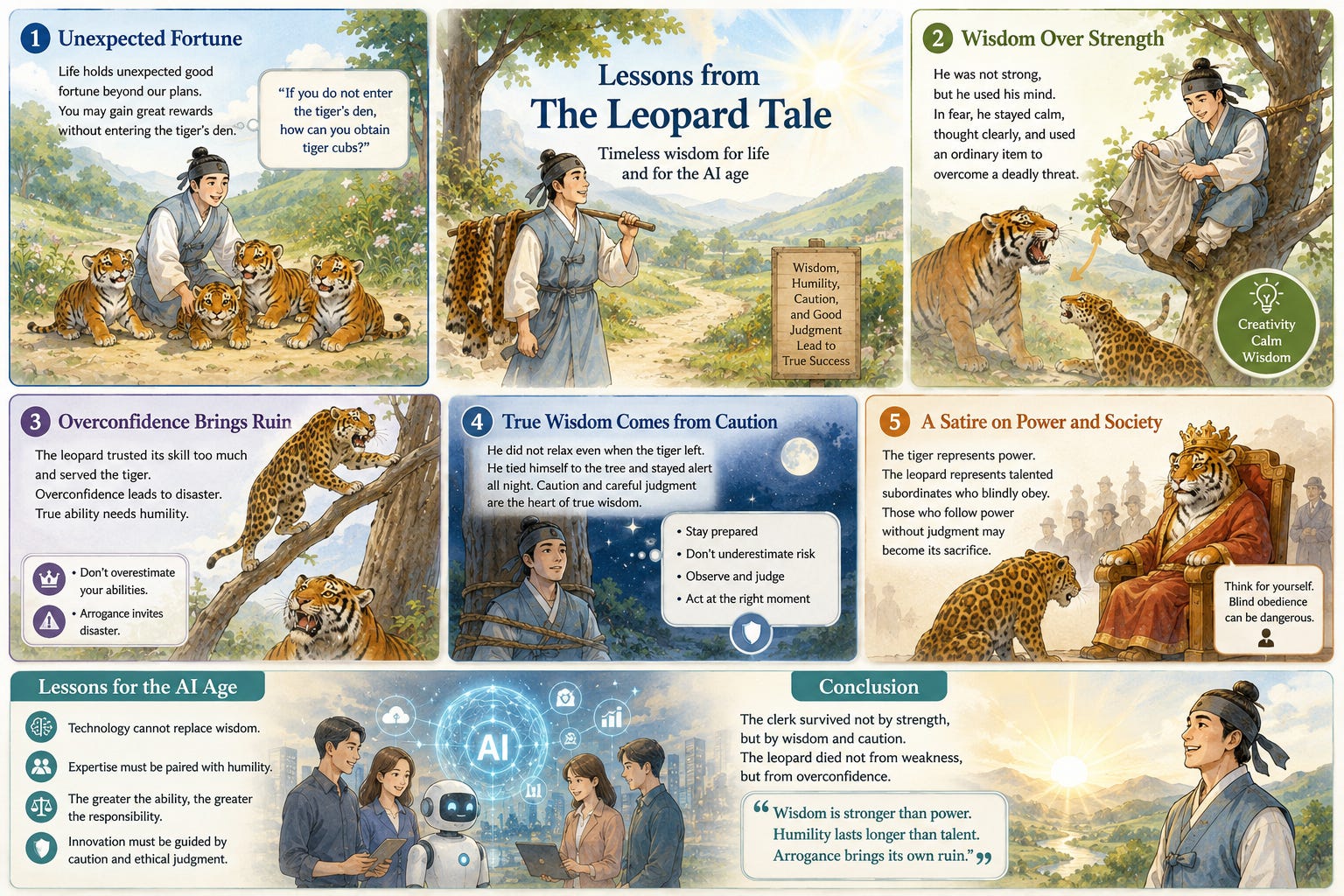
“The Leopard Tale (豹說)” from Gani-jip (簡易集) is a short anecdotal essay by Choi Rip (1539–1612), one of the most distinguished scholars and writers of the late Joseon Dynasty. At first glance, it appears to be an entertaining story about a government clerk, a tiger, and a leopard. Yet beneath its vivid narrative lies a profound reflection on human fortune, prudence, arrogance, and the unpredictable nature of life. Like many classical East Asian essays, the story uses animals and unusual circumstances to illuminate truths about human behavior.
The Story in Simple Modern Language
A government messenger from Danyang was traveling to Chungju carrying an official document. Along the road he encountered three tiger cubs and, without much thought, killed them with his staff.
Soon afterward, the mother tiger returned. Furious and roaring, she charged toward him. Terrified, the messenger climbed a tall tree and escaped immediate danger. The tiger could not reach him and eventually disappeared into the forest.
The man remained in the tree, tying himself securely with his belt so that he would not fall asleep and tumble down. After waiting for some time, he saw the tiger return—but this time she was accompanied by a leopard.
The reason became clear: the leopard was smaller, lighter, and an excellent climber. The tiger had apparently recruited the leopard to help capture the man.
The messenger realized that the leopard posed the greatest threat. Thinking quickly, he removed his trousers, folded them together, and when the leopard approached, threw them over its head. Blinded and confused, the leopard lost its footing and fell to the ground.
The tiger immediately assumed that the falling object was the man. In a blind rage she pounced upon it and tore it apart. Only afterward did she discover that she had killed the leopard rather than the messenger. Frustrated and unable to reach her real enemy, she eventually departed.
At dawn the messenger climbed down, skinned the leopard and the three cubs, and carried the pelts to Chungju. When a local official accused him of arriving late and threatened punishment, the messenger explained what had happened and presented the skins as evidence. His punishment was therefore withdrawn.
Major Lessons of the Essay
Fortune Sometimes Arrives Unexpectedly
The essay concludes by referring to the famous saying:
“If you do not enter the tiger’s den, how can you obtain tiger cubs?”
Traditionally, this proverb teaches that great rewards require courage and risk.
However, Choi Rip deliberately twists the proverb. The messenger never entered the tiger’s den, yet he somehow acquired not only tiger cubs but also the skins of several dangerous beasts. This irony highlights a reality of life: success is not always proportional to effort. Sometimes fortune arrives through circumstances beyond our planning.
The story reminds readers that life contains an element of unpredictability that no amount of wisdom or preparation can fully control.
Quick Thinking Can Overcome Physical Strength
The messenger possessed neither great strength nor superior weapons. Against a tiger and a leopard, he had virtually no chance in direct combat.
What saved him was presence of mind.
Rather than surrendering to panic, he analyzed the situation and devised an unconventional solution. His intelligence compensated for his weakness.
This lesson resonates across history. Human civilization itself has advanced not because humans are the strongest creatures, but because they are capable of creativity, strategy, and adaptation.
Excessive Confidence Leads to Disaster
The essay’s strongest moral judgment falls not upon the tiger but upon the leopard.
According to Choi Rip, the leopard trusted too much in its own agility and climbing ability. Because of this confidence, it accepted the tiger’s command and recklessly pursued the man.
Its skill became the source of its downfall.
This reflects a timeless truth:
Talent without wisdom can become dangerous.
Ability without humility invites disaster.
Confidence without caution often turns into arrogance.
The leopard symbolizes individuals who overestimate themselves and fail to recognize hidden risks.
Intelligence Must Be Guided by Prudence
The messenger survives because he is intelligent, but he also succeeds because he remains cautious.
He does not assume the tiger has abandoned the hunt. He secures himself to the tree and patiently waits. He carefully evaluates the new threat represented by the leopard.
His intelligence is practical rather than boastful.
Choi Rip appears to distinguish between genuine wisdom and mere cleverness. Wisdom combines insight, patience, humility, and good judgment.
The Story Is Also a Satire of Human Society
Many scholars of classical literature note that animal stories often contain indirect social criticism.
The tiger may symbolize raw power and authority.
The leopard may represent capable but subordinate individuals who serve the powerful.
The leopard ultimately becomes a victim of another’s conflict. It dies while carrying out the tiger’s wishes.
From this perspective, the essay subtly criticizes those who blindly serve power without considering the consequences for themselves.
Relevance in the AI Age
Although written over four centuries ago, the message remains surprisingly relevant today.
Artificial intelligence, advanced technologies, and vast digital networks have dramatically increased human capabilities. Yet these same tools can encourage overconfidence.
Organizations sometimes assume that powerful technologies eliminate risk. Professionals may trust algorithms without sufficient oversight. Individuals may mistake technical expertise for complete wisdom.
The leopard’s tragedy offers a warning for the modern era:
Technical skill alone is insufficient.
Intelligence must be accompanied by humility.
Confidence must be balanced by ethical judgment.
Innovation should be guided by prudence.
Meanwhile, the messenger’s survival demonstrates the enduring value of creativity, adaptability, and calm reasoning under pressure.
Conclusion
“The Leopard Tale” is far more than a hunting anecdote. Through a vivid encounter among a messenger, a tiger, and a leopard, Choi Rip explores enduring themes of fortune, intelligence, humility, and human judgment. The messenger survives not because he is stronger than the beasts but because he remains resourceful and composed. The leopard perishes not because it lacks ability but because it relies too heavily on its own talents.
Ultimately, Choi Rip teaches that wisdom lies in recognizing both our strengths and our limitations. Fortune may favor us unexpectedly, but arrogance can destroy us just as unexpectedly. In an age increasingly shaped by artificial intelligence and technological power, this centuries-old lesson remains as relevant as ever: true success comes not merely from capability, but from the prudent and humble use of capability. +++
{Solti}
May 24, 2026
「표설(豹說)」의 현대적 해설과 의미
― 우화 속에 담긴 삶의 지혜
『간이집(簡易集)』에 수록된 「표설(豹說)」은 조선 중기의 문장가이자 사상가인 간이(簡易) 최립(崔岦, 1539–1612)이 지은 짧은 우화 형식의 산문이다. 겉으로 보기에는 한 아전(衙前), 호랑이, 표범이 등장하는 흥미로운 이야기처럼 보이지만, 그 속에는 인간의 운명, 지혜, 교만, 행운과 재앙에 대한 깊은 통찰이 담겨 있다.
최립은 단순히 동물 이야기를 들려주는 것이 아니라, 인간 사회에서 흔히 일어나는 일들을 풍자와 비유를 통해 보여 준다. 특히 자신의 능력을 과신하는 사람의 위험성과 위기 상황에서 발휘되는 지혜의 중요성을 강조하고 있다.
이야기의 현대어 풀이
단양의 한 아전이 공문서를 전달하기 위해 충주로 가던 길에 우연히 길가에 있는 호랑이 새끼 세 마리를 발견하였다. 그는 별다른 생각 없이 지팡이로 새끼들을 모두 죽였다.
잠시 후 어미 호랑이가 나타났다. 새끼를 잃은 호랑이는 분노하여 으르렁거리며 달려들었다. 겁에 질린 아전은 급히 높은 나무 위로 올라가 목숨을 건졌다.
호랑이는 한동안 나무 아래를 맴돌다가 숲속으로 사라졌다.
아전은 혹시라도 잠이 들어 떨어질까 염려하여 허리띠로 자신의 몸을 나무에 묶어 놓고 밤을 지새웠다.
얼마 후 호랑이가 다시 나타났는데, 이번에는 혼자가 아니었다. 함께 온 것은 나무를 잘 타는 표범이었다. 호랑이는 자신이 올라갈 수 없는 나무 위의 사람을 잡기 위해 표범의 도움을 얻은 것이었다.
위기를 직감한 아전은 재빨리 잠방이를 벗어 준비하였다. 표범이 가까이 다가오자 잠방이를 표범의 머리에 씌워 시야를 가린 뒤 아래로 밀어 떨어뜨렸다.
그러자 호랑이는 떨어진 물체가 사람인 줄 알고 달려들어 갈기갈기 찢어 버렸다. 그러나 자세히 보니 죽은 것은 사람이 아니라 표범이었다.
결국 호랑이는 분노만 남긴 채 숲속으로 사라졌다.
날이 밝자 아전은 내려와 표범과 새끼들의 가죽을 챙겨 충주에 도착하였다. 늦게 도착한 이유를 묻는 관리에게 그는 자초지종을 잘 설명하고 가죽을 증거로 내놓자 처벌을 면할 수 있었다.
이 글이 주는 교훈
인생에는 예상치 못한 행운이 있다
최립은 이야기 말미에서 유명한 속담을 인용한다.
“호랑이 굴에 들어가지 않으면 호랑이 새끼를 얻을 수 없다.”
원래 이 말은 위험을 감수해야 큰 성과를 얻는다는 뜻이다.
그런데 이 이야기에서는 아전이 호랑이 굴에 들어간 적이 없다. 오히려 길가에서 우연히 호랑이 새끼를 얻게 되었고, 결과적으로는 표범과 호랑이의 가죽까지 손에 넣었다.
최립은 이를 통해 세상에는 노력과 계산만으로 설명할 수 없는 행운이 존재함을 보여 준다.
인생은 때로 예측할 수 없는 방향으로 흘러가며, 인간의 계획을 뛰어넘는 우연과 기회가 찾아오기도 한다.
힘보다 중요한 것은 지혜이다
아전은 결코 강한 사람이 아니었다.
호랑이나 표범과 정면으로 싸웠다면 살아남을 가능성은 거의 없었다.
그러나 그는 공포 속에서도 침착하게 상황을 분석하였다. 그리고 잠방이라는 평범한 물건을 이용하여 위기를 벗어났다.
이는 인간 사회에서도 마찬가지이다.
육체적 힘이나 권력보다 중요한 것은 문제를 해결하는 지혜와 창의성이다.
최립은 작은 지혜 하나가 거대한 힘을 이길 수 있음을 보여 준다.
재능에 대한 과신은 재앙을 부른다
최립이 가장 강하게 비판하는 대상은 사실 호랑이가 아니라 표범이다.
표범은 나무를 잘 타는 자신의 능력을 믿고 호랑이의 부탁을 받아 사람을 잡으러 올라갔다.
그러나 그 자신감은 결국 죽음으로 이어졌다.
최립은 마지막 문장에서 분명히 말한다.
“자기 재주를 믿고 까불다가 결국 죽임을 당했으니 이는 스스로 재앙을 부른 것이다.”
능력이 있다는 사실 자체는 문제가 아니다.
문제는 능력을 과신하여 경계를 늦추고 위험을 무시하는 태도이다.
역사 속에서도 많은 인물들이 자신의 재능과 권력을 지나치게 믿다가 실패하였다.
겸손은 능력 없는 사람의 덕목이 아니라, 오히려 유능한 사람에게 더욱 필요한 덕목임을 일깨워 준다.
진정한 지혜는 신중함에서 나온다
아전은 단순히 머리가 좋은 사람이 아니다.
그는 매우 신중한 사람이다.
호랑이가 사라졌다고 안심하지 않았고, 나무에 몸을 묶어 밤새 대비하였다.
위험을 과소평가하지 않았기 때문에 살아남을 수 있었다.
반면 표범은 자신의 능력을 지나치게 믿고 경계를 늦추었다.
최립은 여기서 참된 지혜란 단순한 영리함이 아니라 신중함과 절제, 그리고 상황 판단 능력이라고 말하고 있다.
권력과 인간 사회에 대한 풍자
이 글은 단순한 동물 우화가 아니라 인간 사회를 비추는 거울이기도 하다.
호랑이는 강한 권력을 가진 존재를 상징한다고 볼 수 있다.
표범은 권력자의 명령을 수행하는 유능한 부하를 상징한다.
표범은 자신의 일이 아닌데도 권력자의 요구를 따라 나섰다가 결국 희생되었다.
이는 자신의 판단 없이 강자의 명령에만 의존하는 사람들의 위험성을 풍자한 것으로도 해석할 수 있다.
최립은 권력에 무비판적으로 복종하는 삶의 위험성을 은근히 경고하고 있는 것이다.
AI 시대에 주는 시사점
400여 년 전에 쓰인 이 글은 오늘날 인공지능 시대에도 놀라울 정도로 의미가 깊다.
현대인은 AI, 빅데이터, 로봇공학, 첨단 기술을 통해 과거 어느 시대보다 강력한 능력을 갖게 되었다.
그러나 기술이 발전할수록 인간은 자신의 능력을 과신하기 쉽다.
기업은 기술이 모든 문제를 해결할 것이라고 믿고, 개인은 자신의 전문성을 지나치게 신뢰하며, 사회는 혁신의 위험성을 간과하기도 한다.
표범의 죽음은 우리에게 다음과 같은 교훈을 준다.
기술력은 지혜를 대신할 수 없다.
전문성은 겸손과 함께해야 한다.
능력이 커질수록 책임도 커진다.
혁신은 신중함과 윤리적 판단 위에서 이루어져야 한다.
반면 아전은 창의적 사고와 침착한 판단으로 위기를 극복하였다.
이는 AI 시대에도 여전히 인간에게 필요한 핵심 역량이 결국 무엇인지를 보여 준다.
결론
「표설(豹說)」은 단순한 동물 이야기가 아니다. 최립은 호랑이와 표범, 그리고 한 아전의 기묘한 사건을 통해 인간 삶의 본질을 통찰한다. 아전은 강해서 살아남은 것이 아니라 지혜롭고 신중했기 때문에 살아남았다. 반대로 표범은 능력이 부족해서 죽은 것이 아니라 자신의 능력을 지나치게 믿었기 때문에 죽었다.
최립은 이 짧은 우화를 통해 “지혜는 힘보다 강하고, 겸손은 재능보다 오래가며, 교만은 스스로 재앙을 부른다”는 삶의 진리를 전하고 있다.
오늘날 인공지능과 첨단 기술이 세상을 변화시키는 시대에도 이 교훈은 여전히 유효하다. 인간은 능력을 키우는 데만 집중할 것이 아니라, 그 능력을 올바르게 사용하는 지혜와 절제를 함께 길러야 한다. 이것이 「표설」이 오늘날 우리에게 전하는 가장 소중한 메시지일 것이다. +++
{솔티}
2026년 5월 24일
May 23, 2026

Young Choi, PhD is a Professor at Regent University bringing a rare combination of technical expertise and creative spirit to everything he does. A scholar in AI, cybersecurity, and network & telecommunications service management, he has published 38 books including AI and cybersecurity area books, over 200 refereed articles, and over 20 book chapters. Beyond the academy, Dr. Choi is a passionate poet, essayist, and wooden block laser engraving artist whose reflective writing invites readers to rediscover life’s beauty in quiet contemplation(靜觀). He lives under the motto: “Study hard and give generously without holding back! (열심히 공부해서 아낌없이 남주자 !: 열공아남!)”
Published books: https://www.amazon.com/stores/Young-Choi/author/B0DMZ5S6R7?ref=ap_rdr&shoppingPortalEnabled=true