
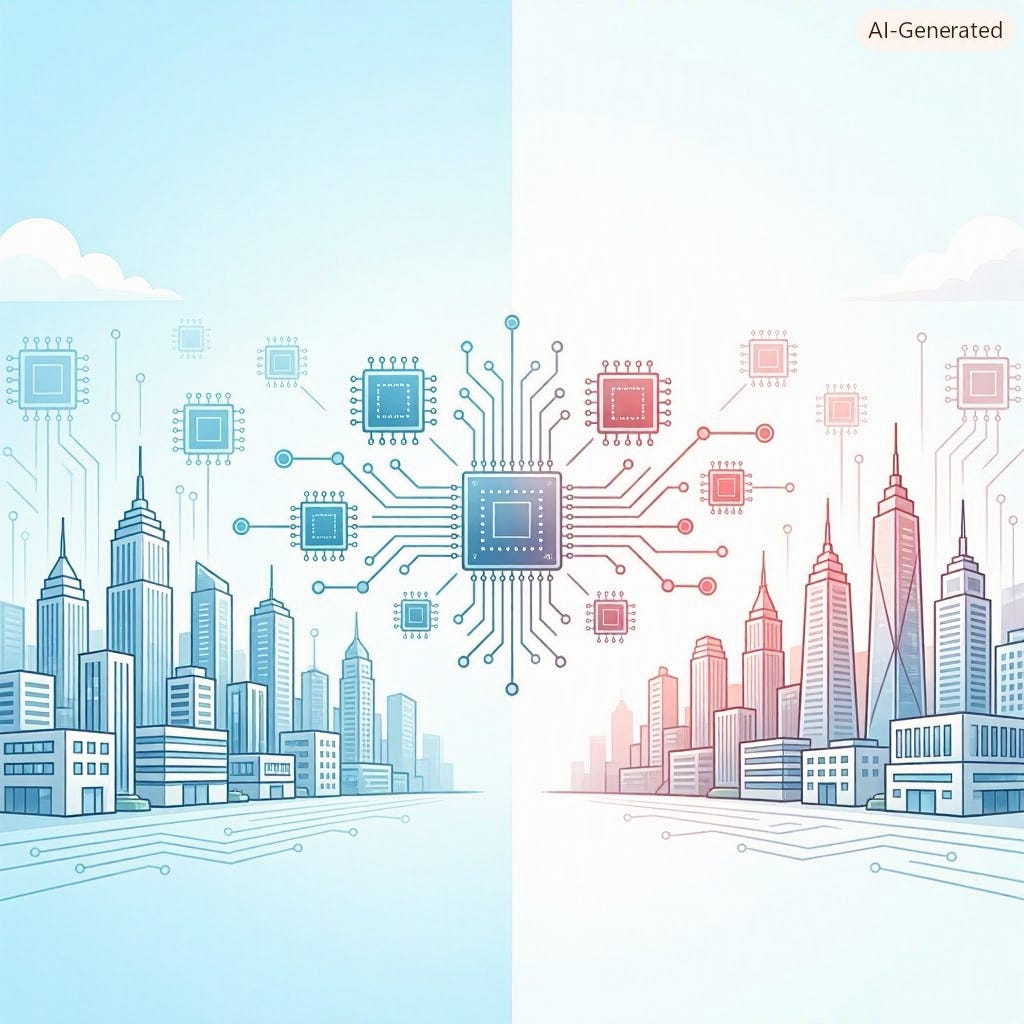
In the summer of 2026, the world is closely watching two major developments in artificial intelligence (AI). One is the World Artificial Intelligence Conference (WAIC) held in Shanghai, China, and the other is Pax Silica, a new international cooperation initiative led by the United States. At first glance, one appears to be an international AI conference, while the other is an economic and technology security framework. However, a closer look reveals that both represent two different faces of the emerging global competition for AI leadership.
The Cold War of the 20th century was defined by competition in nuclear weapons and space exploration. In the early 21st century, the Internet and smartphones became the foundations of national competitiveness. Today, moving toward the latter half of the 21st century, AI has become the most critical strategic asset determining a nation’s economic strength, industrial competitiveness, military capability, and global influence.
China has used WAIC as a platform to present its vision of becoming a central force in AI technology development, international cooperation, and global AI governance. In particular, WAIC 2026 highlighted China’s ambition to expand international AI collaboration through the proposed establishment of the World AI Cooperation Organization (WAICO). China emphasized open-source AI, broader access to AI technologies, and cooperation with developing countries as part of its vision for a more inclusive global AI ecosystem.
In contrast, the United States is promoting Pax Silica as a strategic framework to strengthen the foundation of the AI era: semiconductors, AI computing infrastructure, critical minerals, energy resources, and resilient technology supply chains. The goal is to ensure that the essential components required for AI development are secure, reliable, and based on trusted partnerships.
In simple terms, while China emphasizes AI applications, openness, and international AI cooperation, the United States focuses on the technological foundation, supply-chain security, and trusted infrastructure that enable AI leadership.
AI Competition Is More Than a Technology Race
The competition between the United States and China is not merely a race to develop better AI models. AI has become deeply connected with:
Economic security
National security
International diplomacy
Global technology standards
Ethical values and governance
The future AI competition will not be determined only by who creates the most powerful AI system. It will also depend on who can:
Secure high-quality data,
Produce advanced semiconductors,
Build reliable computing infrastructure,
Establish trustworthy supply chains,
Develop international partnerships.
In this sense, AI has become the foundation of national competitiveness in the 21st century.
Competition and Cooperation Must Coexist
However, this competition should not be viewed only as a conflict. Throughout history, competition has often accelerated human innovation.
The U.S.–Soviet space competition eventually led to remarkable achievements, including the Moon landing, while technologies such as the Internet and GPS emerged from strategic innovation efforts.
Similarly, today’s AI competition could accelerate breakthroughs in:
Healthcare,
Education,
Climate change solutions,
Drug discovery,
Smart manufacturing,
Scientific research.
However, AI is different from previous technologies because it easily crosses national borders. Problems such as AI misuse, cyberattacks, misinformation, and privacy violations cannot be solved by any single country alone.
Therefore, global cooperation and AI safety must develop together with technological competition. The most advanced AI system will not benefit humanity if it cannot be trusted, controlled, and used responsibly.
Strategic Implications for Korea
Republic of Korea holds a unique position in this emerging AI landscape. With world-class capabilities in:
Semiconductor manufacturing,
Information and communications technology (ICT),
Advanced manufacturing,
Artificial intelligence,
Robotics.
Korea has the potential to become a meaningful global AI partner.
Rather than simply choosing one side between the United States and China, Korea can play a bridging role by contributing to:
AI safety,
International AI standards,
Trusted AI development,
Secure semiconductor supply chains,
Global AI governance.
As a technologically advanced democracy with strong international cooperation experience, Korea can emerge as an important middle power leader in the AI era.
The Real Winner of the AI Era
WAIC and Pax Silica may appear to represent different paths, but both reflect a shared recognition: AI will shape the future of humanity.
The ultimate winner of the AI era will not necessarily be the country that builds the most powerful AI. It will be the country that creates an AI ecosystem that is:
Safer,
More trustworthy,
More innovative,
More beneficial to all people.
The new AI global order will not be built by technological power alone. It will require trust, cooperation, responsibility, and visionary leadership for the shared future of humanity.
The AI competition between WAIC and Pax Silica is not simply a U.S.–China rivalry. It is a historic transition in which humanity decides how AI power should be developed, governed, and shared. Countries like Korea have a unique opportunity to help shape a safer and more inclusive AI civilization. +++
{Solti}
July 26, 2026
AI 시대의 새로운 냉전인가, 새로운 협력의 시작인가?
WAIC와 Pax Silica가 보여주는 미·중 AI 패권 경쟁
2026년 여름, 세계는 두 개의 중요한 AI 행사를 주목했다. 하나는 중국 상하이에서 열린 ‘WAIC(World Artificial Intelligence Conference)’였고, 다른 하나는 미국이 주도하는 ‘Pax Silica’라는 새로운 국제 협력 구상이었다. 언뜻 보면 하나는 국제 학술대회이고 다른 하나는 경제안보 협력체이므로 서로 관련이 없어 보인다. 그러나 조금만 들여다보면 두 움직임은 오늘날 세계가 펼치고 있는 AI 패권 경쟁의 두 얼굴이라는 사실을 알 수 있다.
20세기 냉전은 핵무기와 우주개발 경쟁이 중심이었다. 21세기 초에는 인터넷과 스마트폰이 국가 경쟁력을 좌우했다. 이제 21세기 후반을 향해 가는 오늘날에는 AI가 국가의 경제력, 군사력, 산업 경쟁력, 그리고 국제적 영향력을 결정하는 핵심 자산이 되고 있다.
중국은 WAIC를 통해 AI 기술뿐 아니라 국제 AI 거버넌스와 협력의 중심국가가 되겠다는 비전을 제시했다. 특히 2026년 WAIC에서는 세계 AI 협력기구(WAICO) 설립 구상이 발표되면서, AI 기술과 거버넌스를 함께 주도하려는 중국의 의지가 더욱 분명해졌다. 또한 오픈소스 AI와 개발도상국과의 협력을 강조하며 보다 포용적인 국제 AI 생태계를 구축하겠다는 메시지를 내놓았다.
반면 미국은 Pax Silica를 통해 AI 시대의 기반이 되는 반도체, AI 컴퓨팅 인프라, 핵심 광물, 에너지, 그리고 공급망을 동맹국들과 함께 구축하려 하고 있다. 이는 AI 경쟁에서 가장 중요한 자원과 인프라를 안정적으로 확보하려는 전략이다. 다시 말해 중국이 AI 활용과 국제 협력을 강조한다면, 미국은 AI를 가능하게 하는 기반 기술과 공급망의 신뢰성을 강조하고 있는 것이다.
이러한 경쟁은 단순한 기술 경쟁이 아니다. AI가 국가의 미래 산업과 경제를 좌우하는 만큼, AI는 이제 경제안보, 국가안보, 외교, 국제 표준, 그리고 가치 체계까지 연결하는 전략적 자산이 되었다. 앞으로 어느 나라가 더 우수한 AI 모델을 개발하느냐뿐 아니라, 누가 더 많은 데이터를 확보하고, 더 강력한 반도체를 생산하며, 더 안전한 공급망을 구축하고, 더 많은 국가와 협력하느냐가 경쟁의 핵심이 될 것이다.
그러나 이 경쟁을 반드시 부정적으로만 볼 필요는 없다. 역사적으로 경쟁은 기술 혁신을 촉진해 왔다. 미국과 소련의 우주 경쟁은 인류를 달에 보내는 성과를 가져왔고, 인터넷과 GPS 같은 혁신도 탄생시켰다. 오늘날의 AI 경쟁 역시 의료, 교육, 기후변화 대응, 신약 개발, 스마트 제조 등 인류가 직면한 문제를 해결하는 혁신을 더욱 빠르게 이끌 가능성이 있다.
다만 AI는 핵무기와 달리 국경을 쉽게 넘는다. AI의 오용이나 사이버 공격, 허위정보 생성, 개인정보 침해와 같은 문제는 어느 한 나라만의 노력으로 해결할 수 없다. 따라서 경쟁과 함께 국제적 협력과 AI 안전(AI Safety)은 반드시 병행되어야 한다. 아무리 뛰어난 AI도 신뢰할 수 없고 안전하지 않다면 인류에게 진정한 혜택을 줄 수 없기 때문이다.
한국은 이러한 변화 속에서 매우 중요한 위치에 있다. 세계 최고 수준의 반도체 기술과 ICT 역량, 제조 경쟁력을 갖춘 한국은 미국과 중국 어느 한쪽을 단순히 선택하기보다 AI 안전, 국제 표준화, 신뢰할 수 있는 AI, 글로벌 공급망 구축에서 가교 역할을 수행할 수 있다. 기술력과 민주적 가치, 국제 협력 경험을 바탕으로 한국은 AI 시대의 ‘중견 리더(Middle Power)’로서 의미 있는 기여를 할 수 있다.
WAIC와 Pax Silica는 서로 다른 길을 걷고 있는 것처럼 보이지만, 궁극적으로는 모두 AI가 인류의 미래를 좌우할 것이라는 공통된 인식을 바탕으로 하고 있다. 진정한 승자는 단순히 더 강력한 AI를 만드는 나라가 아니라, 더 안전하고, 더 신뢰할 수 있으며, 더 많은 사람에게 혜택을 주는 AI 생태계를 구축하는 나라일 것이다. AI 시대의 새로운 패권은 기술의 힘만으로 완성되지 않는다. 그것은 신뢰, 협력, 그리고 인류 공동의 미래를 향한 책임 있는 리더십 위에서 비로소 완성될 것이다. +++
2026월 7월 26일
{솔티}

Prof. Dr. Young Choi (Editor in Chief) — Regent University
Young B. Choi is a Professor in the Department of Engineering & Computer Science at Regent University. He published 38 books with ‘Selected Readings in Cybersecurity’ (2018) (over 800 copies archived globally at university/college libraries around the world) and ‘Cybersecurity Applications and Artificial Intelligence’ (2023) available in seven major world languages. He proposed the world’s first global and universal telecommunications “Service Order Handling (SOH)” Model (T-SOH Model) (1995) with Dr. Adrian Tang. With this innovative research work, he received the IEEE NOMS ’96 Best Paper Award and became the first recipient of the Outstanding Contribution Award of the TeleManagement Forum in 1998. His research areas include Natural Language Processing-focused AI, AI-applied cybersecurity, network and telecom service management, and Korean studies on Gani Choi Rip’s Jeonggwan (靜觀: Quiet Contemplation) philosophy and Shilhak ( 實學: Practical Learning).
Broad insight to view the global trends! Thank you.