
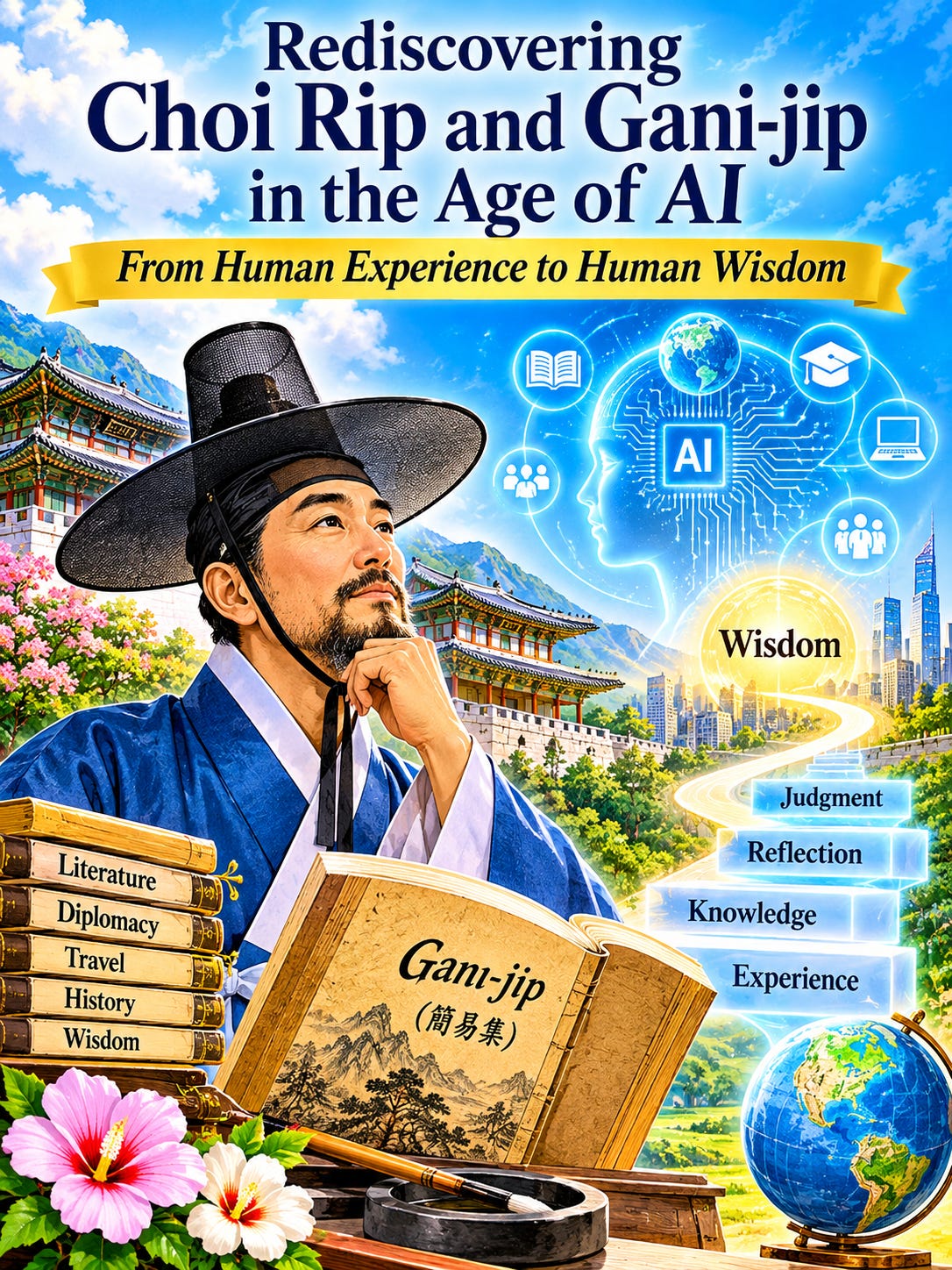
Image credit: Illustration generated with OpenAI’s ChatGPT image-generation tool with the author’s idea, 2026
Rediscovering Choi Rip and Gani-jip in the Age of AI: From Human Experience to Human Wisdom
by Young B. Choi (Author) Format: Paperback published by Amazon KDP
Book URL: https://a.co/d/06LRmh0T
Read Sample (To view a few sample pages, click the link.)
Product details
ASIN : B0HSM9QVTD
Publisher : Independently published
Publication date : November 22, 2026
Language : English/한국어 (bilingual)
Print length : 412 pages
ISBN-13 : 979-8144646918
Item Weight : 2.58 pounds
Dimensions : 8.5 x 0.93 x 11 inches
Book Summary (English)
The future will not be determined simply by how intelligent our machines become, but by how wisely human beings choose to use them.
What can a sixteenth-century Korean scholar teach us about being human in the age of artificial intelligence?
AI is transforming how we read, write, learn, communicate, and create. Generative AI can translate ancient texts, analyze historical records, compose essays, generate images, and answer complex questions in seconds. Yet as machines become more capable, a fundamental question emerges: What does it mean to be human when machines can perform much of the work of the human mind?
This book explores that question through the life and writings of Choi Rip (崔岦, 1539–1612), a distinguished Joseon scholar, writer, diplomat, and statesman whose literary legacy is preserved in Gani-jip (簡易集).
Although Choi Rip lived in a world of Confucian learning, royal government, diplomacy, travel, war, and handwritten literature, his intellectual experiences remain relevant today. Beneath the centuries separating us lies a shared challenge: How should knowledge be understood, communicated, and used wisely?
Gani-jip is more than a collection of historical writings. It reflects a life shaped by observation, travel, cultural encounters, diplomacy, historical change, and reflection. Choi Rip’s writings reveal the connections between literature and politics, travel and observation, diplomacy and communication, history and memory, and knowledge and responsibility. His intellectual life shows how experience becomes meaningful understanding.
In the age of AI, information is abundant and answers are instant. Yet information is not wisdom, an answer is not necessarily understanding, and fluent language does not guarantee meaning. Human beings must still decide what matters, what deserves to be remembered, what should be questioned, and how knowledge should be applied.
Through a renewed reading of Choi Rip, this book explores human creativity, historical memory, interdisciplinary learning, cross-cultural communication, judgment, and responsibility. It considers why creativity involves more than producing words or images, why understanding requires reflection, and why ethical decisions cannot simply be delegated to machines.
This book does not attempt to make Choi Rip artificially modern or suggest that he anticipated AI. Instead, it brings his intellectual legacy into conversation with contemporary questions about technology, education, creativity, and humanity’s future.
The instruments have changed. The fundamental questions have not. People still seek meaning, confront uncertainty, experience conflict and hope, and struggle to understand one another. Technology may transform how we live, but it cannot answer what makes life meaningful.
Perhaps the twenty-first century will not be remembered merely as the age when machines became intelligent, but as the age when humanity was compelled to redefine intelligence—not simply as memory, calculation, language, or knowledge, but also as the ability to recognize what matters, exercise judgment, understand others, and transform knowledge into wisdom.
Great texts do not remain behind us. They wait for another generation to ask new questions.
Today, we open Gani-jip again—not simply to discover what Choi Rip thought, but to discover what his thinking can teach us.
AI may become faster than us, remember more than us, and challenge our understanding of creativity. But it cannot relieve us of the responsibility to decide what is worth remembering, creating, communicating, and living for.
The journey from Choi Rip to AI is not simply a journey from the past to the future. It is a journey from human experience to human wisdom. And that journey has only just begun.
책의 내용 요약 (한국어)
AI 시대에 최립과 『간이집』을 다시 발견하다
인간의 경험에서 인간의 지혜로
미래는 단순히 기계가 얼마나 지능적으로 발전하느냐에 따라 결정되는 것이 아니라, 인간이 그 기계를 얼마나 지혜롭게 사용하기로 선택하느냐에 따라 결정될 것이다.
16세기 조선의 한 학자는 인공지능 시대를 살아가는 우리에게 인간다움에 관해 무엇을 가르쳐 줄 수 있을까?
AI는 우리가 읽고, 쓰고, 배우고, 소통하고, 창작하는 방식을 변화시키고 있다. 생성형 AI는 고전 문헌을 번역하고, 역사 기록을 분석하며, 수필을 작성하고, 이미지를 생성하고, 복잡한 질문에 몇 초 만에 답할 수 있다. 그러나 기계가 점점 더 많은 능력을 갖추게 되면서 근본적인 질문이 떠오른다. 기계가 인간 정신의 상당 부분을 수행할 수 있는 시대에, 인간으로 살아간다는 것은 무엇을 의미하는가?
이 책은 조선의 저명한 학자이자 문인, 외교관, 정치가였으며, 그 문학적 유산이 『간이집(簡易集)』에 보존되어 있는 최립(崔岦, 1539–1612)의 삶과 저술을 통해 이 질문을 탐구한다.
최립이 유교적 학문, 왕실 정치, 외교, 여행, 전쟁, 그리고 손으로 기록하고 창작하는 문학의 세계에서 살았지만, 그의 지적 경험은 오늘날에도 여전히 의미가 있다. 우리를 수백 년의 세월로 갈라놓고 있는 그 간격 아래에는 하나의 공통된 과제가 놓여 있다. 지식은 어떻게 이해되고, 전달되며, 지혜롭게 활용되어야 하는가?
『간이집』은 단순한 역사적 저술의 모음집 그 이상이다. 이 책은 관찰, 여행, 문화적 만남, 외교, 역사적 변화, 그리고 성찰로 형성된 한 인간의 삶을 반영한다. 최립의 글은 문학과 정치, 여행과 관찰, 외교와 소통, 역사와 기억, 지식과 책임 사이의 연결을 보여 준다. 그의 지적 삶은 경험이 어떻게 의미 있는 이해로 발전하는지를 드러낸다.
AI 시대에는 정보가 넘쳐나고 답은 즉각적으로 제공된다. 그러나 정보가 곧 지혜인 것은 아니며, 답을 얻었다고 반드시 이해한 것도 아니다. 유창한 언어가 의미를 보장하는 것도 아니다. 인간은 여전히 무엇이 중요한지, 무엇을 기억할 가치가 있는지, 무엇을 의심하고 질문해야 하는지, 그리고 지식을 어떻게 적용해야 하는지를 스스로 결정해야 한다.
최립을 새롭게 읽는 과정을 통해 이 책은 인간의 창의성, 역사적 기억, 학제 간 학습, 문화 간 소통, 판단, 그리고 책임을 탐구한다. 창의성이 단순히 글이나 이미지를 만들어 내는 것 이상의 의미를 지니는 이유, 이해에 성찰이 필요한 이유, 그리고 윤리적 결정을 기계에 단순히 맡길 수 없는 이유를 살펴본다.
이 책은 최립을 억지로 현대적인 인물로 만들거나, 그가 AI의 출현을 예견했다고 주장하려는 것이 아니다. 오히려 그의 지적 유산을 오늘날 기술, 교육, 창의성, 그리고 인류의 미래에 관한 질문들과 함께 대화하도록 이끌고자 한다.
도구는 바뀌었다. 그러나 근본적인 질문은 바뀌지 않았다. 인간은 여전히 의미를 찾고, 불확실성에 맞서며, 갈등과 희망을 경험하고, 서로를 이해하기 위해 노력한다. 기술은 우리의 삶을 변화시킬 수 있지만, 무엇이 삶을 의미 있게 만드는지에 대한 답까지 대신해 줄 수는 없다.
어쩌면 21세기는 단순히 기계가 지능을 갖게 된 시대가 아니라, 인류가 지능의 의미를 새롭게 정의해야 했던 시대로 기억될지도 모른다. 지능이 단순히 기억, 계산, 언어, 또는 지식만을 의미하는 것이 아니라, 무엇이 중요한지를 알아보고, 판단력을 발휘하며, 타인을 이해하고, 지식을 지혜로 전환하는 능력까지 의미하게 되는 시대 말이다.
위대한 고전은 우리 뒤에 머물러 있지 않는다. 새로운 세대가 새로운 질문을 던지기를 기다리고 있다.
오늘, 우리는 다시 『간이집』을 펼친다. 단순히 최립이 무엇을 생각했는지를 발견하기 위해서가 아니라, 그의 사유가 오늘날 우리에게 무엇을 가르쳐 줄 수 있는지를 발견하기 위해서다.
AI는 우리보다 더 빨라지고, 우리보다 더 많은 것을 기억하며, 창의성에 대한 우리의 이해에 도전할지도 모른다. 그러나 무엇을 기억하고, 창조하고, 소통하며, 살아갈 가치가 있는지 결정해야 하는 우리의 책임까지 대신해 줄 수는 없다.
최립에서 AI로 이어지는 여정은 단순히 과거에서 미래로 향하는 여정이 아니다. 그것은 인간의 경험에서 인간의 지혜로 나아가는 여정이다. 그리고 그 여정은 이제 막 시작되었다.
About the Author

Prof. Dr. Young Choi (Editor-in-Chief) — Regent University
Full list of his K-GSP columns
Full list of his Books at Amazon.com
Young B. Choi is a Professor in the Department of Engineering & Computer Science at Regent University. He published 38 books with ‘Selected Readings in Cybersecurity’ (2018) (about 800 copies archived globally at university/college libraries around the world) and ‘Cybersecurity Applications and Artificial Intelligence’ (2023) available in seven major world languages. He proposed the world’s first global and universal telecommunications “Service Order Handling (SOH)” Model (T-SOH Model) (1995) with Dr. Adrian Tang. With this innovative research work, he received the IEEE NOMS ’96 Best Paper Award and became the first recipient of the Outstanding Contribution Award of the TeleManagement Forum in 1998. His research areas include Natural Language Processing-focused AI, AI-applied cybersecurity, network and telecom service management, and Korean studies on Gani Choi Rip’s Jeonggwan (정관(靜觀): Quiet Contemplation) philosophy and Shilhak (실학(實學): Practical Learning).
Suggested Citation
Choi, Y. B. (2026). Rediscovering Choi Rip and Gani-jip in the Age of AI: From Human Experience to Human Wisdom. K-GSP Forum.
© K-Global Scholars and Professionals Forum. All rights reserved. 2026. Content published in the K-GSP Forum may not be reproduced, distributed, or transmitted in any form without prior written permission from the K-GSP Forum, except for brief quotations with full attribution.