
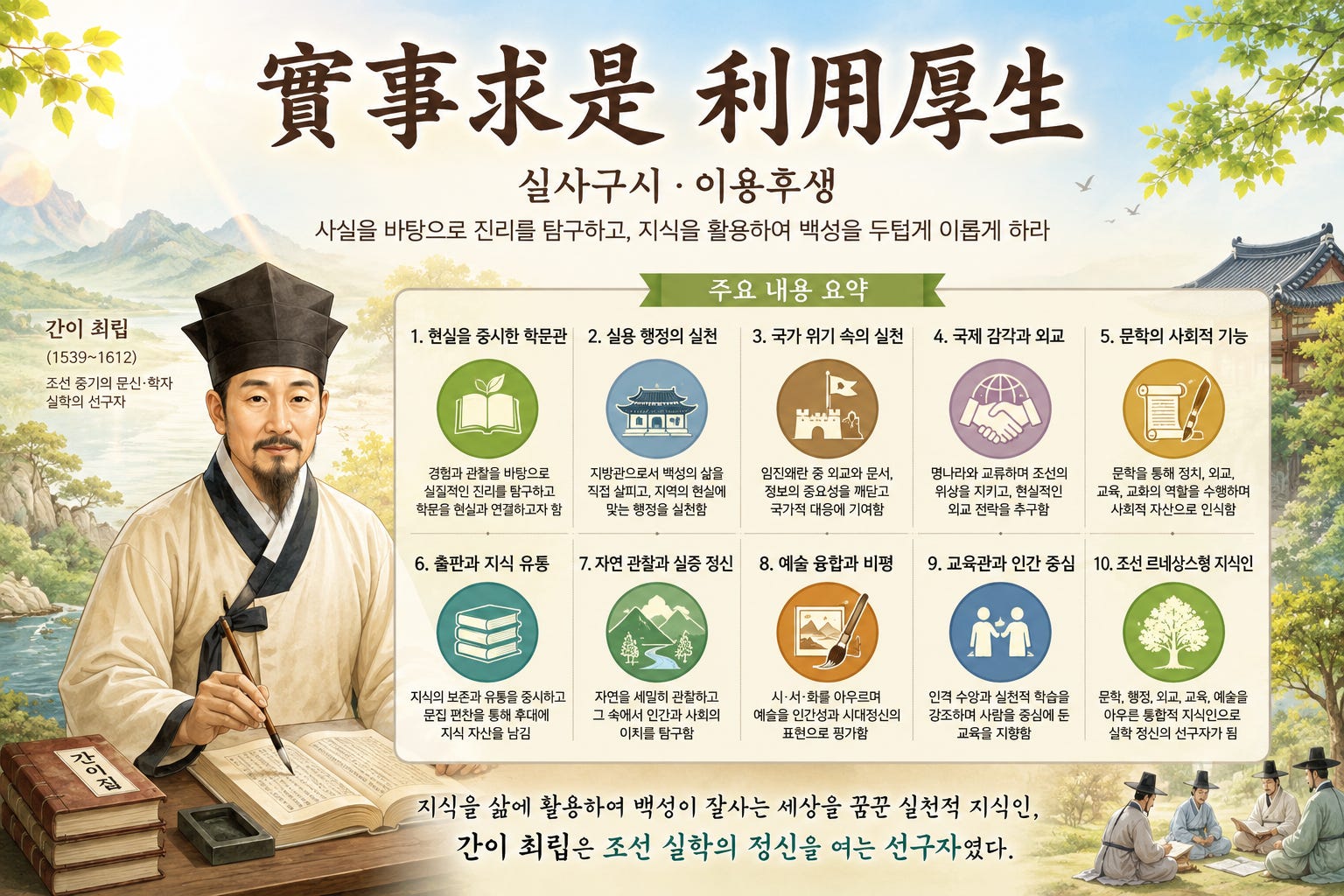
Among the literary figures of the mid-Joseon Dynasty, Choi Rip (崔岦, 1539–1612), known by his pen name Gani (簡易), is commonly remembered as an outstanding classical writer, poet, calligrapher, and diplomat. Yet a deeper examination of his thought and activities reveals that he was far more than a refined man of letters. He may also be understood as an early pioneer of Korean Practical Learning (Silhak), a “practical scholar” who sought to connect intellectual inquiry with the realities of human life and statecraft.
Rather than remaining confined within abstract Neo-Confucian moralism, Choi Rip consistently demonstrated concern for concrete social administration, cultural vitality, diplomacy, education, and the practical function of knowledge. In this respect, his intellectual orientation anticipated many of the later themes developed by major Silhak thinkers such as Yu Hyeong-won, Yi Ik, and Jeong Yak-yong.
What distinguishes Choi Rip most profoundly is the integrated nature of his life. He was simultaneously a literary figure, administrator, educator, diplomat, editor, and cultural critic. To him, learning was not merely ornamental scholarship but a practical instrument for cultivating society and improving governance. Viewed from a modern perspective, he emerges as a Renaissance-like intellectual of Joseon Korea — a thinker who pursued realism, cultural creativity, and humanistic refinement within a rigid ideological age.
A Philosophy of Learning Rooted in Reality
Choi Rip’s scholarship was not centered on rote memorization of classical texts alone. Instead, he sought meaning in lived human experience and social reality. His essays and poems contain remarkably concrete observations concerning nature, politics, society, and human emotion. This distinguishes him from many contemporary literati whose writings often remained confined to abstract moral discourse.
He did not separate learning from reality. Through his administrative service in local provinces, he directly encountered the hardships and complexities of ordinary life. Such experiences deepened his awareness of governance beyond theoretical ideals. This practical orientation resembles the later Silhak principle of gyeongse chiyong (經世致用), meaning “governing the world through practical application.” Rather than merely discussing moral principles, he explored how society could actually function more effectively.
Provincial Administration and Practical Governance
Serving as a provincial magistrate, including his role as governor of Gangneung, Choi Rip gained firsthand experience in local administration. Provincial officials in Joseon Korea were responsible not only for taxation but also for education, public order, economic stability, and the welfare of the people.
His writings reveal careful observations about regional customs, economic conditions, geography, and local culture. These descriptions were not merely literary embellishments; they also functioned as records of administrative insight. Choi Rip recognized that local realities could not always be judged solely through rigid standards established in the capital.
This sensitivity to regional diversity reflects a practical and empirical mode of thinking later associated with Silhak scholarship. Moreover, he regarded local culture not as a backward element to suppress, but as an essential component of the richness and diversity of Joseon civilization.
Practical Thinking During the Imjin War
The Imjin War exposed profound weaknesses within Joseon society. Choi Rip understood the war not merely as a military conflict but as a systemic national crisis affecting administration, diplomacy, communication, and governance.
During this turbulent period, he participated in diplomatic documentation and state communication related to Ming China. His literary skill thus became a practical instrument of national survival rather than a purely artistic endeavor. His prose functioned strategically within the political and diplomatic sphere.
This reflects one of the defining characteristics of Practical Learning: the ability to respond realistically to historical crises. Choi Rip realized that formalistic moral rhetoric alone could not preserve a nation. Effective institutions, information networks, and practical administrative competence were equally necessary.
International Awareness and Diplomatic Realism
Although deeply immersed in Chinese classical culture, Choi Rip did not embrace blind cultural submission. He interacted intellectually with Ming literary circles while simultaneously striving to preserve the distinct identity of Korean literary culture.
His diplomatic writings reveal acute awareness of political psychology and intercultural communication. Diplomacy for him was not simply ceremonial rhetoric; it was a practical mechanism for state survival and cultural exchange.
This perspective anticipated the more outward-looking worldview later associated with the Northern Learning (Bukhak) scholars of late Joseon. Choi Rip combined cultural confidence with openness toward foreign civilizations, demonstrating a remarkably modern intellectual posture for his era.
Literature as a Social Asset
Choi Rip viewed literature not merely as personal artistic expression but as a social and civilizational resource. His writings fulfilled multiple functions simultaneously: political persuasion, diplomatic negotiation, moral cultivation, and cultural refinement.
His prose demonstrates balanced insight into human emotion and social structures. He avoided both excessive utilitarianism and empty formalism. Such a literary philosophy foreshadows the later Silhak emphasis on practical prose and socially meaningful writing.
He also believed literature could elevate public consciousness and cultivate human maturity. In this regard, his literary thought remains highly relevant to modern discussions concerning the social role of the humanities.
Awareness of Publishing and Knowledge Circulation
Choi Rip was concerned not only with writing but also with preserving and disseminating knowledge. His involvement in the compilation and transmission of literary works represents an important contribution to Joseon intellectual culture.
In Joseon society, publishing was closely connected to the formation of intellectual authority and public memory. Choi Rip regarded scholarly works not as private possessions but as public cultural assets worthy of preservation for future generations.
Later Silhak scholars would similarly devote great energy to encyclopedic compilations, textual editing, and practical reference works. Choi Rip’s activities may therefore be seen as part of the broader intellectual current that eventually matured into Practical Learning.
Empirical Observation in His View of Nature
Nature appears frequently in Choi Rip’s poetry and prose, yet he did not treat it merely as symbolic ornamentation for moral lessons. Instead, he carefully observed rivers, mountains, seasonal transitions, weather patterns, and the emotional resonance between humanity and the natural world.
This approach reflects an empirical and observational mentality rather than purely metaphysical abstraction. Since Silhak fundamentally emphasized observation of the real world, Choi Rip’s writings on nature may be interpreted as an early expression of that intellectual tendency.
Moreover, he often sought lessons of balance, moderation, and harmony through nature itself. From a modern perspective, his sensitivity may even be interpreted as containing proto-ecological insight.
Cultural Integration and Art Criticism
Choi Rip excelled in poetry, calligraphy, and literary criticism. He understood art not as superficial decoration but as an expression of human character and civilizational dignity.
His artistic criticism evaluated not only aesthetic form but also the ethical depth and historical consciousness embodied within artistic works. This integrated perspective resembles the cultural criticism later developed within practical scholarship traditions.
Importantly, he refused to separate ethics from aesthetics or art from life. Such an interdisciplinary vision resembles what modern scholars might describe as a form of integrated humanities or cultural humanism.
Educational Philosophy and Human-Centered Thought
For Choi Rip, education was not simply preparation for civil service examinations. He emphasized moral cultivation, cultural refinement, reflective thinking, and experiential learning.
He recognized the limitations of rigid formalistic education and valued broad reading, observation, and contemplation. These ideas parallel later Silhak calls for practical education grounded in real-life experience rather than mere textual repetition.
Most significantly, he believed learning should help human beings become wiser, freer, and more mature. This educational philosophy retains profound relevance even in today’s AI-driven era.
A Renaissance-Type Intellectual of Joseon Korea
Choi Rip was not confined to a single professional identity. He simultaneously functioned as a poet, administrator, diplomat, educator, editor, and cultural critic. Such multidimensional intellectual activity was extremely rare in Joseon society.
His versatility represented more than personal talent; it reflected a profound sense of public responsibility. He sought to connect knowledge with practical governance, cultural creativity, and social improvement.
From a contemporary perspective, Choi Rip may therefore be regarded as an early model of the “public intellectual.” He integrated statecraft, humanism, art, diplomacy, and ethics into a unified intellectual vision. In this sense, he deserves renewed recognition as one of the pioneering figures who anticipated the spirit of Korean Practical Learning.
Choi Rip was far more than an accomplished literary stylist or poet. He was a practical intellectual who sought to understand the interconnected relationships among scholarship, governance, diplomacy, education, culture, and human experience during one of the most turbulent periods of Joseon history.
Although he did not formulate a systematic reform doctrine comparable to later Silhak thinkers, his consistent emphasis on reality, observation, public responsibility, and practical governance clearly reveals proto-Silhak characteristics. He refused to separate ideals from reality, art from administration, or culture from social responsibility.
For this reason, Choi Rip deserves to be reevaluated not only as a literary master but also as a pioneering practical scholar who helped open the intellectual horizon that would later mature into Korean Practical Learning. His life and thought continue to offer meaningful insights for the modern world, particularly in an age increasingly seeking integration between humanistic wisdom and practical problem-solving. +++
{Solti}
May 14, 2026

Young Choi, PhD is a Professor at Regent University bringing a rare combination of technical expertise and creative spirit to everything he does. A scholar in AI, cybersecurity, and network & telecommunications service management, he has published 38 books including AI and cybersecurity area books, over 200 refereed articles, and over 20 book chapters. Beyond the academy, Dr. Choi is a passionate poet, essayist, and wooden block laser engraving artist whose reflective writing invites readers to rediscover life’s beauty in quiet contemplation(靜觀). He lives under the motto: “Study hard and give generously without holding back! (열심히 공부해서 아낌없이 남주자 !: 열공아남)”
Published books: https://www.amazon.com/stores/Young-Choi/author/B0DMZ5S6R7?ref=ap_rdr&shoppingPortalEnabled=true