

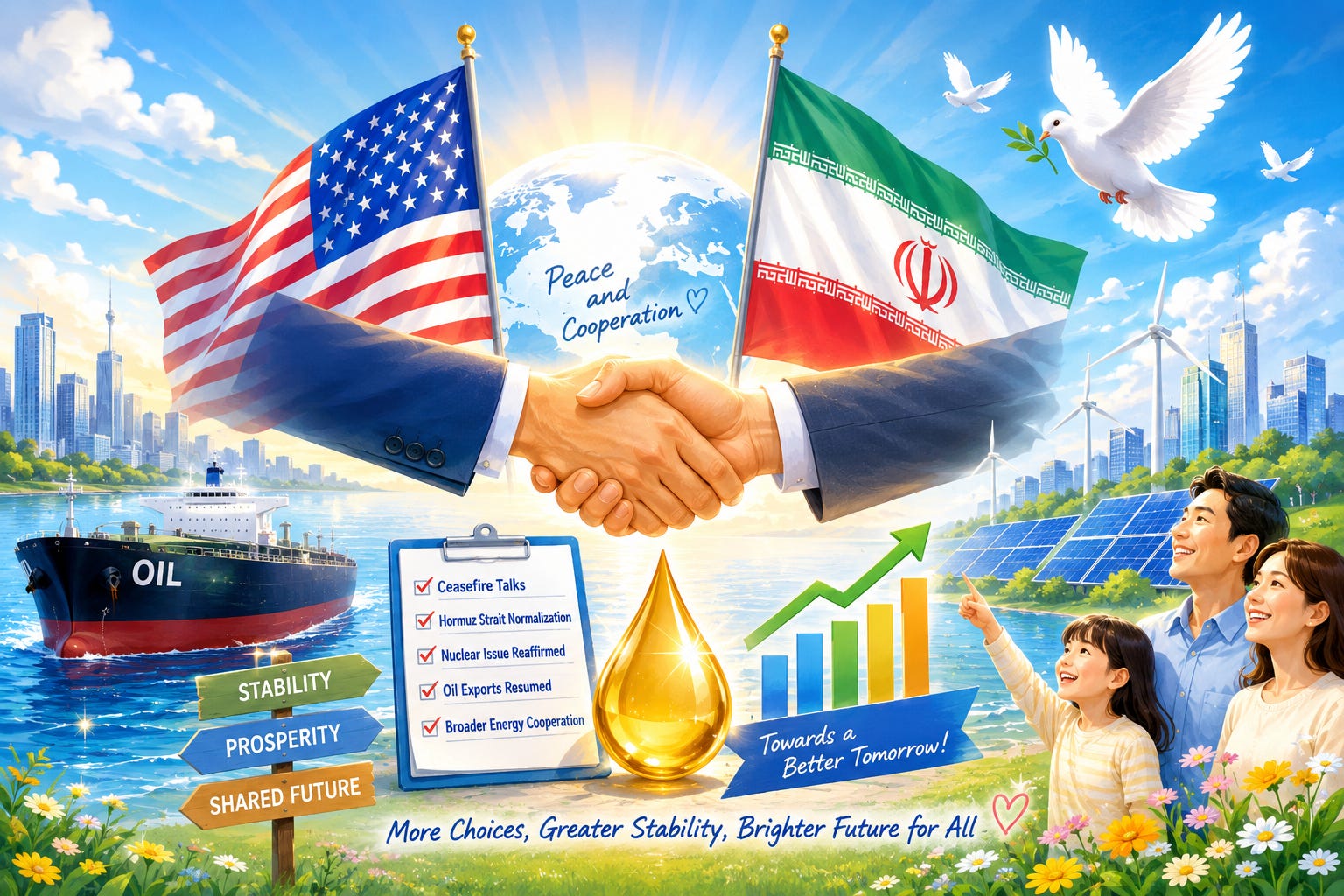
A few days ago, I came across an interesting economic news article. It reported that the United States and Iran were making progress in ceasefire negotiations and that the possibility of allowing Iranian oil exports again was growing. At first glance, this may seem like just another story about Middle Eastern diplomacy. In reality, however, it is closely connected to our daily lives. The price of gasoline, airline tickets, groceries, and even manufacturing costs are all influenced by oil.
We often think of economics as a world of numbers. Exchange rates, interest rates, and stock prices dominate the headlines. Yet the essence of economics is ultimately about people’s lives. When oil prices rise, transportation costs increase. As transportation costs rise, prices at supermarkets also go up. In this way, events occurring thousands of miles away in the Middle East can affect the price tags we see in our local stores.
The Strait of Hormuz was once again mentioned in the article. A significant portion of the world’s oil supply passes through this narrow waterway. Just as a major intersection can bring an entire city’s traffic to a standstill when blocked, instability in the Strait of Hormuz can disrupt the global economy. This is why economists often describe oil as “the lifeblood of the world economy,” even in the twenty-first century.
When we think about it, the situation is quite remarkable. Even in an age dominated by smartphones and artificial intelligence, a single drop of oil continues to influence global politics and economics. The stock prices of high-tech companies are affected by energy costs, and AI-powered data centers require enormous amounts of electricity to operate. Modern technology still depends heavily on reliable energy supplies.
Reading the article also reminded me of the importance of international relations. War is not merely a concern for soldiers. Prolonged conflicts can drive up energy prices, fuel inflation, and discourage investment and consumption. Peace, on the other hand, provides one of the strongest foundations for economic growth. This is why ceasefire negotiations attract so much attention—not only because they may end violence, but also because they can reduce economic uncertainty for millions of people.
From South Korea’s perspective, the development is particularly significant. The country relies heavily on imported energy resources. If the range of available oil suppliers expands, South Korea gains greater flexibility and bargaining power in purchasing energy. Such advantages can contribute to lower costs, improved industrial competitiveness, and greater economic stability.
At the same time, the situation raises an important question: How long will humanity continue to depend on oil? The world is already moving toward carbon neutrality and cleaner energy sources. Solar power, wind energy, hydrogen fuel, and Small Modular Reactors (SMRs) are attracting growing attention. The leaders of tomorrow’s economy may not necessarily be the countries with the largest oil reserves, but rather those that successfully manage the transition to sustainable energy.
History shows that human civilization has always advanced alongside new forms of energy. We moved from wood to coal, from coal to oil, and now toward renewable energy and AI-driven energy management systems. The changes taking place in the Middle East today may represent just one chapter in a much larger story of global energy transformation.
Reading economic news is about far more than understanding money. It is a way of learning how deeply interconnected our world has become. A sentence spoken at a negotiation table in the Middle East can influence fuel prices in South Korea, which in turn affects consumers’ spending habits and companies’ investment decisions. The world is connected in ways that are often invisible but profoundly important.
As I reflected on the article, I realized once again that peace, energy, and economic prosperity are not separate stories. They are part of the same narrative. The cars we drive, the airplanes we fly, the smartphones we use, and even the food on our tables are all linked to international affairs. To understand economics is, in many ways, to understand the world. And to understand the world is to recognize how closely our shared future is intertwined.
Perhaps one day, a single drop of oil will symbolize not only energy but also peace, cooperation, and prosperity. When that day arrives, humanity may take another meaningful step forward in its journey toward a more mature and sustainable civilization. +++
{Solti}
June 21, 2026
석유 한 방울이 바꾸는 세상
며칠 전 경제 뉴스를 읽다가 흥미로운 기사를 접했다. 미국과 이란이 종전 협상을 진행하면서 이란산 원유 수출이 다시 허용될 가능성이 커졌다는 내용이었다. 얼핏 보면 중동의 외교 뉴스처럼 보이지만, 사실 이 이야기는 우리 일상과도 깊은 관련이 있다. 자동차에 넣는 기름값, 항공권 가격, 식료품 물가, 기업의 생산비까지 모두 석유와 연결되어 있기 때문이다.
우리는 종종 경제를 숫자의 세계라고 생각한다. 환율, 금리, 주가 같은 숫자들이 경제 뉴스를 가득 채운다. 그러나 경제의 본질은 결국 사람들의 삶이다. 석유 가격이 오르면 물류비가 상승하고, 물류비가 오르면 마트의 물건값도 오른다. 결국 먼 중동에서 벌어진 사건이 우리 식탁의 가격표를 바꾸는 것이다.
호르무즈 해협이라는 이름도 이번 기사에서 다시 등장했다. 세계 원유 수송의 상당 부분이 이 좁은 바닷길을 통과한다. 마치 도시의 중요한 교차로가 막히면 전체 교통이 마비되듯, 이 해협이 불안해지면 세계 경제도 흔들린다. 그래서 경제학자들은 종종 “21세기에도 석유는 세계 경제의 혈액”이라고 말한다.
생각해 보면 참 신기하다. 스마트폰과 인공지능이 세상을 바꾸고 있는 시대에도 여전히 석유 한 방울이 세계 정치와 경제를 움직인다. 첨단 기술 기업의 주가가 오르내리는 이유 중 하나도 결국 에너지 가격과 무관하지 않다. 인공지능 서버를 돌리는 데이터센터조차 막대한 전력을 필요로 하기 때문이다.
이번 기사를 읽으며 또 하나 느낀 점은 국제 관계의 중요성이다. 전쟁은 단지 군인들만의 문제가 아니다. 전쟁이 길어지면 에너지 가격이 오르고, 물가가 상승하며, 투자와 소비가 위축된다. 반대로 평화는 경제 성장의 가장 강력한 토대가 된다. 종전 협상이 주목받는 이유도 단순히 총성이 멈추는 데 있지 않다. 사람들의 경제적 불안도 함께 줄어들기 때문이다.
한국의 입장에서 보면 더욱 의미가 크다. 우리나라는 대부분의 에너지를 수입에 의존한다. 따라서 원유 공급선이 다양해질수록 선택의 폭이 넓어지고 가격 협상력도 커질 수 있다. 이는 기업 경쟁력 향상과 물가 안정으로 이어질 가능성이 있다.
그러나 여기서 한 가지 질문이 떠오른다. 우리는 언제까지 석유에 의존해야 할까? 세계는 이미 탄소중립과 친환경 에너지 시대로 이동하고 있다. 태양광, 풍력, 수소 에너지, 소형모듈원전(SMR) 같은 새로운 에너지 기술이 주목받는 이유도 여기에 있다. 미래의 경제는 단순히 석유를 많이 확보하는 나라가 아니라 에너지 전환을 성공적으로 이끄는 나라가 주도할 가능성이 크다.
역사를 돌아보면 인류는 늘 새로운 에너지와 함께 발전해 왔다. 나무에서 석탄으로, 석탄에서 석유로, 그리고 이제는 재생에너지와 인공지능 기반 에너지 관리 시스템으로 이동하고 있다. 지금 우리가 목격하는 중동의 변화도 어쩌면 거대한 에너지 전환 시대의 한 장면일지 모른다.
경제 뉴스를 읽는다는 것은 단순히 돈 이야기를 보는 것이 아니다. 그것은 세계가 어떻게 연결되어 있는지를 배우는 과정이다. 중동의 협상 테이블에서 오간 한 문장이 한국의 주유소 가격에 영향을 미치고, 그 가격은 다시 소비자의 지갑과 기업의 투자 계획을 바꾼다. 세계는 생각보다 훨씬 촘촘하게 연결되어 있다.
이번 기사를 읽으며 나는 평화와 에너지, 그리고 경제가 서로 다른 이야기가 아니라 하나의 이야기라는 사실을 다시 느꼈다. 우리가 매일 사용하는 자동차, 비행기, 스마트폰, 심지어 식탁 위의 음식까지도 국제 정세와 연결되어 있다. 결국 경제를 이해한다는 것은 세상을 이해하는 것이며, 세상을 이해한다는 것은 서로 연결된 우리의 미래를 읽는 일인지도 모른다.
석유 한 방울의 가치가 단순한 연료를 넘어 세계 평화와 번영의 상징이 되는 날, 인류는 또 한 단계 성숙한 문명으로 나아갈 수 있을 것이다. +++
{솔티}
2026년 6월 21일
Prof. Dr. Young Choi (Editor in Chief) — Regent University
Young B. Choi is a Professor in the Department of Engineering & Computer Science at Regent University. He published 38 books with ‘Selected Readings in Cybersecurity’ (2018) (over 800 copies archived globally at university/college libraries around the world) and ‘Cybersecurity Applications and Artificial Intelligence’ (2023) available in seven major world languages. He proposed the world’s first global and universal telecommunications “Service Order Handling (SOH)” Model (T-SOH Model) (1995) with Dr. Adrian Tang. With this innovative research work, he received the IEEE NOMS ’96 Best Paper Award and became the first recipient of the Outstanding Contribution Award of the TeleManagement Forum in 1998. His research areas include Natural Language Processing-focused AI, AI-applied cybersecurity, network and telecom service management, and Korean studies on Gani Choi Rip’s Jeonggwan (靜觀: Quiet Contemplation) philosophy and Shilhak ( 實學: Practical Learning).