

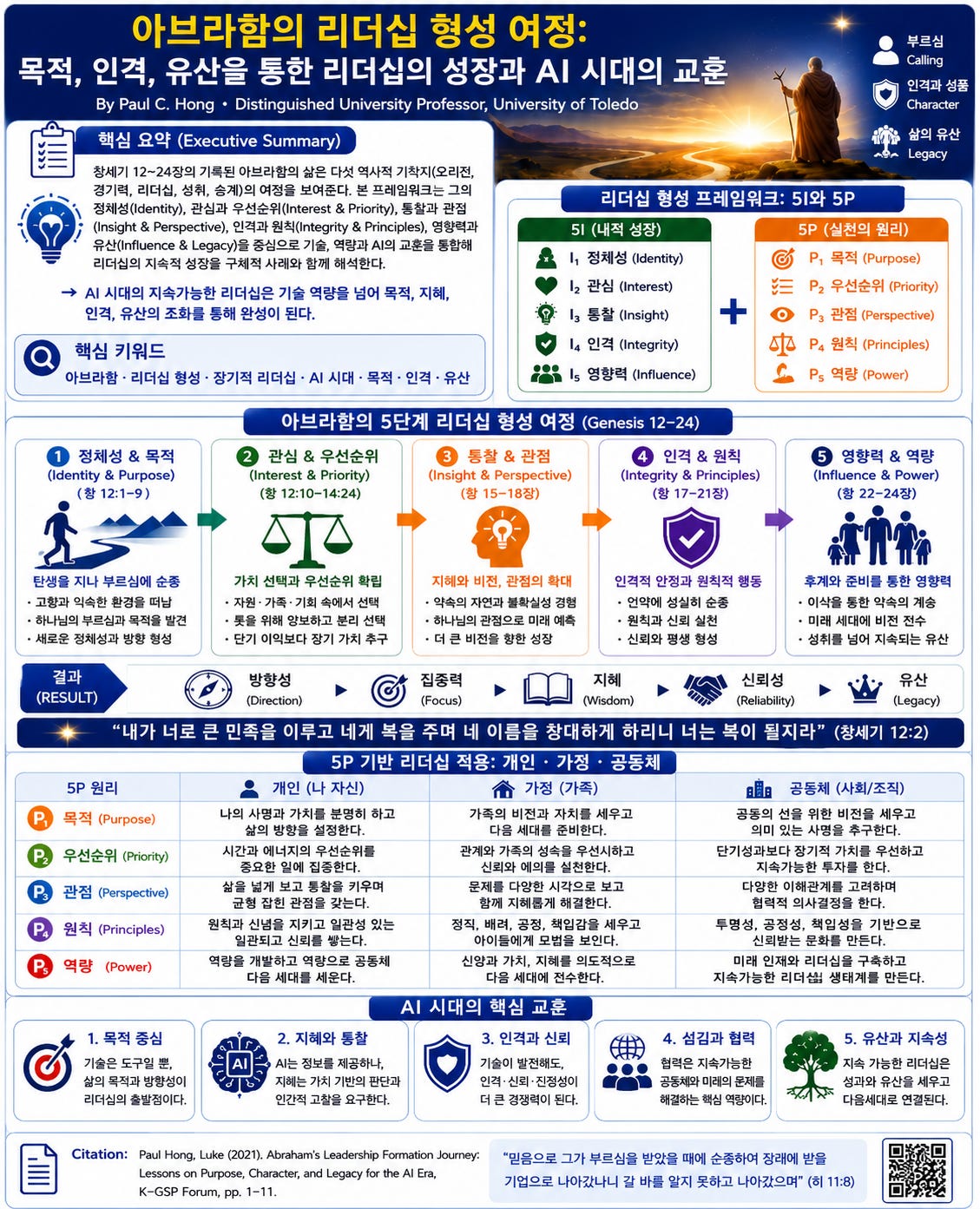
Executive Summary
This article examines Abraham’s life in Genesis 12–24 as one of history’s earliest longitudinal leadership case studies. Using the integrated framework of the 5Is (Identity, Interest, Insight, Integrity, Influence) and 5Ps (Purpose, Priority, Perspective, Principles, Power), it traces Abraham’s transformation from an ordinary individual into a leader whose influence extended far beyond his own lifetime. The findings suggest that in the AI era, sustainable leadership depends not merely on technological competence but on enduring human qualities such as purpose, wisdom, character, stewardship, and generational responsibility.
Keywords: Abraham; Leadership Formation; Longitudinal Leadership; AI Era; Purpose; Character; Legacy
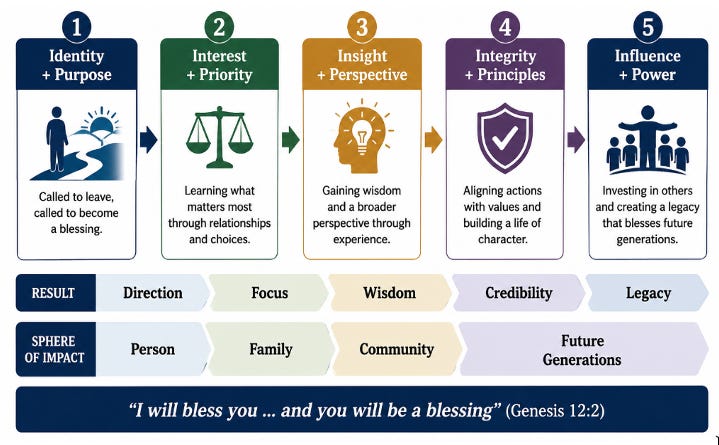
Figure 1. Abraham’s Leadership Formation Model
Source: Figure created by the author based on Genesis 12–24 and leadership formation theory. Artificial intelligence was used as a visualization aid to generate the graphic representation; the underlying concepts, framework, and interpretations were developed independently by the author.
1. Introduction
Throughout history, few individuals have exerted influence across as many generations, cultures, and civilizations as Abraham. His enduring significance is reflected not only in religious traditions but also in the continued use of his name by influential leaders such as Abraham Lincoln, Abraham Kuyper, Abraham Maslow, Abraham Joshua Heschel, and Abraham Verghese. Yet Abraham’s influence extends far beyond those who bear his name. As the founding patriarch of Judaism, Christianity, and Islam, he occupies a unique position in human history. For nearly four millennia, these Abrahamic faith traditions have shaped the beliefs, values, institutions, legal systems, and cultural identities of billions of people around the world. Few historical figures have exercised such broad and lasting influence across geography, religion, and time.
The significance of Abraham is further underscored by the opening verse of the Gospel of Matthew: “This is the genealogy of Jesus the Messiah, the son of David, the son of Abraham” (Matt. 1:1). This statement identifies Abraham, David, and Jesus Christ as three foundational pillars of biblical leadership history. Abraham represents leadership formation through calling and covenant, David exemplifies stewardship and governance, and Jesus demonstrates servant leadership and the multiplication of leaders. Among these three figures, Abraham is especially important because his story reveals how leadership begins, develops, and matures over time. Genesis 12–24 provides a rare longitudinal account spanning approximately twenty-five years, allowing readers to observe how identity, purpose, wisdom, character, and influence are gradually formed through challenges, decisions, relationships, successes, and failures (Peterson, 2000; Maxwell, 2018).
Although this article was originally developed for a missional leadership cohort examining leadership formation through biblical narratives, Abraham’s journey offers insights that extend well beyond religious contexts. His experiences address universal leadership challenges involving purpose, priorities, decision-making, family stewardship, community responsibility, succession planning, and generational impact. For this reason, Abraham can be viewed both as a central figure of faith and as one of history’s earliest longitudinal leadership case studies. His story is particularly relevant in the AI era, when technological advances increasingly transform how people work, communicate, and make decisions. While artificial intelligence can enhance efficiency, process information, and support decision-making, it cannot replace uniquely human qualities such as purpose, wisdom, integrity, trust, and stewardship (Mollick, 2024). Abraham’s life therefore provides a timeless framework for understanding the human dimensions of leadership that remain essential in an age of rapid technological change and increasing complexity.
2. Abraham’s Leadership Formation Journey
Abraham’s life in Genesis 12–24 reveals a progressive process of leadership development through five interconnected stages. Each stage contributes to his growth as an individual, family leader, community influencer, and ultimately a source of blessing to future generations.
Table 1 presents Abraham’s leadership formation as a progressive journey unfolding through five developmental stages in Genesis 12–24, where challenges and experiences shaped his growth in purpose, priorities, wisdom, character, and stewardship. Beginning with a call to leave familiar security, Abraham gradually developed deeper insight, integrity, and trustworthiness through years of decisions, relationships, successes, and failures. The table demonstrates that enduring leadership emerges not from a single achievement but from a lifelong process that ultimately produces generational influence and lasting legacy.
Table 1. Abraham’s Leadership Formation Journey (Genesis 12–24)
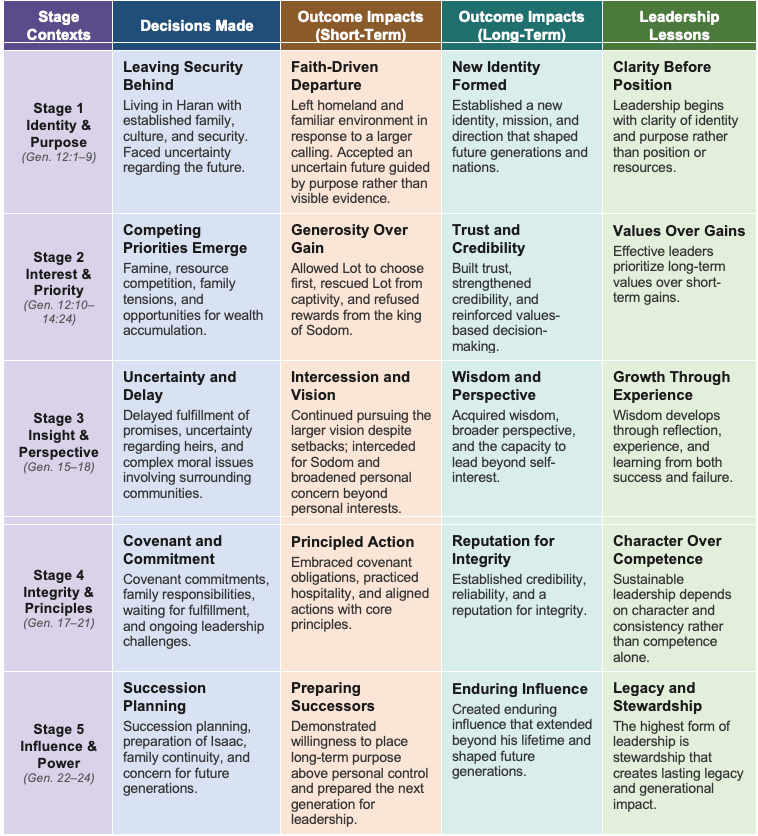
Source: Author’s Own.
Each stage reflects a biblically grounded and empirically observable transition in Abraham’s leadership capacity, confirming that the developmental sequence is purposefully structured rather than arbitrary.
2.1. Stage One: Identity and Purpose (Genesis 12:1–9)
The first stage of Abraham’s leadership formation begins with God’s call to leave his homeland and journey to an unknown destination, despite having no nation, inheritance, or visible evidence that God’s promises would be fulfilled. His response required a profound identity shift, moving beyond familiar sources of security and redefining himself according to a larger divine purpose. In the cultural context of the ancient Near East, where family, tribe, land, and ancestry formed the foundations of identity, economic survival, and social stability, Abraham’s decision involved significant uncertainty and personal risk, illustrating a challenge common to transformational leaders throughout history — the willingness to pursue a compelling vision beyond the limits of present certainty.
This stage established the foundation upon which all subsequent leadership development would rest because before Abraham could influence others, he first needed clarity regarding who he was and why he existed (Drucker, 1999). The promise of Genesis 12:2–3 introduced a purpose greater than personal achievement, calling him not merely to receive blessings but to become a blessing to others and to future generations. The primary outcome of this stage was direction, demonstrating that effective leadership begins with a clear sense of identity and purpose that guides future decisions and actions, enabling leaders to navigate uncertainty, inspire others, and remain resilient during periods of change (Drucker, 1999; Maxwell, 2018).
2.2. Stage Two: Interest and Priority (Genesis 12:10–14:24)
The second stage of Abraham’s leadership formation centers on the development of priorities through challenges involving famine, fear, relationships, and resource management. A significant turning point occurred when Abraham allowed Lot to choose first regarding land allocation, demonstrating generosity and confidence in his larger purpose rather than insisting on his rights as the elder family leader. Later, he risked his own safety and resources to rescue Lot from captivity and refused the material rewards offered by the king of Sodom, choosing instead to preserve his independence and avoid obligations that might compromise his values or mission.
These events unfolded in a context where land, livestock, and political alliances represented the primary measures of wealth and security, making Abraham’s decisions distinctly countercultural. Rather than maximizing territorial advantage, accumulating resources, or strengthening political influence, Abraham consistently placed relationships above possessions and values above immediate gain, revealing an emerging leadership principle that sustainable success depends on priorities aligned with long-term purpose rather than short-term rewards (Drucker, 2006). The outcome of this stage was focus, as Abraham learned to distinguish between immediate interests and enduring priorities, demonstrating that effective leadership is ultimately defined not by the number of opportunities pursued but by the wisdom to identify and commit to what matters most.
2.3. Stage Three: Insight and Perspective (Genesis 15–18)
The third stage of Abraham’s leadership formation focuses on the development of wisdom through years of uncertainty between God’s promise and its fulfillment. The prolonged delay created tension, doubt, and impatience, leading Abraham to attempt to accelerate outcomes through Hagar and the birth of Ishmael, illustrating a common leadership temptation to substitute human solutions for long-term trust and patience. Through both successes and failures, however, Abraham gradually learned that not every challenge can be resolved through immediate action and that some outcomes require sustained commitment, perseverance, and faith.
A particularly significant development appears in Genesis 18 when Abraham intercedes on behalf of Sodom, demonstrating concern not only for his own future but also for the welfare of an entire community. His dialogue with God reveals growing moral awareness, empathy, and the ability to consider broader consequences beyond personal interests, reflecting a transition from self-concern to broader stewardship (Peterson, 2000; Tournier, 2013). The outcome of this stage was wisdom, as Abraham learned to interpret circumstances through a broader perspective, illustrating that effective leadership emerges when individuals reflect on experience, learn from both achievements and mistakes, and align their decisions with larger purposes and responsibilities (Tournier, 2013).
2.4. Stage Four: Integrity and Principles (Genesis 17–21)
The fourth stage of Abraham’s leadership formation focuses on character development, where credibility emerged through increasing consistency between values and actions. Important events such as the covenant of circumcision in Genesis 17 and his hospitality toward the visitors in Genesis 18 required Abraham to move beyond intellectual belief and demonstrate practical commitment, generosity, humility, and accountability. Although he continued to experience moments of weakness and imperfection, the overall trajectory of his life reflected growing faithfulness and alignment between conviction and behavior, illustrating that leadership growth occurs not because individuals become flawless but because they become increasingly committed to living according to clearly defined principles (Foster, 2018; Stott, 2010).
The birth of Isaac reinforced one of the central lessons of Abraham’s life: meaningful outcomes often require patience, discipline, and trust in long-term processes rather than immediate results. Modern leaders face similar challenges when building organizations, developing people, implementing strategy, or pursuing meaningful change, all of which require perseverance and sustained commitment to core values even when outcomes remain uncertain (MacDonald, 2003; Tournier, 2013). The outcome of this stage was credibility, demonstrating that while skills and knowledge may create opportunities, trust and lasting influence emerge when leaders consistently align their actions with their principles across changing circumstances and extended periods of responsibility (MacDonald, 2003; Tournier, 2013).
2.5. Stage Five: Influence and Power (Genesis 22–24)
The fifth stage of Abraham’s leadership formation centers on legacy and influence, culminating in his willingness to offer Isaac in Genesis 22. By this point, Abraham’s confidence rested not in possessions, status, accomplishments, or personal control but in a higher purpose that extended beyond himself, revealing a maturity that had replaced earlier tendencies toward fear, uncertainty, and self-management of outcomes. This stage marks a critical transition from achievement to stewardship, where leadership expands beyond personal success to the preservation of values, the development of successors, and the preparation of future generations (Sanders, 2007).
The final chapters of Genesis 23 and 24 further demonstrate Abraham’s commitment to long-term stewardship through his careful arrangements for Sarah’s burial and his deliberate efforts to secure a suitable marriage for Isaac. These actions reflect strategic concern for continuity, succession, and family stability, illustrating that some of a leader’s most important decisions involve people, institutions, and outcomes that may not fully mature within the leader’s own lifetime (Sanders, 2007). The outcome of this stage was legacy, as Abraham’s influence extended far beyond his immediate circumstances, demonstrating that leadership reaches its highest expression when it creates lasting impact through the growth, success, and stewardship of future generations (Maxwell, 2018).
3. Translating Abraham’s Leadership Journey for the AI Era
Although rooted in a biblical narrative, Abraham’s leadership journey offers timeless guidance for navigating purpose, uncertainty, relationships, succession, and legacy across contemporary personal, organizational, and societal contexts.
The developmental stages observed in Abraham’s life provide practical guidance for contemporary leadership challenges. Although Abraham’s story is rooted in a biblical narrative, many of the leadership principles emerging from his experiences address universal human concerns involving purpose, priorities, decision-making, relationships, character, succession, and legacy. Across individuals, families, organizations, and communities, leaders face similar challenges of navigating uncertainty, balancing competing demands, building trust, and preparing future generations for success.
The relevance of Abraham’s leadership journey becomes even more significant in the AI era. Artificial intelligence is transforming how people work, communicate, analyze information, and make decisions. Yet many of the most important leadership challenges remain fundamentally human. While technology can improve efficiency and expand analytical capabilities, it cannot replace purpose, wisdom, character, stewardship, and ethical judgment.
3.1. Purpose: Direction Beyond Technology
Abraham’s leadership journey began with purpose. Before he acquired resources, influence, or followers, he received a compelling sense of direction that required him to leave familiar security and pursue a larger calling. His willingness to embrace uncertainty illustrates a foundational leadership principle: effective leadership begins with understanding why one exists and what larger mission one seeks to fulfill.
Purpose remains critically important in the AI era because technology cannot determine values, mission, or meaning. Artificial intelligence can enhance decision-making and operational efficiency, but leaders must still answer questions that machines cannot address: What kind of future should be created? What problems are worth solving? How should technology be used to serve human flourishing? At the individual level, purpose aligns talents and activities with meaningful goals; at the family level, it creates shared direction; and at the community level, it encourages service beyond self-interest (Drucker, 1999; Mollick, 2024).
Leadership Insight: Technology can accelerate progress, but purpose determines direction.
Table 2 examined how Abraham’s leadership was formed through five developmental stages. Table 2 shifts the focus from formation to application by translating these leadership dimensions into practical actions for individuals, families, and communities. Together, the two tables demonstrate that leadership development and leadership practice are inseparable processes that reinforce one another across generations.
Table 2. Leadership Applications for Individuals, Families, and Communities
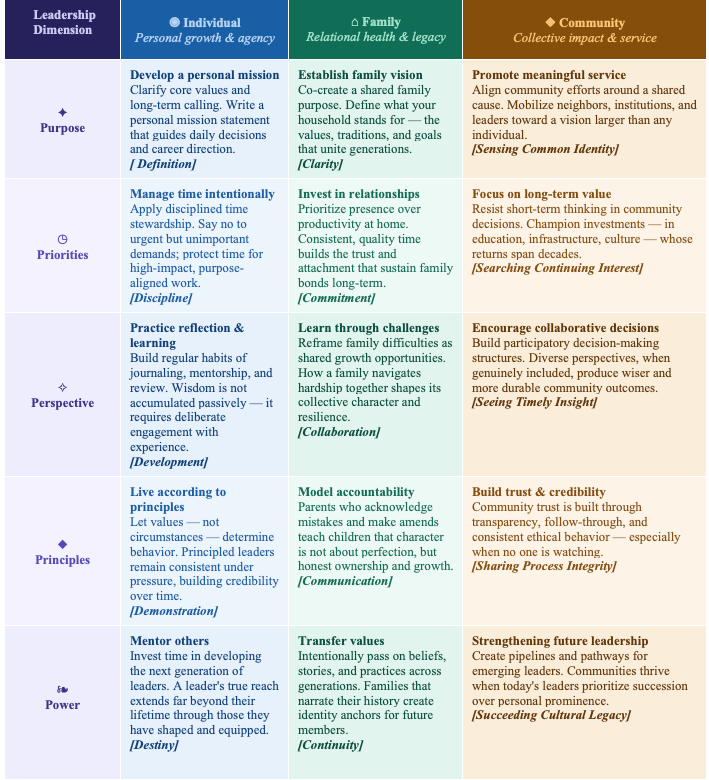
Source: Author’s Own
Each leadership dimension is translated into concrete applications across individual, family, and community contexts, illustrating that Abraham’s formation journey offers practical guidance extending well beyond its biblical origins.
Leadership is not merely what we achieve; it is who we become and what we leave behind for others.
3.2. Priorities: Focus Amid Complexity
A second lesson from Abraham’s life concerns priorities. His decisions regarding Lot, the king of Sodom, and material rewards reveal a growing ability to distinguish between immediate opportunities and enduring values. Rather than maximizing short-term advantage, Abraham consistently chose relationships, independence, and long-term purpose over immediate gain.
This lesson is especially relevant in an age characterized by information overload, digital distraction, and competing stakeholder demands. Modern leaders have access to unprecedented amounts of information, yet often struggle to determine what truly deserves attention. Strategic leadership requires disciplined prioritization that aligns time, energy, and resources with long-term objectives rather than reacting to every demand or opportunity. Individuals benefit from focusing on meaningful goals, families strengthen relationships through intentional investment, and communities create sustainable value when leaders emphasize long-term stewardship over short-term results (Drucker, 2006; Mollick, 2024).
Leadership Insight: In an age of abundant information, leadership depends on disciplined prioritization.
3.3. Wisdom: Judgment Beyond Intelligence
Abraham’s years of waiting, uncertainty, failure, and eventual growth demonstrate that wisdom develops gradually through experience and reflection. His experiences involving Ishmael and his intercession for Sodom reveal an increasing capacity to consider broader consequences, balance competing concerns, and act from a wider perspective than personal interest alone.
The distinction between intelligence and wisdom becomes increasingly important in the AI era. Artificial intelligence can process vast quantities of data and generate recommendations with remarkable speed, but it cannot fully account for ethics, context, human emotions, values, or unintended consequences. Wisdom remains a uniquely human capacity that integrates knowledge with judgment, experience, empathy, and moral reasoning. At the individual level, wisdom grows through reflection and learning; at the family level, it guides long-term decision-making; and at the community level, it encourages leaders to consider diverse perspectives and broader societal consequences (Tournier, 2013; Mollick, 2024).
Leadership Insight: AI may enhance intelligence, but wisdom remains a uniquely human responsibility.
3.4. Character: Trust in a Transparent World
Abraham’s life demonstrates that sustainable influence depends upon character rather than competence alone. Through covenant commitment, hospitality, accountability, and faithfulness, his actions increasingly aligned with his values, creating credibility and trust among those around him. His influence endured because others learned that his behavior consistently reflected his convictions.
Character becomes even more valuable as technology becomes more powerful. The AI era presents ethical challenges involving privacy, transparency, accountability, bias, and responsible innovation. While technology may enhance efficiency, it cannot replace integrity, moral judgment, or personal responsibility. Trust remains one of the few leadership assets that cannot be automated. Individuals build credibility through consistency, families cultivate trust through accountability, and communities depend upon ethical leadership to sustain cooperation and social cohesion (MacDonald, 2003; Stott, 2010; Mollick, 2024).
Leadership Insight: The greater the power of technology, the greater the need for character-driven leadership.
3.5. Stewardship: Legacy Across Generations
The final stage of Abraham’s journey illustrates the transition from achievement to stewardship. His preparation of Isaac, concern for family continuity, and commitment to future generations reveal a mature understanding that leadership ultimately extends beyond personal success. His focus shifted from what he could accomplish personally to what he could leave behind for others.
This perspective is particularly relevant in the AI era because today’s decisions regarding artificial intelligence, education, governance, institutions, and workforce development will shape future generations in profound ways. Effective leaders therefore balance innovation with responsibility, growth with sustainability, and technological progress with human dignity. At the individual level, stewardship involves mentoring and developing others; at the family level, it involves transferring values and wisdom; and at the community level, it involves building institutions and leadership capacity that endure beyond one’s lifetime. Abraham’s experience demonstrates that leadership reaches its highest expression when it creates conditions under which others can flourish (Sanders, 2007; Maxwell, 2018).
Leadership Insight: Leadership reaches its highest expression when it creates lasting value for future generations.
Abraham’s leadership journey demonstrates that while technologies change, the fundamental requirements of leadership remain remarkably constant. Purpose provides direction, priorities create focus, wisdom guides decisions, character builds trust, and stewardship creates legacy. These qualities become even more important in an era when artificial intelligence can amplify both human strengths and human weaknesses. The central lesson of Abraham’s life is therefore profoundly contemporary: sustainable leadership depends not merely on what technology can do, but on who leaders become and what they leave behind for others.
Technology changes tools; purpose, character, and legacy remain timeless.
4. Conclusion
Abraham’s life demonstrates that effective leadership is not a single achievement but a lifelong process of developing Identity, Interests, Insight, Integrity, and Influence, which ultimately shape one’s Purpose, Priorities, Perspective, Principles, and Power. His journey from an unknown traveler to a leader whose influence shaped generations illustrates how enduring leadership emerges through continuous growth, disciplined decision-making, and commitment to values larger than oneself. In the AI era, where technological capabilities continue to expand rapidly, the most important leadership challenges remain fundamentally human: providing direction, exercising judgment, building trust, and preparing future generations to flourish. Technology may change how we lead, but it can never replace who we become — because the greatest legacy of leadership is not what we build for ourselves, but what we leave behind for others.
References
Drucker, P. F. (1999). Managing oneself. Harvard Business Review, 77(2), 64–74.
Drucker, P. F. (2006). The effective executive: The definitive guide to getting the right things done. HarperBusiness. (Original work published 1967)
Foster, R. J. (2018). Celebration of discipline: The path to spiritual growth (40th anniversary ed.). HarperOne. (Original work published 1978)
Maxwell, J. C. (2018). Developing the leader within you 2.0. HarperCollins Leadership. (Original work published 1993)
Mollick, E. (2024). Co-intelligence: Living and working with AI. Portfolio.
Peterson, E. H. (2000). A long obedience in the same direction: Discipleship in an instant society (Rev. ed.). InterVarsity Press. (Original work published 1980)
Sanders, J. O. (2007). Spiritual leadership: Principles of excellence for every believer (Updated ed.). Moody Publishers. (Original work published 1967)
Stott, J. R. W. (2010). The radical disciple: Some neglected aspects of our calling. InterVarsity Press.
The Holy Bible, New International Version. (2011). Zondervan. (Original work published 1978)
Tournier, P. (2013). The strong and the weak. Wipf & Stock Publishers. (Original work published 1963)
About the Author

Distinguished Professor, Dr. Paul Hong (Editor in Chief) — University of Toledo
Paul C. Hong is Distinguished University Professor and Chair of Information Systems and Supply Chain Management at the University of Toledo. Drawing on more than two decades of scholarship in leadership, innovation, organizational development, and global competitiveness, his research explores how individuals, organizations, and societies develop the capabilities necessary for long-term resilience, adaptation, and meaningful impact.
His recent work focuses on leadership formation through the integration of history, management, philosophy, and faith-based narratives, emphasizing the development of purpose, priorities, wisdom, character, stewardship, and legacy. In the age of artificial intelligence, he examines how uniquely human capacities such as ethical judgment, trust-building, relational stewardship, and purposeful action complement technological advances to promote responsible leadership and human flourishing across generations.
Original Article :

Citation
Paul Hong (June 2026). Abraham’s Leadership Formation Journey: Lessons on Purpose, Character, and Legacy for the AI Era. K-GSP Forum, pp. 1–11.
© K-Global Scholars and Professionals Forum. All rights reserved. Content published in the K-GSP Forum may not be reproduced, distributed, or transmitted in any form without prior written permission from the K-GSP Forum, except for brief quotations with full attribution.
I really enjoyed reading this article. As a Christian and a scientist, I find Abraham's story both familiar and inspiring. It is fascinating to see how his life and leadership principles can be connected to the challenges and opportunities of the modern AI era. His example continues to offer timeless guidance for leadership at the personal, family, and community levels. I appreciate your thoughtful insights into developing leadership grounded in biblical narratives and their relevance to today's world.
Dear Dr. Paul Hong
Thank you for sharing this article. It really spoke to me.
I often focus on what God wants me to do, but this reminded me that God is just as concerned with who I am becoming. Seeing Abraham's journey helped me realize that the waiting, the failures, and the difficult seasons are not wasted—they are part of God's way of shaping us.
This was a timely reminder for me to trust God's process instead of rushing ahead. I'm grateful for this encouraging perspective, and it challenged me to look at my own journey a little differently.
Isaac and Rebekah