

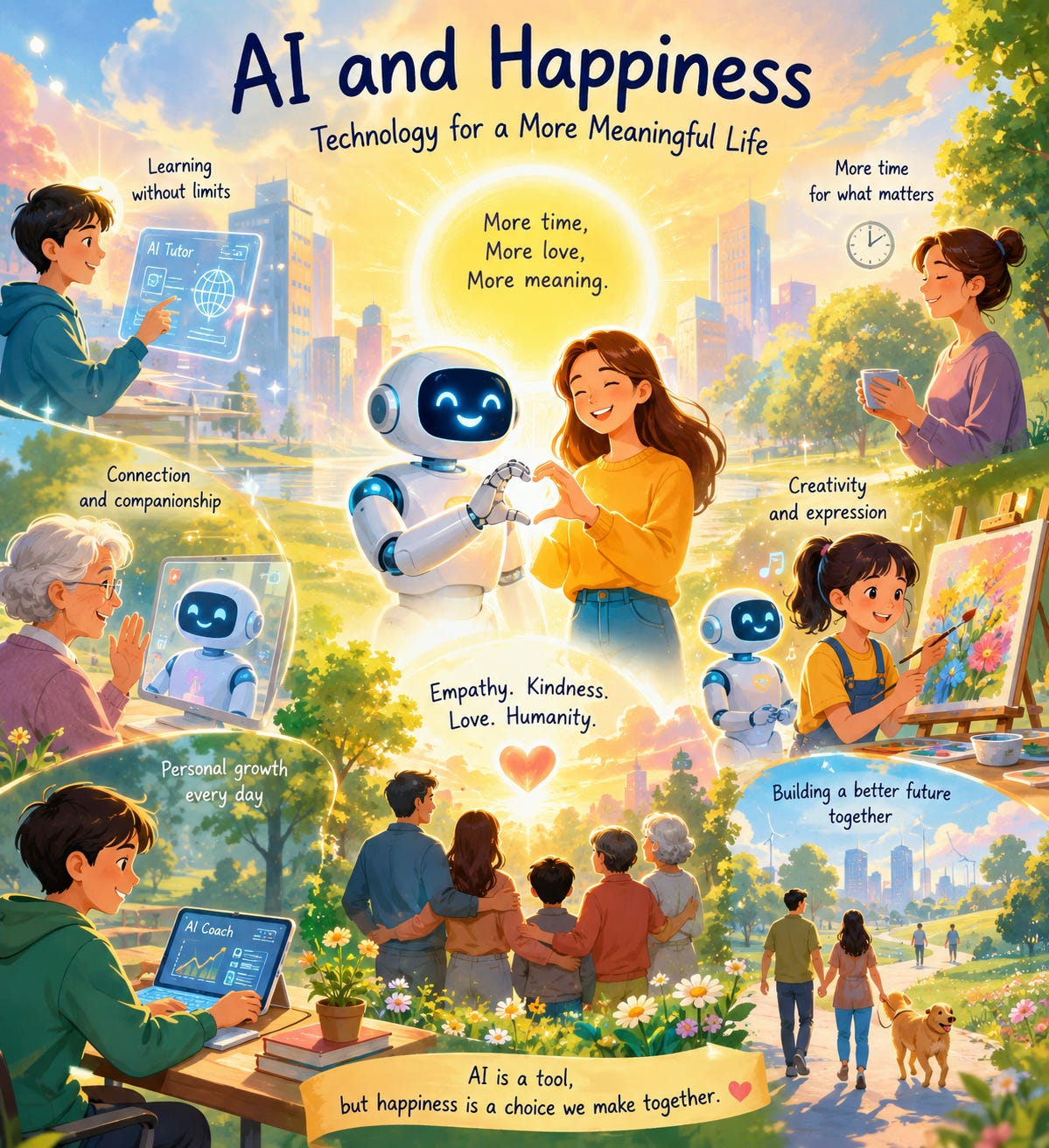
Human beings have long pursued happiness. Ancient philosophers regarded happiness as the ultimate purpose of life, while religions proposed inner peace as the path toward it. The Industrial Revolution brought material abundance, and the Information Age opened an era of knowledge and connectivity. Now, we stand at yet another turning point: the age of artificial intelligence (AI).
Many people view AI as a tool for productivity or a core technology of the future economy. Yet a deeper question emerges: can AI truly make humans happier, or might it threaten happiness itself? This is not merely a technological question, but a fundamental inquiry into human existence.
Happiness Begins with Time
Modern people constantly complain about a lack of time. Between answering emails, attending meetings, completing paperwork, and managing daily chores, little time remains for oneself.
One of AI’s greatest gifts is the return of time. It automates repetitive tasks, organizes complex information, and performs routine labor that once consumed human effort. If AI gives us even one extra hour a day to talk with family, read books, or take a walk, this is not just efficiency—it is an increase in happiness.
Happiness often begins not with more money, but with more free time.
AI as a New Teacher
In the past, it was difficult to find great teachers. Today, however, anyone can learn from AI across a wide range of subjects.
One can practice foreign languages through conversation at any time, or receive explanations in history and science as if from a personal tutor. Learning has been democratized.
Learning brings deep satisfaction to human beings. The joy of understanding something new is a form of happiness that material consumption cannot replace. AI expands access to this intellectual joy for many people.
A Companion in an Age of Loneliness
Modern society is often described as highly connected, yet paradoxically many people feel increasingly lonely.
In aging societies, the number of people living alone is rising, while younger generations also experience isolation in digital environments. AI cannot fully replace human relationships, but it can serve as a conversational partner—someone to talk to, ask questions, and organize thoughts with.
For some, even a short conversation with AI may provide comfort to get through the day. While AI should never replace human relationships, it can meaningfully complement them.
Happiness Is Growth, Not Comparison
Much unhappiness arises from comparison. The pursuit of better houses, higher salaries, and more glamorous lives often leads people to lose sight of present happiness.
AI can become a tool not of comparison, but of growth. It helps individuals improve themselves compared to yesterday, learn new skills, and develop creative ideas.
True happiness comes not from being superior to others, but from discovering one’s own potential.
Expanding the Joy of Creation
Many people believe they cannot draw because they are not artists, or cannot write because they are not writers.
However, AI lowers the barriers to creation. Anyone can now write poetry, compose music, create images, or develop stories.
What matters is not that AI creates for us, but that it expands human imagination. Happiness is often greater when we are creators rather than passive consumers.
AI Reveals Human Value
Interestingly, the more AI advances, the clearer human value becomes.
AI can calculate and store information, but it does not truly love. It can write texts, but it does not feel emotion. It can give advice, but it cannot take responsibility.
Paradoxically, AI forces us to reconsider uniquely human qualities—empathy, love, sacrifice, forgiveness, and friendship. It reminds us that happiness ultimately resides in our humanity.
The Emerging Happiness Gap
However, AI does not automatically guarantee happiness.
A gap may emerge between those who can effectively use AI and those who cannot. Information overload, misinformation, and anxiety about job displacement are also real concerns.
Technological progress alone does not guarantee increased happiness. Education, ethics, and trust must evolve alongside technology to build a truly happy society.
AI as a Mirror
AI functions like a mirror reflecting humanity.
When we ask good questions, it amplifies wisdom. When we bring harmful intentions, it can amplify risks as well. AI itself does not create happiness; rather, human choices determine its outcomes.
Like a hammer that can build a house or break a window, AI reflects the values of its users.
Redefining Happiness
In the AI era, the definition of happiness itself may change.
In the past, survival was central; in the industrial age, material wealth became dominant. But as AI takes over many forms of labor, humans will ask deeper questions:
“Why do I exist?”
“What do I love?”
“What am I living for?”
AI may provide answers, but it cannot live our lives for us. Ultimately, each person must discover the meaning of happiness.
The Most Important Competence of the Future
In the future, the most important skills will not be the ability to calculate faster than machines.
Rather, gratitude, empathy, emotional intelligence, and the ability to live a meaningful life will become essential.
As AI becomes more intelligent, humans must become wiser. This is the true source of competitiveness—and happiness.
AI is likely to become one of the most powerful tools in human history. Yet happiness does not arise from technology itself. It emerges when we transform saved time into love, knowledge into wisdom, and convenience into a meaningful life.
Perhaps the greatest paradox of the AI era is this: the more machines become like humans, the more seriously humans must learn how to live as humans.
Ultimately, it is not AI that builds a happy future—it is the human mind that holds AI. And when that mind turns toward gratitude, love, learning, and creativity, AI becomes not a threat to happiness, but a partner in building a more meaningful world.
The question AI asks us is simple:
“Do you want more technology, or a more meaningful life?”
A wise person does not choose between the two. They use technology to create a more meaningful life. That is the new definition of happiness in the age of AI. +++
{Solti}
May 30, 2026
AI와 행복: 우리는 더 행복해질 수 있을까?
인류는 오랫동안 행복을 추구해 왔다. 고대 철학자들은 행복을 삶의 궁극적인 목적이라 보았고, 종교는 마음의 평안을 통해 행복에 이르는 길을 제시했다. 산업혁명은 물질적 풍요를 가져왔고, 정보혁명은 지식과 연결의 시대를 열었다. 그리고 지금 우리는 또 하나의 거대한 전환점에 서 있다. 바로 인공지능(AI)의 시대다.
많은 사람들은 AI를 생산성을 높이는 도구나 미래 산업의 핵심 기술로 생각한다. 그러나 더 근본적인 질문이 있다. AI는 과연 인간을 행복하게 만들 수 있을까? 아니면 오히려 행복을 위협하는 존재가 될 것인가? 이 질문은 단순한 기술의 문제가 아니라 인간 존재에 관한 질문이다.
행복은 시간에서 시작된다
현대인은 늘 시간이 부족하다고 말한다. 이메일에 답하고, 회의에 참석하고, 서류를 작성하고, 집안일을 처리하다 보면 정작 자신을 위한 시간은 거의 남지 않는다.
AI의 가장 큰 선물 중 하나는 시간을 돌려주는 것이다. 반복적인 업무를 자동화하고 복잡한 정보를 정리해 주며, 인간이 해야 할 단순 노동을 대신한다. AI 덕분에 하루에 한 시간이라도 더 가족과 대화하고, 책을 읽고, 산책할 수 있다면 그것은 단순한 효율성 향상이 아니라 행복의 증가라고 할 수 있다.
행복은 종종 더 많은 돈이 아니라 더 많은 자유 시간에서 시작된다.
AI는 새로운 스승이 될 수 있다
과거에는 훌륭한 스승을 만나기 어려웠다. 하지만 오늘날 누구나 AI를 통해 다양한 지식을 배울 수 있다.
외국어를 배우고 싶으면 언제든지 대화할 수 있고, 역사나 과학을 공부하고 싶으면 개인 교사처럼 설명을 들을 수 있다. 배움의 기회가 민주화된 것이다.
배움은 인간에게 깊은 만족감을 준다. 새로운 것을 이해하는 순간의 기쁨은 물질적 소비가 주지 못하는 행복이다. AI는 이러한 지적 즐거움을 더욱 많은 사람들에게 제공하고 있다.
외로운 시대의 대화 상대
현대 사회는 연결의 시대라고 불리지만, 역설적으로 많은 사람이 외로움을 호소한다.
고령화 사회에서는 독거노인이 늘어나고 있으며, 젊은 세대 역시 디지털 환경 속에서 고립감을 경험한다. AI는 인간을 완전히 대체할 수는 없지만, 대화하고 질문하고 생각을 정리할 수 있는 상대가 될 수 있다.
누군가에게는 AI와의 짧은 대화가 하루를 견디게 하는 작은 위로가 될 수도 있다. 물론 AI가 인간 관계를 대신해서는 안 되지만, 인간 관계를 보완하는 역할은 충분히 가능하다.
행복은 비교가 아니라 성장이다
많은 불행은 비교에서 비롯된다. 남보다 더 좋은 집, 더 높은 연봉, 더 화려한 삶을 추구하다 보면 현재의 행복을 놓치기 쉽다.
AI는 비교의 도구가 아니라 성장의 도구가 될 수 있다. 어제의 나보다 조금 더 나아지도록 돕고, 새로운 기술을 배우게 하며, 창의적인 아이디어를 발전시키게 한다.
진정한 행복은 타인보다 우월해지는 것이 아니라 자신의 가능성을 발견하는 데서 나온다.
창작의 즐거움을 확장하다
많은 사람들은 예술가가 아니기 때문에 그림을 그리지 못하고, 작가가 아니기 때문에 글을 쓰지 못한다고 생각한다.
그러나 AI는 창작의 문턱을 낮추고 있다. 누구나 시를 쓰고, 음악을 만들고, 그림을 그리고, 이야기를 창작할 수 있다.
중요한 것은 AI가 대신 창작하는 것이 아니라 인간의 상상력을 확장한다는 점이다. 행복은 소비자가 될 때보다 창조자가 될 때 더 크게 느껴진다.
AI가 알려주는 인간의 가치
흥미롭게도 AI가 발전할수록 인간의 가치도 더욱 선명해지고 있다.
AI는 계산을 잘하고 정보를 기억하지만, 진정으로 사랑하지는 못한다. AI는 글을 쓰지만 감동을 느끼지 못한다. AI는 조언할 수 있지만 책임을 질 수는 없다.
오히려 AI는 인간만이 가진 공감, 사랑, 희생, 용서, 우정의 가치를 다시 생각하게 만든다. 행복은 결국 인간다움 속에 존재한다는 사실을 깨닫게 하는 것이다.
행복의 새로운 격차를 경계해야 한다
그러나 AI가 항상 행복을 가져다주는 것은 아니다.
AI를 활용하는 사람과 그렇지 못한 사람 사이의 격차가 커질 수 있다. 정보 과잉, 가짜 뉴스, 일자리 변화에 대한 불안도 존재한다.
기술이 발전한다고 해서 자동으로 행복이 증가하는 것은 아니다. 행복한 사회를 만들기 위해서는 교육, 윤리, 신뢰가 함께 발전해야 한다.
AI는 거울이다
AI는 인간의 모습을 비추는 거울과 같다.
우리가 선한 질문을 하면 지혜를 증폭시키고, 악한 의도를 가지면 위험도 증폭시킨다. AI 자체가 행복을 만드는 것이 아니라 인간의 선택이 행복을 만든다.
망치가 집을 지을 수도 있고 창문을 깰 수도 있듯이, AI 역시 사용하는 사람의 가치관에 따라 결과가 달라진다.
행복의 정의를 다시 묻다
AI 시대에는 행복의 정의 자체가 달라질 수 있다.
과거에는 생존이 중요했고, 산업화 시대에는 물질적 풍요가 중요했다. 그러나 AI가 많은 노동을 대신하게 되면 사람들은 더 근본적인 질문을 하게 될 것이다.
“나는 왜 존재하는가?”
“나는 무엇을 사랑하는가?”
“나는 무엇을 위해 살아가는가?”
AI는 답을 줄 수는 있지만 대신 살아줄 수는 없다. 결국 행복의 의미는 인간 스스로 찾아야 한다.
미래의 가장 큰 경쟁력
미래 사회에서 가장 중요한 능력은 AI보다 더 빠르게 계산하는 능력이 아닐 것이다.
오히려 감사할 줄 아는 마음, 타인을 이해하는 능력, 아름다움을 느끼는 감성, 그리고 의미 있는 삶을 만드는 지혜가 더욱 중요해질 것이다.
AI가 똑똑해질수록 인간은 더욱 현명해져야 한다. 그것이 진정한 경쟁력이며 행복의 원천이다.
AI는 인간 역사상 가장 강력한 도구 중 하나가 될 가능성이 높다. 그러나 행복은 기술 그 자체에서 나오지 않는다. 행복은 기술을 통해 확보한 시간을 사랑으로 채우고, 지식을 지혜로 바꾸며, 편리함을 의미 있는 삶으로 연결할 때 비로소 완성된다.
어쩌면 AI 시대의 가장 큰 역설은 이것일지 모른다. 기계가 점점 더 인간처럼 똑똑해질수록, 우리는 인간답게 살아가는 법을 더욱 진지하게 고민하게 된다는 사실이다.
결국 행복한 미래를 만드는 것은 AI가 아니다. AI를 손에 쥔 인간의 마음이다. 그리고 그 마음이 감사와 사랑, 배움과 창조를 향할 때 AI는 인류를 불행하게 만드는 기술이 아니라, 더 행복한 세상을 여는 동반자가 될 수 있을 것이다.
AI가 우리에게 묻고 있는 질문은 단순하다.
“당신은 더 많은 기술을 원하는가, 아니면 더 의미 있는 삶을 원하는가?”
지혜로운 사람은 이 둘 중 하나를 선택하지 않는다. 그는 기술을 활용하여 더욱 의미 있는 삶을 만들어 간다. 그것이 AI 시대 행복의 새로운 정의일 것이다. +++
{솔티}
2026년 5월 30일

Young Choi, PhD is a Professor at Regent University bringing a rare combination of technical expertise and creative spirit to everything he does. A scholar in AI, cybersecurity, and network & telecommunications service management, he has published 38 books including AI and cybersecurity area books, over 200 refereed articles, and over 20 book chapters. Beyond the academy, Dr. Choi is a passionate poet, essayist, and wooden block laser engraving artist whose reflective writing invites readers to rediscover life’s beauty in quiet contemplation(靜觀). He lives under the motto: “Study hard and give generously without holding back! (열심히 공부해서 아낌없이 남주자 !: 열공아남!)”
Published books: https://www.amazon.com/stores/Young-Choi/author/B0DMZ5S6R7?ref=ap_rdr&shoppingPortalEnabled=true