

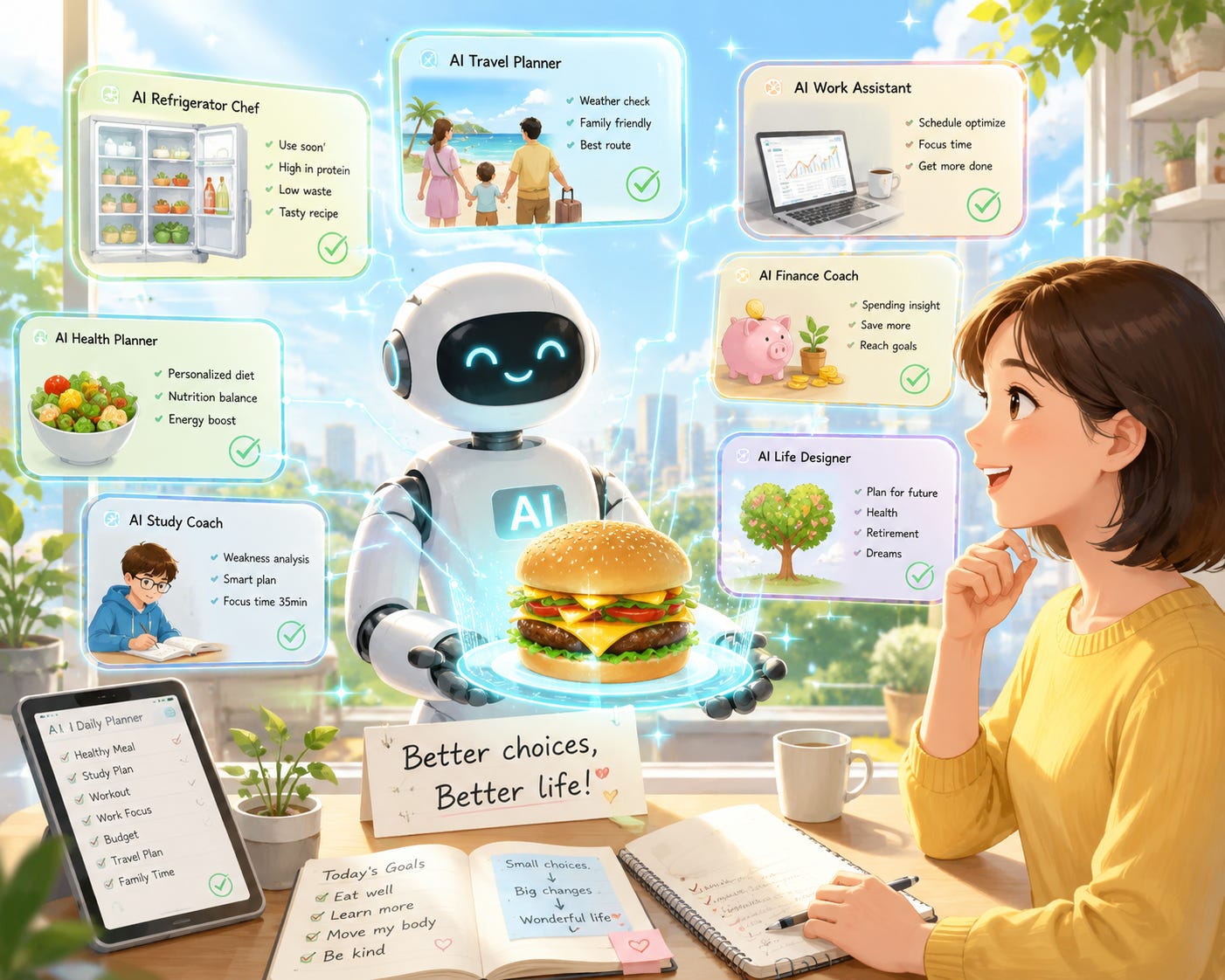
I recently read a fascinating article about AI Burger, an artificial intelligence system developed by researchers at Stanford University. Rather than simply recommending existing recipes, the AI designed entirely new hamburgers by balancing taste, nutrition, and environmental sustainability. Even more impressive, some of the AI-designed burgers received higher ratings than those from well-known fast-food restaurants. By incorporating ingredients such as mushrooms and plant-based proteins, the AI also created burgers that reduced environmental impact while improving nutritional value.
At first, I thought, “So it’s just an AI that creates burgers.”
But after reading the entire article, I realized it was about something much bigger.
This AI was not merely designing hamburgers—it was demonstrating how artificial intelligence can design better decisions.
Our lives are filled with choices.
Every morning we decide what to eat.
We choose which route to take to work.
We decide what to order for lunch.
After work, we choose between exercising or relaxing.
These seemingly small decisions accumulate to shape the course of our lives.
Yet most of us make the same choices over and over again.
“Chicken again today.”
“Instant noodles again.”
“I’ll put it off until tomorrow.”
AI Burger reminds us that there may be better possibilities waiting to be discovered.
What if AI could help us optimize not only our meals but also the countless decisions we make every day?
Imagine an AI Refrigerator Chef.
Simply take a picture of the contents of your refrigerator, and the AI might say:
“Use these ingredients first because they will expire soon.”
“Your protein intake is lower than recommended today.”
“Here’s a recipe that lowers calories without sacrificing flavor.”
Such an assistant could dramatically reduce food waste while making healthy eating much easier.
Or consider an AI Nutrition Planner.
By analyzing your age, blood pressure, blood sugar, activity level, body weight, and even your schedule for the day, it could recommend:
“You have several important meetings today. Here’s a meal that supports sustained concentration.”
“You’re exercising this evening, so today’s lunch should include extra protein.”
Healthy eating would no longer depend solely on willpower—it would become personalized and practical.
Education offers another exciting opportunity.
Every student has unique strengths and weaknesses.
An AI learning coach could identify them individually:
“Your understanding of mathematical functions needs improvement.”
“Your English listening skills require additional practice.”
“A focused 35-minute study session today will maximize your learning efficiency.”
Such personalized guidance could become even more effective than traditional tutoring.
Travel planning could also become far more intelligent.
Most people simply copy itineraries they find online.
Instead, AI could design a trip specifically for your family:
“Rain is expected tomorrow morning, so swap today’s schedule.”
“Since you’re traveling with young children, let’s minimize travel time.”
“Because your parents have limited mobility, we’ll avoid destinations with many stairs.”
The result would be a vacation designed for people—not just places.
For professionals, AI could become an exceptional personal assistant.
By analyzing meeting schedules, workload, deadlines, and periods of peak concentration, it might recommend:
“Write your project proposal this morning when your focus is strongest.”
“Handle routine emails this afternoon.”
Rather than working harder, people could simply work smarter.
Even personal finance could benefit.
Instead of merely tracking expenses, AI could explain spending patterns:
“Your coffee expenses increased by 40% this month.”
“Reducing restaurant visits by two each month would fully fund your next vacation.”
The AI would become not just a bookkeeping tool, but a financial coach that helps people achieve long-term goals.
It could even assist with retirement planning.
After evaluating savings, pensions, living expenses, and health conditions, it might suggest:
“Retiring at age 67 instead of 65 would significantly improve your long-term financial security.”
All of these ideas share one important principle.
Artificial intelligence is evolving from a search engine that retrieves information into a design partner that helps us discover the best possible solutions.
Of course, the final decision should always belong to people.
AI can analyze enormous amounts of data and calculate countless possibilities, but it cannot determine what happiness, purpose, love, or personal fulfillment truly mean. Its recommendations should guide us—not replace our judgment.
Researchers estimate that there are tens of trillions of possible combinations even for something as simple as a hamburger.
If a single burger contains so many possibilities, imagine how many choices exist within a single day—or within an entire lifetime.
Perhaps AI’s greatest contribution will not be creating better hamburgers.
It will be helping us make better decisions.
The AI that designed a burger may actually be asking us a far more profound question:
“Is your next choice truly the best one?”
Perhaps the future of artificial intelligence lies not in replacing human beings, but in becoming the wisest partner we have ever had in designing a healthier, happier, and more meaningful life. +++
{Solti}
June 27, 2026
햄버거를 설계한 AI, 이제는 우리의 인생도 설계할까?
얼마 전 놀라운 기사를 읽었다. 미국 스탠퍼드대학교 연구진이 만든 ‘AI Burger(버거AI)’가 사람마다 다른 입맛과 영양 목표를 분석해 새로운 햄버거를 설계했다는 내용이었다. 더욱 놀라운 사실은 AI가 만든 햄버거가 유명 패스트푸드의 햄버거보다 더 높은 평가를 받은 경우도 있었다는 점이다. 심지어 버섯을 활용해 환경 부담을 크게 줄이거나, 콩을 활용해 영양을 높인 메뉴까지 만들어 냈다고 한다.
처음에는 단순히 “햄버거 만드는 AI인가 보다.”라고 생각했다. 하지만 기사를 다 읽고 나니 생각이 완전히 달라졌다.
이 AI는 햄버거를 만든 것이 아니라 ‘최적의 선택’을 설계하는 방법을 보여주고 있었기 때문이다.
우리의 하루는 선택의 연속이다.
아침에는 무엇을 먹을지 고민하고,
출근할 때 어떤 길로 갈지 고민하며,
점심 메뉴를 고르고,
퇴근 후 운동을 할지 쉴지 결정한다.
작은 선택들이 모여 인생이 된다.
그런데 대부분 우리는 늘 비슷한 선택만 반복한다.
“오늘도 치킨.”
“오늘도 라면.”
“오늘도 미루자.”
AI Burger는 이런 반복에서 벗어나 새로운 가능성을 보여준다.
만약 이런 AI가 햄버거가 아니라 우리의 일상 속 모든 선택을 도와준다면 어떨까?
예를 들어 ’AI 냉장고 셰프’를 상상해 보자.
냉장고 안을 사진으로 찍으면 AI가
“유통기한이 임박한 재료부터 사용하세요.”
“오늘은 단백질이 부족합니다.”
“칼로리는 줄이고 맛은 유지하는 새로운 요리를 추천합니다.”
라고 알려준다.
냉장고 속 음식이 쓰레기로 버려지는 일도 줄어들 것이다.
또 다른 아이디어는 ’AI 건강 도시락 설계사’이다.
나이,
혈압,
혈당,
운동량,
체중,
오늘의 일정까지 고려하여
“오늘은 회의가 많으니 집중력을 높이는 식단”
“오늘은 운동하는 날이니 단백질을 늘린 메뉴”
를 자동으로 추천해 준다.
식단 관리가 훨씬 쉬워질 것이다.
공부에도 활용할 수 있다.
학생마다 어려워하는 과목은 모두 다르다.
AI가
“수학은 함수가 약합니다.”
“영어는 듣기가 부족합니다.”
“오늘은 35분 공부하면 가장 효율적입니다.”
라고 개인 맞춤형 학습 계획을 설계해 준다면 과외보다 더 좋은 학습 코치가 될 수도 있다.
여행도 마찬가지다.
대부분 여행 일정은 인터넷에서 그대로 복사한다.
하지만 AI는
“비가 올 가능성이 있으니 오전 일정을 바꾸세요.”
“아이가 있으므로 이동 시간을 줄이는 것이 좋습니다.”
“부모님은 계단이 많은 관광지는 피하는 것이 좋습니다.”
처럼 가족 구성원까지 고려한 여행을 설계할 수 있다.
직장인에게도 AI는 훌륭한 비서가 된다.
회의 일정,
업무 우선순위,
집중력이 높은 시간대를 분석하여
“오전에는 기획서를 작성하고 오후에는 이메일을 처리하세요.”
처럼 하루를 가장 효율적으로 사용할 방법을 제안할 수 있다.
가계부도 마찬가지다.
AI는 단순히 지출을 기록하는 수준을 넘어
“이번 달은 커피값이 지난달보다 40% 증가했습니다.”
“외식을 두 번 줄이면 여행 경비를 마련할 수 있습니다.”
처럼 미래까지 설계하는 재무 코치가 될 수 있다.
심지어 은퇴 준비도 가능하다.
현재 자산,
연금,
생활비,
건강 상태를 분석하여
“65세 은퇴보다 67세 은퇴가 더 안정적입니다.”
같은 맞춤형 인생 설계를 제안할 수도 있다.
이 모든 아이디어의 공통점은 하나다.
AI는 더 이상 답을 찾아주는 검색엔진이 아니라 최적의 해답을 설계하는 파트너가 된다는 것이다.
물론 최종 결정은 언제나 사람이 내려야 한다.
AI는 수많은 가능성을 계산하는 데는 뛰어나지만, 행복과 가치, 사랑, 꿈의 의미까지 대신 결정할 수는 없다. AI가 제안하는 설계는 훌륭한 참고자료일 뿐, 우리의 삶을 완성하는 마지막 한 조각은 인간의 판단과 경험이다.
버거 하나를 만드는 데도 수십조 개가 넘는 조합이 존재한다고 한다. 그렇다면 사람의 하루, 한 달, 그리고 인생에는 얼마나 많은 선택지가 숨어 있을까? AI는 그 수많은 가능성 속에서 더 나은 길을 비춰주는 길잡이가 될 수 있다.
햄버거를 설계한 AI는 어쩌면 음식보다 더 중요한 질문을 우리에게 던지고 있다.
“당신의 다음 선택은, 정말 최선입니까?”
그리고 앞으로의 AI는 그 질문에 가장 현명한 답을 함께 찾아주는 최고의 인생 파트너가 될지도 모른다. +++
{솔티}
2026년 6월 27일
Prof. Dr. Young Choi (Editor in Chief) — Regent University
Young B. Choi is a Professor in the Department of Engineering & Computer Science at Regent University. He published 38 books with ‘Selected Readings in Cybersecurity’ (2018) (over 800 copies archived globally at university/college libraries around the world) and ‘Cybersecurity Applications and Artificial Intelligence’ (2023) available in seven major world languages. He proposed the world’s first global and universal telecommunications “Service Order Handling (SOH)” Model (T-SOH Model) (1995) with Dr. Adrian Tang. With this innovative research work, he received the IEEE NOMS ’96 Best Paper Award and became the first recipient of the Outstanding Contribution Award of the TeleManagement Forum in 1998. His research areas include Natural Language Processing-focused AI, AI-applied cybersecurity, network and telecom service management, and Korean studies on Gani Choi Rip’s Jeonggwan (靜觀: Quiet Contemplation) philosophy and Shilhak ( 實學: Practical Learning).
I deeply enjoyed reading your insightful column, Your practical examples, such as the "AI Refrigerator Chef" and "AI Health Planner," beautifully illustrate how complex technology can seamlessly enrich our daily lives. I truly resonate with your insight that data-driven AI can serve as a wise guide for modern individuals often overwhelmed by endless choices. At the same time, your reminder that the "final decision" involving human values like happiness and love must always belong to us provides a profound warning against technological omnipotence. Thank you for this inspiring piece that challenges us to thoughtfully leverage AI as a true partner in designing a more meaningful life.