

Executive Summary
China makes about 94 percent of the world’s rare earth permanent magnets and has learned to ration them as a bargaining tool. The United States has answered with tariffs, a one-year truce, and slow domestic investment. This essay argues that Washington holds an underused counterweight: the American software that runs Chinese business, much of it unlicensed. Pairing magnet access with verifiable software licensing, grounded in international intellectual property law, would restore balance against a gray-zone competitor.
Introduction
Every robot joint, aircraft actuator, electric vehicle motor, and precision machine tool depends on small, powerful permanent magnets. China produced about 94 percent of the world’s sintered permanent magnets in 2024, up from roughly half in 2005 (International Energy Agency [IEA], 2026). Beijing now uses that position in the gray zone between trade and coercion. When it placed seven heavy rare earths and related magnets under export licensing in April 2025, automakers in the United States and Europe cut output, and some briefly halted production lines. Broader controls announced that October were suspended for one year, until November 10, 2026 (Huld, 2025). That date is weeks away. The problem is that the United States keeps negotiating over magnets as if it held no comparable card. It does.
China’s Magnet Leverage Is Structural and Selective
China’s advantage rests on refining know-how and an integrated magnet industry, not on ore alone, and the IEA (2026) projects that producers outside China will meet less than one fifth of magnet demand by 2035. Supply has also been rationed by destination. After the 2025 restrictions, European imports rebounded while U.S. imports stayed below 2024 levels (Baskaran & Schwartz, 2026). New mines will not close this gap within a political cycle.
Washington’s Response Has Been Reactive
Tariffs, a negotiated pause, and subsidies for domestic producers address supply but not bargaining power. Each round has ended with Washington asking for supply rather than trading for it. A suspension that Beijing can let lapse is leverage held by the other side.
American Software Is the Missing Counterweight
U.S. firms own much of the productivity layer of the modern economy: office suites such as Word and Excel, Oracle’s enterprise systems, engineering and industrial software, and now artificial intelligence. Much of that value is used in China without payment. BSA’s most recent global survey estimated that 66 percent of PC software installed in China in 2017 was unlicensed (BSA, 2018). My colleagues and I saw the pattern up close. At an American university’s global campus in China, a 2016 surveys found that fewer than 40 percent of business students reported using authorized Microsoft Office, and fewer than 17 percent knew their university already provided it free (Choi et al., 2017).
Even 40 percent is generous!
The survey asked whether students thought their copy was authorized, only about 13 percent had obtained Microsoft Office through it’s legal sales channels, and unlicensed copies sold as genuine by unauthorized resellers are common. The author’s estimate is that verifiably legitimate use was closer to no more than 7 or 8 percent.
The widespread unlicensed use of American software in China gives Washington real leverage. That leverage has limits, but they are narrower than they first appear. China has domestic alternatives such as WPS Office, and open-source tools have become mature and dependable. Office suites, however, are the easy part. Enterprise systems, banking, engineering and industrial design software, databases, and advanced AI tools are much harder to replace, and many Chinese firms still depend on American products to run their daily operations. Beijing could respond to pressure with new mineral controls of its own, and that risk calls for careful play. It does not erase the advantage.
Pushing too hard might also speed China’s effort to replace American software altogether, and Washington should weigh that cost openly. None of this argues for leaving the card unplayed. It argues for playing it with care.
Figure 1.
Strategic Leverage: Amercian Software vs. Chinese Rare Earths
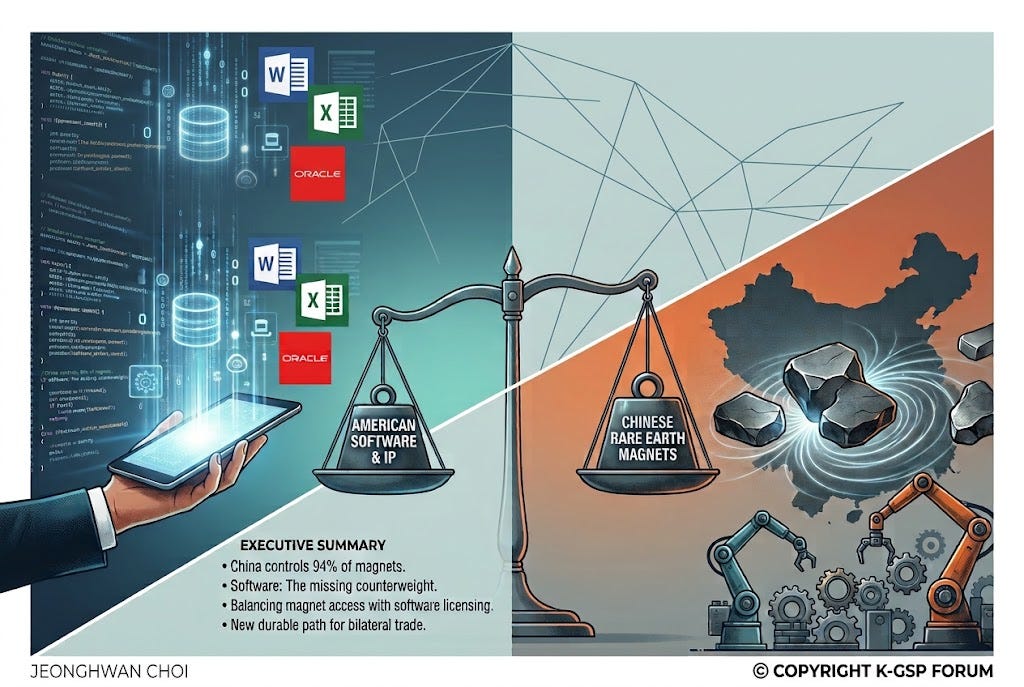
Thesis: Put Software on the Same Table as Minerals
Any renewal of the magnet arrangement could be paired with verifiable commitments to licensed software in state enterprises, universities, and firms selling into U.S. markets. Those commitments would rest on the TRIPS Agreement, which China accepted when it joined the World Trade Organization in 2001. Subscription and cloud licensing now make compliance auditable in ways that boxed software never was. Commitments could be phased, so that each verified gain in licensing is matched by longer and more predictable magnet export licenses. Enforcement would rest on audits, not promises.
Conclusion
Magnets and code are both chokepoints. China uses its own deliberately, and America has barely used its own. In my view, the durable path is balance rather than escalation. Demand for American software in China is real, and our campus evidence suggests that legitimate use rises when rules are clear and access is easy. This kind of leverage asks China only to pay for what it already depends on. Against a competitor at ease in the gray zone, the side that knows the worth of its own assets bargains better.
References
Baskaran, G., & Schwartz, M. (2026, April 27). Rare earth export restrictions one year later. Center for Strategic and International Studies. https://www.csis.org/analysis/rare-earth-export-restrictions-one-year-later
BSA | The Software Alliance. (2018). Software management: Security imperative, business opportunity: 2018 BSA global software survey.
https://www.bsa.org/reports/2018-bsa-global-software-survey
Choi, J., An, R., Zhao, J., Mao, X., & He, L. (2017). Developing piracy software free business college: Action research approach at a global campus in China. International Journal of Business & Applied Science, (2), 15–37. Full Text Available Here : https://www.researchgate.net/publication/334558132_Developing_software_piracy_free_organization_A_case_of_an_American_business_school_in_China
Huld, A. (2025, November 10). How will China’s rare earth export controls impact industries and businesses? China Briefing. https://www.china-briefing.com/news/chinas-rare-earth-export-controls-impacts-on-businesses/
International Energy Agency. (2026). Rare earth elements: Executive summary. https://www.iea.org/reports/rare-earth-elements/executive-summary
Author Profile:

Prof. Dr. Jeonghwan (Jerry) Choi (Managing Editor), University of Maine at Presque Isle
Jeonghwan (Jerry) Choi, PhD is an Associate Professor of Business at the University of Maine at Presque Isle and Editor-in-Coordination of K-GSP Forum (contact: jeonghwan.choi at gmail.com). With over 25 years of industry and consulting experience, he specializes in leadership development, human resource management, organizational behavior, and social entrepreneurship. His research focuses on workforce resilience, organizational health, and self-directed leadership — bridging rigorous scholarship with practical insight to cultivate leaders who create meaningful, sustainable, and humane organizations.
© K-Global Scholars and Professionals Forum. All rights reserved. Content published in the K-GSP Forum may not be reproduced, distributed, or transmitted in any form without prior written permission from the K-GSP Forum, except for brief quotations with full attribution.