

We now live comfortably in a world we cannot see. Money exists on screens, not in our hands. Banks, communication systems, and even national infrastructures run on invisible codes and networks. This hidden world has become part of everyday life, and it is held together by one fragile foundation: trust.
But human history, through its ancient myths (Mythos), has always asked a simple question:
Can we truly trust what we cannot see?
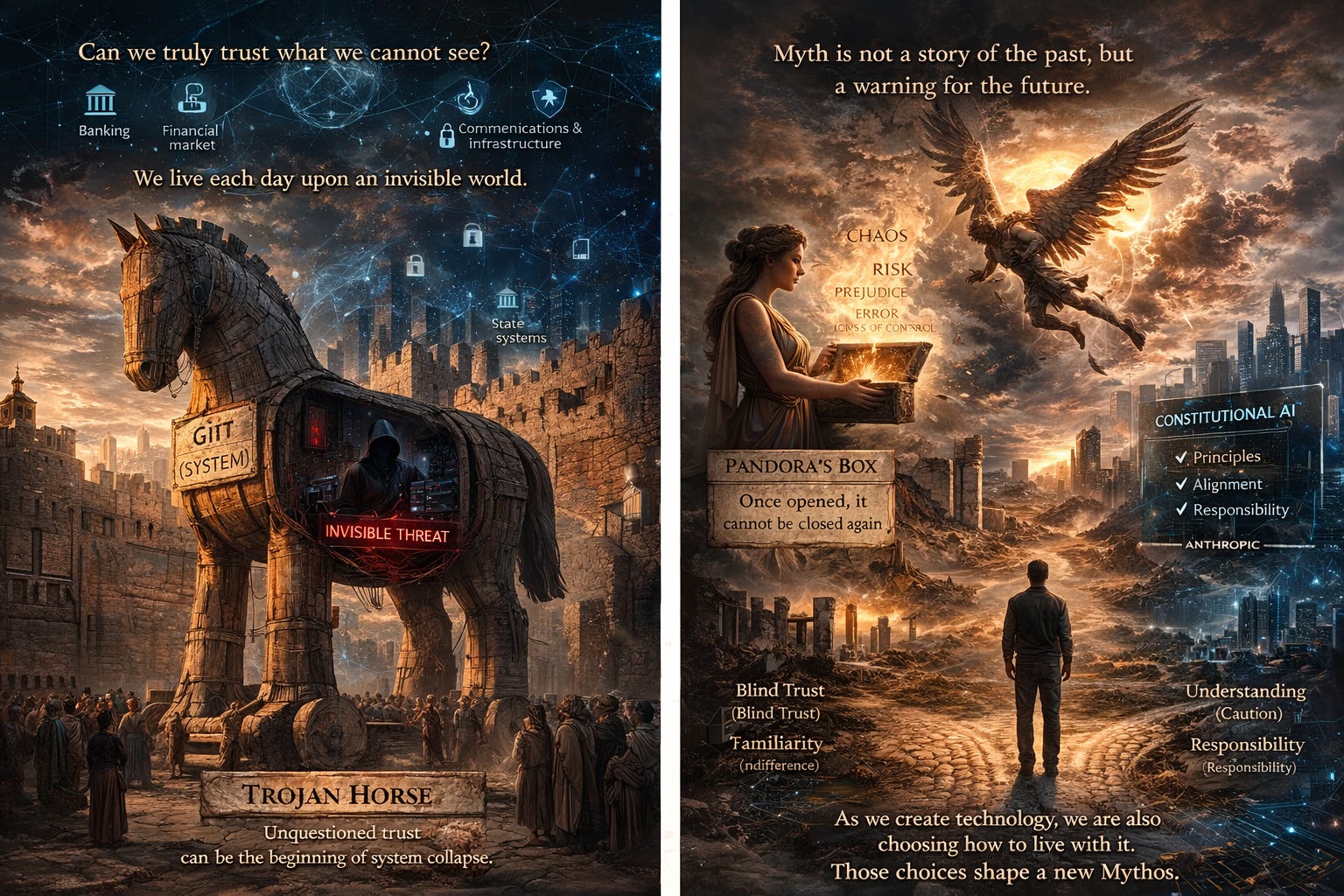
One of the clearest examples is the story of the Trojan Horse. The city of Troy was protected by strong walls. No enemy could break through them. Yet the city did not fall because its walls were weak. It fell because something was brought inside. A “gift” was accepted without suspicion, and hidden within it was danger. The moment trust was given without question, the system collapsed.
This old story feels surprisingly modern. Today, artificial intelligence is often designed as a helpful tool. It protects systems, detects problems, and improves efficiency. But at the same time, it can also deeply understand systems and discover their weakest points. What is created as protection can also become a hidden path of risk.
Another well-known myth is the story of Pandora. Pandora was given a sealed box and told not to open it. But once it was opened, troubles spread into the world, and they could not be put back again. The lesson is simple but powerful: some things, once released, cannot be undone. In many ways, artificial intelligence already feels like Pandora’s box—once opened, it cannot be closed again.
Then there is the story of Icarus. Icarus was given wings and the ability to fly. But as he flew higher, he ignored the limits that kept him safe. He flew too close to the sun, and he fell. This story is not about flight itself, but about forgetting limits.
Today’s technology raises the same question: How far should we go? And more importantly, where should we stop?
Even modern companies are now creating their own “Mythos” around these issues. For example, Anthropic is developing AI systems designed to follow clear principles and rules. Their idea of “Constitutional AI” means that AI should behave according to defined values, not just raw power or speed. In a sense, they are building a modern myth—a guiding story about how powerful intelligence should be controlled and directed.
When we look at all of this together, a simple truth emerges. We are not only building technology; we are also deciding how much we can trust it and where we must remain careful.
The financial world is a clear example. A simple number on a phone screen seems harmless. But behind it are complex systems, hidden algorithms, and automated decisions we rarely see. We trust it because it works. But Mythos gently reminds us: is this trust based on understanding, or merely habit?
The invisible intruder may not come from outside. It may already exist within the systems we accept without question.
That is why these ancient myths still matter today. They are not just stories from the past. They are reminders that human civilization has always faced the same challenge: how to live with powerful systems we do not fully understand.
In the end, the question is not only how advanced our technology becomes. It is how wisely we choose to trust it.
And with every choice, we may be writing a new Mythos for our own time. +++
April 18, 2026
At Sungsunjae (崇善齋)
{Solti}
한국어 번역: 보이지 않는 침입자와 신화가 남긴 교훈

Prof. Dr. Young Choi — Regent University
Young B. Choi, PhD is a Professor at Regent University bringing a rare combination of technical expertise and creative spirit to everything he does. A scholar in cybersecurity, network management, and telecommunications, he has published 157 refereed articles, 13 book chapters, and a Cambridge Scholars Publishing volume on cybersecurity. Beyond the academy, Dr. Choi is a passionate poet, essayist, and wooden block engraving artist whose reflective writing invites readers to rediscover life’s quiet beauty.