
Abstract
Korean history spans more than four millennia, from the legendary founding of Dangun Chosun to the emergence of modern Korea as a leading economic, technological, and cultural power. This article provides a concise overview of Korea’s major historical periods — Gojoseon, the Three Kingdoms, Unified Silla, Goryeo, Joseon, the colonial era, national division, and the remarkable transformation of contemporary Korea. By tracing the continuity of cultural identity, institutional development, resilience, and adaptation across these periods, the article offers a broad framework for understanding the historical foundations of modern Korean society and its growing global influence.
Keywords: Korean History · Dangun Chosun · Joseon Dynasty · Modern Korea · Korean Civilization
1. Introduction
Korea today commands global attention through K-pop, advanced technologies, global brands, and cultural influence. Behind these contemporary achievements lies one of the world’s longest continuous civilizational histories — a story extending more than four millennia from Dangun Chosun to modern Korea. Every year, as a faculty member affiliated with the Asian Studies Program at the University of Toledo, I have the privilege of presenting several modules on Korean history and culture to undergraduate students. Among these, lectures on Korean history consistently generate considerable interest, particularly as Korea’s global influence continues to expand through its economic achievements, technological innovations, cultural exports, and growing diplomatic presence. Students often ask how a relatively small nation on the Korean Peninsula developed such a distinctive historical identity and achieved such remarkable transformation in the modern era (Cumings, 2005; Seth, 2020).
My engagement with Korean history stems from a longstanding interest in Korea’s historical development, intellectual traditions, cultural practices, and national journey. Teaching Korean history and culture to students from diverse backgrounds has deepened my appreciation for the historical foundations that continue to shape contemporary Korea. This series is written from the perspective of an interdisciplinary scholar and educator who seeks to connect historical insight with broader questions of national development, leadership, culture, and global engagement.
Rather than engaging in specialized historiographical debates, the purpose of this series is to provide a concise, accessible, and evidence-based overview of Korean history for general readers, students, and those seeking to understand the historical foundations of contemporary Korea. Drawing upon established works by leading historians and Korea scholars, the series highlights major historical developments, enduring cultural themes, and the historical experiences that continue to shape Korea’s role in the world today.
The series begins with a broad overview of Korean history from the legendary founding of Dangun Chosun to the emergence of modern Korea. Subsequent articles will examine the intellectual traditions of Neo-Confucianism (Seongrihak) and Silhak (Practical Learning), their contributions and limitations, and their relevance to understanding Korea’s modernization. Korea’s historical journey is one of continuity and change, resilience and adaptation, achievement and adversity (Lee, 1984; Nahm, 1990). Across more than four millennia, the Korean people have preserved a strong sense of cultural identity while responding to shifting political, economic, and geopolitical circumstances (Kim, 2012; Seth, 2020). As Korea’s influence expands through technology, culture, education, and diplomacy, understanding its historical foundations matters not only for Koreans but for global audiences. Korea’s experience is particularly significant because it demonstrates how a nation can preserve cultural continuity while adapting to profound political, economic, and technological change. From foreign invasions and colonial rule to rapid industrialization and global leadership, Korea offers valuable lessons in resilience, institutional development, and national transformation that extend well beyond the Korean Peninsula.
2. An Overview of Korean History
National histories are taught differently around the world. In many countries, historical narratives focus primarily on the formation of the modern nation-state, often spanning only a few centuries. Korea presents a different perspective. Korean historical consciousness traditionally traces its origins to Dangun Chosun, founded in 2333 BCE according to Korean historical tradition (Lee, 1984; Nahm, 1990). Whether interpreted as historical fact, cultural memory, or national mythology, the Dangun narrative has served as a powerful symbol of continuity and identity throughout Korean history (Kim, 2012; Seth, 2020).
2.1. Formation of Korean Civilization: From Dangun Chosun to Unified Silla
Korean historical tradition begins with Dangun Chosun (Gojoseon), the earliest foundation of Korean civilization (Lee, 1984; Nahm, 1990). Although the precise historical details remain debated, the Dangun narrative has provided generations of Koreans with a shared origin story and a sense of cultural continuity (Kim, 2012). During this early period, political communities emerged across the Korean Peninsula and surrounding regions, laying the foundations for later state formation and the development of a distinct Korean cultural identity.
The Three Kingdoms period (57 BCE–668 CE) witnessed the rise of Goguryeo, Baekje, and Silla, whose political rivalry stimulated advances in governance, military organization, diplomacy, and culture (Eckert et al., 1990; Seth, 2020). Buddhism entered the peninsula during this era and became a major force in shaping Korean thought, art, architecture, and statecraft (Lee, 1984; Pratt & Rutt, 1999). The eventual unification of much of the peninsula under Silla in 668 marked a turning point in Korean history, bringing greater political integration and cultural flourishing while establishing many of the social institutions, artistic traditions, and cultural patterns that would influence Korean society for centuries.
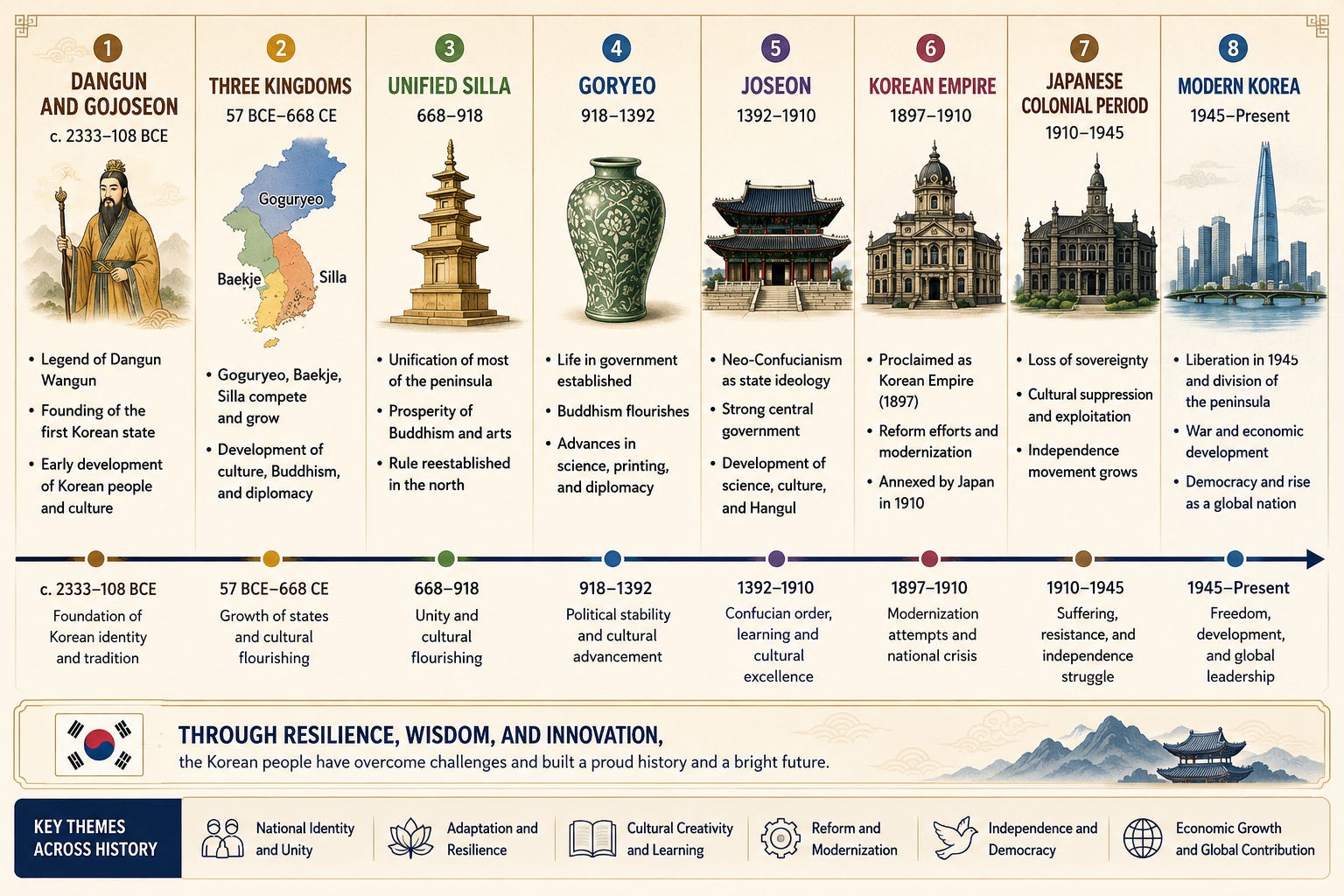
Figure 1
A Short Summary of Korean History: From Dangun Chosun to Modern Korea
Figure 1 presents Korean history as a long civilizational journey extending from the cultural origins represented by Dangun Chosun to the emergence of modern Korea as a globally influential nation. Rather than viewing Korean history as a series of disconnected dynasties and political regimes, this framework emphasizes the continuity of Korean civilization across more than four millennia. Each historical period contributed distinctive political institutions, cultural achievements, intellectual traditions, and adaptive responses to external challenges, collectively shaping the development of contemporary Korea. Viewed from this long-term perspective, Korea’s historical experience reveals enduring themes of national identity, cultural creativity, resilience, learning, reform, and renewal that continue to influence its development in the twenty-first century.
2.2. Consolidation of the Korean State: Goryeo and Joseon
The Goryeo Dynasty (918–1392) reunified the peninsula after a period of fragmentation and gave Korea its modern English name (Lee, 1984; Eckert et al., 1990). Goryeo is remembered for significant achievements in Buddhist culture, celadon ceramics, printing technology, scholarship, and international diplomacy (Pratt & Rutt, 1999; Seth, 2020). Despite repeated invasions and political challenges, the dynasty maintained a distinctive Korean identity and cultural vitality while strengthening the foundations of a unified Korean state.
The Joseon Dynasty (1392–1910), Korea’s longest-lasting dynasty, established Neo-Confucianism as the dominant intellectual and political framework and developed a sophisticated system of governance based on education, bureaucracy, and moral leadership (Palais, 1996; Haboush & Deuchler, 1999). The civil service examination system became a central mechanism for elite recruitment and state administration, while educational institutions cultivated generations of scholar-officials (Palais, 1996).
Joseon also produced some of Korea’s most enduring cultural achievements, most notably the creation of Hangul under King Sejong the Great, which dramatically expanded literacy and remains one of Korea’s proudest accomplishments (Kim-Renaud, 1997; Seth, 2020). At the same time, Joseon faced challenges including rigid social hierarchies, factional conflicts, foreign invasions, and pressures for reform — challenges that would eventually contribute to the emergence of Silhak thinkers and reform movements examined in later articles.
2.3. Modern Transformation: Colonial Rule, National Division, and Global Korea
The late nineteenth century confronted Korea with unprecedented external pressures from expanding imperial powers. Reformers sought modernization through administrative, educational, military, and economic reforms, but these efforts were ultimately overtaken by geopolitical realities. Korea was annexed by Japan in 1910, beginning thirty-five years of colonial rule (Cumings, 2005; Eckert et al., 1990). The colonial period remains one of the most complex and painful chapters in Korean history, characterized by political repression, cultural suppression, economic exploitation, and growing nationalist resistance (Cumings, 2005; Kim, 2012). The March First Movement of 1919 became a defining symbol of the Korean people’s determination to preserve their identity and pursue national independence.
Following liberation in 1945, Korea experienced national division, the Korean War, and decades of reconstruction amid Cold War tensions (Cumings, 2005). Yet the Republic of Korea subsequently achieved one of the most remarkable transformations in modern history, emerging from poverty and war to become a global leader in manufacturing, technology, education, democratic governance, and popular culture (Seth, 2020; Kim, 2012). Today, South Korea’s influence extends far beyond its geographic size through its economic competitiveness, technological innovation, and expanding cultural soft power. Viewed as a whole, Korean history is a story of continuity, resilience, adaptation, and renewal. From the legendary origins of Dangun Chosun to the emergence of modern Korea, the Korean people have repeatedly overcome adversity while preserving a strong sense of cultural identity and national purpose.
For over four millennia, Korea’s story has been one of continuity amid change, resilience amid adversity, and renewal amid transformation.
3. Historical Continuity and National Identity in Korean History
For readers outside Korea, an important question naturally arises: why do many Korean historical narratives begin with Dangun Chosun rather than with a later kingdom or the emergence of the modern state? The answer lies in how Koreans have traditionally understood their historical origins, identity, and continuity. While historians continue to debate the historical details surrounding Dangun and the early Gojoseon period, the broader framework that traces Korean history from Dangun Chosun to modern Korea remains widely accepted in Korean historical scholarship, public education, and cultural institutions. This perspective is reflected not only in academic textbooks but also in the National Museum of Korea in Seoul, where Korean history is presented as a continuous civilizational narrative extending from prehistoric Korea and Gojoseon through the Three Kingdoms, Unified Silla, Goryeo, Joseon, the colonial period, and contemporary Korea. Rather than viewing Korean history as a series of disconnected political entities, this framework emphasizes the long-term development of Korean civilization and provides a foundation for understanding the continuity of Korean culture, institutions, and national identity across more than four millennia. Three reasons help explain why this approach remains credible, meaningful, and necessary.
3.1. Historiographical Legitimacy of the Dangun Chosun Framework
The presentation of Korean history from Dangun Chosun to modern Korea possesses historiographical legitimacy because it reflects the dominant framework employed by Korean historians, educational institutions, museums, and public historical discourse (Lee, 1984; Nahm, 1990; Seth, 2020). Although scholarly debates continue regarding the precise historical nature of Dangun and early Gojoseon, there is broad agreement concerning the importance of these traditions in shaping Korea’s historical consciousness and collective memory. The National Museum of Korea, national curricula, and major historical surveys consistently present Korean history within this long-term civilizational framework.
Modern historians distinguish between mythology, cultural memory, and verifiable historical evidence. Nevertheless, many nations incorporate foundational narratives into their understanding of historical origins. Rome traces its beginnings through the story of Romulus and Remus, while numerous European nations preserve traditions that combine legend with documented history. Similarly, Korea’s Dangun narrative functions as a foundational cultural memory, while archaeological findings and historical records confirm the existence of organized political communities on the Korean Peninsula long before the emergence of the modern state (Kim, 2012; Eckert et al., 1990). Beginning with Dangun Chosun thus recognizes a broadly accepted historical continuity rather than requiring literal acceptance of every traditional account.
3.2. Civilizational Continuity and Historical Interpretation
Beginning Korean history with Dangun Chosun is meaningful because it highlights the continuity of Korean civilization across more than four millennia (Nahm, 1990; Lee, 1984). While dynasties rose and fell, political boundaries shifted, and external influences entered the peninsula, many cultural characteristics persisted across generations. This long-term perspective allows readers to view Korean history not merely as a succession of political regimes but as the evolution of a civilization with enduring cultural foundations.
The Korean language, shared cultural traditions, family structures, educational values, and collective historical memories developed gradually over centuries rather than emerging abruptly during the modern period (Kim-Renaud, 1997; Seth, 2020). From this perspective, the achievements of the Three Kingdoms, Unified Silla, Goryeo, Joseon, and contemporary Korea can be understood as interconnected stages in a continuing civilizational narrative. Such an approach provides historical depth to contemporary discussions of Korean identity, culture, modernization, and national development.
3.3. Historical Consciousness and the Formation of National Identity
A Dangun-centered historical framework is also important because it reflects how many Koreans have traditionally understood their own national identity. Historical narratives do more than record events; they provide a shared understanding of collective origins, cultural values, and historical purpose. In Korea, the perception of a common ancestry and a long historical continuity has served as an important source of national cohesion.
Throughout periods of foreign invasion, political fragmentation, colonial rule, national division, and rapid modernization, Koreans frequently drew upon a shared historical consciousness rooted in a common origin and enduring civilizational heritage (Cumings, 2005; Kim, 2012). This collective memory contributed to cultural resilience and reinforced a sense of belonging that transcended regional, political, and ideological divisions. A survey of Korean history that begins only with the late nineteenth century, Japanese colonial rule, or the establishment of the Republic of Korea would therefore overlook much of the historical foundation upon which contemporary Korean identity and national consciousness have been constructed.
4. Comparative and Future Perspectives
A broader understanding of Korean history can be gained by examining it within both regional and temporal contexts. Comparisons with neighboring East Asian civilizations help illuminate Korea’s distinctive developmental path, while an examination of major intellectual transitions reveals how ideas shaped institutions, culture, and national development over time. Together, these perspectives bridge Korea’s historical experience and the challenges it faces in the twenty-first century.
4.1. Korea in Comparative East Asian Perspective
To illustrate these differences more systematically, Table 1 compares China, Japan, and Korea across several historical dimensions, including governance, political legitimacy, educational orientation, social mobility, and intellectual tradition. Although all three societies were influenced by Confucian thought, each adapted these traditions according to its own historical circumstances and institutional needs.
China developed as a large Confucian empire characterized by centralized bureaucratic governance under scholar-officials serving the imperial state. Japan evolved into a samurai-bureaucratic system in which military authority and administrative governance coexisted, blending elements of Confucianism, Buddhism, and warrior culture. Korea followed a somewhat different path, developing what may be described as a Neo-Confucian scholar state in which scholar-officials, educational institutions, and civil service examinations played particularly important roles in governance, social mobility, and national development (Palais, 1996; Haboush & Deuchler, 1999).
Table 1
Comparative Historical Characteristics: China, Japan, Korea
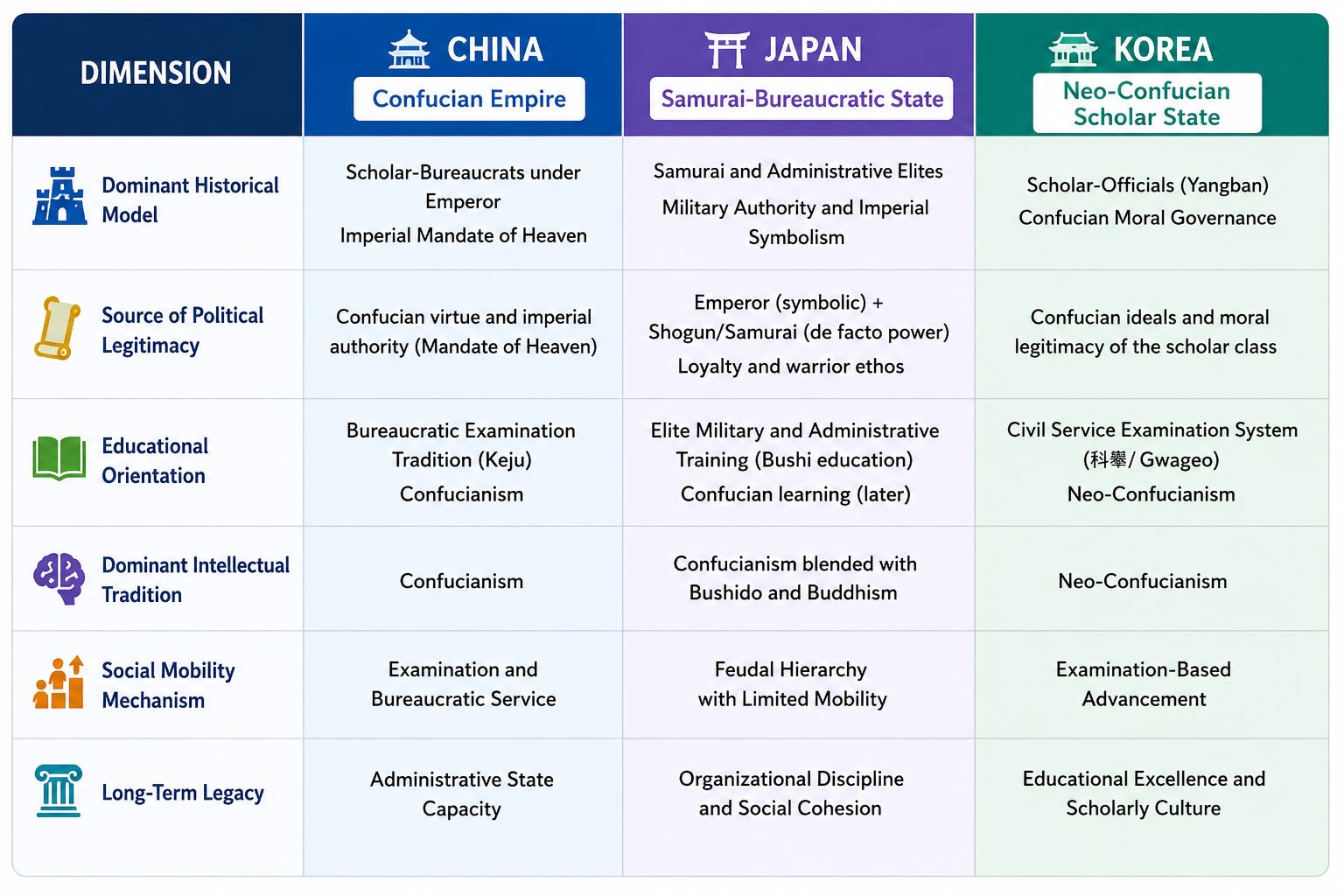
As summarized in Table 1, all three civilizations employed meritocratic and educational mechanisms to varying degrees, though Japan’s feudal structure generally provided fewer opportunities for examination-based advancement than either China or Korea. Their long-term historical legacies also differed significantly. China cultivated a strong administrative state, Japan emphasized organizational discipline and social cohesion, while Korea placed exceptional value on scholarship, education, and intellectual achievement. This comparison situates Korean history within a broader East Asian context while highlighting the distinctive role that learning, moral governance, and intellectual traditions played in shaping Korea’s historical development and enduring national character.
4.2. Intellectual Transitions in Korean Civilization
Beyond political dynasties, Korean history may also be understood through major intellectual transitions that shaped society across different eras. During the Three Kingdoms and Goryeo periods, Buddhism exerted a profound influence on Korean spirituality, culture, art, and statecraft (Pratt & Rutt, 1999; Eckert et al., 1990). With the establishment of Joseon, Neo-Confucianism became the dominant intellectual framework guiding governance, education, and social ethics (Palais, 1996; Haboush & Deuchler, 1999). The creation of Hangul represented one of the most significant cultural innovations of Joseon Korea and contributed substantially to literacy and cultural development (Kim-Renaud, 1997).
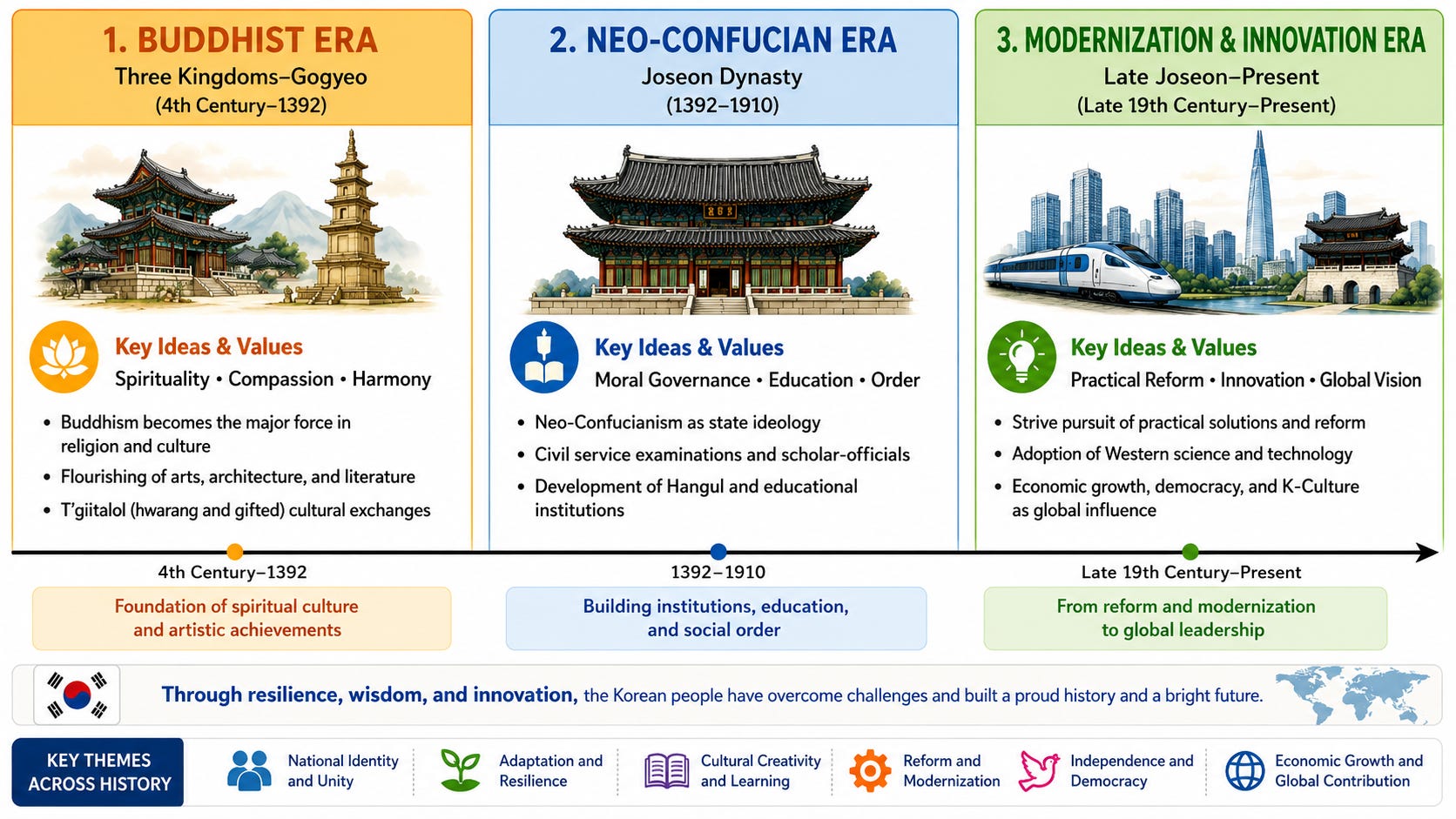
Figure 2
Major Intellectual Eras in Korean History
Figure 2 traces Korean history through three major intellectual eras, each defined by a distinct set of values and institutions. The first, the Buddhist Era spanning the Three Kingdoms through the Goryeo period (4th century–1392), was characterized by spirituality, compassion, and harmony, during which Buddhism became the dominant force in religion and culture, inspiring flourishing arts, architecture, literature, and international exchanges through the Tripitaka Koreana. The second, the Neo-Confucian Era of the Joseon Dynasty (1392–1910), shifted the ideological foundation toward moral governance, education, and order, institutionalizing civil service examinations, a scholar-official class, and landmark cultural achievements such as the creation of Hangul. The third era, Modernization and Innovation (late 19th century–present), is defined by practical reform, innovation, and global vision, encompassing the Silhak pragmatic reform movement, the adoption of Western science and technology, and Korea’s remarkable rise through economic growth, democratization, and the global spread of K-Culture. Running beneath all three eras are unifying themes — national identity, cultural creativity, resilience, and democratic development — captured in the figure’s closing observation that through resilience, wisdom, and innovation, the Korean people have built a proud history and a bright future.
4.3. Historical Legacies and Future Questions
The study of history is valuable not merely because it explains the past but because it raises important questions about the future. Korea’s historical experience demonstrates the importance of cultural continuity, institutional adaptation, intellectual innovation, and resilience in responding to changing domestic and international environments. Each historical era contributed ideas and institutions that helped prepare the nation for subsequent transformations.
As Korea enters the age of artificial intelligence, digital ecosystems, demographic change, and intensified global competition, new questions emerge regarding the intellectual foundations of future development. If Neo-Confucianism shaped premodern Korea and Silhak anticipated reform and modernization, what intellectual traditions, leadership principles, and institutional innovations will guide Korea in the AI era? This question serves as an appropriate bridge to the remaining articles in this series, which examine the historical foundations of Korea’s intellectual development and their continuing relevance for the future.
Korea’s past is not merely a record of what happened—it is a reservoir of wisdom for navigating the future.
5. Conclusion
Korean history is best understood as a long civilizational journey extending from the cultural origins represented by Dangun Chosun to the emergence of modern Korea as a globally influential nation. Examining this broad historical continuum provides a credible, meaningful, and necessary framework for understanding the development of Korean identity, institutions, and culture across more than four millennia. Among the various historical periods, the Joseon Dynasty deserves particular attention because it established many of the educational, political, social, and intellectual foundations that continued to shape Korean society well into the modern era. As Korea navigates the challenges and opportunities of the twenty-first century — including the age of artificial intelligence and global interconnectedness — an understanding of its historical experiences offers valuable insights into the sources of its resilience, adaptability, and continuing national development. Korea’s journey from Dangun Chosun to a leading nation in the AI era demonstrates that national resilience, cultural confidence, and continuous learning remain among the most enduring sources of long-term success.
This article serves as the first installment in a series exploring the foundations of Korea’s national character, intellectual traditions, and civilizational development. Future articles will examine the Seven Ms of Korea, Neo-Confucianism (Seongrihak), Silhak (Practical Learning), comparative East Asian intellectual traditions, and historical lessons for Korea in the AI era. Together, these studies seek to illuminate how Korea’s historical experiences, cultural values, and intellectual heritage continue to shape its national development, global influence, and future aspirations in a rapidly changing world.
References
Cumings, B. (2005). Korea’s place in the sun: A modern history (Updated ed.). W. W. Norton.
Eckert, C. J., Lee, K. B., Lew, Y. I., Robinson, M., & Wagner, E. W. (1990). Korea old and new: A history. Ilchokak Publishers for the Korea Institute, Harvard University.
Haboush, J. K., & Deuchler, M. (Eds.). (1999). Culture and the state in late Chosŏn Korea. Harvard University Asia Center.
Kim, J. H. (2012). A history of Korea: From “Land of the Morning Calm” to states in conflict. Indiana University Press.
Kim-Renaud, Y. K. (Ed.). (1997). The Korean alphabet: Its history and structure. University of Hawai’i Press.
Lee, K. B. (1984). A new history of Korea (E. W. Wagner & E. J. Schultz, Trans.). Harvard University Press.
Nahm, A. C. (1990). A panorama of 5,000 years: Korean history (2nd ed.). Hollym International.
Palais, J. B. (1996). Confucian statecraft and Korean institutions: Yu Hyŏngwŏn and the late Chosŏn Dynasty. University of Washington Press.
Pratt, K., & Rutt, R. (with Hoare, J.). (1999). Korea: A historical and cultural dictionary. Routledge.
Seth, M. J. (2020). A concise history of Korea: From antiquity to the present (3rd ed.). Rowman & Littlefield.
Original Article:

About the Author

Distinguished Professor, Dr. Paul Hong (Editor in Chief) — University of Toledo
Paul C. Hong is a Distinguished University Professor and Chair of Information Systems and Supply Chain Management at the University of Toledo. His work focuses on leadership, governance, and decision-making in the AI era, integrating strategy, technology, and institutional trust. He has published extensively in leading academic journals and writes on how individuals and organizations navigate complexity, disruption, and global transformation.
© K-Global Scholars and Professionals Forum. All rights reserved. Content published in the K-GSP Forum may not be reproduced, distributed, or transmitted in any form without prior written permission from the K-GSP Forum, except for brief quotations with full attribution.
Well-organized article about Korean history with conciseness and clarity.
Good summary of Korea's history. It's structured well and written with relevant references. Should be a good introduction for those interested in contemporary K-culture and history.