

JOURNAL OF K-GSP
K-Global Scholars and Professionals Forum
Guide for Authors
Manuscript preparation, submission, and editorial standards
This guide tells prospective authors how to prepare and submit work to the Journal of K-GSP. It supplements the Journal’s editorial policies and procedures, which govern review authority and decision-making. Where a question of scholarly standard or editorial authority arises, those policies control. Authors should read this guide in full before submitting, since manuscripts that depart substantially from these requirements may be returned without review.
1. Aims and Scope
The Journal of K-GSP is an interdisciplinary, peer-reviewed publication of the K-Global Scholars and Professionals Forum. It publishes Korea-related academic and professional scholarship that deepens understanding of Korea, Korean people, and the Korean diaspora. The Journal reaches an audience of scholars and working professionals, so it values work that is rigorous and also legible to readers outside the author’s immediate specialty.
The Journal welcomes contributions across the disciplines, including but not limited to:
business, management, and economics;
psychology and the behavioral sciences;
science, technology, engineering, and mathematics (STEM);
the social sciences, including sociology, political science, education, and public policy; and
literature, the humanities, and cultural studies.
What unites this range is a substantive connection to Korea, Korean communities, or the Korean-diaspora experience. This connection is understood broadly: it includes scholarship centered on Korea itself, on Korean communities worldwide, and on the experience of non-Koreans of Korean heritage, including later-generation individuals who may identify primarily as American or any other nationalities rather than as members of a Korean diaspora. The Journal does not require a fixed degree of diasporic identification from its subjects or authors; what it requires is a substantive, demonstrable connection to Korea, Korean communities, or Korean-heritage experience. A manuscript may study a Korean context directly, compare Korean and non-Korean cases, or apply a Korean vantage point to a question of broader significance. Purely technical work with no discernible link to the Journal’s mission falls outside its scope, however strong its methods may be.
Authors uncertain whether a topic fits are encouraged to send a brief pre-submission inquiry to the Managing Editor describing the argument and its Korea-related contribution. A short exchange before submission often saves months later.
2. Categories of Submission
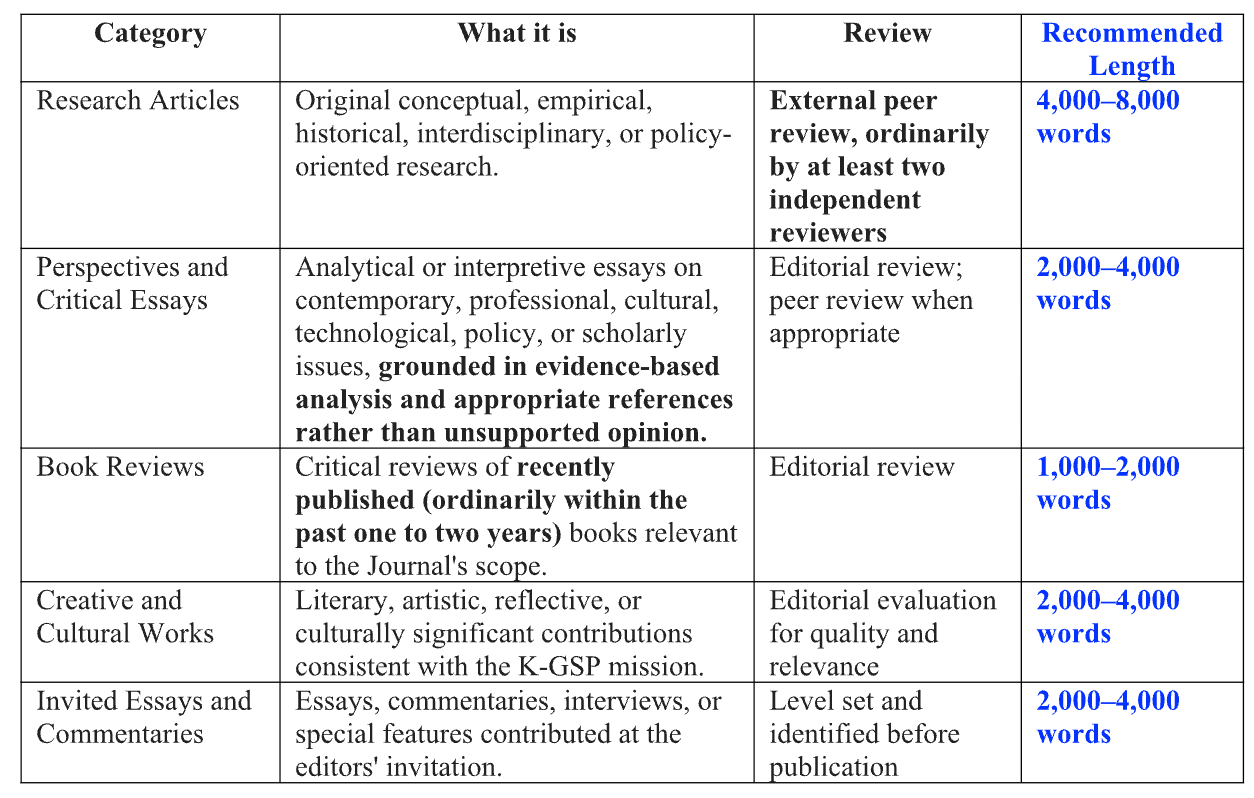
Every manuscript is assigned to one of the categories below before final acceptance. The category determines the level of review, so authors should identify the intended category in their cover letter. The editors may reclassify a manuscript after reading it, in consultation with the author.
CategoryWhat it isReviewRecommended LengthResearch ArticlesOriginal conceptual, empirical, historical, interdisciplinary, or policy-oriented research.External peer review, ordinarily by at least two independent reviewers4,000–8,000 wordsPerspectives and Critical EssaysAnalytical or interpretive essays on contemporary, professional, cultural, technological, policy, or scholarly issues, grounded in evidence-based analysis and appropriate references rather than unsupported opinion.Editorial review; peer review when appropriate2,000–4,000 wordsBook ReviewsCritical reviews of recently published (ordinarily within the past one to two years) books relevant to the Journal’s scope.Editorial review1,000–2,000 wordsCreative and Cultural WorksLiterary, artistic, reflective, or culturally significant contributions consistent with the K-GSP mission.Editorial evaluation for quality and relevance2,000–4,000 wordsInvited Essays and CommentariesEssays, commentaries, interviews, or special features contributed at the editors’ invitation.Level set and identified before publication2,000–4,000 words
Table 1. Submission categories, corresponding level of review, and recommended length.
Peer-reviewed research articles carry the Journal’s highest evidentiary expectations for originality, rigor, and citation. The remaining categories are held to standards of quality, relevance, and integrity appropriate to their form. No submission moves from receipt to publication without an appropriate level of editorial evaluation.
Prior publication in the K-GSP Forum. A research article that appeared in the K-GSP Forum is not, by that fact, ineligible for the Journal. A substantially revised and expanded version of a work previously published in the Forum may be considered for submission, provided the author discloses the prior publication in the cover note and the Journal version reflects material development beyond the original piece, such as expanded evidence, deeper analysis, or a scholarly apparatus the Forum piece did not carry.
3. Manuscript Length and Structure
3.1 Length
Research articles should ordinarily run up to 8,000 words in total, and no submission in any category should exceed 8,000 words. This limit is inclusive: it counts the title, abstract, main text, references, footnotes, tables, and figures. A table or figure counts as the number of words it would occupy in running text, so authors carrying heavy tabular content should budget accordingly. Work that genuinely requires more space, such as certain review or interdisciplinary essays, may request an exception from the Managing Editor before submission rather than assuming one at upload. Recommended length ranges for non-research-article categories appear in Table 1.
3.2 Recommended structure for research articles
Empirical research articles ordinarily follow a conventional sequence. Authors should adapt it to their design rather than force an ill-fitting mold; conceptual, historical, and literary contributions may depart from it entirely where their argument demands.
Title and abstract — see Sections 4 and 5.
Introduction — the problem, its significance, and the contribution the paper makes.
Theory and hypotheses (or conceptual framework) — the reasoning that motivates the study.
Method — enough detail on participants, measures, and analysis for a reader to evaluate and, in principle, reproduce the work.
Results — the findings, reported in past tense with the relevant statistics.
Discussion — interpretation, theoretical and practical implications, limitations, and directions for future work.
References — APA 7, complete and matched to the in-text citations.
Tables and figures — each on its own, numbered in the order cited.
3.3 Headings
Use no more than three levels of heading, and follow APA 7 heading conventions consistently. Two or more subsections should appear under any heading that is subdivided; a lone subsection signals that the division is unnecessary. Number top-level sections when doing so aids navigation, and keep the numbering consistent throughout.
4. Title, Authorship, and Front Matter
4.1 Title
Titles should be concise and informative, ordinarily no longer than 12 to 15 words. A specific title that names the phenomenon and context serves readers and indexing better than a broad or clever one.
4.2 Authorship
Authorship should reflect substantial contribution to the work: to its conception or design, to the acquisition, analysis, or interpretation of data, or to drafting and critical revision. All listed authors approve the submitted version and accept accountability for it. One author is designated corresponding author and manages communication with the Journal. Author order and the author group should be settled before submission, since changes after acceptance are not ordinarily permitted.
4.3 Anonymization for review
Because research articles undergo anonymous review, the manuscript file must be free of information that identifies the authors. Remove names, affiliations, and acknowledgments from the main document, and submit identifying details on a separate title page. Refer to your own prior work in the third person, and avoid citations phrased in a way that reveals authorship. Any acknowledgment of funding or assistance belongs on the title page, not in the manuscript body.
5. Abstract and Keywords
Provide an abstract of 150 to 250 words. Write it in the past tense, without citations or undefined abbreviations. A strong abstract states what was done, what was found, and what the findings mean, and for empirical work it includes the key numbers, such as the sample and the central effect. The abstract is the most-read part of any article, so it should stand on its own.
Supply four to six keywords for indexing, chosen to help the right readers find the work. Where relevant, at least one keyword should signal the Korea-related dimension of the study.
6. Style and Formatting
6.1 Reference and citation style
The Journal follows APA 7 throughout, for both in-text citation and the reference list. Cite sources in text by author and year. Give a page number for direct quotations and for paraphrases of specific arguments or findings. List all authors up to 20 in a reference entry; for more, give the first 19, an ellipsis, and the final author.
The reference list includes only works cited in the text and published or accepted for publication. Alphabetize by first author’s surname, use hanging indentation, italicize journal and book titles along with volume numbers, and include a full DOI link where one exists. Personal communications and unpublished material are mentioned in text only, not listed.
6.2 Language and voice
Write in clear, active prose. Prefer precise nouns and verbs to abbreviation and jargon, and define any necessary term or acronym at first use. Because the readership spans disciplines, explain specialized concepts that a professional reader outside your field would not share. Inclusive, non-biased language is expected throughout; the plural is a simple remedy for gendered generic pronouns.
6.3 Typography
Submit in Microsoft Word (.docx). Use a standard 12-point Times New Roman font, double spacing, and one-inch margins, with pages numbered consecutively. Use the word-processor’s table function for tables rather than tabs or spreadsheets pasted as images.
6.4 Statistical reporting
Report statistics to two or three decimal places, with exact p values rather than star notation where the Journal’s conventions allow. Italicize statistical symbols drawn from the Greek and Latin alphabets, such as p, N, M, SD, β, χ², and r, but set acronym fit indices such as CFI, TLI, RMSEA, and SRMR in plain type. Every reported estimate should carry its standard error or confidence interval, and every inferential test its precise p value.
7. Tables and Figures
Tables and figures should supplement the text, not duplicate it. Because they consume the word budget and add production cost, include only those that materially improve the reader’s understanding. Number tables and figures separately, each in the order first cited in the text, and cite each one explicitly.
Give every table a concise title and every figure a concise caption that identifies its elements.
Use the same variable names in text, tables, and figures.
Report only two decimal places for statistics in tables, except exact p values.
Spell out variable names; avoid code names and undefined abbreviations.
Ensure figures are legible at final size, with lines and lettering crisp, and use patterns as well as color so that colorblind readers can distinguish elements.
Identify any previously published table or figure by citing its source in the caption, and secure written permission from the copyright holder for both print and online use before submission.
8. Research and Publication Ethics
8.1 Originality and concurrent submission
Submission implies that the work is original, has not been published elsewhere in whole or in substantial part, and is not under consideration at another journal. Dividing one study into several thin submissions and reusing one’s own prior text without disclosure both fall short of the Journal’s standards. Where a submission expands on earlier work, authors should be transparent about the relationship. This includes work that previously appeared in the K-GSP Forum; see Section 2 for the Journal’s policy on such submissions.
8.2 Human participants
Studies involving human participants should confirm that the research received approval from, or exemption by, the appropriate institutional or national ethics committee, named in the manuscript, and that it accorded with the 1964 Declaration of Helsinki and its amendments. Informed consent should be obtained and documented, and identifying details of participants should not appear without explicit consent to publish them.
8.3 Data transparency
Authors are encouraged to make the data and materials underlying their findings available, and to include a brief data-availability statement, unless privacy or confidentiality prevents sharing, in which case the statement should explain the conditions of access. Depositing data in a public repository, such as the Open Science Framework, strengthens the credibility and reach of the work.
8.4 Use of generative AI
Large language models do not meet the Journal’s criteria for authorship, since authorship entails accountability that cannot be assigned to a tool. Substantial use of generative AI in the writing, in the production of images or graphical elements, or in the collection or analysis of data should be disclosed, with the tool named and its role described, in the Method section or a comparable part of the manuscript. Routine AI-assisted copyediting for grammar, spelling, and readability does not require disclosure. In every case the authors remain accountable for the final text, and it must reflect their own work.
8.5 Competing interests
Authors should disclose financial and non-financial interests that could be seen to bear on the work, including funding sources, relevant employment, and related professional or personal relationships. Where no such interests exist, a statement to that effect should be provided.
9. Submission and Review Process
9.1 What to submit
A complete submission includes:
the anonymized manuscript in Word format, within the applicable length range set out in Table 1;
a separate title page with the title, each author’s name, affiliation, and contact details, and the corresponding author clearly indicated;
an abstract and four to six keywords, for research articles;
a cover note stating the intended submission category and, where useful, the Korea-related contribution;
disclosure of any prior publication (including prior publication in the K-GSP Forum), concurrent submission, or substantial use of generative AI; and
the required ethics, competing-interest, and data-availability statements, where applicable.
Manuscripts are submitted through the designated K-GSP Journal channel or to the Managing Editor, who acknowledges receipt and records the manuscript’s status.
9.2 Double-blind peer review
Research articles undergo double-blind peer review. Authors and reviewers remain anonymous to one another throughout the process. Each research article is ordinarily read by at least two independent external reviewers with relevant expertise, drawn from qualified scholars outside the Editorial Leadership Team and Editorial Board. External review is the Journal’s default for research articles, since members of the Editorial Leadership Team and Editorial Board may know one another professionally or personally; using external reviewers helps minimize potential conflicts of interest and strengthens the rigor and credibility of the process. Reviewers who have a conflict of interest with a manuscript, such as recent collaboration or shared affiliation with an author, are not assigned to it.
Because the process is blind, it is the author’s responsibility to anonymize the submission. Before uploading, remove author names, affiliations, acknowledgments, and funding details from the manuscript file, place them on the separate title page, refer to your own prior work in the third person, and check file properties and any supplementary materials for identifying metadata. Manuscripts that reveal authorship may be returned for anonymization before review begins.
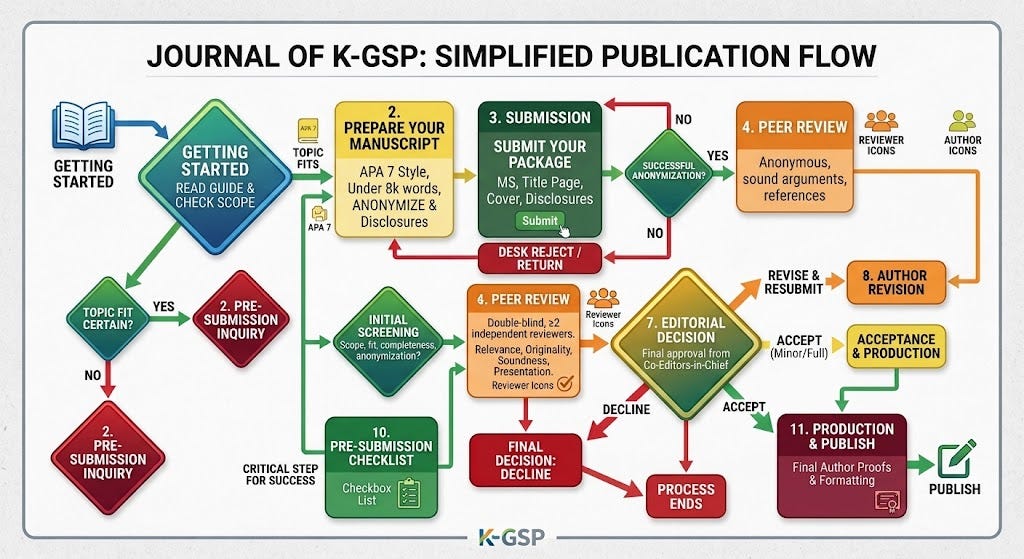
A research article ordinarily follows this path. Each stage is a genuine checkpoint, not a formality, and a manuscript may be returned to the author or declined at any of them.
Submission and acknowledgment.
Initial editorial screening for scope, fit, completeness, and successful anonymization.
Assignment to at least two independent, conflict-free external reviewers.
Double-blind review against the Journal’s stated criteria.
Author revision, with a point-by-point response to the reviews.
Editorial evaluation of the revision, with further review where needed.
Decision by the Co-Editors-in-Chief and, on acceptance, production.
Reviewers assess each manuscript against a consistent set of criteria: its relevance to the Journal’s mission, its originality and contribution, its conceptual and theoretical quality, its methodological and evidentiary soundness, the clarity of its argument, the quality and appropriateness of its references, its scholarly and professional significance, and its presentation. Each reviewer returns a written appraisal and a recommendation of accept, accept with minor revision, revise and resubmit, or decline. Where reviewers disagree, the editors may seek an additional review before deciding. The reviews are advisory; the Co-Editors-in-Chief hold final responsibility for the editorial decision, and an editor who is an author of, or has a significant conflict with, a manuscript recuses from its handling.
Book reviews should include a brief summary of the book together with critical analysis and evaluation of its contribution, written in an academic and professional tone. Reviews should ordinarily address books published within the past one to two years; older works may be proposed to the Managing Editor where their continuing relevance justifies an exception.
9.3 Decisions and proofs
Authors receive the decision together with the reviews. On acceptance, the manuscript is prepared for production, and authors normally receive a formatted proof to correct significant errors before publication. Substantive changes at proof stage, such as new results or a changed title or author list, require editorial approval. An issue is released only after the Co-Editors-in-Chief provide final authorization.
10. Pre-Submission Checklist
Before uploading, confirm that:
the manuscript addresses a Korea-related question within the Journal’s scope;
the total length, including references, tables, and figures, is within the applicable range for the submission category (see Table 1);
the intended submission category is stated in the cover note;
the abstract runs 150 to 250 words and four to six keywords are supplied;
all citations and references follow APA 7 and match one another;
statistical symbols are italicized correctly and estimates carry standard errors or confidence intervals;
the manuscript is fully anonymized for double-blind review, with identifying details and metadata confined to the separate title page;
ethics, competing-interest, data-availability, and AI-use statements are included where applicable, including disclosure of any prior K-GSP Forum publication; and
tables and figures are numbered, cited in order, and cleared for any reused material.
Questions may be directed to the Managing Editor of the Journal of K-GSP.
K-GSP Book Review Submission Guidelines: Summary
K-GSP Forum and K-GSP Journal welcome critical book reviews that summarize a book’s main arguments, assess its strengths and weaknesses, and explain its contribution to the field. Recent books are the usual focus, but retrospective reviews of older books are also welcome when they offer fresh insight or renewed relevance.
Length and audience. Reviews run 500 to 2,500 words (1,000 ~ 2,000 preferable) in a scholarly tone, written for an educated readership of scholars, researchers, students, and professionals. The review should focus on the book and its potential readers, not on the reviewer’s own knowledge or experiences.
Structure. A review should read as one cohesive essay, without section headings, subheadings, or numbering. It should still cover four elements: an introduction (the author, subject, purpose, central argument, and an overall assessment), a summary of the major arguments and themes (by topic or chapter, not every chapter), a critical evaluation (validity of arguments, quality of research and evidence, organization, and significance), and a conclusion (the book’s value and who would benefit most from reading it).
Writing standards. Each paragraph has at least three complete sentences and opens with a clear topic sentence, with four to six sentences preferred when developing a major point. Use formal language and clear transitions, and avoid slang and overly long paragraphs. Discuss the book in the present tense (“The author argues”) and keep first-person pronouns to a minimum.
Analysis and tone. Reviews should not become chapter-by-chapter reports. Substantial attention goes to critical analysis, including the book’s originality, methods, sources, clarity, and contribution, weighed against relevant scholarship. Read the book charitably, offer criticism tactfully and constructively, and explain any factual errors or shortcomings with supporting reasons. A review is not a place to show intellectual superiority or promote one’s own work, and a reviewer who finds a book unsuitable for recommendation should consider declining the assignment.
Documentation. Follow standard academic conventions and an appropriate citation style. Give page numbers for direct quotations and keep quotations few. Each review begins with a bibliographic heading that lists the author or editor’s full name, the complete title and subtitle, the place of publication, the publisher, the year, the total number of pages, and the ISBN if available.
How to submit. Email the manuscript to both co-book review editors (John.Han@mobap.edu and Clark.Triplett@mobap.edu) in the same message. The subject line must include the book’s title and the phrase “K-GSP Book Review Submission.”
A note to contributors. An effective review does more than describe a book. It explains why the book matters, how it contributes to its field, and whether it deserves readers’ attention, and it approaches the work as a thoughtful scholarly conversation with the author and the wider academic community.
© K-Global Scholars and Professionals Forum. All rights reserved.
=============
20261111: Added Book Review Guide
20260821: Revsied to get more inclusive
20260820. Initiall Proposed