

Executive Summary
McKinsey projects that by 2030, roughly two-thirds of today’s HR activities could be fully automated or automated in delivery. This piece argues the more consequential question is not how much HR work agents absorb, but who benefits from that shift and who bears its costs. The McKinsey report frames agentic transformation as a governance design problem; this response reframes it as a distributive one.
Redefined value: As transactional work shifts to agents, procedural expertise is devalued even as HR claims to elevate itself toward “strategic” work.
Apprenticeship gap: Entry-level tasks train future judgment. Losing them requires deliberate, funded reinvestment, not passive hope.
Cognitive load: Time freed by automation is not neutral; someone decides how it gets spent, and by whom.
Global translation: A North Star built around one enterprise’s platform and norms may not transfer across labor markets with different protections and expectations.
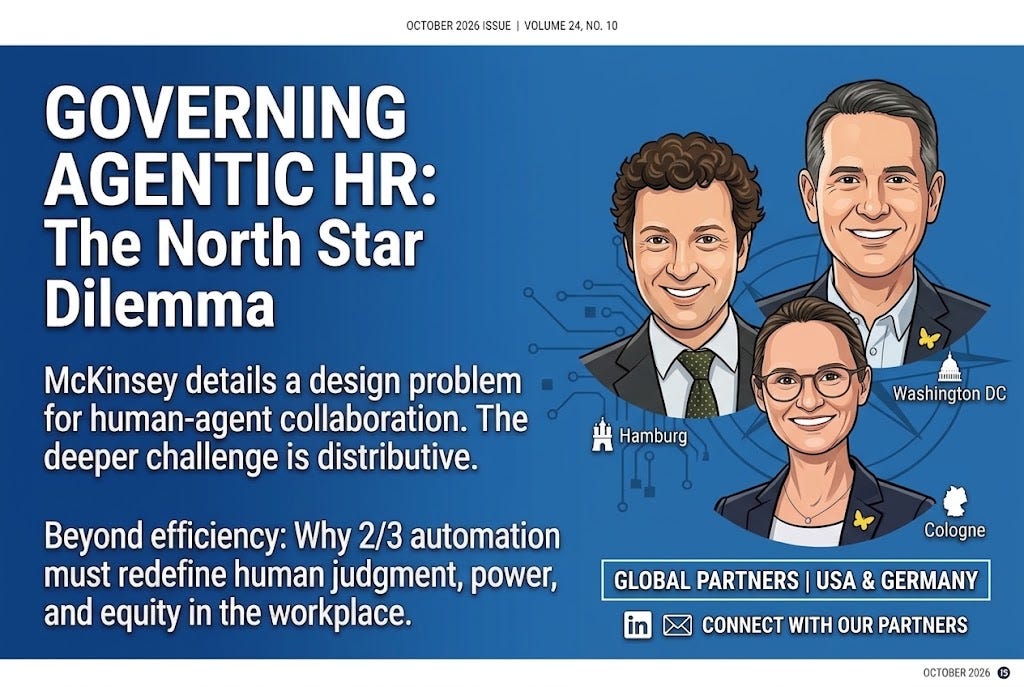
McKinsey analysis indicates that, by 2030, roughly two-thirds of today’s HR activities could be fully automated or fully automated in delivery.
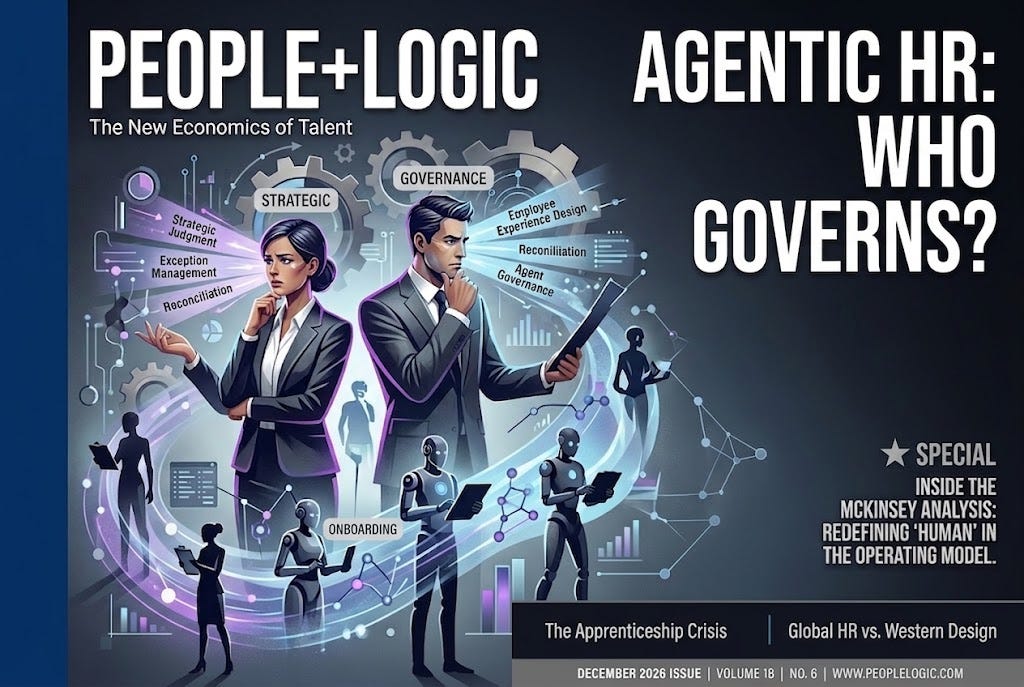
Yet greater automation may not reduce the need for human HR work. As AI agents assume transactional and administrative responsibilities, HR professionals may face growing demands for judgment, agent governance, exception management, employee development, and the reconciliation of management priorities with employee interests.
This tension raises a fundamental question for the “North Star” of agentic HR: Automation for whom, and toward what ends?
Should HR automation primarily reduce costs and increase managerial control, expand HR’s strategic capacity, improve employees’ work and career experiences, or contribute to broader social value? More importantly, how should its benefits, risks, and decision-making authority be distributed among management, HR professionals, employees, and society?
From Governance Design to Distributive Question
Komm, Hancock, and Durth (2026), in their recent McKinsey report on building HR for the agentic era, frame this shift primarily as a design problem. Organizations that succeed, they argue, do not simply scale isolated pilots; they define a human-agent operating model first and work backward to implementation. The authors identify three tensions that any credible North Star must confront: who governs the orchestration platform on which agents run, where personalized HR support tips over into surveillance, and which human capabilities, judgment, relationships, coaching, persuasion, deserve deliberate investment as routine work is absorbed by agents.
These are useful distinctions, but they are framed largely as internal governance questions for HR functions and their C-suite sponsors. The deeper question, and the one this piece wants to press further, is distributive rather than architectural. Automation reallocates work, but it also reallocates power. When two-thirds of HR’s transactional load shifts to agents, someone decides what happens to the freed capacity, and someone decides what happens to the workers whose entry-level tasks disappear.
What Remains for Humans, and Who Decides
Consider the report’s own account of what remains for humans: strategic engagement, agentic capability management, exception handling, and, notably, cognitive load management, the mental effort employees now spend integrating AI into their daily work. That last item deserves more attention than a single line affords it. If a redesigned HR function shifts fifty percent of human time toward “strategic engagement and innovation,” as the report projects, this is not simply a productivity gain. It is a redefinition of what counts as HR work, and by extension, who is qualified to do it. Employees whose value was rooted in procedural expertise, running payroll accurately, managing onboarding smoothly, may find that expertise devalued precisely as the function claims to be elevating itself.
There is also the apprenticeship problem the report raises but does not fully resolve. If agents absorb entry-level tasks, junior professionals lose the on-the-job training ground where judgment has traditionally been built. Organizations will need to construct that development deliberately, the report says, but deliberate construction requires investment, and investment requires someone to decide it is worth making rather than deferring to short-term efficiency gains.
A North Star Built Elsewhere
For diasporic and international HR professionals in particular, these questions carry additional weight. Governance structures built around a Western enterprise’s orchestration platform, its skills graph, its definitions of what personalization “serves” an employee, may not translate cleanly across labor markets with different regulatory protections, different norms around workplace surveillance, and different assumptions about the employer-employee relationship. A North Star defined in Hamburg, Washington, or Cologne is not automatically a North Star everywhere the function operates.
Rebuilding HR, and For Whom
None of this argues against the transformation the McKinsey authors describe. The pilot trap they name, speed at the task level, drift at the level of design, is real, and the organizations that avoid it will likely outperform those that do not. But a North Star worth following should answer not only how HR should be rebuilt, but for whose benefit, and who gets a voice in deciding.
Reference
Komm, A., Hancock, B., & Durth, S. (2026, August). Escaping the pilot trap: Building HR for the agentic era. McKinsey & Company.

Prof. Dr. Jeonghwan (Jerry) Choi (Managing Editor), University of Maine at Presque Isle
Jeonghwan (Jerry) Choi, PhD is an Associate Professor of Business at the University of Maine at Presque Isle and Editor-in-Coordination of K-GSP Forum (contact: jeonghwan.choi at gmail.com). With over 25 years of industry and consulting experience, he specializes in leadership development, human resource management, organizational behavior, and social entrepreneurship. His research focuses on workforce resilience, organizational health, and self-directed leadership — bridging rigorous scholarship with practical insight to cultivate leaders who create meaningful, sustainable, and humane organizations.
한글 요약
맥킨지 분석에 따르면 2030년까지 오늘날 HR 업무의 약 3분의 2가 완전 자동화되거나 전달 단계에서 자동화될 수 있다. 하지만 자동화가 확대된다고 해서 HR 인력의 필요성이 줄어드는 것은 아니다. 에이전트가 거래적·행정적 업무를 맡게 되면서 HR 전문가에게는 판단력, 에이전트 거버넌스, 예외 상황 관리, 직원 개발, 그리고 경영진과 직원 이해관계의 조율이라는 더 높은 수준의 역할이 요구된다.
맥킨지 보고서는 이를 주로 거버넌스 설계 문제로 다루지만, 이 글은 더 근본적인 질문을 제기한다. 자동화는 업무만이 아니라 권력도 재분배한다. 절차적 숙련도에 기반했던 직원들의 가치는 오히려 폄하될 수 있고, 신입 직원이 판단력을 기르던 도제식 훈련 기반도 사라질 위험이 있다.
특히 서구 기업의 플랫폼과 기준을 중심으로 설계된 북극성 비전은 다른 노동시장에 그대로 적용되기 어렵다. 따라서 진정한 북극성 비전은 HR을 어떻게 재구축할 것인가뿐 아니라, 누구를 위한 것이며 누가 그 결정에 참여하는가라는 질문에도 답해야 한다.