

EXECUTIVE SUMMARY
Senator Bernie Sanders and Representative Greg Casar have announced the Ban Artificial Superintelligence Act, which would permanently prohibit AI systems exceeding human cognitive ability, backed by corporate dissolution and prison terms of up to twenty years. The ambition is defensible: technology capable of disempowering human institutions deserves more scrutiny than a food truck receives. Yet the proposal faces two problems the bill cannot solve on its own. Experts cannot agree what superintelligence means, and one researcher believes the stated threshold has already been crossed. More decisively, a unilateral ban assumes an opponent who will also stop. China will not. That produces a chicken game, and in a chicken game the side that visibly commits to braking loses. Sun Tzu’s counsel applies before regulation does.
1. What Has Been Proposed
On September 3, 2026, Sanders announced legislation to permanently prohibit the development of AI systems exceeding human cognitive abilities. Casar’s framing was blunt: cutting-edge AI is less regulated than the average food truck, and that must change.
The bill’s summary offers two thresholds. A system qualifies as superintelligent if it matches or exceeds human cognitive performance across a broad range of domains, or if it possesses sufficient capability to plan and execute the disempowerment of humanity, including overthrowing the U.S. government. Enforcement would fall to a new cabinet-level agency advised by independent experts, with advanced development paused until safety standards are set. Violating firms would face forced dissolution, the “corporate death penalty,” and individuals up to twenty years in prison. The bill also encourages the U.S. government to pursue international agreements toward a global ban.
2. The Case That This Is Necessary
Taken on its own terms, the argument is reasonable. Roman Yampolskiy of the University of Louisville calls it a step in the right direction and rejects the objection that definitional uncertainty makes regulation impossible. Laws routinely regulate categories whose boundaries require expert interpretation. More pointedly, he argues that waiting until a system can be proven superintelligent means waiting until it is too late.
The definitional problem is nonetheless serious. Heidy Khlaaf of the AI Now Institute objects that superintelligence lacks a consistent definition and is often hypothetical and unfalsifiable, which she expects will let companies claim plausible deniability. François Chollet, who built a benchmark for machine intelligence, says he disagrees with the definition but believes it has already been met, since some frontier models already exceed human capability in certain areas. A threshold that one expert considers unfalsifiable and another considers already crossed is not a stable basis for criminal penalties.
3. Why Reality Will Diverge
The deeper problem is strategic rather than definitional. A ban binds only those who accept it.
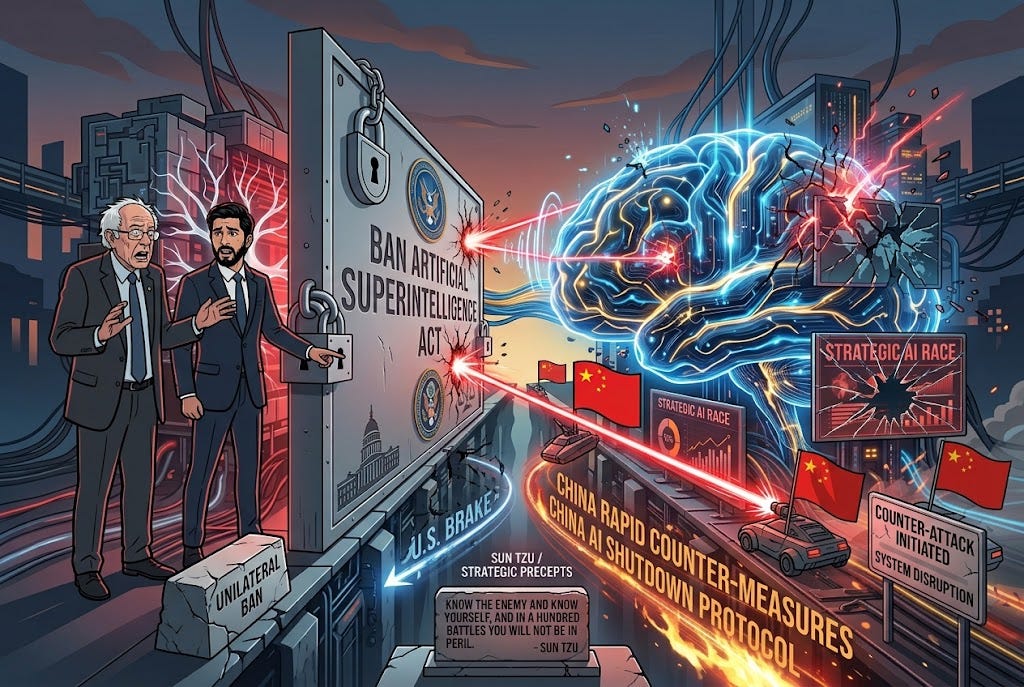
China will not stop. Intelligence capability is now understood as a component of national power, and no state pursuing hegemony abandons a capability its rival might acquire. If China continues, no other serious participant stops either. American labs will argue, with some force, that unilateral restraint hands the frontier to an adversary. European and allied programs will follow the same logic.
This is a chicken game, and its structure is unforgiving. Both parties prefer that the other swerve. Both prefer mutual swerving to mutual collision. But the player who visibly commits to braking has already lost the round, and the player who conspicuously removes the option to brake gains advantage. A legislated permanent ban is the most visible possible commitment to braking. Absent a verifiable, enforceable, mutually binding agreement, it functions less as safety policy than as a unilateral concession.
4. Know the Enemy, Know Yourself
Sun Tzu’s counsel is prior to regulation, not a substitute for it. Know the enemy and know yourself, and in a hundred battles you will not be in peril.
Knowing the enemy means grasping that China’s calculus is driven by strategic necessity rather than persuadable preference. Knowing ourselves means acknowledging that a fragmented American AI sector, disagreeing openly about basic terminology, cannot enforce discipline it has not achieved internally.
The proposal deserves serious attention rather than dismissal. But it cannot be realized while the opposing player remains uncontrolled. The prior work is verification capability, allied coordination, and definitional clarity sufficient to make an agreement enforceable. Without those, a ban is a declaration of intent addressed to people who are not listening.
Reference
Howarth, T. (2026, September 4). Bernie Sanders aims to ban AI ‘superintelligence.’ But experts can’t agree on what the term means. Science. https://doi.org/10.1126/science.z86clp5

Prof. Dr. Jeonghwan (Jerry) Choi (Managing Editor), University of Maine at Presque Isle
Jeonghwan (Jerry) Choi, PhD is an Associate Professor of Business at the University of Maine at Presque Isle and Editor-in-Coordination of K-GSP Forum (contact: jeonghwan.choi at gmail.com). With over 25 years of industry and consulting experience, he specializes in leadership development, human resource management, organizational behavior, and social entrepreneurship. His research focuses on workforce resilience, organizational health, and self-directed leadership — bridging rigorous scholarship with practical insight to cultivate leaders who create meaningful, sustainable, and humane organizations.
한글 요약:
2026년 9월 3일, 버니 샌더스 상원의원과 그렉 카사르 하원의원은 인간의 인지 능력을 넘어서는 인공지능 개발을 영구적으로 금지하는 「인공초지능 금지법(Ban Artificial Superintelligence Act)」을 제안했다. 법안은 초지능 AI를 광범위한 영역에서 인간 수준 이상의 인지 능력을 보이거나, 인간 사회와 정부를 무력화할 수 있는 능력을 가진 시스템으로 규정한다. 위반 기업은 강제 해산될 수 있으며, 개인에게는 최대 20년의 징역형이 부과될 수 있다.
이 법안의 문제의식 자체는 충분히 이해할 만하다. 인간 통제를 벗어날 가능성이 있는 AI라면 강력한 사전 규제가 필요할 수 있기 때문이다. 그러나 핵심 문제는 ‘초지능’의 정의가 아직 불명확하다는 점이다. 일부 전문가는 해당 개념이 검증하기 어렵다고 지적하는 반면, 다른 전문가는 이미 일부 첨단 AI가 기준을 충족했다고 본다. 이런 상황에서 형사처벌까지 연결하는 것은 법적 안정성을 약화시킬 수 있다.
더 큰 문제는 국제 경쟁이다. 미국만 개발을 중단한다고 해서 중국이나 다른 국가들도 함께 멈춘다는 보장은 없다. AI가 국가 경쟁력과 안보의 핵심 자산으로 간주되는 상황에서 일방적인 영구 금지는 전략적으로 불리할 수 있다.
따라서 현실적인 우선순위는 단순한 금지보다 초지능의 명확한 정의, 국제적 검증 체계, 동맹국 간 공조, 그리고 상호 구속력이 있는 협정을 만드는 데 있다. 이러한 기반 없이 미국만 먼저 멈춘다면, 안전정책이라기보다 전략적 양보로 작용할 가능성이 크다.
© K-Global Scholars and Professionals Forum. All rights reserved. Content published in the K-GSP Forum may not be reproduced, distributed, or transmitted in any form without prior written permission from the K-GSP Forum, except for brief quotations with full attribution.