

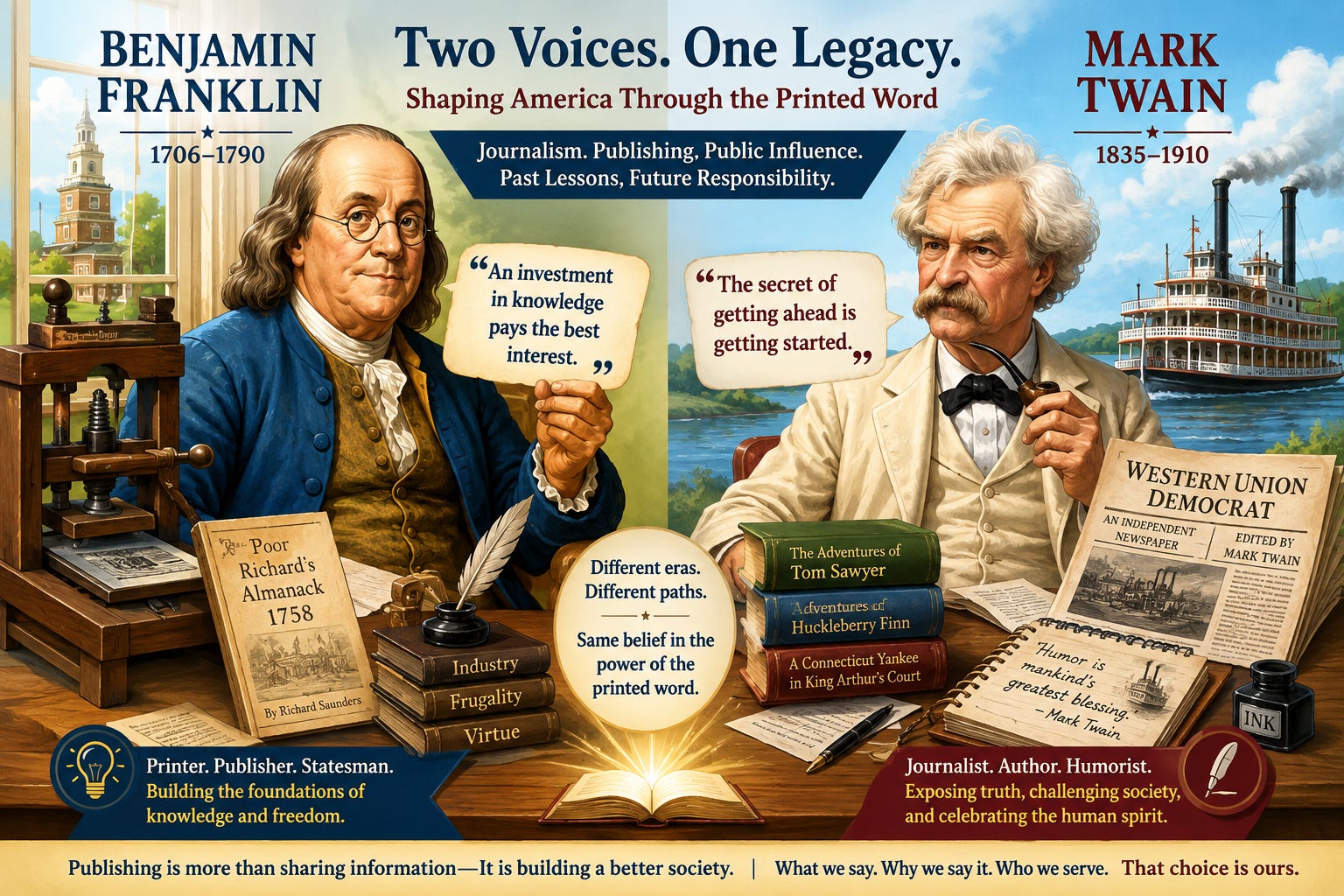
Benjamin Franklin and Mark Twain
From the Printing Press to the Public Sphere: Two Giants of American Journalism and Publishing
Abstract
Benjamin Franklin (1706–1790) and Mark Twain (1835–1910) lived in different eras, yet both left lasting marks on the development of American journalism and publishing. Franklin, as a printer, newspaper publisher, writer, and civic organizer, expanded the foundations of information circulation and public knowledge in colonial America. Mark Twain, who began his career as a newspaper journalist, used humor, satire, travel writing, and fiction to expose the contradictions of American society and reflect on human nature.
This essay compares the two figures through five similarities and five differences in their contributions to journalism and publishing, drawing on historical and scholarly sources. The comparison demonstrates that publishing is not merely an industry that produces and sells written material. It is also a cultural institution that shapes civic judgment, public discussion, and society’s capacity for self-reflection.
Keywords: Benjamin Franklin, Mark Twain, Journalism, Publishing, American Intellectual History, Public Sphere
Two Men, One Printing Civilization
When we discuss the history of American journalism, Benjamin Franklin and Mark Twain may appear to have emerged from entirely different bookshelves. Franklin, the son of a candle maker, learned the printing trade and used newspapers and almanacs to circulate knowledge and information throughout colonial society. Mark Twain, by contrast, developed from a newspaper journalist into a literary figure whose satire and humor examined American society during a period of industrialization and cultural transformation.
If Franklin helped expand the infrastructure of public knowledge on the eve of American independence, Twain reflected the contradictions of a rapidly changing nation through the sharp lens of laughter. Their differences are unmistakable. Franklin directly operated a printing business and publishing enterprise, while Twain began as a newspaper journalist and extended his literary influence through magazines and book publishing.
Yet the two men shared a fundamental principle: they used the printed word to establish relationships with readers and transform information and storytelling into social influence.
The purpose of this comparison is not to force Franklin and Twain into identical categories. Rather, by examining both their similarities and differences, we can better understand how American publishing civilization developed practical knowledge, social criticism, individual expression, and public debate.
Five Similarities
Similarity 1. They Communicated Directly with the Public Through Print Media
Both Franklin and Twain valued communication with ordinary readers rather than restricting their writing to an exclusive intellectual audience.
Franklin used The Pennsylvania Gazette and Poor Richard’s Almanack to deliver news, practical information, moral advice, and humor. His almanac, in particular, combined knowledge and entertainment in a publication designed to be read as part of everyday life. The Library of Congress describes Franklin’s efforts to make the almanac both useful and entertaining, contributing to its commercial success (Library of Congress, n.d.-a).
Twain likewise developed a direct relationship with readers through newspapers and magazines. His early journalism provided not only professional training but also an important foundation for the development of his distinctive voice as a humorist and writer. Scholarship published by Cambridge University Press identifies journalism as a significant part of Twain’s career as an author (Cambridge University Press, 2020).
Lesson: The influence of publishing depends not only on the amount of knowledge a writer possesses. When knowledge is communicated in language that readers can understand, appreciate, and remember, writing gains social vitality.
Similarity 2. They Used Journalism and Publishing as Both Economic Foundations and Sources of Public Influence
For both men, writing and publishing were more than personal hobbies. Publishing provided a means of earning a living while also serving as a platform for public expression.
Franklin operated a printing business and newspaper enterprise, producing newspapers, almanacs, pamphlets, government documents, and other printed materials. His printing business combined financial opportunity with public influence (Library of Congress, n.d.-b).
Twain published in newspapers and magazines and developed his work into books. His career illustrates how writers could move between journalism, periodicals, and book publishing. However, the two men occupied different positions within the publishing system. Franklin directly managed the production and commercial foundations of printing, while Twain worked primarily as an author and copyright holder within relationships involving publishers and periodicals (Mark Twain Project, n.d.-a).
Lesson: Creative work cannot be sustained by ideals alone. When knowledge production is supported by a viable economic structure, writers can maintain a longer conversation with society.
Similarity 3. They Used Humor and Satire to Stimulate Readers’ Thinking
Humor appears in the writings of both men, but their humor was not limited to entertainment.
Franklin used the fictional character Richard Saunders in Poor Richard’s Almanack to present proverbs and practical wisdom. These expressions communicated themes such as diligence, thrift, and self-discipline in a familiar and accessible form (Library of Congress, n.d.-a).
Twain’s humor was often more literary and satirical. He addressed hypocrisy, racial injustice, social inequality, and human self-deception through storytelling and wit. His experience as a newspaper journalist contributed to his development as a keen observer of society and language (Cambridge University Press, 2020).
While Franklin’s humor frequently encouraged readers to reflect on their everyday conduct, Twain’s humor often challenged them to question the social assumptions they had long taken for granted.
Lesson: Good humor does more than make people laugh. Sometimes, it is one of the most effective ways to make a serious question memorable.
Similarity 4. They Helped Shape Social Memory Beyond Their Own Writings
The publishing activities of Franklin and Twain continued to influence historical understanding and literary scholarship long after their lifetimes.
Franklin’s newspapers, almanacs, and pamphlets provide valuable sources for studying the society, politics, economic values, and intellectual life of colonial America. His printing activities were also connected to the circulation of public information and the development of civic institutions (Library of Congress, n.d.-b).
Twain’s writings, ranging from newspaper articles and literary works to letters and autobiographical materials, have been preserved, edited, and studied across generations. The Mark Twain Project at the University of California, Berkeley, continues to support scholarly editing and digital access to his writings (Mark Twain Project, n.d.-b).
Franklin left an important record for understanding the history of early American print culture, while Twain left a rich body of material for examining American literature, journalism, and social criticism.
Lesson: A publication is not merely a product for contemporary readers. Carefully preserved and verified records become windows through which future generations can understand the ideas and conflicts of the past.
Similarity 5. They Expanded Audiences and Explored New Forms of Expression
Both men reached beyond established forms of knowledge and literary expression to engage wider audiences.
Franklin used newspapers and almanacs to communicate practical knowledge and moral advice. Through his printing business, he helped make useful information available to readers in accessible formats (Library of Congress, n.d.-b).
Twain combined journalistic language, conversational expression, regional experience, and satire to expand the possibilities of American literary style. His early journalism was connected to the newspaper culture of the American West and served as important training for his later literary identity (Cambridge University Press, 2020).
Lesson: Innovation in publishing does not always begin with the invention of a new machine. It can also begin by connecting existing media with new audiences and new forms of language.
Main Discussion: Five Differences
Difference 1. Their Primary Roles in Publishing Were Different
The most obvious difference lies in the roles they played within the publishing ecosystem.
Benjamin Franklin
Core roles: Printer, newspaper publisher, writer
Main activities: Operating a printing business; publishing newspapers and almanacs
Publishing foundation: Direct involvement in printing operations and distribution
Historical significance: Early American printing industry and public information circulation
Mark Twain
Core roles: Journalist, author, lecturer, writer
Main activities: Writing for newspapers and magazines; producing books
Publishing foundation: Manuscript production and relationships with publishers
and periodicals
Historical significance: Development of American literature and journalism
Franklin directly operated the physical and commercial foundations of publishing. Twain, by contrast, primarily produced content as a journalist and writer, reaching readers through different publishing channels. Both benefited from the influence of publishing, but their positions within the publishing process were not the same (Library of Congress, n.d.-b; Mark Twain Project, n.d.-a).
Difference 2. They Worked in Different Historical Periods and Media Environments
Franklin worked in eighteenth-century colonial North America. Newspapers had not yet developed into the large-scale media industries familiar today, and printing businesses and postal networks played important roles in the circulation of information (Library of Congress, n.d.-b).
Twain worked from the mid-nineteenth century onward, during a period of westward expansion, industrialization, and the growth of mass publishing markets in the United States. He began an apprenticeship in the printing trade at approximately thirteen years of age and subsequently developed his journalistic career through newspapers in different regions (Cambridge University Press, 2020).
Franklin’s work should therefore be understood within the context of expanding the foundations of printing and public information in colonial society. Twain’s work, in contrast, developed within an increasingly established newspaper and magazine market in which writers could build literary reputations and reach broader audiences.
Difference 3. Their Primary Purposes and Writing Styles Were Different
Franklin’s major publications strongly emphasized practicality and instruction. Poor Richard’s Almanack combined annual information, proverbs, and practical wisdom to offer readers useful knowledge for everyday life (Library of Congress, n.d.-a).
Twain’s writing encompassed travel literature, humor, satire, fiction, and journalism. His experience in newspapers provided an important foundation for social observation and literary experimentation (Cambridge University Press, 2020).
This difference also appears in how they approached their readers. Franklin often encouraged readers to manage their lives more efficiently and responsibly. Twain frequently invited readers to view familiar customs and social beliefs from a different perspective.
This distinction, however, is not absolute. Franklin also employed satire and engaged in public controversies, while Twain’s writing could contain practical information and educational value.
Difference 4. Their Forms of Political and Social Engagement Were Different
Franklin’s publishing activities were closely connected to civic organization and political change in colonial America. He combined his work as a printer with public activities and contributed to the circulation of information and the development of civic society (Library of Congress, n.d.-b).
Twain’s social criticism was expressed primarily through literary and journalistic language. He portrayed social contradictions and injustices through satire, and his works have become important materials for critically examining American history and culture (National Endowment for the Humanities, n.d.).
Both men were concerned with public issues, but Franklin’s activities were closely associated with the formation of civic and political institutions during the founding period of the United States. Twain’s influence was more prominently expressed through literary and journalistic criticism of social conventions and power relationships.
Difference 5. Their Posthumous Publishing and Editorial Histories Were Different
The writings of both Franklin and Twain continued to be published and studied after their deaths, but the nature of that process differed.
Franklin’s writings and printed materials are preserved as historical resources for understanding colonial society and the founding period of the United States. The Library of Congress presents his printing activities and publications alongside historical source materials (Library of Congress, n.d.-a).
In Twain’s case, posthumous publication and editorial work became especially important areas of scholarship. He requested that the complete publication of his autobiography be delayed for a specified period. Beginning in 2010, the Mark Twain Project published the autobiography in multiple volumes through scholarly editorial work. His manuscripts, letters, and newspaper articles have also been subjected to ongoing verification, annotation, and publication (National Endowment for the Humanities, n.d.; Mark Twain Project, n.d.-b).
This difference reveals an important principle: an author’s reputation alone does not guarantee the historical accuracy of a publication. The selection of manuscripts, the establishment of authoritative editions, and the documentation of editorial decisions all matter.
Publishing as the Mirror of Human Memory and Society
A comparison of Benjamin Franklin and Mark Twain reveals that American print civilization was more than a story of technological progress. It was also a process through which society developed intellectual reflection, cultural expression, and public discourse.
Both men communicated with broad audiences through print media, used publishing as a foundation for economic activity and public influence, and employed humor and language to stimulate readers’ thinking. They also expanded audiences and left writings that continue to influence later generations.
Yet their differences are equally important. Franklin expanded the foundations of publishing infrastructure and civic information as a printer and publisher, while Twain exposed the contradictions of American society through humor and satire as a journalist and literary figure. Their differences reflected not only individual personalities but also the distinct media environments and publishing markets of their respective eras.
Today, we use digital platforms instead of printing presses, read online news and social media instead of relying exclusively on newspapers, and increasingly encounter content recommended by algorithms rather than selected by individual editors. Yet one fundamental question remains: Are we merely producing information more quickly, or are we delivering knowledge that is trustworthy, useful, and humane?
Franklin demonstrated the value of practical knowledge and civic participation. Twain showed how humor and critical thinking could offer new perspectives on society. Together, their legacies remind us that publishing is not simply the act of transmitting information. It is a cultural practice that helps readers think, judge, and imagine a better society.
In the age of artificial intelligence, when machines can write articles, summarize books, publish content, and deliver personalized information, this lesson becomes even more significant. Technology may accelerate the production of language, but the responsibility for deciding what to say, whom to serve, and how words affect society remains fundamentally human.
‘Franklin’s printing press’ and ‘Twain’s pen’ were tools of different eras. Yet their most enduring shared legacy lies in their efforts to expand human possibilities through knowledge and language. Looking back at the history of print civilization is, therefore, also a way to reflect on the direction of digital civilization today. +++
References
Cambridge University Press. (2020). Early periodical writing. In Mark Twain in Context (pp. 77–90). Cambridge University Press. https://doi.org/10.1017/9781108617208.010
Library of Congress. (n.d.-a). Printer and writer. In Benjamin Franklin: In His Own Words. https://www.loc.gov/exhibits/franklin/franklin-printer.html
Library of Congress. (n.d.-b). Franklin as colonial printer. In First Among Many: The Bay Psalm Book and Early Moments in American Printing. https://www.loc.gov/exhibits/bay-psalm-book-and-american-printing/online-exhibition.html
Mark Twain Project. (n.d.). The writings of Mark Twain: Editorial and publishing resources. https://www.marktwainproject.org/writings/about/buybooks/
National Endowment for the Humanities. (n.d.). Documenting Mark Twain. Humanities. https://www.neh.gov/project/documenting-mark-twain
벤저민 프랭클린과 마크 트웨인
인쇄기에서 공론장으로: 미국 언론과 출판의 두 거장
Abstract
벤저민 프랭클린(Benjamin Franklin, 1706–1790)과 마크 트웨인(Mark Twain, 1835–1910)은 서로 다른 시대를 살았지만 미국의 언론과 출판 발전에 깊은 흔적을 남겼다. 프랭클린은 인쇄업자, 신문 발행인, 저술가, 시민사회 조직가로서 식민지 미국의 정보 유통과 공공 지식의 기반을 넓혔다. 마크 트웨인은 신문 기자에서 출발하여 유머, 풍자, 여행기, 소설을 통해 미국 사회의 모순과 인간의 본성을 대중에게 비추었다. 이 글은 두 인물의 언론 및 출판 활동을 중심으로 5가지 공통점과 5가지 차이점을 역사적 자료와 학술적 연구에 근거하여 비교한다. 이를 통해 출판이 단순히 글을 생산하고 판매하는 산업을 넘어, 시민의 판단과 사회의 자기 성찰을 형성하는 문화적 제도라는 사실을 살펴본다.
Keywords: Benjamin Franklin, Mark Twain, Journalism, Publishing, American Intellectual History, Public Sphere, K-GSP Forum
두 사람, 하나의 인쇄 문명
미국의 언론사를 이야기할 때 벤저민 프랭클린과 마크 트웨인은 서로 다른 책장에서 걸어 나온 인물처럼 보인다. 프랭클린은 촛불 제조업자의 아들로 태어나 인쇄업을 익혔고, 신문과 연감으로 식민지 사회의 지식과 정보를 유통시켰다. 반면 마크 트웨인은 미시시피강의 경험과 미국 서부의 신문 기자 생활을 거쳐 풍자와 유머의 문학가로 성장했다. 프랭클린이 미국 건국 전야의 공적 지식 인프라를 확장한 인물이라면, 트웨인은 산업화와 대중문화가 성장하던 미국 사회를 날카로운 웃음으로 해부한 작가였다 (Library of Congress, n.d.-a; Cambridge University Press, 2020).
두 사람의 차이는 분명하다. 프랭클린은 신문을 직접 운영하고 인쇄업을 사업과 시민적 활동의 기반으로 활용했으며, 트웨인은 신문 기자로 출발해 잡지와 단행본 출판으로 자신의 문학적 영향력을 넓혔다. 그러나 이들을 연결하는 공통된 원리가 있다. 인쇄된 언어를 통해 독자와 관계를 맺고, 정보와 이야기를 사회적 영향력으로 전환했다는 점이다.
다음 비교는 두 사람을 억지로 같은 인물로 만들려는 시도가 아니다. 오히려 공통점과 차이점을 함께 살펴봄으로써, 미국 출판 문명이 어떻게 실용적 지식과 사회 비판, 개인의 표현, 공적 토론을 발전시켰는지 이해하려는 시도다.
다섯 가지 공통점
공통점 1. 인쇄 매체를 통해 대중과 직접 소통했다
프랭클린과 트웨인은 모두 전문 지식인만을 위한 폐쇄적인 글쓰기보다 독자와의 직접적인 소통을 중요하게 여겼다.
프랭클린은 ‘The Pennsylvania Gazette’와 ‘Poor Richard’s Almanack’을 통해 뉴스, 실용 정보, 도덕적 조언, 유머를 독자에게 전달했다. 특히 연감은 지식과 오락을 결합하여 일상생활 속에서 읽히는 출판물이었다. 미국 의회도서관은 프랭클린이 연감을 유용하면서도 재미있게 만들려 했으며, 상당한 판매량을 거두었다고 소개한다 (Library of Congress, n.d.-a).
트웨인 역시 신문과 잡지에서 활동하며 독자와 직접적인 관계를 구축했다. 그의 초기 언론 활동은 기자로서의 훈련이었을 뿐 아니라 유머 작가로서의 목소리를 형성하는 과정이었다. Cambridge University Press의 연구는 트웨인의 저널리즘이 그의 작가 경력에서 중심적인 역할을 했다고 설명한다 (Cambridge University Press, 2020).
교훈: 출판의 영향력은 글쓴이의 지식량만으로 결정되지 않는다. 독자가 이해하고 공감하며 다시 읽을 수 있는 언어로 지식을 전달할 때, 글은 사회적 생명력을 얻는다.
공통점 2. 언론과 출판을 개인의 경제적 기반이자 공적 영향력으로 활용했다
두 사람에게 글쓰기는 단순한 취미가 아니었다. 출판은 생계를 마련하는 경제적 활동이면서 동시에 사회에 발언하는 수단이었다.
프랭클린은 인쇄소와 신문 사업을 운영하며 신문, 연감, 팸플릿, 정부 인쇄물 등 다양한 인쇄 사업을 발전시켰다. 그의 인쇄 사업은 재정적 성공과 공적 영향력을 함께 제공했다 (Library of Congress, n.d.-b).
트웨인은 신문과 잡지에 글을 발표하고 이를 단행본으로 확장하는 출판 경로를 활용했다. 다만 두 사람의 사업 방식에는 차이가 있었다. 프랭클린은 인쇄업자이자 발행인으로서 제작과 유통의 기반을 직접 운영했지만, 트웨인은 작가와 저작권자, 출판사 사이의 관계 속에서 문학적 작품을 생산하고 판매했다. 마크 트웨인 프로젝트의 자료는 그가 신문과 잡지 글을 수집하고 재출판하려 했던 사실을 보여 준다 (Mark Twain Project, n.d.-a).
교훈: 창작의 지속 가능성은 이상만으로 유지되지 않는다. 지식 생산과 경제적 구조가 만날 때, 저자는 더 오랫동안 사회와 대화할 수 있다.
공통점 3. 유머와 풍자를 통해 독자의 사고를 자극했다
두 사람의 글에는 웃음이 존재하지만, 그 웃음은 단순한 오락에 머물지 않았다.
프랭클린은 리처드 손더스(Richard Saunders)라는 가상 인물을 활용하여 ‘Poor Richard’s Almanack’에 속담과 생활의 지혜를 담았다. 이러한 표현은 근면, 절약, 자기 관리와 같은 실용적 주제를 독자에게 친숙하게 전달했다 (Library of Congress, n.d.-a).
트웨인의 유머는 더욱 풍자적이고 문학적인 성격을 띠었다. 그는 미국 사회의 위선, 인종 문제, 계층적 모순, 인간의 자기기만을 웃음과 이야기 속에 담았다. 그의 신문 기자 경험은 이후의 문학적 목소리와 밀접하게 연결되어 있었다 (Cambridge University Press, 2020).
프랭클린의 웃음이 독자의 생활 태도를 다듬는 데 자주 활용되었다면, 트웨인의 웃음은 독자가 사회의 익숙한 믿음 자체를 의심하도록 만드는 경우가 많았다.
교훈: 좋은 유머는 독자를 단순히 웃게 하는 데서 끝나지 않는다. 때로는 심각한 질문을 가장 오래 기억하게 만드는 가장 부드러운 방법이다.
공통점 4. 개인의 글을 넘어 사회적 기억을 형성했다
프랭클린과 트웨인의 출판 활동은 그들의 생애에 한정되지 않고 이후 세대의 역사 인식과 문학 연구에 영향을 주었다.
프랭클린의 신문, 연감, 팸플릿은 식민지 미국의 사회와 정치, 경제적 가치관을 연구하는 중요한 자료다. 그의 인쇄 활동은 공공 정보의 유통과 시민적 조직의 발전에도 연결되었다 (Library of Congress, n.d.-b).
트웨인의 글 역시 신문 기사에서 문학 작품, 편지, 자서전에 이르기까지 광범위하게 보존되고 편집되었다. UC 버클리의 마크 트웨인 프로젝트는 그의 글을 학술적으로 편집하고 디지털 환경에서 제공하는 작업을 지속하고 있다 (Mark Twain Project, n.d.-b).
한 사람은 초기 미국 인쇄 문화의 역사를 이해하는 데 중요한 자료를 남겼고, 다른 한 사람은 미국 문학과 저널리즘의 변화, 사회 비판의 역사를 연구하는 데 풍부한 기록을 남겼다.
교훈: 출판물은 현재의 독자만을 위한 상품이 아니다. 잘 보존되고 검증된 기록은 미래 세대가 과거의 사고방식과 사회적 갈등을 이해하는 창이 된다.
공통점 5. 새로운 독자층과 새로운 표현 방식을 개척했다
두 사람 모두 기존의 지식과 문학이 도달하던 범위를 넘어 더 넓은 독자층에 접근했다.
프랭클린은 신문과 연감이라는 대중적 형식을 통해 실용 지식과 도덕적 조언을 전달했다. 인쇄업의 사업적 기반을 확장하면서 독자들에게 접근 가능한 콘텐츠를 제공했다 (Library of Congress, n.d.-b).
트웨인은 신문과 잡지의 기자적 문체, 구어체적 표현, 지역적 경험, 풍자를 결합하여 미국 문학의 표현 가능성을 넓혔다. 그의 초기 저널리즘은 미국 서부의 신문 문화와 연결되어 있었고, 이후 문학적 정체성을 형성하는 중요한 훈련 과정이 되었다 (Cambridge University Press, 2020).
교훈: 출판의 혁신은 반드시 새로운 기계를 발명하는 데서 시작하지 않는다. 기존 매체를 새로운 독자와 새로운 언어로 연결하는 데서도 시작된다.
다섯 가지 차이점
차이점 1. 출판 활동의 중심 역할이 달랐다
가장 분명한 차이는 두 사람이 출판 생태계에서 담당한 역할이다.
비교 항목 벤저민 프랭클린 마크 트웨인
핵심 역할 인쇄업자·신문 발행인·저술가 기자·작가·강연가·저술가
주요 활동 인쇄소 운영, 신문·연감 발행 신문·잡지 기고, 단행본 집필
출판의 기반 직접적인 인쇄 사업과 유통망 작가의 원고와 출판사·잡지 네트워크
대표적 의미 초기 미국 인쇄산업과 공공정보 미국 문학과 저널리즘의 발전
유통
프랭클린은 출판물을 만드는 물리적·상업적 기반을 직접 운영했다. 반면 트웨인은 기자와 작가로서 콘텐츠를 생산하고 다양한 출판 경로를 통해 독자에게 도달했다. 두 사람 모두 출판의 영향력을 활용했지만, 출판 과정에서의 위치는 동일하지 않았다 (Library of Congress, n.d.-b; Mark Twain Project, n.d.-a).
차이점 2. 역사적 시대와 언론 환경이 달랐다
프랭클린은 18세기 식민지 북아메리카에서 활동했다. 신문은 오늘날과 같은 대규모 매체 산업으로 발전하기 전이었으며, 인쇄업과 우편 제도는 정보 유통에 중요한 역할을 했다 (Library of Congress, n.d.-b).
트웨인은 19세기 중반 이후 미국의 서부 개척, 산업화, 대중 출판 시장의 성장 속에서 활동했다. 그는 13세 무렵 인쇄공의 도제 경험을 시작했고, 이후 여러 지역의 신문과 잡지에서 활동하며 저널리즘 경력을 쌓았다 (Cambridge University Press, 2020).
따라서 프랭클린의 활동은 미국 식민지 사회에서 인쇄와 공적 정보의 기반을 확장하는 맥락에서 이해할 수 있고, 트웨인의 활동은 이미 성장한 신문 및 잡지 시장에서 작가의 명성과 문학적 영향력을 확대하는 맥락에서 이해할 수 있다.
차이점 3. 글쓰기의 주요 목적과 문체가 달랐다
프랭클린의 대표적인 출판물은 실용성과 교훈성을 강하게 드러낸다. ‘Poor Richard’s Almanack’은 연간 정보와 속담, 생활의 지혜를 결합하여 독자들의 일상에 유용한 지식을 제공했다 (Library of Congress, n.d.-a).
트웨인의 글은 여행기, 유머, 풍자, 소설, 신문 기사 등 다양한 장르에 걸쳐 있다. 그의 저널리즘 경험은 사회적 관찰과 언어적 실험을 위한 중요한 기반이었다 (Cambridge University Press, 2020).
이 차이는 두 사람이 독자를 대하는 방식에서도 드러난다. 프랭클린은 독자가 삶을 더 효율적이고 도덕적으로 관리하도록 돕는 글을 자주 생산했다. 트웨인은 독자가 익숙한 관습과 사회적 신념을 다른 각도에서 바라보도록 만드는 글을 많이 썼다. 다만 이 구분은 절대적인 것이 아니다. 프랭클린에게도 풍자와 논쟁이 있었고, 트웨인에게도 실용적인 정보와 교육적 가치가 있었다.
차이점 4. 정치적·사회적 개입의 방식이 달랐다
프랭클린의 출판 활동은 미국 식민지 사회의 시민적 조직과 정치적 변화에 직접적으로 연결되었다. 그는 인쇄업과 공적 활동을 함께 수행했으며, 정보의 유통과 시민사회의 발전에 관여했다 (Library of Congress, n.d.-b).
트웨인의 사회 비판은 주로 문학과 저널리즘의 언어를 통해 나타났다. 그는 사회적 모순과 부조리를 풍자적으로 묘사했고, 이러한 작품들은 미국의 역사와 문화를 비판적으로 읽는 데 중요한 자료가 되었다 (National Endowment for the Humanities, n.d.).
두 사람 모두 공적 문제에 관심을 가졌지만, 프랭클린의 활동은 건국기 시민적·정치적 제도 형성과 긴밀히 연결되었고, 트웨인의 영향력은 작가와 기자로서 사회의 관습과 권력 관계를 비판적으로 묘사하는 데 크게 나타났다.
차이점 5. 사후 출판과 편집의 역사가 달랐다
프랭클린과 트웨인 모두 사후에도 저술과 기록이 출판되고 연구되었지만, 그 과정의 특징은 달랐다.
프랭클린의 대표적 저술과 인쇄물은 식민지 시대와 미국 건국기의 역사 자료로서 도서관과 기록기관의 소장품에 포함되어 있다. 미국 의회도서관은 그의 인쇄 활동과 출판물을 원자료와 함께 소개하고 있다 (Library of Congress, n.d.-a).
트웨인의 경우 사후 출판과 편집의 문제가 특히 중요한 연구 주제가 되었다. 그는 자서전의 완전한 출판을 일정 기간 유예하도록 요청했으며, 2010년 이후 마크 트웨인 프로젝트의 학술 편집을 통해 자서전이 여러 권으로 출판되었다. 또한 그의 원고와 편지, 신문 기사 등을 검증하고 주석을 붙이는 작업이 이어지고 있다 (National Endowment for the Humanities, n.d.; Mark Twain Project, n.d.-b).
이 차이는 한 가지 중요한 사실을 보여 준다. 저자의 명성만으로 출판물의 역사적 정확성이 보장되는 것은 아니다. 어떤 원고를 선택하고, 어떤 판본을 기준으로 삼으며, 어떤 부분을 편집했는지에 대한 기록이 중요하다.
출판은 인간의 기억과 사회의 거울이다
벤저민 프랭클린과 마크 트웨인의 언론 및 출판 업적을 비교하면, 미국의 인쇄 문명이 단순한 기술 발전을 넘어 사회적 사고와 문화적 표현을 발전시키는 과정이었다는 사실을 확인할 수 있다.
두 사람은 모두 인쇄 매체를 통해 대중과 소통했고, 출판을 경제적 활동과 공적 영향력의 기반으로 활용했으며, 유머와 언어를 통해 독자의 사고를 자극했다. 또한 새로운 독자층을 개척하고 자신들의 글을 후대에 남겼다. 그러나 프랭클린은 인쇄업자와 발행인으로서 출판 인프라와 시민적 정보 유통의 기반을 넓혔고, 트웨인은 기자와 문학가로서 미국 사회의 모순을 유머와 풍자로 드러냈다. 이들의 차이는 단순한 개인적 성향의 차이가 아니라 서로 다른 시대의 언론 환경과 출판 시장을 반영한다.
오늘날 우리는 인쇄기 대신 디지털 플랫폼을 사용하고, 신문 대신 온라인 뉴스와 소셜 미디어를 읽으며, 저자 대신 알고리즘이 추천하는 콘텐츠를 접하는 경우가 많다. 하지만 핵심적인 질문은 여전히 남아 있다. 우리는 정보를 얼마나 빠르게 생산하는가가 아니라, 얼마나 신뢰할 수 있고 유용하며 인간적인 지식을 사회에 전달하는가?
프랭클린은 실용적 지식과 시민적 참여의 가치를 보여 주었고, 트웨인은 유머와 비판적 사고가 사회를 바라보는 새로운 시각을 제공할 수 있음을 보여 주었다. 두 사람의 유산은 출판이 단순히 정보를 전달하는 행위가 아니라, 독자가 생각하고 판단하며 더 나은 사회를 상상하도록 돕는 문화적 활동임을 일깨운다.
오늘날 인공지능이 글을 쓰고, 기사를 요약하고, 책을 출판하며, 독자에게 맞춤형 정보를 제공하는 시대에 이 교훈은 더욱 중요해진다. 기술이 언어의 생산 속도를 높일 수는 있지만, 무엇을 말할 것인가, 누구를 위해 말할 것인가, 그리고 그 말이 사회에 어떤 영향을 미칠 것인가를 결정하는 책임은 여전히 인간에게 있다.
‘프랭클린의 인쇄기’와 ‘트웨인의 펜’은 서로 다른 시대의 도구였지만, 두 사람의 가장 중요한 공통 유산은 지식과 언어를 통해 인간의 가능성을 확장하려 했다는 데 있다. 인쇄 문명의 역사를 되돌아보는 일은 곧 오늘날 디지털 문명의 방향을 성찰하는 일이기도 하다. +++
참고문헌
Cambridge University Press. (2020). Early periodical writing. In Mark Twain in Context (pp. 77–90). Cambridge University Press. https://doi.org/10.1017/9781108617208.010
Library of Congress. (n.d.-a). Printer and writer. In Benjamin Franklin: In His Own Words. https://www.loc.gov/exhibits/franklin/franklin-printer.html
Library of Congress. (n.d.-b). Franklin as colonial printer. In First Among Many: The Bay Psalm Book and Early Moments in American Printing. https://www.loc.gov/exhibits/bay-psalm-book-and-american-printing/online-exhibition.html
Mark Twain Project. (n.d.). The writings of Mark Twain: Editorial and publishing resources. https://www.marktwainproject.org/writings/about/buybooks/
National Endowment for the Humanities. (n.d.). Documenting Mark Twain. Humanities. https://www.neh.gov/project/documenting-mark-twain
2026년 9월 18일
{솔티}

Prof. Dr. Young Choi (Editor in Chief) — Regent University
Young B. Choi is a Professor in the Department of Engineering & Computer Science at Regent University. He published 38 books with ‘Selected Readings in Cybersecurity’ (2018) (over 800 copies archived globally at university/college libraries around the world) and ‘Cybersecurity Applications and Artificial Intelligence’ (2023) available in seven major world languages. He proposed the world’s first global and universal telecommunications “Service Order Handling (SOH)” Model (T-SOH Model) (1995) with Dr. Adrian Tang. With this innovative research work, he received the IEEE NOMS ’96 Best Paper Award and became the first recipient of the Outstanding Contribution Award of the TeleManagement Forum in 1998. His research areas include Natural Language Processing-focused AI, AI-applied cybersecurity, network and telecom service management, and Korean studies on Gani Choi Rip’s Jeonggwan (靜觀: Quiet Contemplation) philosophy and Shilhak ( 實學: Practical Learning).
© K-GSP (K-Global Scholars and Professionals) Forum. All rights reserved. 2026.
Suggested Citation:
Choi, Y. B. (2026, September 18). Benjamin Franklin and Mark Twain: From the Printing Press to the Public Sphere: Two Giants of American Journalism and Publishing. K-GSP.