

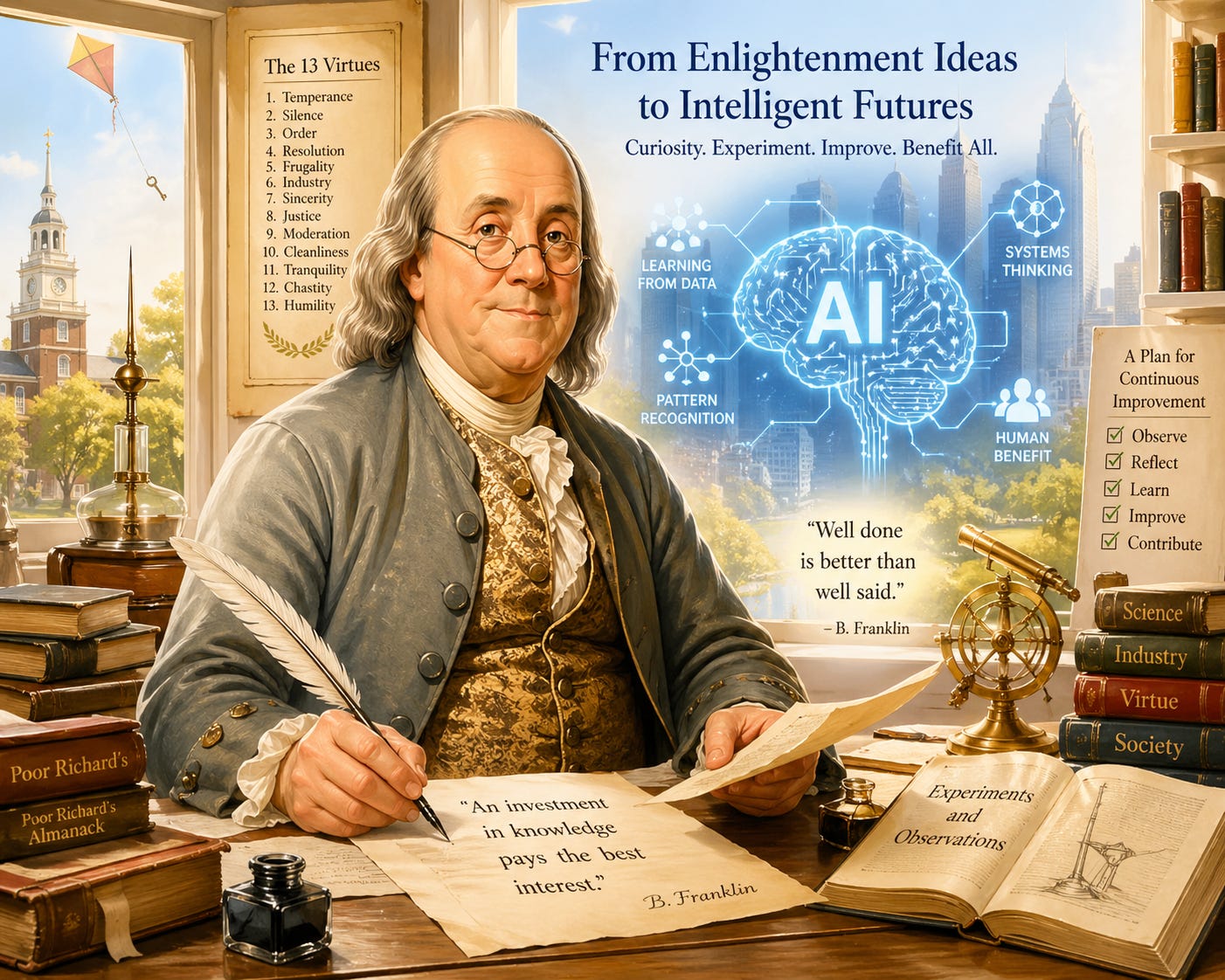
Benjamin Franklin did not know computers, algorithms, or artificial intelligence. Yet, if one examines the intellectual foundations of the AI age, Franklin’s influence is surprisingly present—quietly embedded in the way we think about knowledge, systems, experimentation, and human progress. He stands not as a technological ancestor of AI, but as a philosophical architect of the mindset that made AI possible.
At the core of Franklin’s legacy is his radical commitment to empirical reasoning. In an era still dominated by authority and tradition, Franklin insisted that knowledge should be built from observation, experiment, and iterative correction. This epistemic shift—knowledge as something to be continuously tested rather than passively accepted—is the same principle that underlies modern machine learning systems. AI models are not “taught” truth in a traditional sense; they learn through exposure to data, error correction, and optimization. In this sense, Franklin’s scientific temperament prefigures the logic of learning systems that improve through feedback loops.
Franklin’s famous experimental spirit—seen in his work on electricity, weather patterns, and civic engineering—also reflects a proto-systemic mindset. He understood the world as interconnected systems rather than isolated phenomena. This systems thinking is foundational to AI architecture today, where complex neural networks model relationships between variables in layered, non-linear ways. Franklin’s curiosity about how small causes produce large effects mirrors the way AI models detect patterns across vast, seemingly unrelated datasets.
Equally important is Franklin’s philosophy of pragmatic intelligence. He was less interested in abstract perfection than in useful outcomes. His inventions—from the lightning rod to bifocal glasses—were designed to solve real human problems. Modern AI, at its best, follows the same principle: not intelligence for its own sake, but intelligence deployed to enhance human capability, efficiency, and decision-making. In this way, Franklin represents the ethical grounding of applied intelligence systems.
Franklin’s approach to knowledge organization also foreshadows AI-era information systems. His creation of libraries, civic institutions, and structured methods for self-improvement (such as his famous virtue tracking system) reveals an early attempt to externalize cognition—to build systems that extend human memory and reasoning. Today, AI acts as exactly such an extension: a cognitive infrastructure that stores, retrieves, and synthesizes knowledge at scale. Franklin’s “self-management system” can be seen as a primitive analogue of today’s data-driven personal optimization tools.
Moreover, Franklin’s identity as a bridging thinker—between science and politics, theory and practice, individual and society—reflects a quality essential for the AI age. Artificial intelligence does not exist in isolation; it sits at the intersection of ethics, governance, engineering, and human behavior. Franklin’s ability to navigate multiple domains and synthesize them into practical systems is precisely the interdisciplinary intelligence required to guide AI responsibly today.
Finally, Franklin’s moral philosophy provides a cautionary framework for the AI era. He believed intelligence must be tied to virtue—particularly humility, public service, and accountability. In a world where AI systems increasingly shape economies, security, and human behavior, Franklin’s insistence on ethical self-governance becomes especially relevant. Intelligence without virtue, he would likely warn, risks becoming powerful but directionless.
In conclusion, Benjamin Franklin did not contribute to artificial intelligence in a technical sense, but he contributed something more foundational: a way of thinking. His empirical mindset, systems perspective, practical ingenuity, and ethical pragmatism form part of the intellectual DNA of the AI age. If artificial intelligence represents the power of machines to learn and adapt, Franklin represents the human blueprint for learning how to think about learning itself.
The AI age, in many ways, is not only a technological revolution—it is also the fulfillment of an Enlightenment project that Franklin helped define: the belief that intelligence, properly cultivated, can improve both knowledge and the human condition.
{Solti}
April 28, 2026

Young Choi, PhD is a Professor at Regent University bringing a rare combination of technical expertise and creative spirit to everything he does. A scholar in AI, cybersecurity, and network & telecommunications service management, he has published 38 books including AI and cybersecurity area books, over 200 refereed articles, and over 20 book chapters. Beyond the academy, Dr. Choi is a passionate poet, essayist, and wooden block engraving artist whose reflective writing invites readers to rediscover life’s beauty in quiet contemplation. He lives under the motto: “Study hard and give generously without holding back! (열심히 공부해서 아낌없이 남주자 !)”
Published books: https://www.amazon.com/stores/Young-Choi/author/B0DMZ5S6R7?ref=ap_rdr&shoppingPortalEnabled=true