
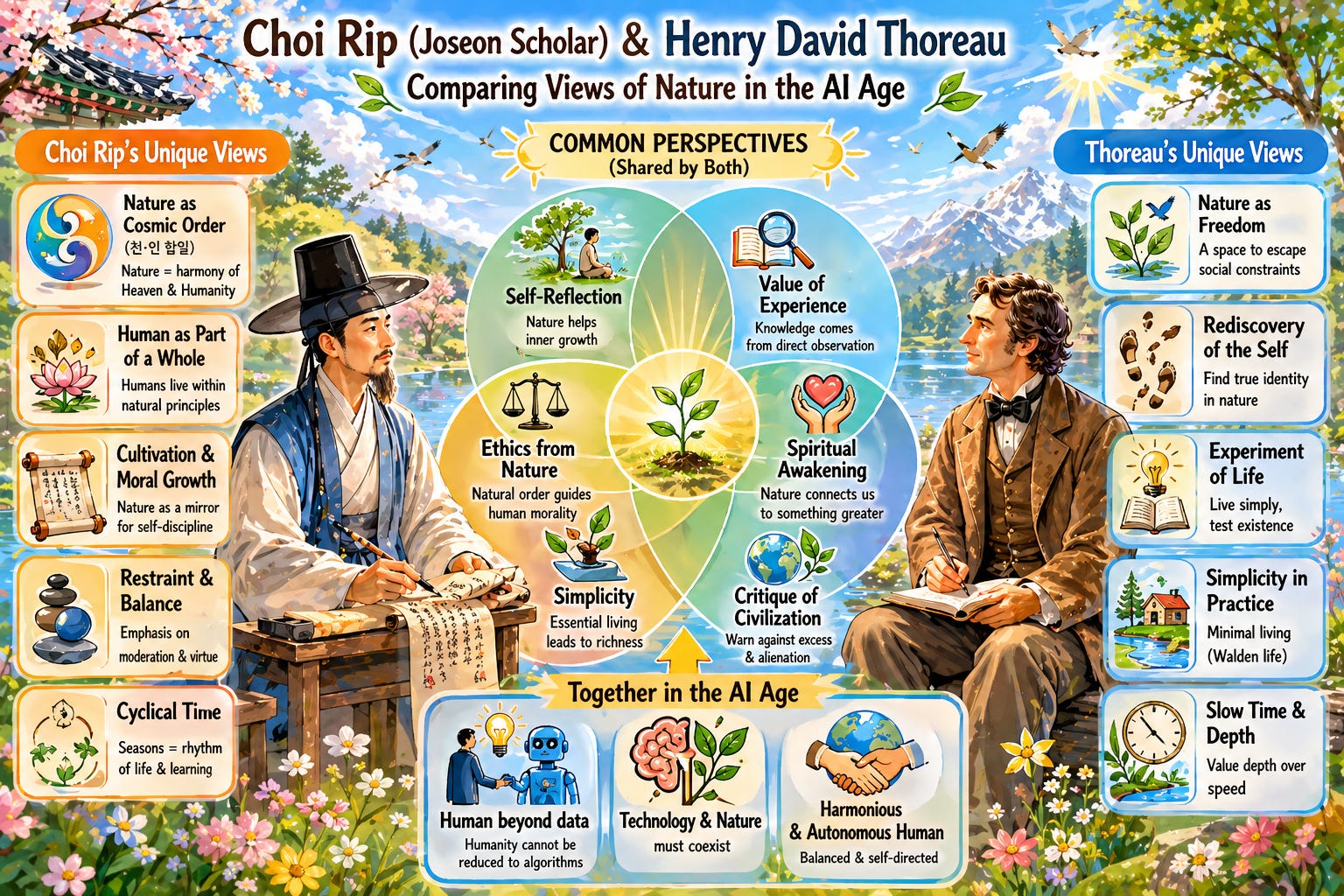
In the sweeping transformation of the AI era, comparing the views of nature held by Choi Rip and Henry David Thoreau goes beyond a simple intellectual exercise; it becomes a way of rethinking the direction of human existence itself. Although they lived in different times and cultural contexts, both thinkers are deeply connected in their shared effort to understand the essence of humanity through nature. The following ten perspectives present a clearer and more expanded comparison.
1. Ontology of Nature: An Ordered Universe vs. A Space of Freedom
For Choi Rip, nature is a harmonious system in which heaven and humanity are interconnected. It is a balanced structure that humans are meant to understand and follow. In contrast, for Thoreau, nature is a space where individuals can escape social constraints and recover their freedom. He sought to redesign his life within nature. In the AI era, these perspectives appear as a tension between “algorithmic order” and “human freedom.”
2. Relationship Between Humans and Nature: Part of a Whole vs. Rediscovered Self
Choi Rip viewed humans as an integral part of nature. Humans are not separate but exist within natural order and should live according to its principles. Thoreau, on the other hand, believed that humans had lost their true selves in civilization and must rediscover their authentic identity in nature. While AI technologies tend to analyze and categorize humans as data, both thinkers remind us that human beings can only be fully understood in relation to nature.
3. Nature and Self-Reflection: A Mirror of Cultivation vs. A Life Experiment
For Choi Rip, nature is a place to cultivate the mind. He reflected on his thoughts and actions in natural settings to pursue moral growth. For Thoreau, nature was a space for experimenting with life itself. He lived in nature to explore the meaning of existence. Even in the AI age, where humans are surrounded by information, nature remains a powerful space for deep self-reflection.
4. Nature and Simplicity: A Life of Restraint vs. A Minimal Life
Choi Rip emphasized a life of restraint and balance, aligning oneself with the order of nature. Thoreau practiced a life of simplicity by reducing unnecessary possessions and focusing on essentials. He believed that simplicity leads to greater richness of life. In today’s complex technological environment, both perspectives highlight the enduring value of simplicity.
5. Nature and Knowledge: Understanding Principles vs. Experiential Knowing
Choi Rip approached nature through the study of classical knowledge and universal principles, treating it as something to be interpreted. Thoreau emphasized direct experience and observation as the highest form of knowledge. In an age where AI generates knowledge from vast datasets, both thinkers underscore the importance of embodied, lived understanding.
6. Nature and Ethics: Moral Order vs. Natural Law
Choi Rip saw the harmony of nature as a model for human morality. For him, natural order provided a foundation for ethical living. Thoreau used the laws of nature as a standard to critique unjust social systems. In contemporary debates on AI ethics, nature can still serve as a reference point beyond purely human-centered reasoning.
7. Nature and Time: Cyclical Rhythm vs. Slow Time
Choi Rip recognized stable rhythms of life in nature’s recurring cycles, such as the changing seasons. Thoreau, by contrast, experienced time in nature as slow and profound, valuing depth over speed. In the fast-paced AI era, these perspectives help restore a more balanced understanding of time.
8. Nature and Critique of Civilization: Emphasis on Restraint vs. Active Resistance
Choi Rip warned against excessive human desires and promoted balance. Thoreau actively criticized industrial society and resisted unjust institutions. As AI-driven societies risk alienating individuals, their approaches offer both internal discipline and external resistance as meaningful responses.
9. Nature and Spirituality: Realization of the Way vs. Sacred Experience
For Choi Rip, nature is where moral truth is revealed, guiding humans toward right living. For Thoreau, nature is a place of sacred experience, where one connects with something greater than oneself. In a technology-centered age, such spiritual dimensions become even more significant.
10. Nature and the Future Human Ideal: Harmonious Being vs. Autonomous Individual
Choi Rip envisioned an ideal human who lives in harmony with nature and embodies moral integrity. Thoreau emphasized an independent individual who lives freely and deliberately in nature. In the AI era, the future human ideal may well be a synthesis of these two: a person who is both harmonious and autonomous.
In conclusion, the views of nature presented by Choi Rip and Thoreau invite us to reconsider the direction of humanity in the age of AI. Nature is no longer merely a backdrop of the past, but a vital reference point for understanding ourselves and shaping the future. +++
{Solti}
April 30, 2026
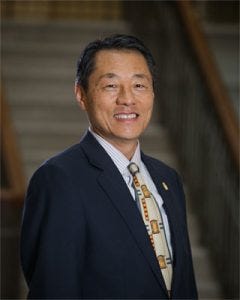
Young Choi, PhD is a Professor at Regent University bringing a rare combination of technical expertise and creative spirit to everything he does. A scholar in AI, cybersecurity, and network & telecommunications service management, he has published 38 books including AI and cybersecurity area books, over 200 refereed articles, and over 20 book chapters. Beyond the academy, Dr. Choi is a passionate poet, essayist, and wooden block engraving artist whose reflective writing invites readers to rediscover life’s beauty in quiet contemplation. He lives under the motto: “Study hard and give generously without holding back! (열심히 공부해서 아낌없이 남주자 !)”
Published books: https://www.amazon.com/stores/Young-Choi/author/B0DMZ5S6R7?ref=ap_rdr&shoppingPortalEnabled=true