
Executive Summary
Günter Grass and Kim Ji-ha emerged from very different historical contexts, yet both demonstrate how literature can connect historical experience with moral responsibility and public action. Grass became an important postwar voice urging Germany to confront historical guilt and collective responsibility, while Kim Ji-ha acted as a literary and civic activist during Korea’s authoritarian transition, using satire and poetic witness to challenge repression and defend human dignity. Their contrasting roles illustrate a broader principle of nexus leadership: societies need voices that help the public remember historical lessons while resisting injustice in changing contemporary contexts, transforming memory and moral courage into constructive social renewal.
Keywords: Collective Memory; Historical Remembrance; Democratic Resistance; Nexus Leadership; Moral Responsibility
1. Introduction
This article began with a series of conversations between two scholars trained in different intellectual traditions. Heejoong Kim, trained in German literature and memory studies, completed his Ph.D. research on Günter Grass’s later works within the context of German memory culture, while also developing a comparative perspective on the early works of Korean poet Kim Ji-ha. Paul C. Hong, a global supply chain and management scholar, has become increasingly interested in literature as another way of understanding how individuals, institutions, and societies respond to disruption, uncertainty, historical experience, and moral choice. Their conversations brought together literary interpretation and broader questions of social responsibility, leading to a central question: What can literature teach us about how societies remember the past, resist injustice, and carry those lessons into the future?
The comparison between Günter Grass and Kim Ji-ha emerged naturally from Kim’s earlier scholarly work and from the authors’ subsequent discussions. Grass and Kim came from different languages, political systems, and literary traditions, yet both treated literature as more than artistic expression. Grass repeatedly challenged postwar Germany to confront Nazism, collective guilt, silence, and historical responsibility, while Kim Ji-ha used poetry and satire to challenge political repression and defend justice, freedom, and human dignity during South Korea’s authoritarian period. Their contrasting experiences reveal two complementary functions of literature: Grass asks societies to remember; Kim Ji-ha challenges them to resist (Grass, 1962; Kim, 1974; Kim, 2003).
These conversations also led naturally to the concept of collective memory. Maurice Halbwachs demonstrated that memory is socially constructed rather than simply individual (Halbwachs, 1992). Jan Assmann distinguished communicative memory from cultural memory transmitted across generations, while Aleida Assmann further differentiated storage memory from functional memory (A. Assmann, 2011; J. Assmann, 2011). Pierre Nora similarly showed how societies sustain historical consciousness through lieux de mémoire, or sites of memory (Nora, 1989). Literature can therefore be understood as a distinctive medium through which historical experiences are not merely recorded but interpreted, contested, remembered, and transmitted.
The central argument of this article is that remembering and resisting are not competing literary functions but complementary forms of social responsibility. Grass demonstrates how literature can compel societies to confront uncomfortable truths and accept historical accountability, while Kim Ji-ha shows how literature can preserve moral courage and resistance in the face of political injustice. Remembering without resistance can become passive commemoration, whereas resistance without remembering can lose historical direction. Taken together, their literary legacies suggest that truthful remembrance and principled resistance are both necessary for preserving human dignity and strengthening collective responsibility.
2. Contextual Overview
Postwar Germany and authoritarian Korea represent two very different historical settings, yet both reveal how political authority, ordinary citizens, public intellectuals, dissident voices, and the broader majority interact in periods of moral and political transformation.
Germany’s central challenge was how to confront historical guilt and responsibility after dictatorship and war, whereas Korea’s challenge was how to resist repression and defend human dignity under authoritarian rule. In both cases, social change depended on the movement from private experience toward public consciousness, collective judgment, and broader civic response.
2.1. Postwar Germany: From Burdened Memory to Accountable Remembrance
Postwar Germany inherited the moral and political burden of Nazism, war, mass violence, and national collapse. Political authority faced the difficult task of rebuilding democratic institutions while society struggled with trauma, guilt, silence, and the temptation to distance itself from the recent past. For many ordinary citizens, the immediate postwar years involved not only material reconstruction but also an uneasy relationship with questions of complicity, responsibility, and remembrance. The historical problem was therefore not simply how Germany could recover economically and politically, but how it could confront a past that many initially preferred to suppress or compartmentalize.
Public intellectuals, writers, historians, educators, and civic voices gradually became important nexus actors connecting historical experience with public debate. Günter Grass belonged to this wider intellectual environment, using literature to challenge silence and force difficult questions about guilt, memory, and responsibility into public consciousness. As such debates expanded, the broader majority increasingly moved from avoidance toward moral reckoning, public discussion, and institutionalized remembrance. The long-term outcome was the development of a stronger culture of accountable memory, in which remembrance became connected with responsibility, democratic renewal, and continuing self-examination.
Figure 1 shows that historical change cannot be understood through rulers or prominent writers alone, because the meanings of oppression, guilt, resistance, and responsibility emerge through interactions among rulers, the ruled, nexus activists, and the broader majority. By placing postwar Germany and authoritarian Korea side by side, the figure highlights how different historical contexts produced different pathways—Germany toward accountable memory and Korea toward civic resistance—while both depended on the gradual movement of private experience into public consciousness. These broader historical dynamics provide the foundation for the more detailed discussion of the roles played by writers, intellectuals, civic actors, and the broader public within those historical contexts, and of how their legacies continued to shape collective memory, democratic responsibility, and constructive social resolution over time.
Figure 1
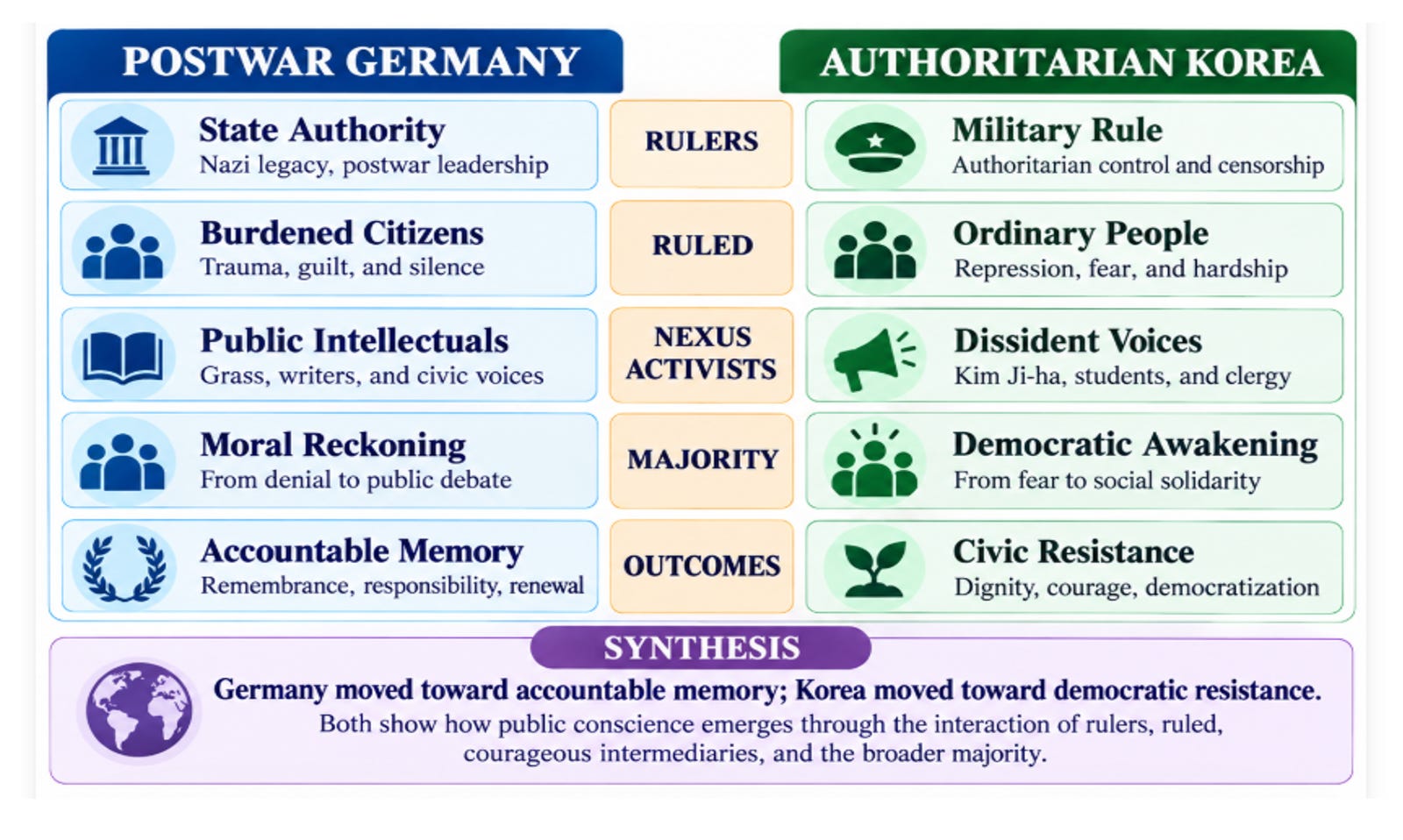
Historical Contexts of Remembering and Resisting: Rulers, Ruled, Nexus Activists, Majority, and Outcomes
2.2. Authoritarian Korea: From Repression to Democratic Resistance
South Korea’s authoritarian period developed under a different historical structure. Political authority was concentrated within military-backed governments that emphasized order, rapid development, national security, and centralized control, while also restricting political dissent and public criticism. Ordinary citizens experienced this environment unevenly, but censorship, surveillance, fear, and political repression shaped the boundaries of public expression. The central tension was therefore less about confronting the crimes of a defeated regime than about how citizens could respond to injustice and restrictions occurring in their own time.
Within this setting, poets, students, clergy, journalists, intellectuals, and other dissident voices acted as nexus activists between political repression and broader public awareness. Kim Ji-ha became one of the most visible literary figures in this role, transforming poetry and satire into forms of witness that exposed corruption, oppression, and violations of human dignity. Such voices did not act alone; their influence depended on the gradual expansion of social solidarity among students, workers, religious communities, civic organizations, and ordinary citizens. Over time, fear increasingly gave way to democratic awakening, contributing to a broader culture of civic resistance grounded in dignity, courage, participation, and democratization.
2.3. Comparing the Two Contexts: Rulers, Ruled, Nexus Activists, and the Majority
The German and Korean cases differ in historical timing, political structure, and the nature of the central moral problem. Postwar Germany confronted the legacy of a collapsed dictatorship and the question of how a society should remember its own involvement in historical wrongdoing; authoritarian Korea confronted ongoing political repression and the question of how citizens should respond to injustice while it was occurring. In Germany, the movement was broadly from silence toward remembrance; in Korea, it was from fear toward resistance. Yet both contexts show that public transformation involved more than a simple confrontation between rulers and the ruled.
The crucial connecting role was played by nexus activists—writers, intellectuals, students, clergy, and civic voices who translated private suffering or historical discomfort into public language. Their influence became consequential when the broader majority began to engage with the questions they raised, whether through moral reckoning, public debate, solidarity, or collective action. The eventual outcomes were therefore different but related: Germany developed a stronger culture of accountable memory, while Korea strengthened civic resistance and democratic participation. The shared pattern is clear: rulers shape the conditions, the ruled experience them, nexus activists interpret and challenge them, and the majority determines whether memory or resistance becomes a broader social force.
3. Roles of Günter Grass and Kim Ji-ha
Although literary works often transcend the lives of their authors, understanding the historical experiences, cultural environments, and intellectual commitments that shaped writers provides valuable insight into the enduring significance of their works. Günter Grass and Kim Ji-ha wrote in response to very different national crises, yet both believed that literature bears a profound responsibility to preserve historical truth, awaken public conscience, and encourage moral reflection.
Figure 2
Günter Grass and Kim Ji-ha: Remembering and Resisting Through Collective Memory
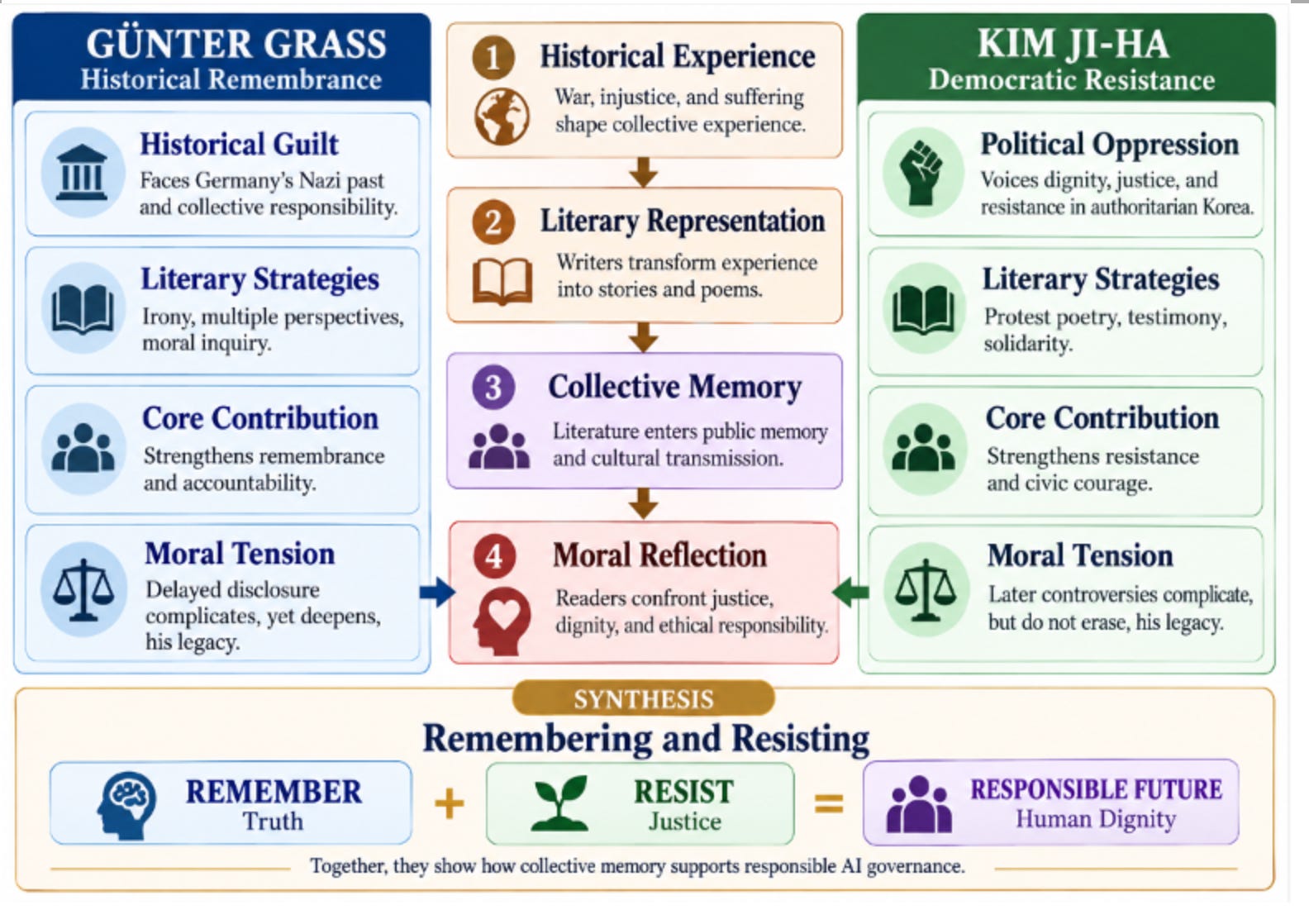
Source: Authors’ Own Synthesis
Figure 2 presents two complementary pathways through which literature shapes collective memory: Günter Grass emphasizes historical remembrance, while Kim Ji-ha emphasizes democratic resistance. Their works move from historical experience to literary representation, then into collective memory and finally moral reflection, showing how literature transforms suffering and injustice into public meaning. Grass reminds societies to remember uncomfortable truths with accountability, while Kim Ji-ha reminds them to resist injustice with courage and human dignity. Together, the figure captures the article’s central message: remember truth, resist injustice, and build a more responsible future.
3.1. Günter Grass: The Conscience of Germany’s Memory Culture
Günter Grass (1927–2015) was born in the Free City of Danzig (now Gdańsk, Poland) during one of Europe’s most turbulent periods. As a teenager, he experienced the collapse of Nazi Germany firsthand, including military service during the final stages of World War II. These formative experiences profoundly influenced his lifelong determination to confront Germany’s difficult past rather than allow it to be forgotten or simplified. Throughout his literary career, Grass consistently argued that democratic societies mature only when they acknowledge historical guilt, examine uncomfortable truths, and cultivate open public dialogue (Grass, 1962).
His landmark novel The Tin Drum (1959), together with later works such as Cat and Mouse and Dog Years, challenged postwar Germany to confront Nazism, wartime complicity, and postwar silence. Rather than portraying history as a closed chapter, Grass viewed remembrance as an ongoing civic obligation requiring continuous reflection and debate. Yet his moral authority became more complicated after his 2006 disclosure that, as a teenager, he had served in the Waffen-SS—a fact he had not publicly revealed during the decades in which he became one of Germany’s most prominent advocates of confronting the Nazi past. The controversy exposed a tension between his public call for historical candor and his delayed personal disclosure, but it also deepens the significance of his legacy for collective memory: remembering requires not only confronting a nation’s uncomfortable past but also facing one’s own. Grass’s life and writings therefore illuminate both the moral necessity of historical accountability and the human difficulty of practicing complete self-confrontation (Grass, 1962; Grass, 2008; A. Assmann, 2011).
3.2. Kim Ji-ha: The Poet of Democratic Resistance
Kim Ji-ha (1941–2022) emerged as one of South Korea’s most influential poets and public intellectuals during decades marked by political authoritarianism and rapid social transformation. Writing primarily during the 1970s under the Park Chung-hee government, Kim employed poetry, satire, and traditional Korean literary forms to expose political repression, social injustice, and violations of human rights. His writing and political activism led to censorship, imprisonment, surveillance, torture, and repeated legal persecution, transforming him into an international symbol of artistic freedom and democratic resistance (Kim, 1974; Kim, 2003).
Among his most influential works, Five Bandits sharply criticized political corruption and the concentration of economic and political power, while many of his poems gave voice to ordinary citizens whose experiences were excluded from official narratives. Kim understood literature not merely as artistic expression but as moral witness capable of preserving the memory of suffering and inspiring democratic aspirations. Yet his legacy also contains an important moral tension: the poet who became an internationally recognized symbol of resistance later adopted philosophical and public positions that generated controversy and disagreement within Korean society. This does not erase the courage or historical significance of his earlier resistance, but it complicates any simple portrayal of him as a fixed moral symbol. Kim’s changing public identity therefore reminds us that collective memory should preserve not only heroic moments but also the ambiguities, transformations, and contradictions that accompany a human life (Kim, 1974; Kim, 2003).
A society that remembers with honesty builds wisdom. A society that resists injustice preserves freedom.
4. Literary Masterpieces: Remembering and Resisting Through Literature
The literary legacies of Günter Grass and Kim Ji-ha are best understood through their major works, which transformed literature into a vehicle for historical remembrance, moral reflection, and democratic engagement. Rather than merely recording historical events, both writers challenged readers to confront difficult truths, question established narratives, and assume responsibility for shaping a more just society. Their writings demonstrate that literature not only reflects collective memory but also actively constructs and renews it across generations (Halbwachs, 1992; J. Assmann, 2011).
Table 1
Günter Grass and Kim Ji-ha on Collective Memory
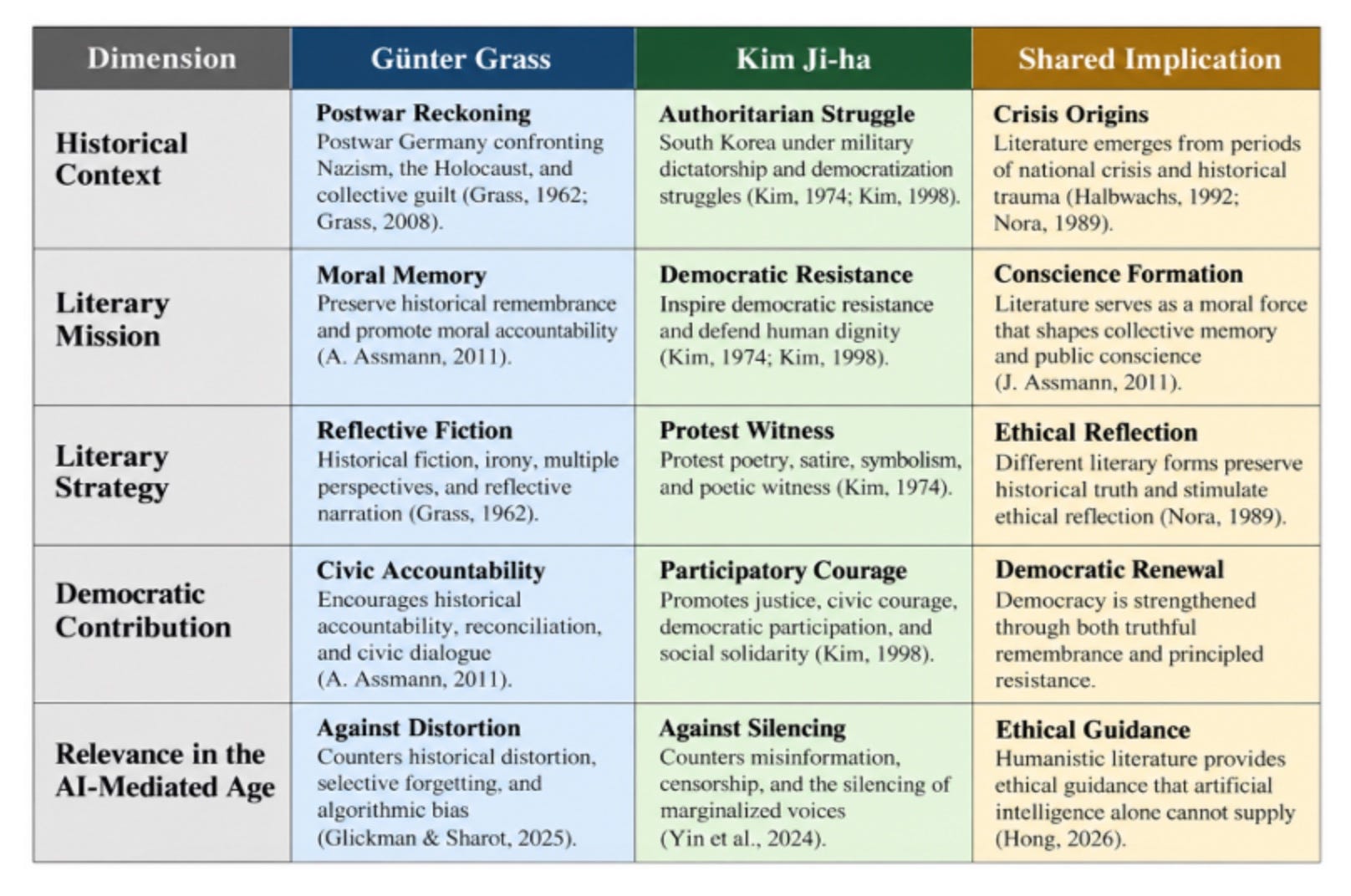
Source: Authors’ Synthesis
Table 1 provides a concise comparative summary of how Günter Grass and Kim Ji-ha used literature as a medium of collective memory in two different historical settings. Grass is presented as a writer of historical remembrance and moral accountability in postwar Germany, whereas Kim Ji-ha is presented as a poet of democratic resistance and human dignity in authoritarian Korea, while the shared implication column shows that both literary paths strengthen public conscience and civic responsibility. By organizing the comparison across historical context, literary mission, strategy, democratic contribution, and contemporary relevance, the table makes clear that literature does not merely reflect history but helps societies interpret trauma, preserve truth, and pursue constructive moral and political renewal.
4.1. Günter Grass’s The Tin Drum: Remembering the Burden of History
Published in 1959, The Tin Drum (Die Blechtrommel) established Günter Grass as one of the leading literary voices of postwar Europe. Through the unforgettable character Oskar Matzerath, who refuses to grow physically while witnessing the moral collapse of German society, Grass employs satire, magical realism, and historical symbolism to expose the consequences of Nazism, war, and collective silence. Rather than offering a straightforward historical narrative, the novel challenges readers to examine how ordinary individuals become participants in or spectators of historical injustice. The novel became an influential contribution to Germany’s evolving public discourse about its past. Grass rejected selective forgetting and argued that democratic societies cannot build a healthy future without honestly confronting historical guilt. The Tin Drum therefore became more than a literary masterpiece; it became an important contribution to Germany’s evolving Erinnerungskultur (memory culture), encouraging generations of readers to recognize remembrance as an ethical and civic responsibility rather than a purely historical exercise (Grass, 1962; A. Assmann, 2011; Nora, 1989).
4.2. Kim Ji-ha’s Five Bandits: Resisting Oppression Through Poetic Witness
Kim Ji-ha’s satirical poem Five Bandits (오적), published in 1970, became an influential literary expression of Korea’s democratization struggle by exposing the connections among political authority, economic privilege, corruption, and social inequality. Drawing on satire and traditional Korean literary forms, Kim challenged official narratives and gave voice to people whose experiences of repression and injustice were often excluded from public discourse (Kim, 1974). Government censorship, imprisonment, surveillance, and repeated persecution increased the personal cost of his criticism but also reinforced his public role as a literary witness to injustice and human dignity. Five Bandits thus demonstrates how literature can preserve the memory of oppression while turning satire, testimony, and moral courage into forms of peaceful resistance and hope for democratic transformation (Kim, 1974; Kim, 2003).
5. Comparative Analysis: Lessons from Günter Grass and Kim Ji-ha
The comparison of Günter Grass and Kim Ji-ha reveals two complementary democratic responsibilities: truthful remembrance of historical wrongdoing and principled resistance to present injustice (Halbwachs, 1992; J. Assmann, 2011; Nora, 1989).
5.1. Günter Grass: Remembering as Moral Responsibility
One of Grass’s enduring contributions is his insistence that societies cannot build a healthy future by suppressing painful memories, because historical responsibility begins with acknowledging uncomfortable truths rather than constructing convenient national myths. By confronting Germany’s experience of Nazism, war, and collective guilt, his writings helped make remembrance a democratic responsibility rather than merely a source of shame (Grass, 1962; A. Assmann, 2011). Grass also emphasized that memory culture should remain an open public conversation grounded in self-criticism, historical evidence, and multiple perspectives rather than becoming a rigid official narrative. In this sense, his literary legacy suggests that honest remembrance can support reconciliation, civic trust, democratic maturity, and ultimately stronger national resilience (A. Assmann, 2011; Nora, 1989).
5.2. Kim Ji-ha: Resisting as Democratic Responsibility
Where Grass emphasized historical remembrance, Kim Ji-ha emphasized moral resistance to injustice in the present, showing how silence under oppression can erode human dignity and democratic freedom. Through satire, symbolism, and poetic witness, Kim transformed literature into an act of civic courage that preserved marginalized voices and encouraged ordinary citizens to defend truth despite censorship and repression (Kim, 1974; Kim, 2003). His writings suggest that freedom is neither automatic nor permanent but depends on vigilance, ethical conviction, public participation, and the preservation of lived experiences of suffering, sacrifice, and hope. Günter Grass and Kim Ji-ha show that remembrance safeguards historical truth, resistance protects democratic freedom, and literature sustains the moral imagination needed for responsible collective life (Glickman & Sharot, 2025; Yin et al., 2024; Hong, 2026).
Artificial intelligence can preserve information; human conscience gives collective memory meaning and responsibility for future generations.
6. Conclusion
In any era, societies need nexus leaders who connect historical lessons with present challenges—remembering what must not be forgotten while resisting what should not be accepted. Kim Ji-ha played this role during Korea’s difficult transition from authoritarian rule toward democratization, using literature and activism to expose repression, defend human dignity, and give moral language to civic resistance. Günter Grass played a different but equally important role in postwar Germany by pressing society to confront Nazism, collective guilt, and historical responsibility, even though his own delayed disclosure of Waffen-SS service complicated his moral authority. Their personal limitations do not erase the significance of their messages: constructive social renewal depends on voices willing to interpret the past, challenge the present, and help the broader public transform memory and resistance into responsibility.
References
Assmann, A. (2011). Cultural memory and Western civilization: Functions, media, archives. Cambridge University Press. (Original work published 1999)
Assmann, J. (2011). Cultural memory and early civilization: Writing, remembrance, and political imagination. Cambridge University Press. (Original work published 1992)
Glickman, M., & Sharot, T. (2025). How human–AI feedback loops alter human perceptual, emotional and social judgements. Nature Human Behaviour, 9(2), 345–359. https://doi.org/10.1038/s41562-024-02077-2
Grass, G. (1962). The tin drum (R. Manheim, Trans.). Pantheon Books. (Original work published 1959)
Grass, G. (2004). Crabwalk (K. Winston, Trans.). Faber & Faber. (Original work published 2002)
Grass, G. (2008). Peeling the onion (M. H. Heim, Trans.). Vintage. (Original work published 2006)
Halbwachs, M. (1992). On collective memory (L. A. Coser, Ed. & Trans.). University of Chicago Press. (Original work published 1925)
Hong, P. C. (2026, June 18). Between the inner journey and the outer struggle: Hermann Hesse and Ernest Hemingway on human flourishing in the AI-mediated collective memory. K-Global Scholars and Professionals Forum, 1–9.
Kim, C.-H. (1974). Cry of the people and other poems. Autumn Press.
Kim, J.-H. (2003). 흰 그늘의 길 [The path of the white shadow] (Vols. 1–3). Hakgojae.
Nora, P. (1989). Between memory and history: Les lieux de mémoire. Representations, 26, 7–24. https://doi.org/10.2307/2928520
Yin, Y., Jia, N., & Wakslak, C. J. (2024). AI can help people feel heard, but an AI label diminishes this impact. Proceedings of the National Academy of Sciences, 121(14), Article e2319112121. https://doi.org/10.1073/pnas.2319112121
ABOUT THE AUTHORS

Heejoong Kim — Lecturer in German Literature, Hankuk University of Foreign Studies
Heejoong Kim is a lecturer in German literature at Hankuk University of Foreign Studies whose research focuses on modern German literature, memory studies, and collective memory. He earned his Ph.D. in Modern German Literature from Ludwig Maximilian University of Munich, where his research examined Günter Grass and Korean poet Kim Ji-ha through the lens of memory culture and historical responsibility. His scholarship explores how literature preserves historical memory, encourages moral reflection, and strengthens intercultural understanding in the AI-mediated age.

Paul C. Hong — Distinguished University Professor, University of Toledo
Paul C. Hong is a Distinguished University Professor at the University of Toledo whose research spans leadership, governance, global supply chain management, and decision-making in the AI-mediated age. His interest in literature grew from his work as a global supply chain scholar, where he came to see that complex systems are shaped not only by technology, economics, and institutions but also by human character, cultural memory, moral judgment, and historical experience. This perspective led him to explore literature, biography, history, and philosophy as complementary sources of insight into leadership and human development. He believes that as artificial intelligence transforms society, understanding human nature and moral judgment becomes increasingly important for responsible leadership and innovation.
Original Article:

Suggested Citation
Kim, H., & Hong, P. C. (2026, October 1). Between remembering and resisting: Günter Grass and Kim Ji-ha on collective memory in the AI-mediated age. K-GSP Forum, pp. 1–11.
한글요약
기억과 저항 사이: 귄터 그라스와 김지하가 AI 시대의 집단기억에 주는 교훈
김희중은 한국외국어대학교에서 독일문학을 강의하며, 현대 독일문학·기억연구·집단기억과 역사적 의식을 연구한다.
Paul C. Hong은 미국 University of Toledo의 Distinguished University Professor로 리더십·거버넌스·글로벌 공급망·AI 시대의 의사결정과 인간적 지혜를 연구하며, 공급망 현상을 경제적 효율성과 기술의 문제만이 아니라 인간의 선택, 역사적 경험, 문화적 가치와 사회적 책임이 상호작용하는 과정으로 이해하기 위해 문학적 통찰을 중요하게 여긴다.
인공지능은 이제 단순히 정보를 처리하는 도구를 넘어, 어떤 역사적 사건과 이야기가 기억되고 강조되며 잊히는지를 결정하는 집단기억의 새로운 매개자가 되고 있다. 검색 알고리즘과 생성형 AI는 방대한 역사 자료를 보존하고 접근성을 높일 수 있지만, 동시에 잘못된 정보, 알고리즘 편향, 선택적 기억과 역사 왜곡을 확대할 위험도 가지고 있다. 이러한 시대에 문학은 단순히 과거의 사실을 기록하는 것이 아니라 인간의 고통과 감정, 도덕적 갈등을 해석하고 다음 세대가 역사를 어떻게 기억해야 하는지를 성찰하게 하는 중요한 역할을 한다. 이 글은 집단기억 이론을 바탕으로 독일의 귄터 그라스(Günter Grass)와 한국의 김지하(Kim Ji-ha)를 비교하면서, 문학이 역사적 경험을 집단기억과 도덕적 성찰로 전환하여 민주적 책임과 윤리적 AI 거버넌스에 기여할 수 있음을 제시한다.
두 작가는 서로 다른 역사와 문학적 전통에서 출발했지만, 문학을 사회적 양심과 도덕적 책임의 수단으로 보았다는 점에서 만난다. 귄터 그라스는 『양철북(The Tin Drum)』을 비롯한 작품들을 통해 나치즘, 홀로코스트, 전쟁과 독일 사회의 집단적 책임을 끊임없이 되돌아보게 하면서, 민주사회의 성숙은 불편한 과거를 망각하는 것이 아니라 정직하게 기억(remembering) 하는 데서 시작된다고 강조하였다. 반면 김지하는 군사독재 시대에 「오적(Five Bandits)」과 같은 풍자시를 통해 정치적 억압, 부패와 사회적 불의를 고발하고 인간의 존엄성과 자유를 위한 저항(resisting) 의 목소리를 냈다. 따라서 그라스가 “과거의 잘못을 어떻게 기억할 것인가”라는 역사적 책임을 강조했다면, 김지하는 “현재의 불의에 어떻게 저항할 것인가”라는 민주적 책임을 강조하였다. 기억 없는 저항은 역사적 방향을 잃을 수 있고, 저항 없는 기억은 수동적인 기념에 머물 수 있다는 점에서 두 사람의 문학은 상호보완적이다.
이러한 비교는 AI 시대에 더욱 중요한 의미를 갖는다. AI는 엄청난 양의 역사적 정보를 저장하고 설득력 있는 이야기를 만들어낼 수 있지만, 어떤 기억이 도덕적 관심을 받아야 하는지, 어떤 왜곡에 저항해야 하는지, 그리고 과거의 고통을 오늘의 책임과 어떻게 연결할 것인지 스스로 판단할 수는 없다. 그라스는 기술적 진보가 역사적 기억과 책임 위에 세워져야 함을 일깨우고, 김지하는 민주사회가 새로운 형태의 검열·조작·배제에 지속적으로 저항해야 함을 보여준다. 결국 이 글이 제시하는 핵심은 명료하다. 기억은 역사적 진실을 지키고, 저항은 민주적 자유를 보호하며, 문학은 AI가 대신할 수 없는 인간의 윤리적 상상력과 양심을 길러준다. AI가 정보를 보존할 수 있다면, 그 정보를 지혜와 책임으로 전환하여 미래 세대에게 전달하는 일은 여전히 인간의 몫이다.
© K-Global Scholars and Professionals Forum. All rights reserved. Content published in the K-GSP Forum may not be reproduced, distributed, or transmitted in any form without prior written permission from the K-GSP Forum, except for brief quotations with full attribution.