

EXECUTIVE SUMMARY
Hermann Hesse and Ernest Hemingway were two of the most influential twentieth-century writers, yet they pursued remarkably different paths in understanding the human condition. Hesse explored the inner world of self-discovery, spirituality, and personal transformation, while Hemingway focused on courage, endurance, and dignity amid life’s harsh realities. Together, their works offer complementary insights that remain highly relevant in the AI Era, where individuals must balance inner meaning with external performance.
Key Words: Self-Discovery; Existential Resilience; Spiritual Growth; Human Dignity; Authentic Living
1. Introduction
Although contemporary readers are often drawn to popular fiction, digital media, and entertainment-oriented content, classic literary works continue to attract scholars, educators, and reflective readers. Authors such as Hermann Hesse and Ernest Hemingway remain widely studied in university courses, discussed in literary circles, and revisited by readers seeking insight into enduring questions of identity, suffering, purpose, and personal growth. In an era increasingly shaped by artificial intelligence and technological change, their works offer perspectives on dimensions of human experience that remain difficult to reduce to algorithms or technological solutions. Their continuing relevance lies in their ability to illuminate fundamental aspects of the human condition across generations.
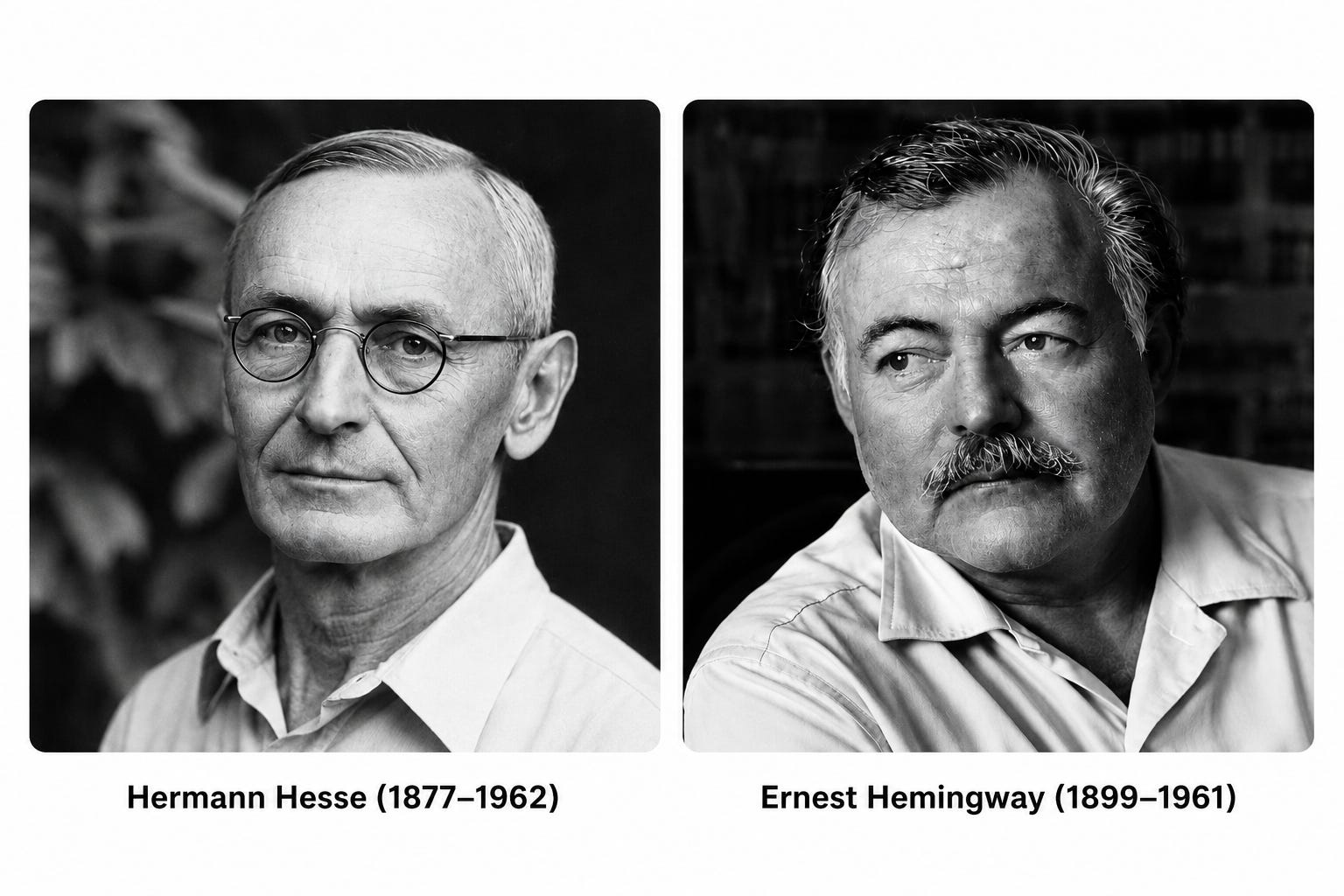
Among the most influential literary figures of the twentieth century, Hermann Hesse and Ernest Hemingway approached many of life’s central questions through different literary emphases. Hesse explored themes of spiritual growth, identity, self-discovery, and the search for meaning, while also critically examining social conventions and institutional structures. Hemingway portrayed characters confronting hardship, conflict, and adversity, yet his works also examine deeper questions of faith, purpose, suffering, dignity, and mortality. Rather than representing opposing worldviews, both writers sought to understand the human condition through different narrative styles and points of emphasis (Mileck, 1978; Donaldson, 1977).
The perspectives of Hesse and Hemingway offer valuable insights for discussions of human flourishing in the AI Era. As artificial intelligence becomes increasingly integrated into work, communication, and decision-making, questions concerning identity, purpose, resilience, and authenticity remain essential dimensions of human experience. Hesse’s exploration of self-discovery and spiritual development invites reflection on the inner life, while Hemingway’s portrayals of courage, responsibility, and endurance illuminate how individuals respond to adversity and uncertainty. This article compares and contrasts their biographies, literary philosophies, major themes, and enduring relevance, seeking to identify insights that may help contemporary readers navigate both the opportunities and challenges of an increasingly technological world.
2. Biographical Profiles and Intellectual Contexts
Although literary works ultimately speak for themselves, the lives of their authors often provide valuable insights into the ideas, struggles, and experiences that shaped their creative vision.
2.1. Hermann Hesse: The Seeker of the Inner World
Hermann Hesse (1877–1962) was born in Calw, Germany, into a deeply religious family shaped by Protestant missionary traditions and theological scholarship. His parents, Johannes Hesse and Marie Gundert, had both been involved in missionary work connected to India and hoped that their son would pursue a similar path of Christian service. In keeping with these expectations, Hesse entered the Protestant seminary at Maulbronn to prepare for ministry. However, he soon found himself in conflict with the institution’s rigid discipline and authority, eventually running away and experiencing significant emotional turmoil during adolescence. This episode marked the beginning of a lifelong struggle between external authority and personal authenticity (Mileck, 1978).
Rather than becoming a pastor, Hesse embarked on a different journey centered on literature, philosophy, and spiritual exploration. These formative experiences profoundly shaped his literary worldview and became recurring themes in his writings. Many of his protagonists, including Sinclair in Demian and Siddhartha in Siddhartha, reject conventional expectations in pursuit of self-discovery and personal truth. Hesse’s emphasis on individuation, spiritual freedom, and the search for meaning reflected his own efforts to reconcile inherited traditions with an authentic sense of self.
In his later years, Hesse settled in Montagnola, Switzerland, where he devoted himself to writing, painting, and reflection. His major works, including Demian, Siddhartha, and The Glass Bead Game, earned international recognition and culminated in the Nobel Prize in Literature in 1946. Throughout his life, he remained a strong advocate of individual conscience, spiritual freedom, and human dignity despite the upheavals of the twentieth century. He died peacefully in his sleep on August 9, 1962, at the age of eighty-five, leaving a literary legacy that continues to inspire readers seeking meaning, authenticity, and personal transformation.
2.2. Ernest Hemingway: The Chronicler of Human Endurance
Ernest Hemingway (1899–1961) grew up in Oak Park, Illinois, within a family shaped by contrasting parental influences. His father, Clarence Hemingway, was a physician who loved hunting, fishing, and outdoor life, while his mother, Grace Hall Hemingway, was a talented musician and a strong-willed personality who exercised considerable influence within the household. Many biographers suggest that Hemingway perceived a sharp contrast between his father’s confidence in nature and his relative passivity at home, a perception that left a lasting impression on the young writer. As a result, Hemingway came to admire courage, independence, and self-reliance while developing a deep resistance to domination and dependency (Donaldson, 1977; Reynolds, 1999).
These formative experiences influenced many of the themes that later defined Hemingway’s literary works. His protagonists frequently seek to prove themselves through action, endurance, and competence under pressure rather than through words or ideals. Characters such as Frederic Henry in A Farewell to Arms and Santiago in The Old Man and the Sea embody courage through disciplined action and perseverance amid adversity. Hemingway’s lifelong emphasis on toughness, dignity, and resilience can therefore be understood, at least in part, as a response to the tensions and contradictions he observed within his own family environment.
Hemingway’s later years reflected a striking contrast between public acclaim and private struggle. Following the publication of The Old Man and the Sea, he received the Pulitzer Prize in 1953 and the Nobel Prize in Literature in 1954, securing his place among the most celebrated writers of the twentieth century. Yet declining health, accumulated injuries, concerns about diminishing creativity, and severe depression increasingly burdened him. On July 2, 1961, Hemingway died by suicide at his home in Ketchum, Idaho, at the age of sixty-one, leaving behind a literary legacy that continues to inspire readers through its powerful portrayal of courage, endurance, and human dignity in the face of life’s inevitable challenges.
2.3. The Value of Comparing and Contrasting Hesse and Hemingway
At first glance, Hermann Hesse and Ernest Hemingway appear to occupy opposite ends of the literary spectrum. Hesse was deeply interested in introspection, spirituality, and psychological transformation, whereas Hemingway focused on action, conflict, and practical engagement with the world. Hesse sought answers through contemplation; Hemingway sought them through experience (Mileck, 1978; Donaldson, 1977). One journeyed inward in search of self-understanding, while the other journeyed outward through direct confrontation with reality and adversity.
Beneath these differences, however, lies a common concern: both writers searched for authentic ways of living in a fractured and uncertain world. Each responded to the challenges of modernity, war, alienation, and meaninglessness, but through different pathways. Hesse emphasized inner integration, spiritual growth, and self-realization, whereas Hemingway highlighted courage, discipline, resilience, and honorable conduct in the face of suffering. Together, their works offer complementary perspectives on how individuals can pursue meaning and human flourishing amid uncertainty.
The comparison is particularly valuable in the AI Era, where individuals confront both external challenges, such as technological disruption, economic uncertainty, and rapid social change, and internal questions concerning identity, purpose, and well-being. Hesse offers guidance for cultivating self-awareness and inner wisdom, while Hemingway teaches resilience, action, and composure under pressure. Their contrasting contributions were reflected in the Nobel Prizes they received: Hesse in 1946 for his exploration of spiritual and psychological self-realization, and Hemingway in 1954 for his mastery of narrative craftsmanship and portrayals of courage under pressure. Together, they represent two complementary visions of human flourishing: the inward search for meaning and the outward pursuit of dignity through action.
Hesse teaches us to examine ourselves;
Hemingway teaches us to engage ourselves.
3. Primary Works: Four Literary Masterpieces
Among their many writings, four masterpieces stand out as particularly influential in revealing the central themes that defined Hesse’s inward quest for self-understanding and Hemingway’s outward pursuit of courage and resilience.
3.1. Hermann Hesse’s Siddhartha: The Search for Spiritual Wisdom
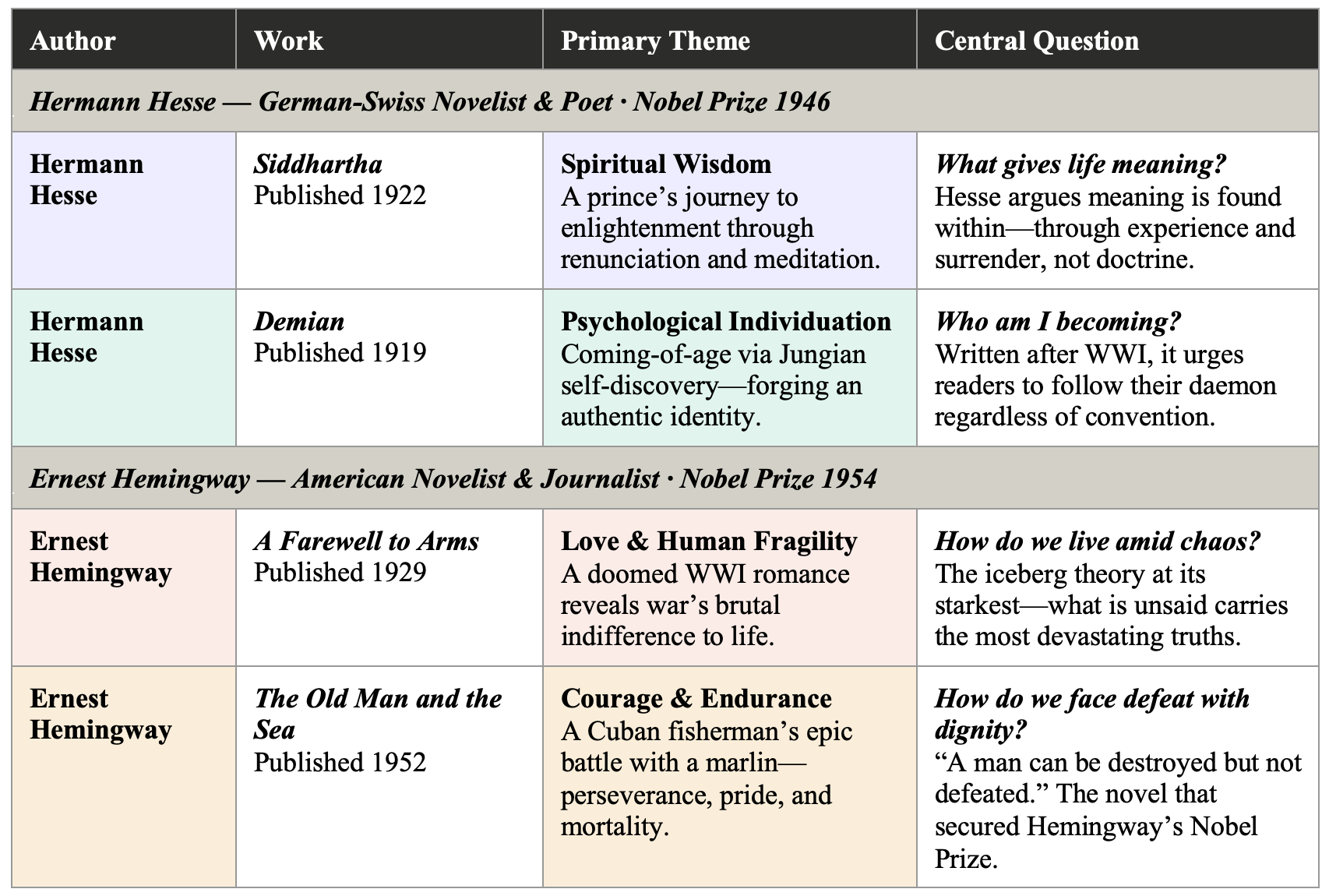
Siddhartha (1922) is Hesse’s most widely read novel and perhaps the clearest expression of his lifelong quest for self-discovery and spiritual awakening. Set in ancient India, the novel follows a young seeker’s journey toward enlightenment through experience rather than doctrine. The story explores themes of individuality, authenticity, and the integration of opposites. The river, one of the novel’s central symbols, represents the unity of life and the continuous process of learning.
For generations of readers, Siddhartha has served as a guide to personal growth and the search for meaning beyond material success. The novel reflects Hesse’s engagement with Buddhism, Hinduism, and Jungian psychology (Hesse, 1951; Tarnas, 1993) and remains highly relevant for individuals navigating questions of identity in the AI Era.
3.2. Hermann Hesse’s Demian: The Journey Toward Authentic Selfhood
While Siddhartha emphasizes spiritual wisdom, Demian (1919) focuses on psychological awakening. The novel follows Emil Sinclair as he struggles to move beyond conventional morality and discover his authentic self. Guided by the mysterious Max Demian, Sinclair learns to confront the tensions between conformity and individuality, light and darkness, social expectations and personal truth. Through Sinclair’s journey, Hesse suggests that genuine personal growth emerges from self-awareness and the willingness to embrace the complexities of one’s own identity rather than merely conforming to external expectations (Hesse, 2002).
Table 1. Four Masterpieces and Their Central Themes
Many literary scholars regard Demian as the work that established Hesse’s reputation among younger generations in the aftermath of World War I (Mileck, 1978). The novel introduced themes that would recur throughout his later writings, including self-discovery, individuation, and the need to embrace complexity within the human personality (Hesse, 2002; Mileck, 1978). Through Sinclair’s journey toward authenticity, Hesse suggests that genuine growth emerges not from conformity to external expectations but from the courage to confront one’s inner conflicts and pursue an independent path toward self-realization.
3.3. Ernest Hemingway’s A Farewell to Arms: Love, War, and Human Fragility
A Farewell to Arms (1929) established Hemingway as one of the leading literary voices of the twentieth century. Drawing heavily from his own experiences as an ambulance driver during World War I, the novel tells the tragic story of Frederic Henry and Catherine Barkley against the backdrop of war (Hemingway, 1995; Donaldson, 1977).
Unlike romanticized portrayals of heroism, Hemingway presents war as chaotic, indifferent, and deeply destructive. Yet amid suffering and uncertainty, the novel explores love, loyalty, and personal responsibility. Its emotional depth demonstrated that Hemingway’s minimalist style could convey profound human experience. The novel helped establish Hemingway’s international reputation and remains one of the most influential anti-war novels in modern literature.
3.4. Ernest Hemingway’s The Old Man and the Sea: Courage Under Pressure
Published in 1952, The Old Man and the Sea represents the culmination of Hemingway’s literary philosophy. The novella recounts the struggle of Santiago, an aging Cuban fisherman who battles a giant marlin far from shore (Hemingway, 1952). Although he ultimately loses the physical prize, he achieves a moral victory through perseverance, dignity, and unwavering determination. The work earned Hemingway the Pulitzer Prize in 1953 and contributed significantly to his receiving the Nobel Prize in Literature in 1954.
Through Santiago’s struggle, Hemingway articulated his enduring belief that human greatness is measured not by material success but by courage, endurance, and resilience in the face of adversity. Santiago’s famous observation, “A man can be destroyed but not defeated,” captures Hemingway’s ideal of grace under pressure (Hemingway, 1952). Taken together, the four masterpieces examined in this study reveal two complementary visions of human flourishing: Hesse emphasizes the inner development of identity, wisdom, and self-understanding, whereas Hemingway highlights the external realities of struggle, responsibility, and resilience.
4. Comparative Analysis: Lessons and Implications from Hesse and Hemingway
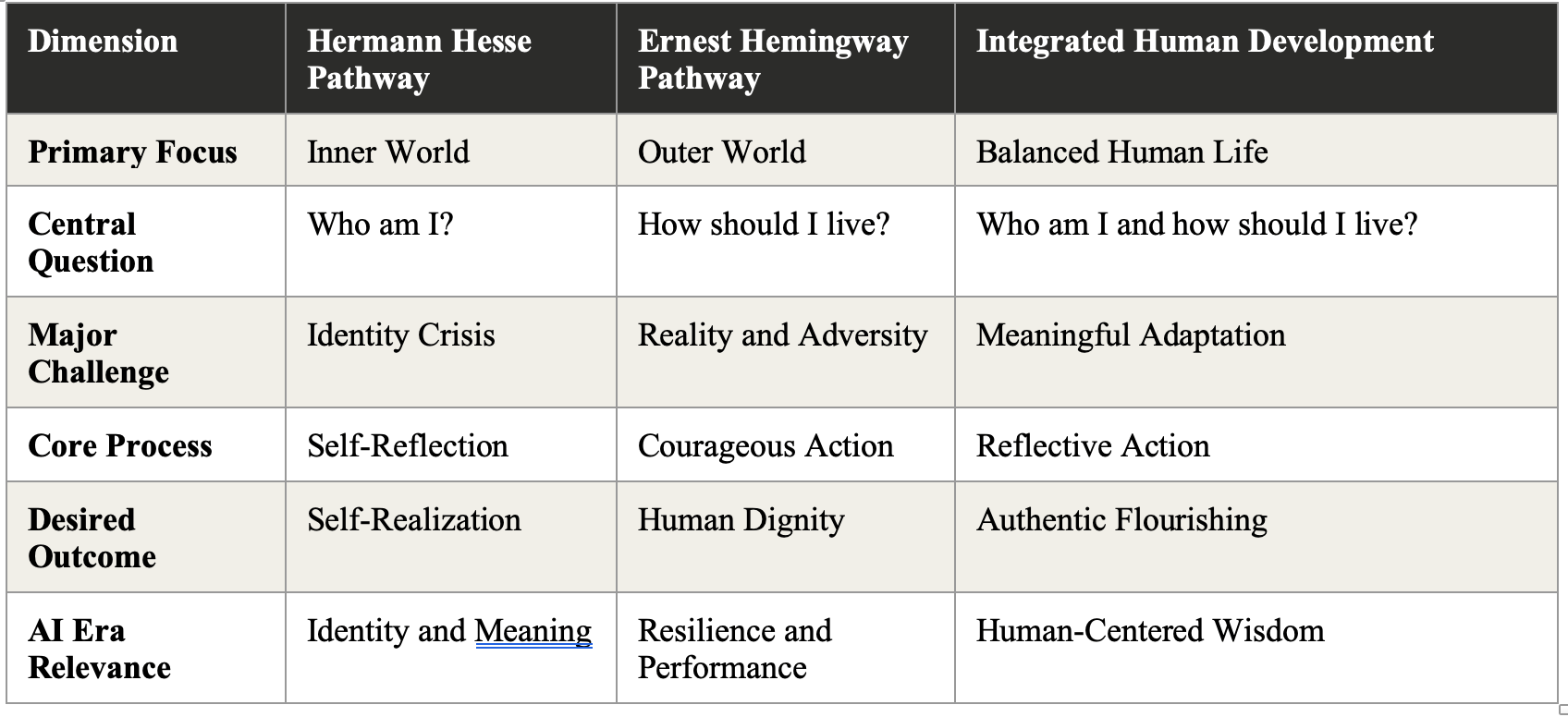
The lives and writings of Hermann Hesse and Ernest Hemingway provide two distinct yet complementary pathways for understanding the human condition. While Hesse focused primarily on the inner journey of self-discovery and spiritual integration, Hemingway concentrated on the external struggle for courage, dignity, and endurance. Their contrasting approaches can be synthesized into a framework that offers valuable lessons for individuals seeking meaning and resilience in the twenty-first century.
4.1. Lessons from Hermann Hesse: The Importance of the Inner Journey
One of the central lessons emerging from Hesse’s life and works is that external success alone cannot satisfy the deeper needs of the human spirit. Throughout his novels, characters repeatedly discover that achievement, status, and conformity fail to resolve fundamental questions of identity and purpose. Instead, meaningful living requires self-examination, introspection, and a willingness to confront one’s inner contradictions. Hesse’s protagonists often pursue authenticity by moving beyond inherited expectations and social pressures in search of a more integrated and genuine sense of self.
A second lesson concerns the necessity of continual growth and self-renewal. Hesse viewed life not as a destination but as an ongoing process of becoming (Hesse, 1951; Hesse, 2002). His writings suggest that wisdom emerges not from eliminating complexity but from learning to embrace the paradoxes and tensions inherent in human experience. In today’s world, where social media, artificial intelligence, and rapidly changing technologies increasingly shape personal choices, Hesse reminds readers of the importance of maintaining an independent inner life grounded in reflection, self-awareness, and the lifelong pursuit of meaning.
Table 2. Two Pathways Toward Authentic Human Flourishing
4.2. Lessons from Ernest Hemingway: The Importance of Courageous Engagement
Where Hesse emphasized self-discovery, Hemingway emphasized purposeful action in the face of adversity. His writings suggest that suffering, disappointment, and loss are unavoidable aspects of life; the critical question is how individuals choose to respond when confronted with them. A central theme in Hemingway’s work is “courage under pressure” (Bruccoli, 1986). His protagonists rarely achieve perfect victories, yet they demonstrate dignity through perseverance, discipline, and resilience. Santiago in The Old Man and the Sea remains the classic example of a man who may lose materially but achieves a moral victory through endurance and determination.
Another important lesson from Hemingway is the necessity of accepting reality without illusion. Influenced by his background in journalism, he valued careful observation, honesty, and clarity rather than sentimentality or wishful thinking. In an age increasingly shaped by virtual realities, algorithmic narratives, and information overload, Hemingway’s insistence on confronting reality directly remains highly relevant. His writings ultimately suggest that character is forged through action and experience, where courage, responsibility, and resilience are developed not through theory alone but through active engagement with life’s challenges.
4.3. Implications for the AI Era: Toward a Balanced Model of Human Development
The AI Era creates a unique environment in which both Hesse’s and Hemingway’s insights become increasingly important. Artificial intelligence can enhance productivity, generate knowledge, and automate routine tasks, but it cannot fully address questions of identity, purpose, morality, or human meaning. Research suggests that human–AI interactions may amplify cognitive and social biases without users’ awareness (Glickman & Sharot, 2025), while people often feel less understood when they learn that an empathetic response originates from AI rather than a human source (Yin et al., 2024). Similarly, Bjerring and Busch (2025) argue that algorithmic systems represent individuals through statistical patterns that cannot fully capture the biological, psychological, and narrative dimensions of human personhood. These findings suggest that technological capability is advancing more rapidly than human wisdom, making self-awareness, moral discernment, and authentic relationships increasingly important.
In this context, Hesse and Hemingway offer complementary perspectives for human development. Hesse emphasizes the importance of knowing oneself through reflection, self-examination, and the search for meaning, while Hemingway highlights the importance of mastering oneself through courage, discipline, and resilience in the face of adversity. One illuminates the inner landscape of identity and purpose; the other demonstrates how to navigate the external realities of life with dignity and perseverance. Together, they provide a balanced model of human flourishing that remains highly relevant in an increasingly technological world.
5. Conclusion
Hermann Hesse and Ernest Hemingway remain influential because they explored enduring questions of identity, meaning, suffering, and human flourishing through distinct yet complementary perspectives. Hesse emphasized self-discovery, spiritual growth, and authenticity, while Hemingway highlighted courage, resilience, responsibility, and dignity in the face of adversity. Together, their lives and works suggest that a meaningful life requires both inward reflection and purposeful engagement with the realities of the world. In an AI-driven age, their enduring insights remind us that wisdom, character, and human purpose remain essential foundations of authentic human flourishing.
References
Bjerring, J. C., & Busch, J. (2025). Artificial intelligence and identity: The rise of the statistical individual. AI & Society, 40(2), 311–323. https://doi.org/10.1007/s00146-024-01877-4
Bruccoli, M. J. (Ed.). (1986). Conversations with Ernest Hemingway. University Press of Mississippi.
Donaldson, S. (1977). By force of will: The life and art of Ernest Hemingway. Viking Press.
Glickman, M., & Sharot, T. (2025). How human–AI feedback loops alter human perceptual, emotional and social judgements. Nature Human Behaviour, 9(2), 345–359. https://doi.org/10.1038/s41562-024-02077-2
Hemingway, E. (1952). The old man and the sea. Charles Scribner’s Sons.
Hemingway, E. (1995). A farewell to arms. Scribner. (Original work published 1929)
Hesse, H. (1951). Siddhartha (Hilda Rosner, Trans.). New Directions. (Original work published 1922)
Hesse, H. (2002). Demian: A dual-language book (S. Appelbaum, Ed. & Trans.). Dover Publications.
Mileck, J. (1978). Hermann Hesse: Life and art. University of California Press.
Reynolds, M. S. (1999). Hemingway: The final years. W. W. Norton.
Tarnas, R. (1993). The passion of the Western mind: Understanding the ideas that have shaped our world view. Ballantine Books.
Yin, Y., Jia, N., & Wakslak, C. J. (2024). AI can help people feel heard, but an AI label diminishes this impact. Proceedings of the National Academy of Sciences, 121(14), Article e2319112121. https://doi.org/10.1073/pnas.2319112121
Acknowledgment
The author gratefully acknowledges Dr. John J. Han, Professor of English, Missouri Baptist University, for reading an earlier draft of this manuscript and for providing thoughtful comments and suggestions that helped improve its clarity, precision, and balance. Any remaining errors or interpretations are solely the responsibility of the author.
Full article is available here:

ABOUT THE AUTHOR

Distinguished Professor, Dr. Paul Hong (Editor in Chief) — University of Toledo
Paul C. Hong is a Distinguished University Professor and Chair of Information Systems and Supply Chain Management at the University of Toledo. His work focuses on leadership, governance, and decision-making in the AI era, integrating strategy, technology, and institutional trust. He has published extensively in leading academic journals and writes on how individuals and organizations navigate complexity, disruption, and global transformation.
© K-Global Scholars and Professionals Forum.
June 2026. All rights reserved.
Your approach of reexamining literature as a branch of the humanities through the perspective of a management scholar struck me as both refreshing and intellectually inspiring. It made me realize that genuine curiosity about, and understanding of, diverse fields of knowledge may be one of the most important ways to move beyond narrow thinking and cultivate greater intellectual flexibility, objectivity, and balance. With that realization, I came to appreciate the literary worlds of both Ernest Hemingway and Hermann Hesse from an entirely new perspective—one that I had never considered before. Your insights offered me a fresh and meaningful way of understanding their works, and I found them both enlightening and deeply thought-provoking.