

EXECUTIVE SUMMARY
As artificial intelligence rapidly transforms how people learn, work, communicate, and make decisions, the central challenge is shifting from generating information and answers to developing meaningful knowledge, critical thinking, and sound human judgment. This article examines how the progression from data to information, knowledge, intelligence, and wisdom—supported by effective AI prompting, knowledge structures, and human–AI collaboration—can strengthen individual capabilities, organizational effectiveness, and societal well-being. It argues that the ultimate value of artificial intelligence lies not merely in technological sophistication or computational efficiency but in humanity’s ability to exercise ethical responsibility, preserve human agency, and pursue wisdom and human flourishing in an increasingly complex and interconnected world.
Keywords: Artificial Intelligence; Human–AI Collaboration; Knowledge Development; Intelligence; Human Judgment; Human Flourishing
1. Introduction
The rapid expansion of artificial intelligence (AI) platforms and tools has generated unprecedented interest in their applications across everyday life, education, professional work, and academic research. Students explore AI for learning, writing, and career preparation; professionals seek greater productivity, creativity, and better decision-making; and researchers investigate its potential for literature reviews, data analysis, theory development, and scholarly communication. However, growing concerns about misinformation, inaccurate content, intellectual property, privacy, academic integrity, and technological dependence have shifted attention from whether people should use AI to how they can use it effectively, responsibly, and wisely (Noy & Zhang, 2023; Miao & Holmes, 2023).
Representing complementary academic disciplines, Young Choi, a computer scientist, and Paul Hong, an information systems and supply chain management scholar, regularly encounter questions from students, educators, researchers, and professionals concerning appropriate AI tools, effective prompting, information reliability, and academic integrity. From a computer science perspective, AI integrates data, algorithms, machine learning, knowledge representation, and intelligent systems, whereas an information systems and supply chain management perspective emphasizes dynamic networks of individuals, organizations, technologies, and institutions requiring coordination, contextual understanding, and responsible decision-making. Together, these perspectives demonstrate that effective AI utilization requires more than technical proficiency; it demands the integration of technological capabilities, domain knowledge, critical thinking, and ethical judgment.
A useful conceptual foundation is the progression from data to information, knowledge, intelligence, and wisdom, in which observations become contextualized information, evidence-based understanding, reasoning capabilities, and sound judgment guided by experience, values, and long-term consequences. Effective prompting, ontologies, knowledge graphs, and human–AI collaboration can strengthen this progression by improving information organization, contextual relevance, knowledge integration, and analytical capabilities, although sophisticated AI-generated responses do not necessarily represent genuine understanding or reliable knowledge. As AI becomes increasingly embedded in education, business, healthcare, research, and public life, the central challenge is ensuring that technological efficiency strengthens rather than diminishes human creativity, intellectual independence, ethical responsibility, and informed decision-making (Rowley, 2007).
Moving beyond conventional prompt engineering, this article examines how artificial intelligence can support knowledge development, human judgment, and societal flourishing through the complementary perspectives of computer science and information systems and supply chain management. It addresses three interconnected questions: how individuals can transform AI-generated answers into reliable knowledge and critical thinking; how human–AI collaboration can strengthen learning, professional effectiveness, and organizational capabilities while preserving human agency; and how ethical principles and practical guidelines can support responsible AI utilization. By integrating technological foundations, structured prompting, practical applications, and ethical considerations, the article argues that AI’s ultimate value lies not merely in generating information efficiently but in enabling humans to develop knowledge, exercise sound judgment, undertake responsible action, and advance lasting human flourishing.
2. From Computing to Wisdom: Understanding the Foundations of Artificial Intelligence
The foundations of artificial intelligence can be understood through three interconnected developments: the evolution from traditional computing to intelligent systems, the transformation of data into meaningful knowledge and wisdom, and the organization of interconnected information through ontologies and knowledge graphs to support more reliable reasoning, informed human judgment, and responsible decision-making.
2.1. From Traditional Computing to Generative AI: The Evolution of Intelligent Systems
Artificial intelligence has evolved from traditional computing systems based on explicit programming and deterministic rules toward machine learning, deep learning, generative AI, and increasingly autonomous AI agents. While traditional computers primarily execute predefined instructions, contemporary AI systems can identify patterns, generate content, support reasoning tasks, and adapt their responses to different contexts. These developments have expanded AI applications from numerical computation and information processing to education, research, healthcare, business management, and everyday problem-solving. Nevertheless, computational sophistication and linguistic fluency should not be confused with genuine human understanding, sound judgment, or wisdom, making human oversight essential for responsible AI utilization (Vaswani et al., 2017; Bender et al., 2021).
Figure 1 illustrates three interconnected dimensions of artificial intelligence development: the evolution from traditional computing to generative AI and intelligent agents, the progression from data to information, knowledge, intelligence, and wisdom, and the transformation of isolated information into connected knowledge through ontologies and knowledge graphs. These developments demonstrate how AI capabilities extend beyond computational efficiency toward meaningful knowledge representation, contextual reasoning, and improved decision-making through the integration of technological capabilities and human understanding. The framework emphasizes that the greatest value of AI lies not merely in generating information or automating tasks, but in strengthening human knowledge, ethical judgment, and responsible action in an increasingly complex and interconnected world.
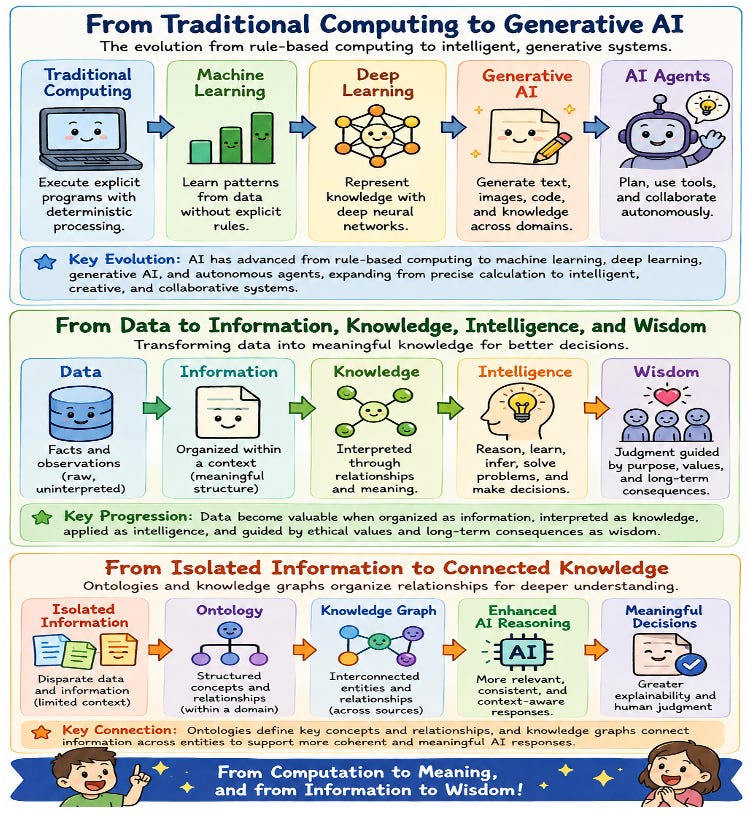
Figure 1. From Computing to Wisdom: The Evolution of AI
Source: Authors’ conceptual synthesis; AI-assisted visualization developed under the authors’ direction.
2.2. From Data to Information, Knowledge, Intelligence, and Wisdom
Progression from data to information, knowledge, intelligence, and wisdom provides a useful framework for understanding how AI can support increasingly sophisticated human activities. Data represents observations and facts, information organizes them within meaningful contexts, knowledge emerges through relationships and interpretation, and intelligence supports reasoning, learning, inference, and problem-solving. Wisdom extends beyond these capabilities by integrating experience, ethical values, contextual understanding, and consideration of long-term consequences into responsible decisions. The central challenge in the AI era is therefore not merely producing more information but transforming reliable information into meaningful knowledge and using that knowledge to strengthen human judgment and purposeful action (Rowley, 2007).
2.3. From Isolated Information to Connected Knowledge: Ontologies and Knowledge Graphs
Individual pieces of information often have limited usefulness until their meanings, relationships, and broader contexts are identified and systematically organized. Ontologies provide structured definitions of concepts, properties, and relationships, while knowledge graphs connect specific entities and their relationships to support knowledge retrieval, interpretation, and reasoning. When integrated with generative AI, these knowledge structures can improve the relevance, consistency, and traceability of AI-generated responses in fields such as cybersecurity, healthcare, education, and supply chain management. From a network ecosystem perspective, the value of AI emerges not simply from accumulating information but from connecting reliable knowledge across individuals, organizations, technologies, and institutions to support better-informed human decisions (Lewis et al., 2020).

3. From Prompt Engineering to Effective Human–AI Collaboration
Effective engagement with generative AI requires moving beyond simple questions toward structured communication, evidence-based reasoning, and continuous refinement of AI-generated responses. Building on Young Choi’s twelve prompt engineering techniques, this section develops three complementary approaches that help individuals use AI more effectively while strengthening their own analytical capabilities and judgment (Amershi et al., 2019).
3.1. From Simple Questions to Structured Prompts: Clarifying Purpose, Context, and Expectations
The quality of AI-generated responses depends partly on how effectively users communicate their intentions, provide relevant background information, and specify the desired outcomes rather than relying on vague or incomplete questions. Choi’s twelve prompt engineering techniques—including role prompting, audience specification, context provisioning, task decomposition, few-shot prompting, reasoning guidance, constraint prompting, output-format prompting, grounding, verification, iterative refinement, and meta-prompting—provide a systematic foundation for improving human–AI communication. For example, instead of simply asking AI to explain supply chain risks, a more structured prompt might request an analysis from the perspective of a supply chain manager, identify a specific industry and audience, distinguish operational from geopolitical risks, incorporate credible evidence, and present actionable recommendations in a comparative framework. The broader contribution of structured prompting is not merely obtaining better answers but developing the human capabilities to define problems clearly, recognize relevant contexts, establish meaningful expectations, and communicate complex questions effectively (White et al., 2023; Wei et al., 2022).
3.2. From AI-Generated Answers to Evidence-Based Knowledge: Grounding, Verification, and Refinement
Although generative AI can produce fluent explanations and sophisticated analyses, its responses may contain unsupported claims, factual inaccuracies, incomplete interpretations, or misleading conclusions that require independent evaluation. Choi’s presentation emphasizes grounding AI responses in authoritative information, checking their accuracy and completeness, and improving them through iterative refinement, while introducing ontology-guided prompt design as a method for incorporating domain-specific concepts and relationships into AI interactions. In education and research, this approach involves comparing AI-generated claims with original publications and verified references; in business and supply chain management, it requires evaluating recommendations against operational data, organizational constraints, stakeholder interests, and changing market conditions. The essential principle is that AI-generated information should be treated as a starting point for inquiry rather than an unquestionable conclusion, with credibility strengthened through reliable evidence, contextual interpretation, systematic verification, and continuous human evaluation (Ji et al., 2023; Lewis et al., 2020).
3.3. From Prompting Tools to Human–AI Collaboration: Strengthening Learning, Creativity, and Judgment
The most promising applications of AI emerge when technological capabilities complement human knowledge, creativity, professional expertise, and ethical judgment rather than simply replacing established intellectual activities. Choi’s discussion of ontology-guided prompt design, knowledge graphs, and AI applications demonstrates how structured human questions can interact with machine-generated analyses to support more relevant and context-sensitive responses across cybersecurity, healthcare, education, and interconnected digital systems. Extending these insights through a network ecosystem perspective, human–AI collaboration can be understood as a dynamic process in which individuals identify problems and objectives, AI systems assist with information retrieval and analytical alternatives, and human participants evaluate results, refine interpretations, and retain responsibility for consequential decisions. The ultimate objective is therefore to progress from using AI as an automated answer-generating tool toward developing mutually reinforcing human and technological capabilities that support lifelong learning, responsible innovation, informed decisions, and human flourishing (Amershi et al., 2019; Hong et al., 2026).
4. From AI Prompting to Practical Applications: Five Pathways for Everyday Life, Learning, Research, Work, and Creativity
Understanding prompt engineering becomes particularly valuable when individuals recognize how structured questions, contextual information, credible evidence, and clear expectations can improve practical AI applications. Building on Choi’s twelve prompt engineering techniques, this section illustrates five pathways through which individuals, students, researchers, professionals, and creative writers can move from simple AI-generated answers toward more meaningful, dependable, and responsible outcomes.
4.1 Twelve Practical Prompt Engineering Techniques for Better Generative AI
Effective prompt engineering strengthens human–AI interaction through twelve complementary techniques that structure instructions, clarify expectations, provide relevant context, and improve the quality of generated responses (White et al., 2023). The first five techniques—role prompting, audience specification, context provisioning, task decomposition, and few-shot prompting—clarify perspectives, audiences, information, tasks, and examples, while the remaining seven—reasoning guidance, constraint prompting, output-format prompting, grounding, self-critique and verification, iterative refinement, and meta-prompting—support systematic analysis, evidence-based responses, quality assessment, and continuous improvement across academic, professional, and technical applications. Although these techniques enhance the relevance and usefulness of AI-generated outputs, they cannot eliminate factual inaccuracies or misinterpretations, making independent verification, critical thinking, and responsible human judgment essential for reliable knowledge development and meaningful human–AI collaboration (Ji et al., 2023).
4.2. Everyday Life: From General Questions to Context-Sensitive Personal Guidance
Generative AI can assist individuals and families with everyday activities, including travel planning, household budgeting, technology learning, personal organization, and understanding complex information. However, broad questions often produce generic recommendations that overlook individual circumstances, priorities, resources, and practical limitations. Effective prompting incorporates relevant context, audience specifications, constraints, and output requirements to generate more personalized and useful guidance while protecting privacy, strengthening practical problem-solving, and preserving human judgment and responsibility.
Simple prompt: “How can I manage my daily activities better?”
Improved prompt: “Act as a practical planning assistant for an older adult balancing physical activity, family relationships, reading, community involvement, and personal projects. Suggest a flexible weekly routine with five priorities, explain their importance, and identify ways to avoid unnecessary commitments. Present the recommendations in a concise table, distinguish general guidance from individualized advice, and emphasize flexibility and well-being.”
Prompting techniques: Role prompting, audience specification, context provisioning, constraint prompting, and output-format prompting
4.3. Education and Learning: From Answer Generation to Critical Thinking and Intellectual Development
Generative AI can support education by explaining complex concepts, developing study materials, exploring alternative perspectives, and facilitating independent learning. However, relying on AI-generated answers without engaging in reasoning may encourage passive learning, weaken critical thinking, and raise academic integrity concerns. Effective educational prompting emphasizes active participation, structured reasoning, and iterative feedback to strengthen knowledge, analytical capabilities, intellectual independence, and lifelong learning (Kasneci et al., 2023; Miao & Holmes, 2023).
Simple prompt: “Explain the normal distribution.”
Improved prompt: “Act as a university statistics tutor for undergraduate business students with limited mathematical backgrounds. Explain the normal distribution using a familiar business example, such as customer waiting times, and define the mean, standard deviation, and z-score in plain English. Provide one worked probability example and two practice questions without revealing the answers, then evaluate my reasoning and explain how to improve it.”
Prompting techniques: Role prompting, audience specification, task decomposition, few-shot examples, reasoning guidance, and iterative refinement.
Table 1. Practical Applications of Structured AI Prompting Across Five Human Activities
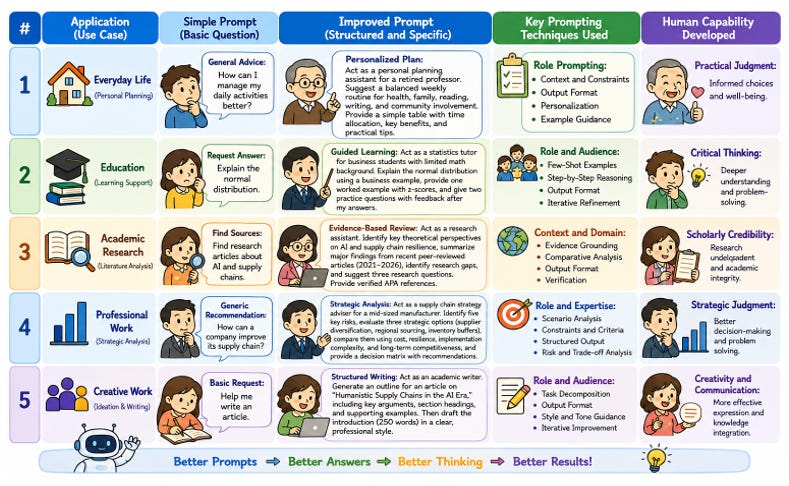
Source: Authors’ conceptual synthesis; AI-assisted visualization developed under the authors’ direction.
Table 1 illustrates five practical applications of structured AI prompting in everyday life, education, academic research, professional work, and creative writing, comparing simple questions with more specific, context-sensitive prompts. By integrating role specification, contextual information, task decomposition, evidence grounding, output requirements, and iterative refinement, these examples demonstrate how effective prompting can improve the relevance, clarity, credibility, and usefulness of AI-generated responses. The central contribution is that structured prompting goes beyond obtaining better AI answers to strengthening human capabilities in practical judgment, critical thinking, scholarly credibility, strategic decision-making, creativity, and knowledge integration.
4.4. Academic Research: From Information Retrieval to Credible Knowledge Development
Generative AI can assist researchers in exploring theoretical perspectives, organizing literature, comparing conceptual frameworks, developing research questions, and improving scholarly writing. However, AI-generated citations, interpretations, and conclusions may be inaccurate or fabricated, making independent verification and methodological transparency essential. Effective research prompting specifies disciplinary context, theoretical foundations, evidence requirements, and analytical boundaries while ensuring that researchers retain responsibility for scholarly integrity, critical evaluation, and original intellectual judgment (Bender et al., 2021).
Simple prompt: “Find research articles about AI and supply chains.”
Improved prompt: “Act as an interdisciplinary research assistant specializing in information systems, supply chain management, and artificial intelligence. Identify three established theoretical perspectives explaining how AI influences supply chain resilience, organizational learning, and interorganizational coordination. Organize the findings into three research streams, identify potential gaps, and propose three research questions using verifiable academic references in APA style, clearly distinguishing established findings from proposed interpretations.”
Prompting techniques: Role prompting, context provisioning, task decomposition, grounding, output-format prompting, verification, and iterative refinement.
4.5. Professional Work and Organizational Decisions: From Automated Responses to Strategic Problem-Solving
Generative AI can support business professionals and organizational leaders in operational planning, supply chain risk assessment, financial analysis, customer communication, and strategic decision-making. However, complex organizational challenges involve competing objectives, incomplete information, uncertain environments, and multiple stakeholder interests that require contextual understanding beyond generic AI recommendations. Effective professional prompting integrates domain knowledge, alternative scenarios, measurable decision criteria, and evidence verification while protecting confidential information and strengthening managerial judgment, strategic coordination, and responsible decision-making (Noy & Zhang, 2023; Hong et al., 2026).
Simple prompt: “How can a company improve its supply chain?”
Improved prompt: “Act as a supply chain strategy adviser for a mid-sized automotive manufacturer facing supplier concentration risks, rising transportation costs, and trade uncertainty. Identify five major vulnerabilities and compare supplier diversification, regional sourcing, and inventory buffers based on cost, resilience, implementation complexity, and long-term competitiveness. Present a decision matrix, distinguish assumptions from verified facts, identify unintended consequences, and recommend a phased implementation plan subject to management review.”
Prompting techniques: Domain-specific role prompting, context provisioning, task decomposition, constraint prompting, grounding, comparative analysis, verification, and structured output.

4.6. Creative Writing and Knowledge Integration: From Draft Generation to Responsible Expression
Generative AI can help writers develop outlines, explore alternative narratives, clarify audiences, and revise drafts for coherence and readability. Yet creativity requires more than fluent text: authors must contribute original insight, interpret evidence, maintain an authentic voice, and take responsibility for factual accuracy, attribution, and intellectual integrity. Structured prompting can support the movement from initial ideas to thoughtful communication by specifying an audience, purpose, thematic structure, examples, and verification expectations while preserving human editorial control (Amershi et al., 2019; Miao & Holmes, 2023).
Simple prompt: “Help me write an article.”
Improved prompt: “Act as an editorial collaborator preparing an accessible research-note article on how AI can strengthen human wisdom. Propose a clear five-part outline for educated general readers, identify three claims that require source verification, and suggest two concrete examples. Distinguish established research from the author’s interpretation, avoid invented citations, and recommend revisions that preserve the author’s own voice and judgment.”
Prompting techniques: Role and audience specification, context provisioning, task decomposition, grounding, output-format prompting, and iterative refinement.
5. Conclusion
Artificial intelligence is transforming how individuals learn, work, conduct research, and make decisions, creating unprecedented opportunities alongside growing responsibilities for its effective and ethical use. Moving beyond simple prompting toward structured questions, evidence-based knowledge, systematic verification, and continuous refinement enables more meaningful human–AI collaboration across everyday life, education, research, and professional practice. The integration of computer science and information systems and supply chain management perspectives demonstrates that AI’s greatest potential lies not merely in technological efficiency but in strengthening human capabilities, critical thinking, creativity, and responsible judgment within increasingly complex and interconnected network ecosystems. The future of AI should be evaluated not simply by how intelligently machines generate answers, but by how wisely humans use these capabilities to advance knowledge, preserve human agency, uphold ethical responsibility, and promote lasting human flourishing (Floridi & Cowls, 2019; Choi et al., 2026; National Institute of Standards and Technology, 2023).
References
Amershi, S., Weld, D., Vorvoreanu, M., Fourney, A., Nushi, B., Collisson, P., Suh, J., Iqbal, S., Bennett, P. N., Inkpen, K., Teevan, J., Kikin-Gil, R., & Horvitz, E. (2019). Guidelines for human-AI interaction. In Proceedings of the 2019 CHI Conference on Human Factors in Computing Systems (Article 3, pp. 1–13). Association for Computing Machinery. https://doi.org/10.1145/3290605.3300233
Bender, E. M., Gebru, T., McMillan-Major, A., & Shmitchell, S. (2021). On the dangers of stochastic parrots: Can language models be too big? In Proceedings of the 2021 ACM Conference on Fairness, Accountability, and Transparency (pp. 610–623). Association for Computing Machinery. https://doi.org/10.1145/3442188.3445922
Choi, Y. B., Hong, P. C., & Park, Y. S. (2026). Layered control architectures for AI safety: A cybersecurity-oriented systems framework. Systems, 14(4), Article 447. https://doi.org/10.3390/systems14040447
Floridi, L., & Cowls, J. (2019). A unified framework of five principles for AI in society. Harvard Data Science Review, 1(1). https://doi.org/10.1162/99608f92.8cd550d1
Hong, P. C., Choi, Y. B., & Park, Y. S. (2026). AI diffusion and the new triad of supply chain transformation: Productivity, perspective, and power in the era of Claude, ChatGPT, Gemini, LLaMA, and Mistral. Logistics, 10(2), Article 40. https://doi.org/10.3390/logistics10020040
Ji, Z., Lee, N., Frieske, R., Yu, T., Su, D., Xu, Y., Ishii, E., Bang, Y. J., Madotto, A., & Fung, P. (2023). Survey of hallucination in natural language generation. ACM Computing Surveys, 55(12), Article 248. https://doi.org/10.1145/3571730
Kasneci, E., Seßler, K., Küchemann, S., Bannert, M., Dementieva, D., Fischer, F., Gasser, U., Groh, G., Günnemann, S., Hüllermeier, E., Krusche, S., Kutyniok, G., Michaeli, T., Nerdel, C., Pfeffer, J., Poquet, O., Sailer, M., Schmidt, A., Seidel, T., . . . Kasneci, G. (2023). ChatGPT for good? On opportunities and challenges of large language models for education. Learning and Individual Differences, 103, Article 102274. https://doi.org/10.1016/j.lindif.2023.102274
Lewis, P., Perez, E., Piktus, A., Petroni, F., Karpukhin, V., Goyal, N., Küttler, H., Lewis, M., Yih, W.-t., Rocktäschel, T., Riedel, S., & Kiela, D. (2020). Retrieval-augmented generation for knowledge-intensive NLP tasks. Advances in Neural Information Processing Systems, 33, 9459–9474. https://proceedings.neurips.cc/paper/2020/hash/6b493230205f780e1bc26945df7481e5-Abstract.html
Miao, F., & Holmes, W. (2023). Guidance for generative AI in education and research. UNESCO. https://unesdoc.unesco.org/ark:/48223/pf0000386693
National Institute of Standards and Technology. (2023). Artificial intelligence risk management framework (AI RMF 1.0) (NIST AI 100-1). U.S. Department of Commerce. https://doi.org/10.6028/NIST.AI.100-1
Noy, S., & Zhang, W. (2023). Experimental evidence on the productivity effects of generative artificial intelligence. Science, 381(6654), 187–192. https://doi.org/10.1126/science.adh2586
Rowley, J. (2007). The wisdom hierarchy: Representations of the DIKW hierarchy. Journal of Information Science, 33(2), 163–180. https://doi.org/10.1177/0165551506070706
Vaswani, A., Shazeer, N., Parmar, N., Uszkoreit, J., Jones, L., Gomez, A. N., Kaiser, Ł., & Polosukhin, I. (2017). Attention is all you need. Advances in Neural Information Processing Systems, 30, 5998–6008. https://proceedings.neurips.cc/paper/2017/hash/3f5ee243547dee91fbd053c1c4a845aa-Abstract.html
Wei, J., Wang, X., Schuurmans, D., Bosma, M., Ichter, B., Xia, F., Chi, E. H., Le, Q. V., & Zhou, D. (2022). Chain-of-thought prompting elicits reasoning in large language models. Advances in Neural Information Processing Systems, 35, 24824–24837. https://proceedings.neurips.cc/paper/2022/hash/9d5609613524ecf4f15af0f7b31abca4-Abstract-Conference.html
White, J., Fu, Q., Hays, S., Sandborn, M., Olea, C., Gilbert, H., Elnashar, A., Spencer-Smith, J., & Schmidt, D. C. (2023). A prompt pattern catalog to enhance prompt engineering with ChatGPT [Preprint]. arXiv. https://doi.org/10.48550/arXiv.2302.11382
Suggested Citation
Choi, Y. B., & Hong, P. C. (2026, November 5). Beyond AI prompts: From data and information to knowledge, human judgment, and wisdom. K-GSP Forum, 1–12.
Original Article:

ABOUT AUTHORS

Prof. Dr. Young Choi (Editor-in-Chief) — Regent University
Full list of his K-GSP columns:
Young B. Choi is Professor of Engineering and Computer Science at Regent University. His work encompasses artificial intelligence, cybersecurity, natural language processing, computer networking, and telecommunications management. His publications include Selected Readings in Cybersecurity (2018) and Cybersecurity Applications and Artificial Intelligence (2023), the latter published in English and six additional languages. He also studies Korean intellectual traditions, including Gani Choi Rip’s Jeonggwan (靜觀, quiet contemplation) and Shilhak (實學, practical learning). His interdisciplinary interests connect technical innovation with the responsible application of knowledge.

Paul C. Hong (Editor-in-Chief) - Distinguished University Professor, University of Toledo
Full list of his K-GSP columns:
Paul C. Hong is a Distinguished University Professor of Information Systems and Supply Chain Management at the University of Toledo. His interdisciplinary research examines artificial intelligence, global supply chains, organizational learning, leadership, and responsible decision-making within complex network ecosystems. Integrating technological innovation with human judgment, ethical governance, and institutional trust, he has published extensively in academic journals and interdisciplinary publications. His recent work emphasizes how individuals and organizations can move beyond AI-generated information toward meaningful knowledge, critical thinking, responsible human–AI collaboration, and human flourishing.
k-GSP Forum · November 2026 · All Rights Reserved
한글 요약
AI 프롬프트를 넘어서: 정보에서 지식, 인간의 판단과 지혜로
인공지능(AI) 기술의 급속한 발전은 개인의 일상생활, 교육, 학술연구, 전문직 업무 및 조직의 의사결정 방식에 근본적인 변화를 가져오고 있다. ChatGPT를 비롯한 생성형 AI 플랫폼의 확산으로 누구나 방대한 정보를 신속하게 활용할 수 있게 되었지만, AI가 제공하는 답변의 정확성, 신뢰성, 윤리성에 대한 우려도 커지고 있다. 이제 중요한 과제는 AI를 얼마나 자주 또는 빠르게 사용하는가가 아니라, AI를 활용하여 어떻게 올바른 질문을 제기하고, 신뢰할 수 있는 지식을 형성하며, 책임 있는 판단을 내릴 것인가에 있다.
본 논문은 컴퓨터과학과 정보시스템 및 공급망관리의 융합적 관점에서 AI의 발전과 인간의 지적 역량 사이의 관계를 분석한다. 특히 전통적인 컴퓨팅에서 기계학습, 딥러닝, 생성형 AI로 이어지는 기술적 진화와 함께, 데이터(Data)에서 정보(Information), 지식(Knowledge), 지능(Intelligence), 지혜(Wisdom)로 발전하는 과정을 설명한다. 또한 온톨로지(Ontology)와 지식 그래프(Knowledge Graph)를 활용한 정보의 구조화와 상호연결이 AI의 분석 능력과 지식 활용에 어떠한 기여를 할 수 있는지 살펴본다. 이러한 접근은 정보의 양적 확대보다 의미 있는 지식의 형성과 인간의 비판적 사고 및 판단 능력 강화가 더욱 중요함을 강조한다. 실천적 측면에서 본 논문은 효과적인 AI 활용을 위한 12가지 프롬프트 엔지니어링 기법을 바탕으로, 일상생활, 교육, 학술연구, 전문직 업무 및 창의적 활동에서 활용할 수 있는 구체적인 사례를 제시한다. 단순한 질문과 목적, 맥락, 역할, 제약조건, 근거자료 및 출력 형식을 명확히 설정한 구조화된 질문을 비교함으로써 AI 활용의 질을 높이는 방법을 설명한다. 특히 AI가 생성한 정보를 무조건 수용하기보다 출처 확인, 근거 검증, 반복적 수정 및 비판적 해석을 통해 신뢰성과 유용성을 높여야 한다고 주장한다. 이러한 인간과 AI의 협력은 학습 능력, 연구의 신뢰성, 창의성, 전략적 사고 및 책임 있는 의사결정 역량을 강화하는 중요한 수단이 될 수 있다.
결론적으로 AI의 진정한 가치는 단순히 정보를 빠르게 생성하거나 인간의 업무를 자동화하는 데 있지 않으며, 인간이 복잡하고 상호연결된 사회와 조직의 문제를 더욱 깊이 이해하고 현명하게 해결하도록 돕는 데 있다. 특히 역동적인 네트워크 생태계(Network Ecosystem) 관점에서 기술 혁신은 인간의 경험, 전문지식, 윤리적 가치 및 제도적 신뢰와 조화를 이룰 때 지속적인 가치를 창출할 수 있다. 따라서 AI 시대에는 기술적 숙련도뿐 아니라 올바른 질문을 제기하는 능력, 지식을 검증하는 태도, 독립적인 판단력, 인간의 자율성 및 윤리적 책임을 함께 발전시켜야 한다. 궁극적으로 AI 시대의 미래는 기계가 얼마나 지능적으로 답변하는가보다 인간이 AI를 얼마나 지혜롭고 책임 있게 활용하여 개인과 조직의 발전, 사회적 신뢰 및 인간의 번영(Human Flourishing)에 기여하는가에 달려 있다.
Young B. Choi 교수는 미국 리전트 대학교(Regent University) 공학 및 컴퓨터 과학부 교수이다. 그는 총 38권의 저서를 출판했는데, 그중 『사이버 보안 선집(Selected Readings in Cybersecurity)』(2018년)은 전 세계 대학 및 기관 도서관에 약 800부가 소장되어 있으며, 『사이버 보안 응용과 인공지능(Cybersecurity Applications and Artificial Intelligence)』(2023년)은 세계 7대 주요 언어로 번역·출판되었다. 그는 1995년 에드리언 탕(Adrian Tang) 박사와 함께 세계 최초의 범용 글로벌 통신 ‘서비스 주문 처리(Service Order Handling, SOH)’ 모델인 ‘T-SOH 모델’을 제안했다. 이 혁신적인 연구 성과를 인정받아 1996년 IEEE NOMS에서 최우수 논문상(Best Paper Award)을 수상했으며, 1998년에는 텔리매니지먼트 포럼(TeleManagement Forum)으로부터 ‘탁월한 공헌상(Outstanding Contribution Award)’을 최초로 수상했다. 그의 주요 연구 분야는 자연어 처리 중심의 인공지능, 인공지능을 적용한 사이버 보안, 네트워크 및 통신 서비스 관리이며, 더불어 간이 최립(Gani Choi Rip)의 ‘정관(靜觀)’ 철학과 실학(實學)에 관한 한국학 연구도 수행하고 있다.
Paul C. Hong 교수는 미국 톨레도대학교 (University of Toledo) 의 정보시스템 및 공급망관리 분야 석좌교수로, 인공지능, 글로벌 공급망, 조직학습, 리더십, 전략적 의사결정 및 네트워크 생태계에 관한 융합적 연구를 수행하고 있다. 그는 기술 혁신과 인간의 판단, 윤리적 거버넌스 및 제도적 신뢰 사이의 관계를 중점적으로 연구하며, 국제 학술지와 다양한 학술 출판물을 통해 연구 성과를 발표해 왔다. 최근에는 AI 시대의 기술적 변화와 글로벌 공급망의 복잡성을 연결하여 개인과 조직이 불확실성과 급격한 환경 변화에 효과적으로 대응할 수 있는 방안을 탐구하고 있다. 특히 AI가 생성하는 방대한 정보를 의미 있는 지식으로 발전시키고, 비판적 사고와 책임 있는 인간–AI 협력을 통해 인간의 지혜, 사회적 신뢰 및 지속적인 인간의 번영을 실현하는 방안에 관심을 두고 있다.
© K-Global Scholars and Professionals Forum. All rights reserved. Content published in the K-GSP Forum may not be reproduced, distributed, or transmitted in any form without prior written permission from the K-GSP Forum, except for brief quotations with full attribution.