

EXECUTIVE SUMMARY
This article examines five great classical composers—Johann Sebastian Bach, Wolfgang Amadeus Mozart, Ludwig van Beethoven, Frédéric Chopin, and Pyotr Ilyich Tchaikovsky—to explain how distinctive talents, sustained efforts, and enabling support ecosystems contribute to enduring musical greatness. Drawing on the Scope–Scale Framework, the analysis distinguishes the breadth and longevity of influence (scope) from the magnitude of artistic achievement and historical impact (scale), while considering how musical legacies expand across generations. The five composers illustrate different pathways to enduring excellence: Bach through foundational mastery and posthumous amplification, Mozart through versatility and broad influence, Beethoven through transformational innovation, Chopin through specialized depth and global diffusion, and Tchaikovsky through emotional accessibility and worldwide reach. The article demonstrates that lasting greatness emerges not from talent alone but from the interaction of disciplined development, institutional support, cultural transmission, and enduring artistic relevance. Beyond classical music, these insights offer broader lessons for understanding sustainable excellence and lasting legacy in leadership, science, business, education, sports, and the arts.
Keywords: Classical composers; Enduring excellence; Scope–Scale Framework; Support ecosystems; Musical legacy
1. Introduction
Kevin Reilly brings a lifetime of professional experience in classical music as a pianist, conductor, composer, and educator. Trained at the Peabody Institute of The Johns Hopkins University, he served for many years on the music faculty at the University of Toledo, teaching music history and piano, directing choral performances, mentoring young musicians, and composing sacred music. Through these diverse experiences, he has observed how the works of great composers transcend their historical origins, remaining alive through continuous performance, interpretation, education, and appreciation. His professional perspective provides a foundation for understanding how musical excellence is cultivated, preserved, and transmitted across generations.
Paul C. Hong’s appreciation for classical music began as a member of the brass band at Seoul High School (서울고등학교) in South Korea, where rehearsals five days a week before and after classes instilled discipline, teamwork, and dedication to musical excellence. Through intensive practice of overtures, marches, and classical masterpieces, he developed a lifelong admiration for composers whose works continue to inspire audiences worldwide. His musical interests have continued through attending orchestral performances and listening closely to recordings of classical masters. These experiences complement his academic research on leadership, innovation, institutional transformation, and enduring excellence, particularly the ways in which individual achievement develops into lasting historical influence.
Drawing upon these complementary musical and academic perspectives, the authors explore a central question: Why do certain composers continue to inspire global audiences centuries after their deaths? Musical genius alone cannot fully explain such enduring prominence, as some composers transformed established musical traditions while others achieved extraordinary distinction through versatility, specialized mastery, or emotional expression. Their legacies reflect the interaction of distinctive talent, disciplined effort, artistic innovation, and enabling support ecosystems, which collectively shape how exceptional achievements develop and endure. Understanding these different pathways requires examining not only what composers accomplished during their lifetimes but also how their contributions continued to influence subsequent generations.
This article examines five great classical composers—Bach, Mozart, Beethoven, Chopin, and Tchaikovsky—to identify their distinctive pathways to enduring musical greatness. It begins with an overview of Western musical history and the foundations of excellence, followed by a comparative analysis of the five masters’ talents, sustained efforts, and supporting ecosystems. Building on these comparisons, the article introduces a Scope–Scale Framework that evaluates the breadth, magnitude, and temporal evolution of their artistic legacies through five conceptual propositions. The resulting insights extend beyond classical music, offering broader lessons about how greatness emerges, expands, and endures in leadership, science, business, education, sports, and the arts.
2. Music History Overview and Foundations of Enduring Musical Excellence
Western classical music developed through successive historical periods in which structure, balance, expression, and innovation accumulated rather than simply replacing one another; this historical progression provides the context for understanding why certain composers later achieved unusually broad and lasting influence.
2.1. Historical Evolution: From Structure to Innovation
The Baroque period (1600–1750) established Western classical music through Sacred Structure, emphasizing contrapuntal mastery, formal construction, and the disciplined musical systems associated with composers such as Bach, Handel, and Vivaldi. The Classical period (1750–1820) advanced toward Formal Balance, as Haydn, Mozart, and Beethoven refined symphonies, sonatas, concertos, and chamber music through clarity, proportion, and greater expressive flexibility. The Romantic and Modern periods then extended this development through Expressive Expansion and Innovative Diversity, as composers increasingly emphasized emotion, individuality, national identity, harmonic experimentation, and stylistic innovation.
Figure 1 shows how Western classical music evolved across four major periods—Baroque, Classical, Romantic, and Modern—moving from sacred structure and formal balance toward expressive expansion and innovative diversity. Across these periods, musical greatness developed through both continuity and innovation, as each generation preserved important traditions while extending musical form, expression, and interpretation in new directions. This historical progression ultimately supports six foundations of enduring musical excellence: technical mastery, artistic originality, emotional depth, cultural influence, historical significance, and educational importance.
Figure 1
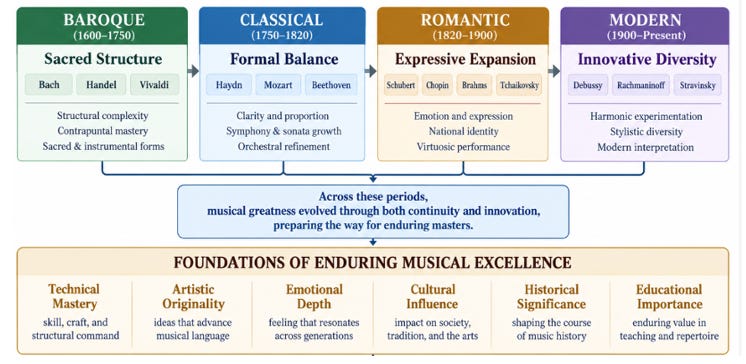
Source: Authors’ own conceptualization based on Burkholder et al. (2019), Rosen (1997), and Taruskin (2010).
2.2. Foundations of Enduring Musical Excellence
Enduring musical excellence begins with technical mastery, through which command of form, harmony, instrumentation, and compositional technique enables imagination to become coherent artistic expression. It is strengthened by the interaction of artistic originality and emotional depth, allowing composers such as Beethoven, Chopin, and Tchaikovsky to extend musical language while creating works that continue to resonate across cultures and generations. Finally, cultural influence, historical significance, and educational importance transform individual achievement into enduring legacy as compositions are repeatedly performed, taught, interpreted, preserved, and transmitted through cultural and institutional ecosystems.
2.3. Historical Foundations and Diverse Pathways to Enduring Greatness
The historical evolution of classical music demonstrates that enduring greatness emerges through multiple pathways, rather than a single formula for artistic achievement. While some composers established foundational musical structures, others expanded existing traditions through versatility, transformational innovation, specialized mastery, or emotional expression. These different pathways reflect the interaction of distinctive talent, disciplined effort, and enabling support ecosystems, through which exceptional musical achievements are developed, preserved, and transmitted across generations. The experiences of Bach, Mozart, Beethoven, Chopin, and Tchaikovsky illustrate how individual creativity and sustained dedication, reinforced by cultural institutions, performers, educators, and audiences, can transform musical excellence into an enduring historical legacy.

3. Five Masters, Five Pathways to Greatness
The five masters illustrate distinct pathways to enduring greatness through the interaction of talent, disciplined effort, and enabling ecosystems, showing that excellence may emerge through structural mastery, versatility, transformation, specialization, or emotional communication,
while lasting legacy depends on how individual achievement is developed, supported, and transmitted across generations.
3.1. Johann Sebastian Bach — Disciplined Structure and Foundations
Johann Sebastian Bach (1685–1750) achieved greatness through architectural thinking, as his mastery of counterpoint, harmony, fugue, sacred music, keyboard writing, and instrumental composition enabled him to organize multiple musical voices into complex yet coherent structures. His extraordinary natural capacity became enduring mastery through disciplined craftsmanship, sustained by continuous composing, performing, teaching, revising, and adapting his work within demanding church and court settings. At the same time, Bach’s legacy was amplified by a rich musical ecosystem of family, institutions, performers, students, publishers, and later advocates such as Mendelssohn, demonstrating how enduring greatness depends on developing, performing, preserving, and transmitting excellence.
3.2. Wolfgang Amadeus Mozart — Genius, Versatility, and Extraordinary Productivity
Wolfgang Amadeus Mozart (1756–1791) achieved greatness through exceptional natural musical fluency and extraordinary versatility, allowing him to excel across opera, symphony, concerto, chamber music, sacred music, and keyboard composition while maintaining clarity, balance, and melodic invention. His seemingly effortless genius was reinforced by disciplined development, as years of performing, composing, revising, traveling, studying, and responding to commissions produced more than six hundred works within a remarkably short lifetime. Mozart’s achievement was further accelerated by a rich ecosystem shaped by Leopold Mozart, European travel, Vienna’s musical networks, patrons, publishers, performers, and audiences, showing that exceptional talent develops faster when supported by diverse knowledge, capable collaborators, and repeated opportunities for application.
Table 1.
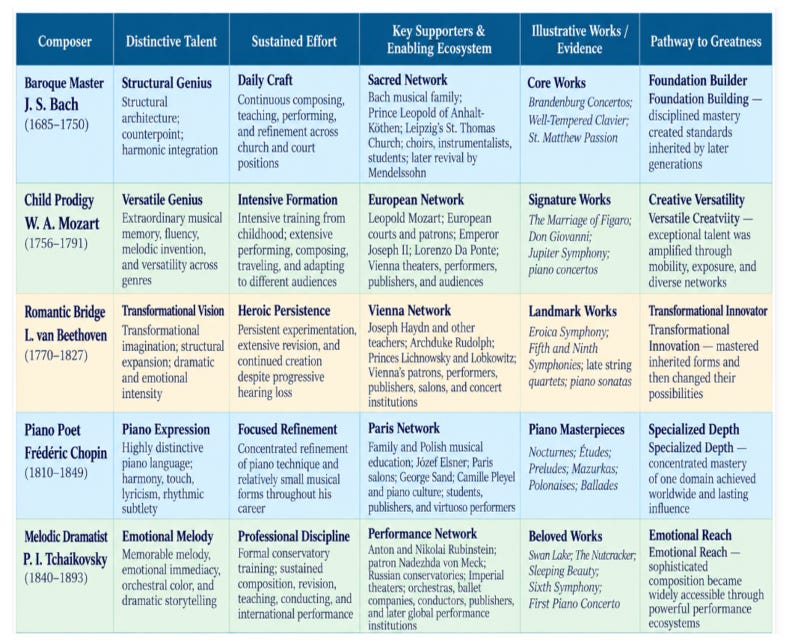
Five Great Masters: Talent, Efforts, Support Ecosystems and Paths to Enduring Greatness
Source: Authors’ synthesis. The table illustrates how enduring greatness develops through the interactions of distinctive talents, sustained efforts, and enabling support ecosystems. The examples are illustrative rather than exhaustive and are not intended to rank the five composers.
Table 1 compares five great composers—Bach, Mozart, Beethoven, Chopin, and Tchaikovsky—across distinctive talent, sustained effort, enabling ecosystems, representative works, and their different pathways to enduring greatness. It shows that lasting musical excellence emerged through contrasting strengths: Bach’s structural genius and foundation building, Mozart’s versatility, Beethoven’s transformational innovation, Chopin’s specialized piano mastery, and Tchaikovsky’s emotional reach. Taken together, the table demonstrates that greatness results not from talent alone but from the interaction of individual capability, disciplined development, supportive networks, and works capable of enduring across generations.
3.3. Ludwig van Beethoven — Transformation and the Classical–Romantic Bridge
Ludwig van Beethoven (1770–1827) demonstrated a strongly transformational form of greatness by mastering the Classical tradition of Haydn and Mozart and then expanding its structures, harmonic possibilities, dramatic contrasts, and expressive intensity in ways that helped prepare the transition toward Romanticism. His achievement was strengthened by extraordinary persistence and disciplined experimentation, as progressive hearing loss did not prevent him from continuing to revise, reconsider, and create increasingly ambitious works through sustained effort and self-criticism. Beethoven’s legacy was also amplified by Vienna’s rich ecosystem of teachers, patrons, publishers, performers, instrument makers, concert institutions, and later composers, showing how transformational talent becomes historically consequential when personal persistence interacts with networks that support experimentation and carry innovation forward.
3.4. Frédéric Chopin — Depth Through Specialization
Frédéric Chopin (1810–1849) followed a distinctive path to greatness through specialized depth, concentrating overwhelmingly on the piano and expanding its possibilities of touch, phrasing, harmony, rhythm, ornamentation, and emotional expression through forms such as nocturnes, études, preludes, mazurkas, polonaises, waltzes, and ballades. His achievement depended on focused refinement, as sustained practice, technical experimentation, subtle revision, and intimate knowledge of the instrument enabled him to transform specialization into cumulative artistic mastery rather than narrow limitation. Chopin’s legacy was further amplified by Polish cultural traditions, Parisian networks of artists, publishers, students, patrons, and salon audiences, and the wider spread of piano culture, demonstrating how focused individual mastery can achieve universal influence when supported by an ecosystem well matched to the domain of excellence.
3.5. Pyotr Ilyich Tchaikovsky — Emotional Communication and Worldwide Reach
Pyotr Ilyich Tchaikovsky (1840–1893) achieved greatness through emotional resonance combined with professional craftsmanship, using memorable melodies, orchestral color, dramatic pacing, and expressive intensity to make works such as Swan Lake and The Nutcracker accessible to audiences far beyond specialist circles. His apparent accessibility rested on disciplined development, including formal training, composing, teaching, revising, conducting, and sustained engagement with orchestral and theatrical forms that transformed melodic talent into technically sophisticated large-scale works. Tchaikovsky’s worldwide legacy was further amplified by conservatories, orchestras, ballet companies, theaters, publishers, patrons, recordings, broadcasting, film, education, and holiday traditions, demonstrating how great work acquires extraordinary scope when an ecosystem repeatedly translates artistic achievement into memorable experiences for new generations.
The five masters reveal two sides of enduring greatness. Talent, effort, and support ecosystems explain how exceptional achievement is developed and sustained; scope and scale explain how that achievement subsequently travels across audiences, institutions, cultures, and generations. Greatness therefore begins with individual capability but becomes enduring legacy through an ecosystem.
4. A Scope–Scale and Temporal Perspective on Enduring Musical Greatness
The Scope–Scale Framework provides a conceptual basis for distinguishing breadth of influence, magnitude of achievement, and change in impact over time. Rather than treating greatness as a single reputation measure, this section examines how each composer’s influence can be understood through observable indicators such as repertoire presence, institutional adoption, educational use, genre breadth, performance diffusion, and posthumous expansion. The purpose is not to produce a definitive ranking, but to show how different conceptual patterns can explain different pathways to enduring greatness.
4.1. The Scope–Scale Framework: Breadth, Magnitude, and Time
The conceptual framework examines enduring musical greatness through two core dimensions and a temporal perspective: scope, the breadth and longevity of influence; scale, the magnitude and consequence of achievement; and time, the distinction between lifetime impact and posthumous expansion. This temporal perspective recognizes that greatness can grow differently across generations, leading to the conceptual model Enduring Legacy = f(Scope, Scale, Lifetime Impact, Posthumous Expansion). By comparing lifetime impact with later expansion, the framework identifies four broad patterns—Rediscovered Greatness, Amplified Greatness, Contemporary Greatness, and Constrained Legacy—showing that enduring influence can emerge through multiple patterns of historical influence rather than a single path.
Figure 2 presents a conceptual perspective on enduring musical greatness through three complementary dimensions: scope (breadth of influence), scale (magnitude of achievement), and time (lifetime impact and posthumous expansion). The five composers illustrate distinct pathways: Bach represents rediscovered greatness through posthumous amplification, while Mozart, Beethoven, Chopin, and Tchaikovsky represent amplified greatness through versatility, transformational innovation, specialized depth, and emotional accessibility, respectively. Together, the five propositions demonstrate that enduring musical excellence emerges through different combinations of artistic achievement, institutional support, historical influence, and intergenerational diffusion, rather than a single pathway to greatness.
Figure 2. Conceptual Pathways to Enduring Musical Greatness
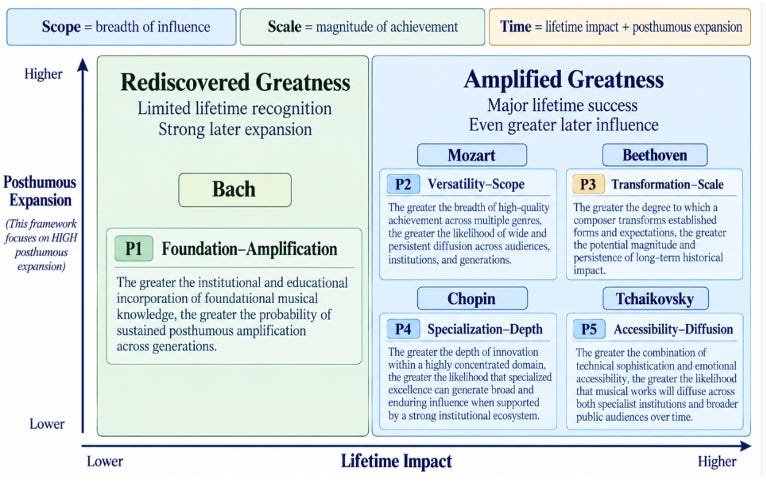
Source: Authors’ Own Synthesis
Note: The composer placements are illustrative conceptual interpretations rather than empirically estimated rankings, emphasizing contrasting patterns of lifetime impact and posthumous expansion.
4.2. Bach: Foundation and Posthumous Amplification
Johann Sebastian Bach’s legacy pattern reflects the interaction of foundational depth and posthumous diffusion, as his influence expanded far beyond the churches, courts, and teaching networks of his lifetime through later revival, publication, conservatory education, and performance. His enduring scope can be observed through the continued teaching, performance, curricular use, and multi-century persistence of his works across countries and institutions. Bach therefore illustrates legacy amplification, showing that historically significant influence can grow substantially after death when structurally powerful work is repeatedly preserved, taught, performed, and transmitted to new generations.
Proposition 1 — Foundation–Amplification Proposition:
The greater the institutional and educational incorporation of foundational musical knowledge, the greater the probability of sustained posthumous amplification across generations.
4.3. Wolfgang Amadeus Mozart: Versatility and Broad Scope
Mozart achieved substantial recognition during his lifetime and experienced even greater posthumous expansion through the extraordinary breadth of his work across opera, symphony, concerto, chamber music, sacred music, and keyboard repertoire. From a conceptual perspective, his enduring influence can be understood through genre diversity, repertoire persistence, international performance, and educational use, all of which increased the number of channels through which his music could reach audiences and institutions. Mozart therefore represents a pattern of diversified excellence and high scope, showing how versatility can support wide and persistent influence across generations.
Proposition 2 — Versatility–Scope Proposition:
The greater the breadth of high-quality achievement across multiple genres, the greater the likelihood of wide and persistent diffusion across audiences, institutions, and generations.
4.4. Ludwig van Beethoven: Transformation and Historical Scale
Beethoven’s legacy pattern is distinguished less by breadth alone than by transformational scale, because his works reshaped expectations regarding symphonic form, expressive intensity, artistic autonomy, and the role of the composer. His enduring impact can be examined through indicators such as the continued performance of his symphonies and sonatas, persistence in educational curricula, influence on later composers, and long-term centrality within orchestras and conservatories. Beethoven therefore illustrates how historically consequential innovation can generate deep, persistent, and institutionally embedded influence across generations.
Proposition 3 — Transformation–Scale Proposition:
The greater the degree to which a composer transforms established forms and expectations, the greater the potential magnitude and persistence of long-term historical impact.
4.5. Chopin: Specialized Depth and Global Diffusion
Chopin represents a distinctive pathway to enduring greatness because his compositional scope was concentrated heavily on the piano, yet that specialization generated extraordinary depth and long-run diffusion through education, recital traditions, conservatories, competitions, publishing, and private musical culture. His case shows why conceptual analysis should distinguish domain breadth from geographic and institutional breadth, since a narrow genre focus can still produce wide international influence when the domain itself is strongly institutionalized. Chopin therefore demonstrates that specialized excellence can achieve global and enduring impact, as reflected in the continued teaching, performance, recording, and competitive use of his works across countries and generations.
Proposition 4 — Specialization–Depth Proposition:
The greater the depth of innovation within a highly concentrated domain, the greater the likelihood that specialized excellence can generate broad and enduring influence when supported by a strong institutional ecosystem.
4.6. Tchaikovsky: Emotional Accessibility and Performance Diffusion
Tchaikovsky’s legacy pattern can be examined through the combination of artistic sophistication and broad emotional accessibility. His symphonies, concertos, and especially ballets became embedded not only in professional concert life but also in theaters, education, recordings, broadcasting, film, holiday traditions, and popular cultural contexts. Unlike a composer whose influence remains largely within specialist communities, Tchaikovsky’s works move repeatedly between elite artistic institutions and mass audiences.
This suggests a diffusion pattern in which emotional accessibility increases the number of channels through which music can circulate. Illustrative indicators might include performance frequency across orchestras and ballet companies, geographic diffusion, seasonal recurrence, recording volume, educational exposure, and appearances in broader media environments. His case shows how accessibility can magnify scale without necessarily reducing artistic complexity.
Proposition 5 — Accessibility–Diffusion Proposition:
The greater the combination of technical sophistication and emotional accessibility, the greater the likelihood that musical works will diffuse across both specialist institutions and broader public audiences over time.

5. Conclusion
The Scope–Scale Framework demonstrates that enduring musical greatness does not follow a single pathway but emerges through different combinations of exceptional talent, disciplined effort, artistic innovation, and enabling support ecosystems. The five great composers illustrate distinctive pathways to enduring excellence: Bach through foundational mastery and posthumous amplification, Mozart through versatility and broad influence, Beethoven through transformational innovation, Chopin through specialized depth and global diffusion, and Tchaikovsky through emotional accessibility and worldwide reach. Their contrasting achievements reveal that lasting influence depends not only on the magnitude of artistic accomplishment but also on its breadth, longevity, institutional support, and transmission across cultures and generations. Ultimately, the central question shifts from “Who is greatest?” to “Through what pathways does greatness emerge, expand, and endure?”, offering timeless lessons for leadership, science, business, education, sports, and the arts, where true greatness is measured not merely by lifetime accomplishments but by the enduring capacity to inspire, transform, and enrich future generations.
References
Burkholder, J. P., Grout, D. J., & Palisca, C. V. (2019). A history of Western music (10th ed.). W. W. Norton.
Cook, N. (1998). Music: A very short introduction. Oxford University Press.
Dahlhaus, C. (1989). Nineteenth-century music. University of California Press.
Goehr, L. (2007). The imaginary museum of musical works: An essay in the philosophy of music (Rev. ed.). Oxford University Press.
Greenberg, R. (2011). How to listen to and understand great music (3rd ed.). The Great Courses.
Grout, D. J., & Palisca, C. V. (2001). A history of Western music (6th ed.). W. W. Norton.
Lockwood, L. (2003). Beethoven: The music and the life. W. W. Norton & Company.
Morgan, R. P. (1991). Twentieth-century music: A history of musical style in modern Europe and America. W. W. Norton.
Plantinga, L. (1984). Romantic music: A history of musical style in nineteenth-century Europe. W. W. Norton.
Rosen, C. (1997). The classical style: Haydn, Mozart, Beethoven (Expanded ed.). W. W. Norton & Company.
Stanley, G. (Ed.). (2000). The Cambridge companion to Beethoven. Cambridge University Press.
Taruskin, R. (2010). The Oxford history of Western music. Oxford University Press.
Schonberg, H. C. (1997). The lives of the great composers (3rd ed.). W. W. Norton.
Wold, M. A., Martin, G. C., Miller, J. A., & Cykler, E. (1994). An outline history of Western music (8th ed.). Brown & Benchmark.
ABOUT THE AUTHORS
Kevin Reilly — Pianist, Music Director, Composer and Music Educator

Kevin Reilly, a graduate of the Peabody Institute of The Johns Hopkins University, is a distinguished music director, pianist, educator, and composer dedicated to musical excellence. A longtime faculty member of the University of Toledo School of Music, he has taught music history, conducted numerous choral performances, including Handel’s Messiah, Mozart’s Gloria, and a rich repertoire of spirituals and sacred music, while leading University of Toledo students to multiple honors at the Choral Festival (Songfest). His lifelong passion for teaching piano, mentoring young musicians, and composing sacred works—including “The Prayer of St. Francis”—reflects his enduring commitment to inspiring others through faith, creativity, and music.

Paul C. Hong (Editor-in-Chief) - Distinguished University Professor, University of Toledo
Full list of his K-GSP columns:
Paul C. Hong is a Distinguished University Professor at the University of Toledo whose academic background integrates economics, manufacturing management, engineering, and global supply chain strategy. He earned a B.A. in Economics from Yonsei University, an M.A. in Economics from Bowling Green State University, and a Ph.D. in Manufacturing Management and Engineering from the University of Toledo. His research focuses on global supply chain management, strategic benchmarking, manufacturing competitiveness, resilience, industrial policy, and geo-economics, with particular interest in how trade policy, technological change, economic security, and geopolitical competition reshape international production networks and national competitiveness. His current work increasingly examines the intersection of global supply chains, strategic industries, AI-enabled transformation, and geo-economic relations among major economies, emphasizing how firms and nations can balance efficiency, resilience, strategic autonomy, and international cooperation in an increasingly complex global environment.
© K-Global Scholars and Professionals Forum. October 8, 2026 All rights reserved
Citation:
Kevin Reilly & Paul C. Hong (2026, October 8). Beyond greatness: What the five great classical composers teach us about enduring excellence. K-Global Scholars and Professionals Forum.
Original Article:

한국어 요약
위대함을 넘어: 다섯 명의 위대한 클래식 작곡가가 전하는 지속적 탁월성의 교훈
이 글은 케빈 라일리(Kevin Reilly)와 폴 C. 홍(Paul C. Hong)이 공동 집필한 것으로, 바흐(Johann Sebastian Bach), 모차르트(Wolfgang Amadeus Mozart), 베토벤(Ludwig van Beethoven), 쇼팽(Frédéric Chopin), 차이콥스키(Pyotr Ilyich Tchaikovsky) 등 다섯 명의 위대한 클래식 작곡가들이 어떻게 서로 다른 경로를 통해 시대를 초월하는 음악적 유산을 남겼는지를 탐구한다. 피아니스트이자 음악감독, 교육자, 작곡가인 라일리의 전문적 경험과 리더십 및 지속적 탁월성을 연구해 온 홍 교수의 학문적 관점을 결합하여, 음악적 위대함이 단순한 천재성이나 일시적인 명성만으로 설명될 수 없음을 강조한다. 특히 탁월한 재능, 지속적인 노력, 그리고 이를 뒷받침하는 교육·문화·사회적 지원 생태계가 상호작용할 때 개인의 예술적 성취가 여러 세대에 걸쳐 지속되는 역사적 유산으로 발전한다는 점을 제시한다.
이 글의 핵심 분석 도구는 스코프–스케일 프레임워크(Scope–Scale Framework)이다. 스코프(scope)는 작곡가의 영향력이 여러 세대와 국가, 장르, 교육기관 및 연주 현장에 걸쳐 얼마나 폭넓고 오랫동안 확산되는지를 의미하며, 스케일(scale)은 예술적 성취와 혁신이 음악사에 남긴 영향의 크기와 중요성을 의미한다. 이 프레임워크에 따라 바흐는 정교한 음악적 구조와 대위법의 기초를 확립하고 사후에 영향력이 크게 확장된 기초 확립과 유산의 증폭, 모차르트는 다양한 장르에서 탁월한 작품을 창조한 천재성과 다재다능함, 베토벤은 고전주의의 전통을 혁신하고 낭만주의로의 전환을 이끈 변혁적 혁신, 쇼팽은 피아노라는 전문 영역에서 깊이 있는 예술적 완성도를 이룬 전문화와 심화, 차이콥스키는 풍부한 감성과 극적인 표현을 통해 전 세계 청중에게 다가간 정서적 공감과 대중적 확산의 전형으로 제시된다. 또한 작곡가들의 생전 영향력과 사후 확산을 구분함으로써 음악적 위대함이 형성되고 확대되는 다양한 시간적 경로를 설명하고, 다섯 가지 명제를 통해 각 경로의 특성을 체계화한다.
다섯 작곡가의 비교는 지속적인 위대함에는 단일한 성공 공식이 존재하지 않는다는 중요한 교훈을 제공한다. 바흐의 체계적 장인정신, 모차르트의 폭넓은 창조성, 베토벤의 고난을 극복한 변혁적 도전, 쇼팽의 집중적 전문성, 차이콥스키의 보편적 감성 전달 능력은 서로 다른 재능과 노력의 결합이 탁월한 성취로 이어질 수 있음을 보여 준다. 그러나 개인의 성취가 장기적인 역사적 유산으로 발전하려면 교육기관, 후원자, 연주자, 출판사, 문화적 전통, 그리고 후대의 청중과 같은 지원 생태계의 역할이 필수적이다. 이러한 통찰은 클래식 음악을 넘어 과학, 경영, 정치, 스포츠, 교육 및 예술 등 다양한 분야에서 지속적 탁월성과 리더십을 이해하는 데 적용될 수 있다. 궁극적으로 위대함은 한 개인이 생전에 얼마나 많은 업적을 이루었는가뿐 아니라, 그 업적이 세대를 넘어 얼마나 오랫동안 사람들에게 영감을 주고 새로운 가능성을 열어 주는가에 의해 평가되어야 한다.
© K-Global Schoalrs and Professionals Forum. All rights reserved. Content published in the K-GSP Forum may not be reproduced, distributed, or transmitted in any form without prior written permission from the K-GSP Forum, except for brief quotations with full attribution.