

EXECUTIVE SUMMARY
South Korea’s remarkable transformation from a resource-constrained, war-devastated nation into a leading industrial and technological economy challenges deterministic explanations of national development and highlights the interplay of geography, institutions, and human agency. Drawing on Jared Diamond’s Guns, Germs, and Steel, Acemoglu and Robinson’s Why Nations Fail, and Graeber and Wengrow’s The Dawn of Everything, this article develops an integrative framework explaining how South Korea overcame structural disadvantages through institutional development, strategic industrialization, global networks, and collective societal action. The analysis further examines how Korea’s historical achievements and emerging challenges—including demographic decline, technological disruption, geopolitical competition, and social sustainability—offer broader lessons for national resilience, institutional adaptability, and long-term prosperity.
Keywords: South Korea; Geographic Constraints; Institutional Capabilities; Human Agency; Societal Transformation
1. Introduction
A three-day series of U.S.–Korea relations events held in Toledo, Ohio (October 27–29, 2026), including the public forum “U.S.–Korea Shared Futures: Innovation, Security, and Culture” at the Toledo Lucas County Public Library, provided a timely setting for reconsidering South Korea’s transformation. The forum, moderated by Paul C. Hong and organized through the World Affairs Council of Northwest Ohio and its partners, brought together diplomats, scholars, business leaders, students, and community members. Discussions spanning trade, investment, advanced manufacturing, national security, culture, and educational cooperation demonstrated growing American interest in Korea’s economic achievements and cultural influence—even far from the Korean Peninsula. Seven decades ago, South Korea was a war-devastated, impoverished nation struggling for survival; today, it is a major industrial, technological, and cultural economy. These developments invite a fundamental question: How did a country with limited natural resources, severe geopolitical constraints, and devastating historical experiences become globally influential, and what might other nations learn from its experience?
South Korea’s remarkable development invites a reconsideration of three influential interpretations of human civilization and national prosperity. Jared Diamond’s Guns, Germs, and Steel (1997) examines how long-run geographic and environmental differences shaped opportunities for agriculture, technological diffusion, and societal expansion. Daron Acemoglu and James A. Robinson’s Why Nations Fail (2012) emphasizes how political and economic institutions shape incentives and patterns of prosperity, while David Graeber and David Wengrow’s The Dawn of Everything (2021) draws on deep historical and archaeological evidence to recover the diversity of social arrangements and the possibilities of collective choice. These books operate at different scales and make distinct, sometimes competing claims; none directly provides a comprehensive explanation of South Korea’s modern development.
South Korea provides a compelling setting for examining these explanations. Despite resource scarcity, national division, and the destruction of the Korean War (1950–1953), the country achieved rapid industrialization through investments in education, infrastructure, technological learning, export-oriented manufacturing, and strategic coordination between government and business. Its transformation from an aid recipient into an advanced industrial economy was subsequently accompanied by democratization, institutional reforms, and growing international cultural influence. However, Korea’s success was neither automatic nor without significant costs, including authoritarian governance during much of its early industrialization, labor conflicts, and persistent social inequalities. Its present challenges—demographic decline, population aging, geopolitical competition, technological disruption, and regional disparities—also demonstrate that past economic achievements do not guarantee future societal sustainability.
This article examines South Korea’s transformation through three interconnected dimensions: geographic and historical conditions, institutional capabilities, and transformative human agency. It first reviews the major insights and limitations of the three books, then explores how Korea converted structural constraints into industrial competitiveness, democratic development, and global cultural influence. Building on these perspectives, the article proposes an integrative societal development framework that connects inherited conditions, institutional adaptation, global networks, and collective human action. The central argument is that national prosperity is neither predetermined by geography nor guaranteed by institutions alone; rather, sustainable progress emerges from a society’s continuing capacity to learn, coordinate, innovate, and renew itself across generations.
2. Why These Three Books Matter for Understanding South Korea
Three influential books—Jared Diamond’s Guns, Germs, and Steel (1997), Acemoglu and Robinson’s Why Nations Fail (2012), and Graeber and Wengrow’s The Dawn of Everything (2021)—offer different analytical lenses on the long-run effects of geography, institutional incentives, and historical possibilities for human choice. Their application to South Korea is the author’s interpretive synthesis rather than a direct empirical test or an assertion that the books advance a unified theory.
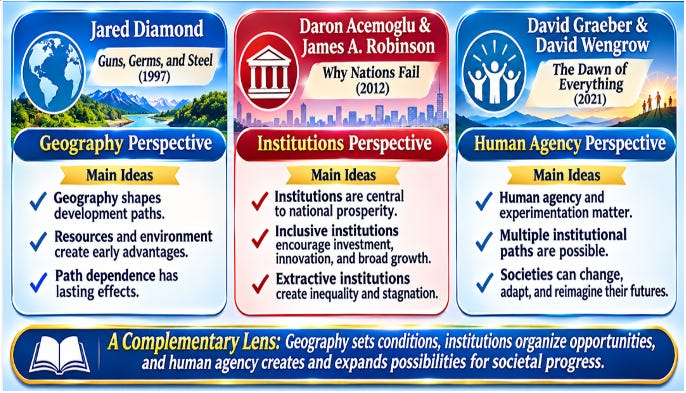
Figure 1. Three Influential Perspectives on National Development
Source: Author’s own synthesis, informed by Diamond (1997), Acemoglu and Robinson (2012), and Graeber and Wengrow (2021).
Note: The figure was developed with AI-assisted visualization under the author’s conceptual direction, review, and approval.
Figure 1 juxtaposes three perspectives that operate at different historical and analytical levels: Diamond’s long-run geographic and environmental conditions, Acemoglu and Robinson’s institutional incentives and political-economic arrangements, and Graeber and Wengrow’s historical diversity of social choices. The figure is a heuristic comparison, not a claim of theoretical equivalence or a test of the books’ arguments in South Korea. It illustrates how inherited conditions, institutional arrangements, and collective choices may be considered together in an interpretive account of national development.
2.1. Guns, Germs, and Steel: Geography Shapes Opportunities, Not Destinies
Jared Diamond’s Guns, Germs, and Steel (1997) emphasizes how geography, domesticable species, ecological differences, and the diffusion of technologies influenced long-run patterns of human development. Its central argument concerns broad historical trajectories rather than a deterministic prediction of any modern country’s industrial performance. South Korea’s resource constraints and its success in steel, shipbuilding, automobiles, electronics, and semiconductors illustrate the importance of education, technological learning, imported inputs, and global trade in responding to inherited conditions. Korea’s modern experience therefore qualifies a simplistic geographic determinism but does not directly falsify Diamond’s long-horizon historical explanation.
2.2. Why Nations Fail: Institutions Convert Opportunities into Capabilities
Daron Acemoglu and James A. Robinson’s Why Nations Fail (2012) argues that political and economic institutions shape incentives for participation, innovation, and the distribution of power. North and South Korea offer a prominent comparison of sharply divergent institutions against a backdrop of shared history, though their trajectories also reflect security, international support, and geopolitical conditions. South Korea’s early industrial growth relied heavily on state-led coordination under authoritarian rule, complicating any simple claim that political inclusion preceded industrial success. Its later democratization and institutional reforms are better understood as part of a changing configuration of growth capabilities and political accountability. Institutions matter, but their effects unfold historically and require careful attention to context.
2.3. The Dawn of Everything: Human Agency Creates Alternative Futures
David Graeber and David Wengrow’s The Dawn of Everything (2021) uses archaeological and anthropological examples to challenge linear accounts of social evolution and to show the historical variety of political and social arrangements. It does not directly propose a model of contemporary Korean industrialization. Nevertheless, South Korea’s democratic mobilization in 1987, educational investment, entrepreneurship, and globally connected cultural creativity can be interpreted through its broader emphasis on the possibility of deliberate social change. That application remains analogical: historical human agency helps frame questions about collective choice without itself establishing the causes of Korea’s developmental outcomes.
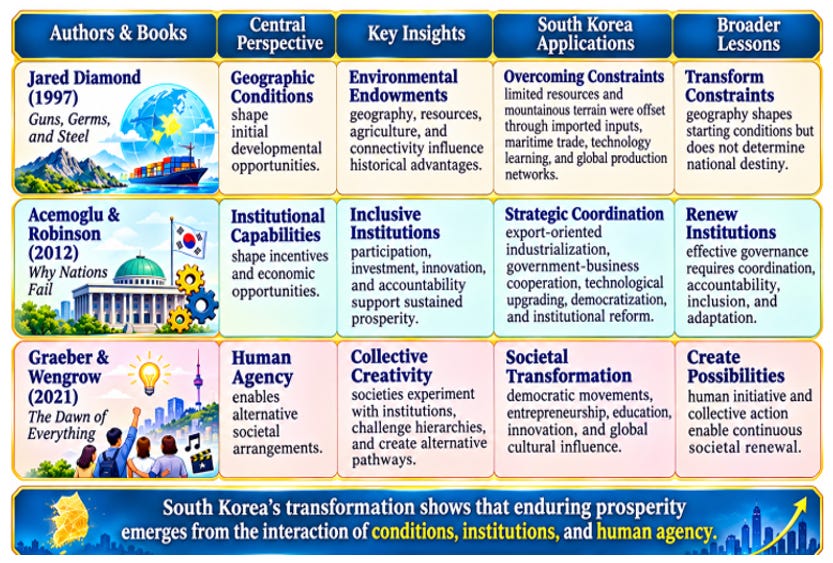
These three perspectives operate at different historical and analytical levels: geography shapes long-term constraints and opportunities, institutions influence incentives and collective capabilities, and human agency enables societies to challenge existing arrangements and pursue alternative pathways. South Korea’s experience illustrates their potential interaction without establishing that any one perspective fully explains its transformation or that the authors themselves present a common theory of Korea. The proposed integration is therefore a framework for informed comparison and interpretation, strengthened by Korea-specific research on industrial policy, technological learning, democratization, and global networks (Amsden, 1989; Kim, 1997; Kim, 2000; Rodrik, 1995).
Table 1 compares the distinct analytical focus of each book, its central insights, the author’s interpretive applications to South Korea, and the lessons drawn for national development. The comparison does not equate the books’ historical scope or suggest that the authors explicitly examined all aspects of Korea’s transformation. Read alongside Korea-specific research, it offers a structured lens for examining how geographic constraints, institutional change, and collective choices may interact.
Table 1. Three Influential Books and Their Implications for South Korea’s Transformation
Source: Author’s own comparative synthesis, informed by Diamond (1997), Acemoglu and Robinson (2012), Graeber and Wengrow (2021), Amsden (1989), Kim (1997), Kim (2000), and Hong and Park (2020).
Note: South Korea applications represent the author’s interpretations rather than claims directly advanced by all three books. The original visualization was developed with AI assistance under the author’s conceptual direction, review, and approval.

3. Five Central Themes of South Korea’s Societal Transformation
South Korea’s transformation from a war-devastated, resource-constrained country into an advanced industrial economy and globally influential society illustrates how nations can overcome historical disadvantages through institutional development, technological learning, international connectivity, and collective human agency. Drawing on Guns, Germs, and Steel, Why Nations Fail, and The Dawn of Everything, five central themes explain Korea’s developmental trajectory and its implications for the future.
3.1. Geographic Constraints and the Transformation of National Disadvantages
South Korea’s development began under severe geographic and historical constraints, including mountainous terrain, limited natural resources, geopolitical vulnerability, and the devastation of the Korean War (1950–1953). As Jared Diamond’s Guns, Germs, and Steel (1997) suggests, geographic conditions shape initial developmental opportunities, but Korea’s experience demonstrates that such constraints need not determine long-term economic outcomes. By leveraging imported resources, technological learning, maritime trade, and global production networks, South Korea transformed its strategic location and international connectivity into competitive advantages in advanced manufacturing and technology. The central theme is that national prosperity depends not simply on inherited geographic endowments but on a society’s capacity to convert structural constraints into opportunities through strategic coordination, innovation, and global engagement.
3.2. Institutional Development and Strategic Industrial Coordination
South Korea’s industrial transformation demonstrates the importance of institutional capabilities, as emphasized in Acemoglu and Robinson’s Why Nations Fail (2012), particularly through government-led industrialization, educational investment, and technological upgrading since the 1960s. Strategic coordination among government agencies, financial institutions, businesses, universities, and research organizations enabled the development of globally competitive industries in steel, shipbuilding, automobiles, electronics, and semiconductors. However, early industrialization under authoritarian rule, concentrated corporate power, and vulnerabilities exposed by the 1997–1998 Asian financial crisis revealed the need for greater transparency, accountability, and institutional reform. The central theme is that sustainable national competitiveness requires institutions that combine strategic coordination and economic capabilities with effective governance, continuous adaptation, and inclusive participation.
3.3. Education, Technological Learning, and Global Network Capabilities
South Korea’s transformation into an advanced industrial economy demonstrates how sustained investments in education, engineering, research, and technological learning can convert human capital into national competitiveness. As an indication of its current economic scale, the World Bank reports GDP per capita of approximately US$36,227 in 2025 (current U.S. dollars; World Bank, n.d.-a). The OECD (2026b) reports that exports of goods and services rose from about 24% of GDP in 1996 to 44% in 2024, reflecting deeper integration into global markets alongside a shift toward higher-value manufacturing. These descriptive indicators establish neither the relative contribution of particular institutions nor a causal test of the three books. Korean firms moved from dependence on imported technologies and labor-intensive production toward sophisticated manufacturing and innovation through research and development, organizational learning, and international competition. Global partnerships and knowledge networks helped companies such as Samsung, Hyundai Motor, LG, and SK develop advanced capabilities. The central theme is that competitiveness increasingly depends on human capital, technological innovation, and global network capabilities rather than natural resource endowments alone.
3.4. Democratic Transformation, Cultural Creativity, and Collective Human Agency
South Korea’s transformation extends beyond industrial competitiveness to democratic participation, social development, and cultural influence, reflecting Graeber and Wengrow’s The Dawn of Everything (2021), which emphasizes human agency and the capacity to reshape established institutions. The June 1987 Democratic Uprising demonstrated how students, workers, religious organizations, civic groups, and ordinary citizens could collectively advance political reforms and strengthen public accountability. Similarly, the global success of Korean music, films, television dramas, and BTS illustrates how artistic creativity, entrepreneurship, digital platforms, and international networks have expanded Korea’s cultural influence across countries and generations. The central theme is that sustainable societal progress depends not only on economic and technological capabilities but also on democratic participation, cultural creativity, institutional renewal, and collective human agency.
3.5. From Economic Success to Societal Sustainability and Institutional Renewal
Despite its remarkable achievements, South Korea faces low fertility, rapid population aging, labor-market inequalities, regional disparities, and geopolitical uncertainty that threaten the long-term sustainability of its development model. The OECD (2026a, 2026b) reports that the total fertility rate fell to 0.72 children per woman in 2023 and recovered only modestly to a preliminary 0.80 in 2025; this limited rebound does not establish a lasting reversal. Meanwhile, artificial intelligence, semiconductor competition, global supply chain restructuring, and energy transitions require renewed institutional capabilities, technological adaptability, and international cooperation. The three-book perspective suggests that Korea’s next transformation must combine demographic resilience, inclusion, institutional trust, and intergenerational prosperity. The central theme is that sustainable national prosperity cannot rest on past industrial successes, but requires continuous institutional adaptation and collective action.
4. So What? Strategic Implications for South Korea and Beyond
South Korea’s remarkable transformation, viewed through Guns, Germs, and Steel, Why Nations Fail, and The Dawn of Everything, offers three broader implications: rethinking national development beyond geographic constraints, renewing Korea’s institutional and societal foundations for intergenerational prosperity, and applying its lessons to other nations confronting economic, technological, and geopolitical uncertainties.
4.1. Rethinking National Development: From Inherited Conditions to Transformative Capabilities
The first implication is that national development can be interpreted through the interaction of inherited geographic conditions, institutional arrangements, and human agency, while respecting the different historical scales and claims of the three books (Diamond, 1997; Acemoglu & Robinson, 2012; Graeber & Wengrow, 2021). South Korea demonstrates how resource constraints may be addressed through industrial development, technological innovation, institutional reforms, and international partnerships. Three interpretive propositions follow: (1) geography influences but does not fix the options available to countries linked to global networks; (2) institutional incentives and coordination can support capability accumulation, though their effectiveness depends on political and historical circumstances; and (3) collective human action can shape democratic reforms, innovation, and institutional renewal. These are conceptual propositions for comparative learning, not causal conclusions demonstrated by the three books.
4.2. Renewing South Korea’s Development Model: From Industrial Competitiveness to Societal Sustainability
The second implication is strategic: South Korea must move beyond an industrial growth model centered on exports and technological competitiveness toward a more inclusive development framework that integrates demographic resilience, institutional renewal, and societal well-being. Five priorities are essential: (1) improving career opportunities, housing affordability, and work-life balance for younger generations; (2) ensuring inclusive benefits from AI and advanced technologies; (3) strengthening institutional transparency, educational reform, and governance adaptability; (4) expanding international cooperation while managing strategic supply chain dependencies; and (5) promoting community development, lifelong learning, and cultural participation. Achieving these priorities requires coordinated efforts among government, businesses, universities, and communities, alongside broader measures of national progress that include social mobility, regional opportunities, institutional trust, and quality of life. The central implication is that Korea’s next developmental transformation must shift from maximizing industrial competitiveness alone toward building a sustainable, inclusive, and resilient society in which economic prosperity and intergenerational well-being reinforce one another.
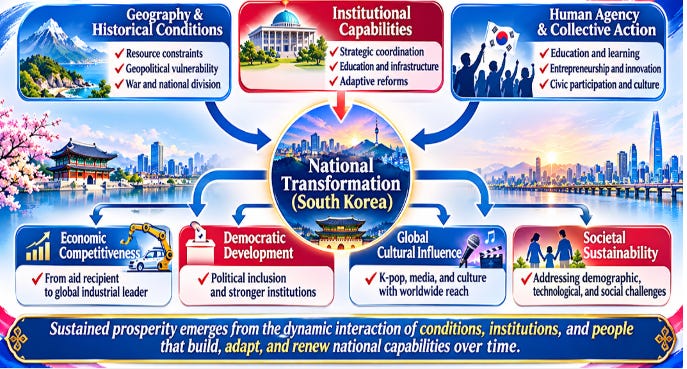
Figure 2. An Integrative Framework of National Development: The Korea Experience
Source: Author’s own conceptual synthesis, informed by Diamond (1997), Acemoglu and Robinson (2012), Graeber and Wengrow (2021), Amsden (1989), Kim (1997), and Hong and Park (2020).
Note: The framework represents the author’s original integration of geographic conditions, institutional capabilities, and human agency to explain South Korea’s transformation and future developmental priorities. The figure was developed with AI-assisted visualization under the author’s conceptual direction, review, and approval.
Figure 2 presents an integrative framework explaining South Korea’s national transformation through the dynamic interaction of geographic and historical conditions, institutional capabilities, and collective human agency. The framework illustrates how strategic coordination, education, technological innovation, and civic participation have contributed to four interconnected outcomes: economic competitiveness, democratic development, global cultural influence, and societal sustainability. The central insight is that sustained national prosperity emerges not from geographic advantages or institutions alone but from the continuous interaction of inherited conditions, adaptive institutions, and purposeful human action that builds, strengthens, and renews national capabilities across generations.
4.3. Lessons for Other Nations: From Economic Catch-Up to Continuous Societal Renewal
The third implication is international: South Korea demonstrates that national development is neither predetermined by natural resources nor guaranteed by a particular institutional model, offering valuable lessons for countries facing geographic constraints, technological dependence, and geopolitical uncertainty. Emerging economies can learn from Korea’s investments in education, infrastructure, industrial capabilities, and export competitiveness, while advanced economies can draw lessons about technological adaptability, institutional renewal, and human capital development. However, Korea’s transformation occurred under distinctive historical circumstances, including Cold War security arrangements, access to global markets, and strategic government-business coordination, requiring other nations to adapt rather than simply replicate its experience. The central implication is that sustainable national prosperity requires balancing strategic coordination with human initiative, economic competitiveness with social inclusion, and international cooperation with continuous institutional renewal to create opportunities for future generations.

5. Conclusion
South Korea’s remarkable transformation from a war-devastated, resource-constrained nation into a global leader in manufacturing, technology, and culture demonstrates that geographic limitations need not determine national destiny. Integrating the perspectives of Guns, Germs, and Steel, Why Nations Fail, and The Dawn of Everything, this article highlights how institutional capabilities, global networks, technological learning, and collective human agency can transform inherited disadvantages into sustained national competitiveness. Korea’s next developmental challenge is to move beyond industrial achievement toward societal longevity by addressing demographic decline, strengthening institutional adaptability, expanding inclusive opportunities, and ensuring intergenerational prosperity. The growing American interest in South Korea reflected in the recent U.S.–Korea events in Toledo illustrates the global reach of Korea’s transformation and the responsibility of each generation to strengthen institutional renewal, international collaboration, and societal well-being.
References
Acemoglu, D., & Robinson, J. A. (2012). Why nations fail: The origins of power, prosperity, and poverty. Crown Business.
Amsden, A. H. (1989). Asia’s next giant: South Korea and late industrialization. Oxford University Press.
Diamond, J. M. (1997). Guns, germs, and steel: The fates of human societies. W. W. Norton & Company.
Graeber, D., & Wengrow, D. (2021). The dawn of everything: A new history of humanity. Farrar, Straus and Giroux.
Hong, P., Hwang, D., Park, Y. S., & Ferreira, F. C. M. (2026). Benchmarking national semiconductor strategies: Advancing innovation systems and policy learning for global competitiveness. Benchmarking: An International Journal. 1-27. https://doi.org/10.1108/BIJ-02-2025-0131
Hong, P., & Park, Y. W. (2020). Rising Asia and American hegemony: Case of competitive firms from Japan, Korea, China and India. Springer. https://doi.org/10.1007/978-981-13-7635-1
Jin, D. Y. (2016). New Korean wave: Transnational cultural power in the age of social media. University of Illinois Press.
Kim, L. (1997). Imitation to innovation: The dynamics of Korea’s technological learning. Harvard Business School Press.
Kim, S. (2000). The politics of democratization in Korea: The role of civil society. University of Pittsburgh Press.
Organisation for Economic Co-operation and Development. (2026a). Exploring Korea’s fertility, work, and family policy trends. OECD Publishing. https://doi.org/10.1787/1155864e-en
Organisation for Economic Co-operation and Development. (2026b). OECD economic surveys: Korea 2026. OECD Publishing. https://doi.org/10.1787/6b87f585-en
Park, Y. W., & Hong, P. (2019). Creative innovative firms from Japan: A benchmark inquiry into firms from three rival nations. Springer. https://doi.org/10.1007/978-981-13-1681-4
Rodrik, D. (1995). Getting interventions right: How South Korea and Taiwan grew rich. Economic Policy, 10(20), 53–107. https://doi.org/10.2307/1344538
World Bank. (n.d.-a). GDP per capita (current US$) – Korea, Rep. [Data set]. World Development Indicators. Retrieved November 5, 2026, from https://data.worldbank.org/indicator/NY.GDP.PCAP.CD?locations=KR
World Bank. (n.d.-b). Republic of Korea. Retrieved October 31, 2026, from https://www.worldbank.org/ext/en/country/korea
About the Author

Paul C. Hong (Editor-in-Chief) - Distinguished University Professor, University of Toledo
Full list of his K-GSP columns:
Paul C. Hong is a Distinguished University Professor of Information Systems and Supply Chain Management at the University of Toledo. His research focuses on global competitiveness, industrial transformation, technological innovation, institutional capabilities, and international business networks, with particular emphasis on South Korea and other Asian economies. Through extensive publications in scholarly journals and academic books, he examines how nations, industries, and organizations overcome structural constraints through strategic coordination, collective learning, and institutional adaptation to achieve sustainable development and long-term prosperity.
Suggested Citation
Hong, Paul. C. (2026). “Beyond Guns, Germs, and Steel: South Korea’s Transformation Through Geography, Institutions, and Human Agency”, K-Global Scholars and Professionals Forum, November 12, 1-13
Original Articel

한글 요약
총·균·쇠를 넘어서: 지리적 조건, 제도적 역량, 인간의 주체성으로 본 대한민국의 대전환
2026년 10월 27일부터 29일까지 미국 오하이오주 톨레도에서 열린 한미관계 관련 행사와 필자가 좌장을 맡은 톨레도 공공도서관의 공개강연은 한국에 대한 미국 지역사회의 관심이 경제, 무역, 첨단산업, 안보, 문화, 역사에 이르기까지 폭넓게 확대되고 있음을 보여주었다. 불과 70여 년 전 전쟁의 폐허와 빈곤 속에서 생존을 고민하던 대한민국은 오늘날 반도체, 자동차, 조선, 전자산업과 문화산업에서 세계적 경쟁력을 갖춘 국가로 성장하였다. 이 글은 천연자원이 부족하고 지정학적 제약이 큰 한국이 어떻게 산업적 성공과 민주화, 세계적 문화 영향력을 동시에 이루어냈는가라는 질문에서 출발한다.
이러한 변화를 설명하기 위해 세 권의 대표적인 저서를 비교한다. 재러드 다이아몬드의 『총, 균, 쇠』(1997)는 지리와 자연환경이 문명의 출발 조건을 형성한다는 점을, 대런 애쓰모글루와 제임스 로빈슨의 『국가는 왜 실패하는가』(2012)는 정치·경제 제도가 국가의 번영을 좌우한다는 점을, 데이비드 그레이버와 데이비드 웬그로의 『모든 것의 새벽』(2021)은 인간의 창의성과 집단적 선택이 기존 질서를 변화시킬 수 있다는 점을 강조한다. 이 세 관점을 통합하면 대한민국의 발전은 단순한 경제성장이 아니라 지리적 제약을 제도적 역량과 인간의 주체적 행동으로 극복한 역사적 전환으로 이해할 수 있다.
대한민국의 발전 과정에서는 다섯 가지 핵심 요인이 확인된다.
첫째, 자원 부족과 지정학적 취약성을 국제무역과 글로벌 네트워크를 통해 극복하였고,
둘째, 정부·기업·대학·연구기관의 전략적 협력을 통해 산업경쟁력을 축적하였다.
셋째, 교육과 기술학습을 바탕으로 모방에서 혁신으로 발전하였으며,
넷째, 1987년 민주화운동과 시민 참여, 한류와 BTS 등 문화적 창의성을 통해 사회적 역량과 국제적 영향력을 확대하였다.
다섯째, 과거의 산업화 성과에 안주하지 않고 저출산, 고령화, 지역 불균형, 인공지능 확산, 공급망 재편과 같은 새로운 도전에 대응하기 위한 지속적인 제도 혁신이 요구된다.
이 글이 제시하는 가장 중요한 교훈은 국가의 미래가 지리적 조건이나 과거의 성공에 의해 결정되는 것이 아니라, 사회 구성원들이 역량을 축적하고 제도를 개선하며 새로운 가능성을 창출하는 과정에서 형성된다는 것이다. 한국의 다음 발전 단계에서는 수출과 첨단기술 경쟁력뿐 아니라 청년세대의 기회 확대, 일과 가정의 양립, 사회적 신뢰, 지역 균형발전, 삶의 질과 세대 간 지속가능성을 함께 추구해야 한다. 또한 한국의 경험은 다른 국가들에도 중요한 시사점을 제공하지만, 각국의 역사적·제도적 특성을 고려한 창의적 적용이 필요하다. 궁극적으로 대한민국의 지속가능한 번영은 경제적 경쟁력에서 사회적 지속가능성으로, 산업적 성공에서 세대 간 공동번영으로 발전의 목표를 확장하는 데 달려 있다.
Paul C. Hong 교수는 미국 톨레도대학교의 Distinguished University Professor이자 정보시스템·공급망관리 및 아시아연구 분야의 학자로서, 글로벌 공급망과 산업경쟁력, 기술혁신, 리더십과 제도적 거버넌스를 연구하며 국가와 기업의 지속가능한 발전 및 국제협력에 관한 학술 저술과 연구 활동을 수행하고 있다.
© K-Global Scholars and Professionals Forum. All rights reserved. Content published in the K-GSP Forum may not be reproduced, distributed, or transmitted in any form without prior written permission from the K-GSP Forum, except for brief quotations with full attribution.
Professor Hong, thank you for this insightful piece. The central lesson — that a nation’s future is built not by inherited conditions but by continuous learning, coordination, and human agency — resonates deeply with me. As a Korean-American who graduated in Korea in 1996, came to the U.S. in 1999, and has spent the years since building a career, raising three children, and serving in campus ministry here, I’ve come to believe the same is true of a person and a family: destiny isn’t fixed by where you start, but by what you build, day by day. Korea’s journey from devastation to global leadership is a reminder that steady, purposeful effort compounds across generations. Grateful for your work bridging these ideas across borders.
— Andrew Park, Downey, CA
Dr. Paul Hong, thank you for this insightful and thought-provoking piece.
Your article offers a compelling perspective on how geography, institutions, and human agency have shaped South Korea’s transformation.
It powerfully illustrates how sustained learning and collective choices can turn profound challenges into new possibilities.
Your call to move beyond industrial achievement toward societal sustainability is especially timely.
These lessons resonate far beyond Korea, inviting us to reflect on what lasting prosperity means for future generations.