

EXECUTIVE SUMMARY
Using BTS as a central case, this article argues that success is not a terminal achievement but a transitional phase that demands a new discipline: sustaining relevance in a rapidly shifting cultural and digital landscape. It proposes that enduring relevance emerges from the integration of identity stability, continuous discipline, adaptive innovation, and a clear expansion of purpose beyond initial success. By reframing BTS as a socio-technological system rather than merely a cultural phenomenon, the article offers a transferable framework for how global actors can convert peak success into sustained influence.
Keywords: Enduring Relevance, Cultural Influence, Socio-Technological Systems, Post-Success Discipline, Global Soft Power
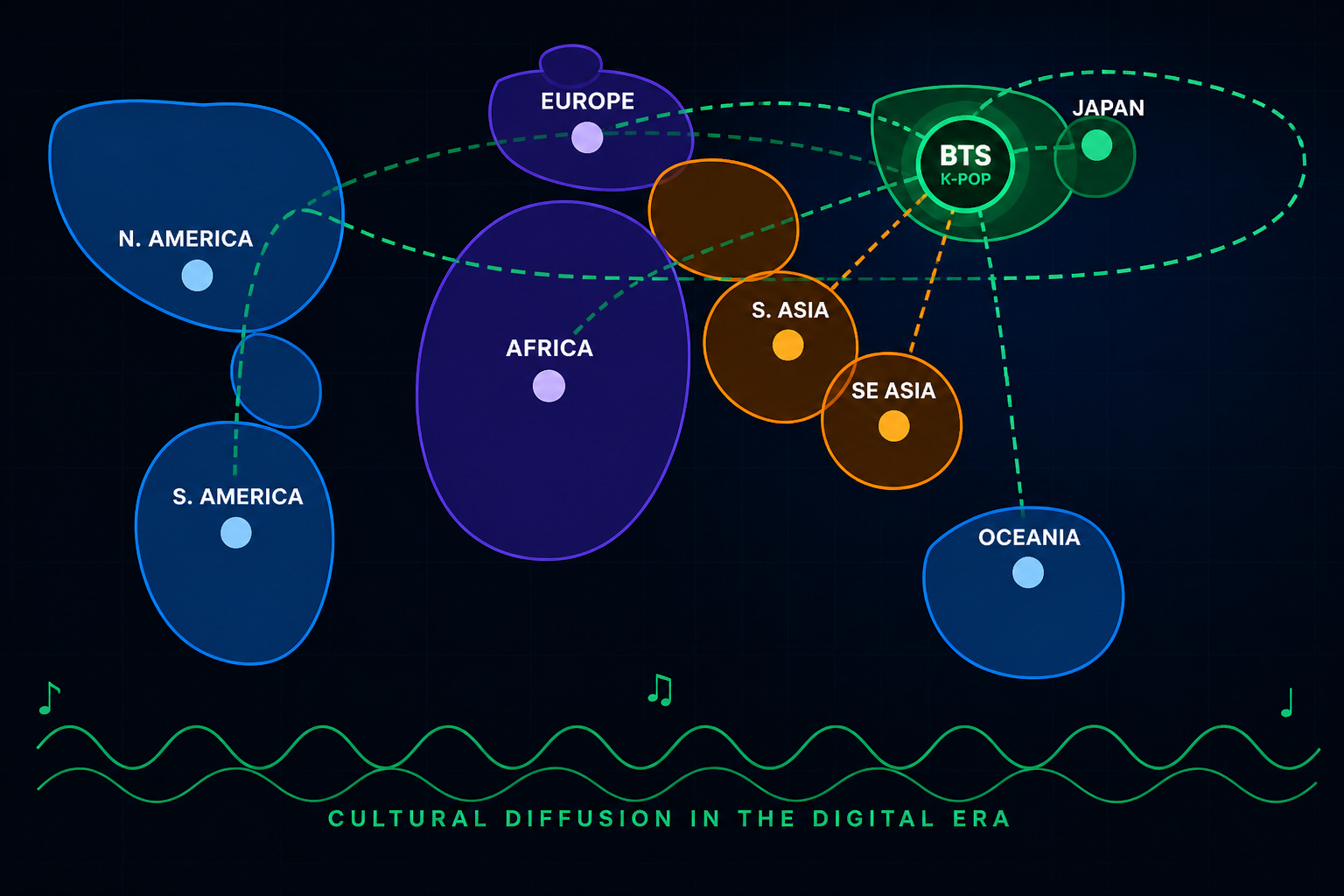
Figure 1. Global Cultural Diffusion of BTS in the Digital Era (Source: Author’s Own). Illustrates the transnational spread of BTS’s cultural influence across major regions through digitally mediated networks. Highlights how synchronized content, platforms, and fandom interactions enable continuous global engagement and relevance.
1. INTRODUCTION
At the height of global fame, success often becomes the beginning of decline. History is filled with artists, athletes, and business leaders who reached extraordinary heights only to unravel under the weight of their own success. Yet a small number of individuals and organizations defy this pattern. The global rise of BTS is not merely a story of cultural breakthrough — it is an unfolding case of how success can be managed, extended, and transformed into enduring influence. In an age defined by volatility, digital acceleration, and attention scarcity, the more important question is no longer how success is achieved, but how it is sustained (Collins, 2001; Sinek, 2019).
When all members of BTS chose to fulfill their mandatory military service at the peak of their global popularity, many observers predicted an inevitable decline — a disruption that would fracture momentum, weaken fan engagement, and erode their hard-earned global position. In a cultural economy driven by constant visibility and rapid content cycles, even a temporary absence can prove fatal. Yet their return to the global stage — marked by renewed tours, synchronized re-engagement, and sustained cultural resonance — suggests a different narrative.
BTS is not merely coming back; they are demonstrating a rare capacity to remain relevant amid accelerating change. Their trajectory challenges the conventional lifecycle of global fame and points instead to a deeper discipline of continuity, identity, and strategic reinvention that defines enduring greatness.
2. THE INTERRUPTION THAT TESTED CONTINUITY
In the entertainment industry, interruptions in visibility often disrupt momentum, weaken audience engagement, and expose performers to rapid competitive substitution.
2.1. The Predicted Decline
When all members of BTS committed to completing their mandatory military service, the prevailing assumption was that their absence would trigger a gradual erosion of global influence. Analysts and industry observers pointed to the unforgiving nature of digital attention cycles, where even short gaps can lead to audience fragmentation and competitive displacement. The expectation was not sudden collapse, but a slow fading — an almost inevitable loss of cultural centrality. In this view, continuity was inseparable from constant output.
This prediction reflected a broader misunderstanding of how deep cultural capital is formed and sustained. BTS had already moved beyond transactional popularity into a domain of relational engagement with a globally distributed fandom. Their influence was embedded not only in content production but in identity, narrative, and shared meaning. As a result, their temporary absence did not dissolve relevance; it preserved anticipation. What appeared as a pause was, in effect, a strategic compression of visibility that intensified long-term attention.
2.2. The Return and Reinforcement
Their return to the global stage has not simply restored prior momentum but has redefined the terms of their relevance. Rather than competing in the same cycle of rapid production, BTS re-entered with amplified symbolic weight, where presence itself became an event. The global tour signals not a restart, but a continuation under transformed conditions. This distinction marks the difference between recovery and reinforcement.
More importantly, their comeback demonstrates that enduring success is not dependent on uninterrupted exposure but on the strength of underlying structures — identity, discipline, and trust. In a rapidly changing global environment, where trends accelerate and attention fragments, BTS has shown that relevance can be sustained through coherence rather than constant visibility (Sinek, 2019). Their trajectory reframes success as something that can withstand interruption and still expand. In doing so, they offer a compelling model of enduring greatness in the digital age.
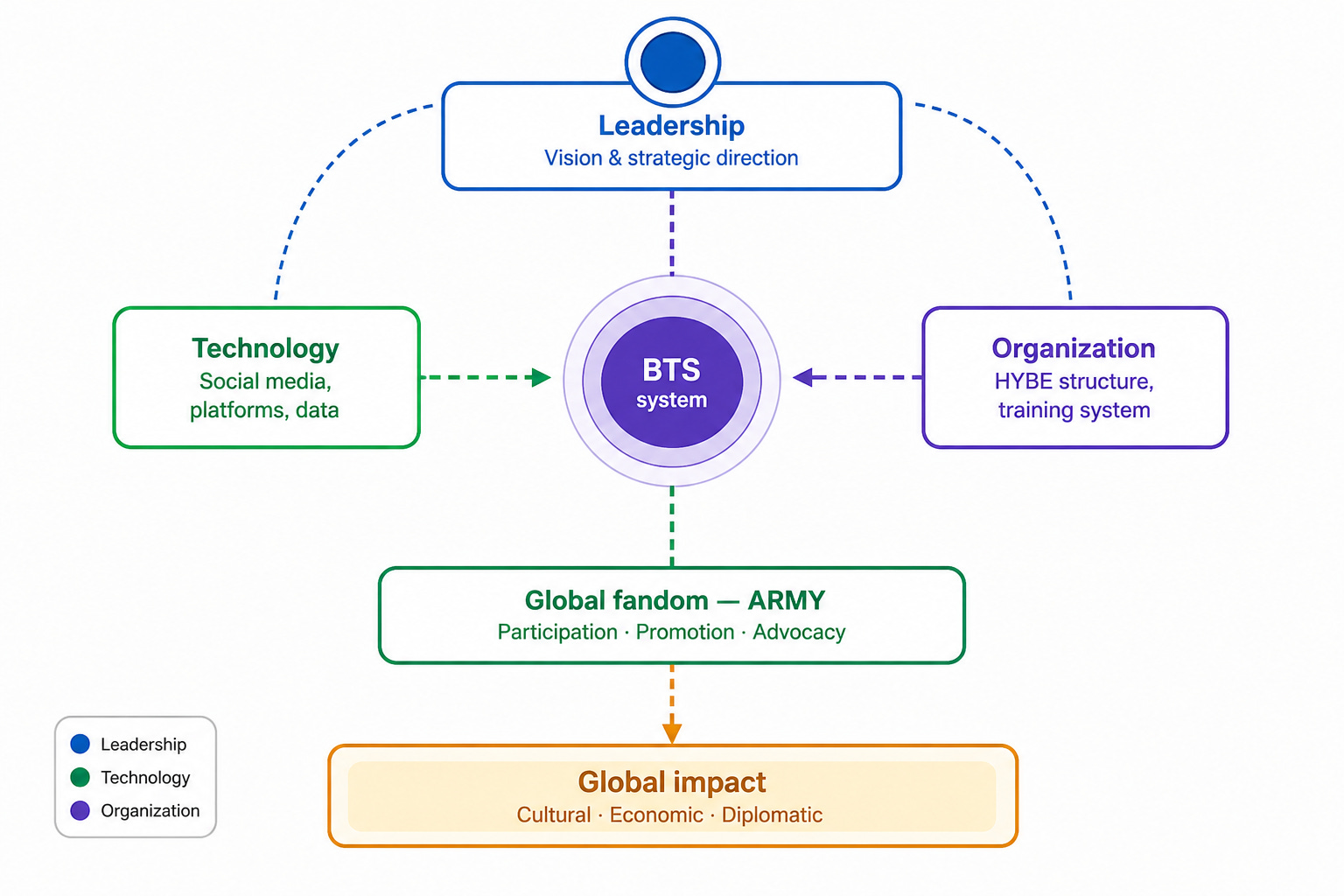
Figure 2. BTS Socio-Technological System Model (Source: Author’s Own). Figure 2 presents BTS as a socio-technological system in which leadership vision drives a dual infrastructure of technology (social media, streaming platforms, data analytics) and organizational design (HYBE structure, artist training). These converge in the BTS system core — an integrated creative engine — which mobilizes a global participatory fandom (ARMY) through participation, promotion, and activism. The system culminates in sustained global impact across cultural, economic, and diplomatic dimensions.
Success creates the spotlight — but only discipline sustains the stage.
3. ANALYTICAL FRAMEWORK
The challenge of sustaining success requires a structured model that explains how high performers avoid post-achievement decline. The 5D Framework of Enduring Success offers a clean, transferable lens to understand how BTS has converted global success into enduring influence (Ericsson & Pool, 2016).
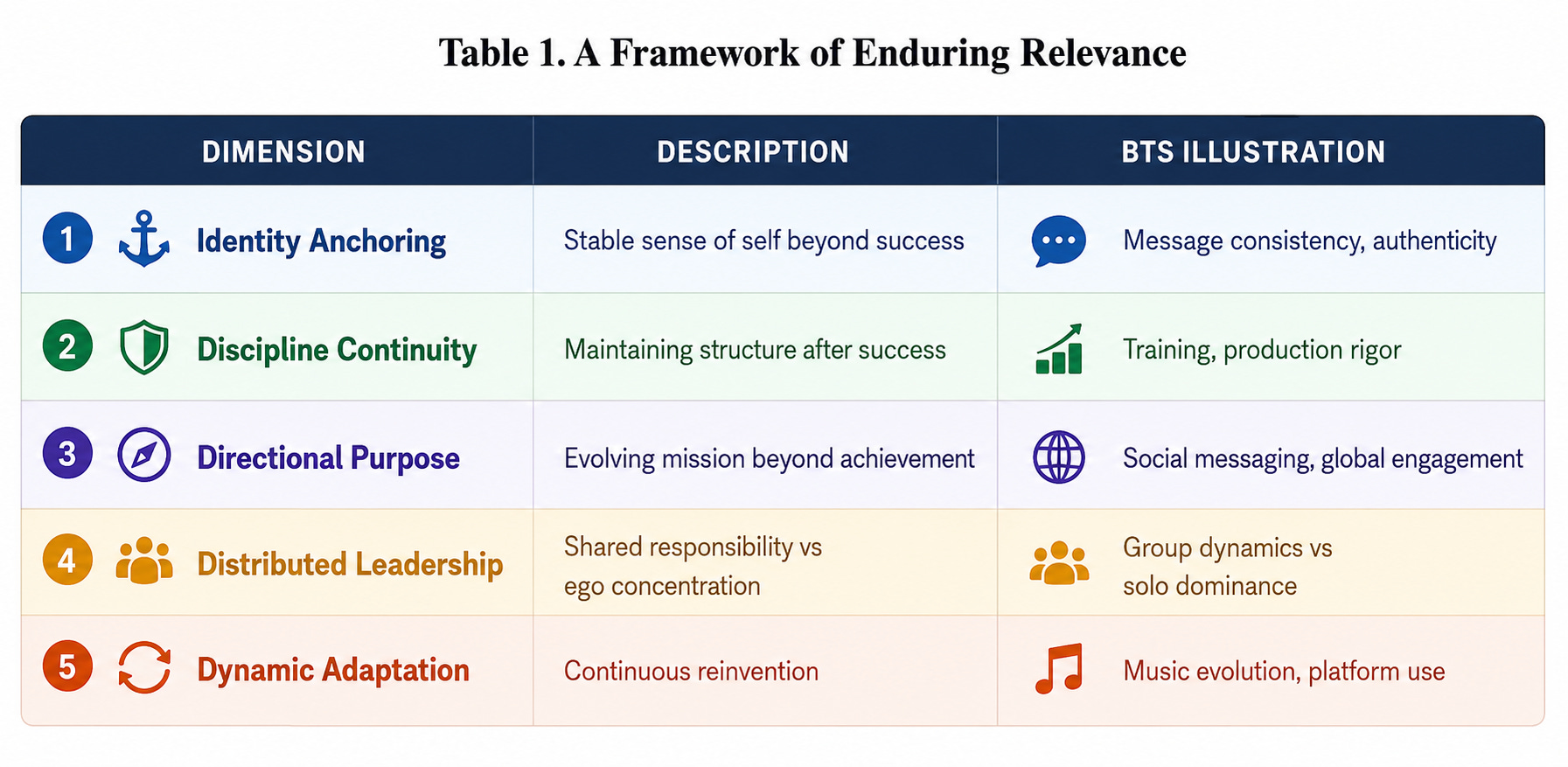
Table 1. A Framework of Enduring Relevance
Table 1 presents a structured analytical framework — the 5D Framework of Enduring Relevance — that explains how success can be sustained beyond initial achievement through five interrelated dimensions: identity anchoring, discipline continuity, directional purpose, distributed leadership, and dynamic adaptation. As an analytical model, it integrates internal drivers (identity, discipline, purpose) with external execution mechanisms (leadership, adaptation), offering a systematic lens for converting peak success into long-term influence. The framework functions as a coherent and transferable system, where interdependent dimensions are operationalized through BTS to demonstrate how enduring relevance is achieved in dynamic environments.
3.1. Internal Foundations: Identity, Discipline, and Purpose
The first three dimensions — identity anchoring, discipline continuity, and directional purpose — form the internal core of sustained success. In the case of BTS, identity anchoring is evident in their consistent narrative of authenticity and self-reflection, which remains stable despite global fame. This stable identity prevents the distortion that often accompanies rapid success and public adulation. Without such grounding, success can easily redefine the individual or group in ways that lead to instability (Hong et al., 2024).
Discipline continuity reinforces this identity by preserving the rigor that produced initial success. BTS has maintained high standards in training, production, and performance even after reaching the peak of global recognition. At the same time, directional purpose ensures that success evolves into meaning, as the group expands its mission into social messaging and global engagement. Together, these three elements create an internal architecture that transforms success from a temporary outcome into a sustained trajectory (Ericsson & Pool, 2016; Duhigg, 2012).
3.2. External Execution: Leadership and Adaptation
The remaining two dimensions — distributed leadership and dynamic adaptation — operate at the system level and determine how success is managed in complex environments. BTS exemplifies distributed leadership through its group-centered structure, where influence and responsibility are shared rather than concentrated in a single dominant figure. This reduces ego-driven fragility and enables resilience, as the group can absorb shocks without collapsing around one individual. Such a structure contrasts sharply with many celebrity models that depend heavily on singular charisma (Park et al., 2025).
Dynamic adaptation complements this leadership model by ensuring continuous reinvention. BTS has consistently evolved its music, digital presence, and modes of fan engagement in response to changing global conditions. This adaptability is not reactive but strategically embedded in their operating system, allowing them to remain relevant across different cultural and technological shifts. Together, distributed leadership and dynamic adaptation transform success into a scalable and renewable system, forming the external engine of enduring greatness (Kocienda, 2018).
4. BTS AS A STRATEGIC SYSTEM: MORE THAN JUST ARTISTS
Reframing BTS beyond entertainment reveals a highly coordinated system rather than a conventional music group. BTS operates simultaneously as a cultural production engine, a digital platform-driven ecosystem, and a globally synchronized network of content and engagement. This perspective shifts analysis from individual talent to system design, where success is generated, scaled, and sustained through structured integration (Hong et al., 2024; Park et al., 2025). In this sense, BTS is not simply producing music but orchestrating a continuous flow of cultural value across global audiences.
4.1. BTS as a Cultural Production System
As a cultural production system, BTS integrates storytelling, music creation, visual design, and performance into a coherent narrative architecture. Each album, video, and live performance is not an isolated product but part of a larger, evolving storyline that reinforces identity and emotional connection. This systemic approach allows BTS to produce not just content but meaning, which strengthens long-term audience engagement. Cultural production, therefore, becomes cumulative rather than episodic.
This system also reflects industrial-level coordination behind creative output. Writers, producers, choreographers, and visual teams operate within a synchronized framework that ensures consistency without limiting innovation. The result is a scalable model of creativity where quality and narrative coherence are maintained across outputs. Such a structure distinguishes BTS from artists who rely primarily on sporadic hits rather than sustained cultural construction (Kocienda, 2018).
4.2. BTS as a Digital Ecosystem and Global Supply Chain
BTS functions as a digital platform-driven ecosystem in which content distribution and fan interaction are tightly interconnected. Through social media, streaming platforms, and direct fan communication channels, the group maintains continuous global presence and real-time engagement. Fans are not passive consumers but active participants in amplifying and co-creating value within the ecosystem. This transforms audience engagement into a strategic asset rather than a byproduct of success.
From a strategic perspective, this ecosystem can be understood as a globally synchronized supply chain of content and engagement. Content creation, platform distribution, and fan response operate as integrated stages of a unified system rather than isolated activities. BTS operates as a cultural supply chain — where content creation, platform distribution, and fan engagement are tightly integrated. This system-level coordination enables speed, scalability, and resilience, allowing BTS to sustain global influence in a rapidly changing digital environment (Hong et al., 2024).
5. BENCHMARKING FROM OTHERS THAT FALL AND DECLINE
The sustainability of success becomes clearer when contrasted with patterns of decline observed across high-profile individuals and organizations. Many globally recognized figures — from Elvis Presley to Mike Tyson — demonstrate that success often contains the seeds of its own erosion (Duhigg, 2012). The recurring failure pattern includes identity inflation, discipline erosion, feedback isolation, and purpose stagnation. In contrast, BTS systematically deviates from each of these failure points through deliberate structural and cultural mechanisms.
5.1. The Failure Pattern: Post-Success Collapse
Identity inflation occurs when success reshapes self-perception, leading individuals to equate achievement with inherent superiority. This often disconnects them from the humility and learning orientation that initially enabled their rise. Over time, such distortion weakens adaptability and increases vulnerability to external shocks. As identity becomes inflated, decision-making shifts from grounded judgment to ego-driven impulses.
Discipline erosion follows as the constraints that once enforced rigor are removed after success. Without external pressure, routines weaken, standards decline, and performance consistency deteriorates. Simultaneously, feedback isolation emerges as individuals become surrounded by affirmation rather than honest critique. Purpose stagnation then completes the cycle, as the original goals that drove success are no longer sufficient to sustain motivation or direction.
5.2. BTS Deviation: A Model of Sustained Alignment
BTS avoids identity inflation by grounding its self-concept in a continuous narrative of growth, authenticity, and collective purpose. Rather than allowing fame to redefine identity, the group reinforces its core message through consistent storytelling and engagement. This narrative anchoring stabilizes internal alignment even as external recognition expands. As a result, identity remains a source of strength rather than distortion.
Discipline within BTS is not diminished by success but institutionalized through structured training, production systems, and performance expectations. Feedback is continuously generated in real time through global fan engagement, creating a dynamic loop of interaction and adjustment. Purpose, meanwhile, is continuously expanded beyond music into cultural and social domains, ensuring long-term relevance. Together, these elements form a counter-model to post-success decline, demonstrating how alignment across identity, discipline, feedback, and purpose sustains enduring success (Ericsson & Pool, 2016; Park et al., 2025).
Enduring greatness is not achieved once; it is continuously made relevant.
5.3. Key Takeaways
The following insights distill the core principles of sustaining success beyond initial achievement.
Success Must Be Reframed as Responsibility — Not a reward to enjoy, but a burden to manage with discipline, structure, and accountability.
Systems Must Replace Charisma — Sustained success depends on repeatable processes and institutional strength, not individual personality or star power.
Identity Must Outgrow Achievement — Without continuous identity evolution, success becomes static and eventually leads to stagnation or collapse.
6. CONCLUSION
In the case of BTS, enduring success is not an accident of talent but the outcome of disciplined systems, adaptive strategy, and evolving purpose. Their trajectory demonstrates that sustainability requires aligning identity, structure, and mission beyond the moment of peak achievement. By institutionalizing discipline and continuously expanding purpose, BTS avoids the common traps that follow global success. This case suggests that long-term greatness is engineered, not improvised, and must be actively managed as conditions change. Success reaches the top — but only discipline, purpose, and system design allow it to stay there.
REFERENCES
Collins, J. (2001). Good to great: Why some companies make the leap...and others don’t.HarperBusiness.
Duhigg, C. (2012). The power of habit: Why we do what we do in life and business. Random House.
Ericsson, K. A., & Pool, R. (2016). Peak: Secrets from the new science of expertise. Eamon Dolan/Houghton Mifflin Harcourt.
Hong, P., Kim, S. C., Lee, A., & Kang, H. (2024). The entrepreneurial transformation process of BTS: initiation, development, growth and expansion. Journal of Enterprising Communities: People and Places in the Global Economy, 18(5), 1078–1097.
Kocienda, K. (2018). Creative selection: Inside Apple’s design process during the golden age of Steve Jobs. St. Martin’s Press.
Park, D. S. H., Kim, S. C., & Hong, P. (2025). Empowering leadership and socio-technological practices: an empirical investigation of BTS’s success. Arts and the Market, 15(2–3), 128–145.
Sinek, S. (2019). The infinite game. Portfolio/Penguin.
Original Document:

ABOUT THE AUTHOR

Paul C. Hong DISTINGUISHED UNIVERSITY PROFESSOR · UNIVERSITY OF TOLEDO
Paul C. Hong is a Distinguished University Professor and Chair of Information Systems and Supply Chain Management at the University of Toledo. His work focuses on leadership, governance, and decision-making in the AI era, integrating strategy, technology, and institutional trust. He has published extensively in leading academic journals and writes on how individuals and organizations navigate complexity, disruption, and global transformation.
K-GSP Forum · May 2026 · All Rights Reserved
© K-Global Scholars and Professionals Forum. All rights reserved. Content published in the K-GSP Forum may not be reproduced, distributed, or transmitted in any form without prior written permission from the K-GSP Forum, except for brief quotations with full attribution.