

EXECUTIVE SUMMARY
Dead Poets Society dramatizes the tension between conformity and independent judgment, while Friedrich Nietzsche’s Thus Spoke Zarathustra explores the same tension philosophically through ideas of the Übermensch, self-overcoming, perspective, and resistance to unexamined majority opinion. Statistical thinking extends this philosophical challenge by providing disciplined ways to question assumptions, examine variation, compare perspectives, recognize uncertainty, and revise conclusions when evidence changes. Bringing film, philosophy, and statistics together, this article argues that genuine independent thinking does not mean simply disagreeing with others but developing the capacity to examine evidence responsibly and change one’s judgment when better understanding requires it.
Keywords: Nietzsche; Übermensch; Statistical Thinking; Independent Judgment; Self-Overcoming
1. Introduction
The 1989 film Dead Poets Society presents students at the fictional Welton Academy, an elite school governed by tradition, discipline, achievement, and powerful expectations concerning how young men should think and live. Into this environment comes English teacher John Keating, whose unconventional teaching encourages his students to look at familiar things differently, read poetry personally, discover their own voices, and reconsider assumptions that others have made for them. His famous classroom exercises, standing on desks, questioning conventional interpretations, and urging students to seize meaningful opportunities, challenge the students to move beyond passive conformity. Yet the film also shows that independence is neither easy nor free from consequences, particularly through Neil Perry’s tragic conflict with parental authority.
The tension between conformity and independent judgment provides a useful entry into Friedrich Nietzsche’s philosophy. Few philosophers have challenged conventional thinking as persistently as Nietzsche, yet few have been as easily misunderstood. His statement that “God is dead” (Nietzsche, 1974), for example, is frequently interpreted as little more than a declaration against religion. Nietzsche’s larger concern, however, was the cultural consequence of traditional religious and moral authority losing its unquestioned position in modern Europe while society continued to depend on values inherited from those traditions (Kaufmann, 1974; Young, 2010). His question was therefore not merely whether people continued to believe in God, but what would guide human judgment when inherited frameworks could no longer automatically provide answers.
In Thus Spoke Zarathustra, Nietzsche develops ideas such as the Übermensch, self-overcoming, resistance to conformity, and the continuing creation and reexamination of values. Although his conclusions differ fundamentally from religious traditions such as Christianity, his questions remain valuable to religious and nonreligious readers alike. How much of what we believe has actually been examined? When should we question majority opinion? How do we distinguish genuine independence from simple rebellion? Can human beings continue developing throughout life rather than becoming intellectually settled?
These questions also provide an unexpected connection to statistics. Statistical thinking requires people to move beyond intuition, averages, majority impressions, and apparently obvious relationships in order to investigate what the evidence actually shows. The purpose of this article is therefore not to portray Nietzsche as a statistician, but to show how Dead Poets Society, Nietzsche’s philosophical challenge, and statistical thinking illuminate a common problem: how can individuals move beyond unexamined assumptions without replacing them with equally unsupported opinions?
2. Dead Poets Society: Conformity, Voice, and Independent Judgment
The story that follows moves through three stages, its setting, its characters, and the lessons they teach, before returning to the question of independent judgment.
2.1. The Story and Its Setting
Dead Poets Society is set in 1959 at Welton Academy, whose educational philosophy emphasizes tradition, honor, discipline, and excellence. The school represents an environment in which success has already been defined for its students by parents, teachers, and institutional expectations. John Keating enters this environment with a different understanding of education. Instead of simply transmitting knowledge, he encourages students to develop judgment, imagination, and personal responsibility. Keating’s methods are memorable because they change perspective. He asks students to stand on desks so they can literally see the classroom differently, challenges mechanical approaches to poetry, and encourages them to recognize that education should help them develop their own voices. The larger lesson is not that established knowledge or authority should automatically be rejected. Rather, students should understand why they believe what they believe and become capable of evaluating inherited assumptions for themselves.
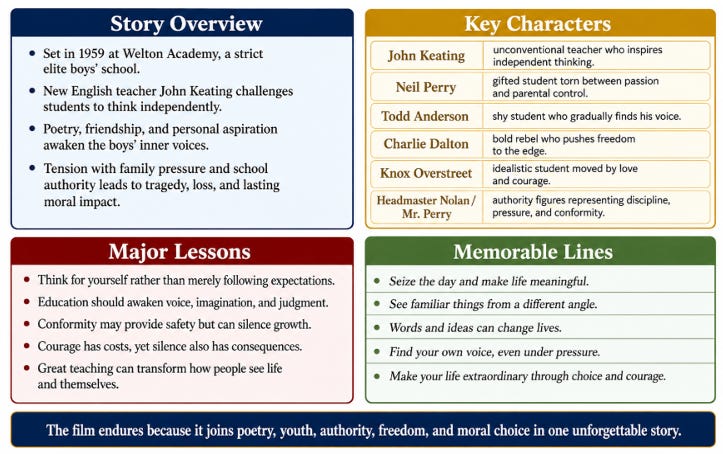
Figure 1 summarizes Dead Poets Society by presenting its story, major characters, central lessons, and memorable lines. It highlights how John Keating challenges students to think independently, while characters such as Neil Perry and Todd Anderson reveal the tensions between personal aspiration, authority, conformity, and finding one’s own voice. Overall, the figure shows that the film’s lasting message is about using education, courage, perspective, and responsible judgment to live more meaningfully rather than simply following expectations.
Figure 1
Dead Poets Society: Story, Characters and Lessons
Source: Author’s Own Compilation
2.2. Key Characters and the Search for Voice
The major characters illustrate different responses to authority and independence. Keating represents the teacher as catalyst rather than controller. Neil Perry possesses talent and aspiration but struggles under a father who has already determined his future. Todd Anderson begins as quiet and insecure but gradually discovers his ability to speak with confidence. Charlie Dalton represents a more impulsive form of rebellion, demonstrating that rejecting authority does not automatically constitute mature judgment. The contrast between these characters is important. Independent thinking is not simply doing the opposite of what authorities or most people expect. Neil’s experience demonstrates the consequences of extreme conflict between personal aspiration and rigid authority, while Todd’s development shows a more gradual process of finding an authentic voice. The film therefore raises a question that leads naturally to Nietzsche: How can individuals develop themselves without allowing either conformity or impulsive rebellion to determine their lives?
2.3. Lessons: Question, Reconsider, and Judge
The film’s lessons converge from three angles into one idea. Inherited expectations deserve to be examined rather than obeyed automatically, since assumptions absorbed without question rarely survive contact with evidence. Perspective matters just as much, as familiar situations can look entirely different once viewed from another position, which is why Keating insists his students literally change where they stand. These lessons should not be mistaken for a claim that every traditional belief is wrong or every unconventional belief is right. Keating’s more constructive message is that individuals should learn to see and judge for themselves, a discipline the film dramatizes through story rather than argument. Nietzsche takes up the same challenge philosophically, in the pages that follow.
Independent judgment isn’t rejecting the crowd on principle — it’s earning the right to disagree by examining the evidence the crowd never bothered to check.
3. Nietzsche and Thus Spoke Zarathustra: Context, Structure, and Core Ideas
The discussion that follows moves through three stages, Nietzsche’s context, the structure of Zarathustra, and its core ideas, before turning to what these ideas mean for readers today.
3.1. Nietzsche’s Personal and Historical Context
Friedrich Nietzsche was born in 1844 in Röcken, Prussia, into a strongly Protestant family whose Lutheran-pastor father set the religious environment he would later leave behind, becoming, by his mid-twenties, professor of classical philology at the University of Basel (Young, 2010). His academic career was cut short by severe, recurring health problems, and after resigning his professorship in 1879, he spent much of his remaining productive life moving among Switzerland, Italy, and southern France. Illness, intellectual isolation, broken relationships, and his rupture with his former mentor Richard Wagner all pushed him toward an increasingly independent intellectual life. It was during this period, mainly between 1883 and 1885, that he wrote Thus Spoke Zarathustra.
Nietzsche also lived through dramatic changes across Germany and Europe, as unification, industrialization, nationalism, expanding scientific knowledge, Darwinian thought, historical criticism of religion, and rising secularization together challenged inherited sources of authority. His announcement of the “death of God” must be read against that background. He feared that Europe was abandoning the theological foundations of its morality without fully understanding what would replace them, risking a slide into nihilism, a condition in which inherited meaning collapses without a credible alternative (Kaufmann, 1974; Leiter, 2002). That fear, more than any hostility to religion itself, is the real engine of Zarathustra‘s argument.
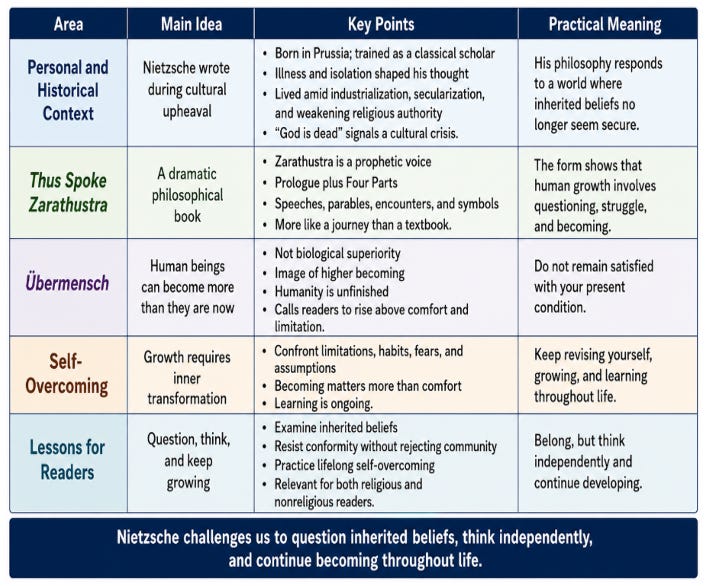
Table 1 summarizes Nietzsche’s personal and historical context, the purpose and structure of Thus Spoke Zarathustra, and the major ideas of the Übermensch and self-overcoming in a simple and organized format. It shows that Nietzsche’s philosophy calls readers to move beyond passive acceptance, confront their limitations, and continue developing through questioning, reflection, and growth. Overall, the table emphasizes that Nietzsche’s practical message for both religious and nonreligious readers is to examine inherited beliefs, think independently, and continue becoming throughout life.
Table 1
Nietzsche, Thus Spoke Zarathustra, and Practical Lessons
3.2. Why Thus Spoke Zarathustra and How the Book Works
Nietzsche chose Zarathustra, the ancient Persian teacher traditionally associated with Zoroastrianism, as his central character for a deliberately provocative reason: since the historical Zarathustra was linked to a strong moral distinction between good and evil, Nietzsche imagined the same figure returning to reconsider the very morality he had once helped establish. This let him adopt a prophetic voice while simultaneously unsettling the religious and moral traditions that voice would normally serve. The book that resulted, consisting of a prologue and four parts, abandons conventional philosophical argument almost entirely (Nietzsche, 2006). In its place come speeches, parables, symbolic encounters, poetry, animals, mountains, journeys, solitude, and recurring images of transformation.
Zarathustra descends from the mountains to share what he has learned, meets resistance and misunderstanding, withdraws, returns, teaches, and keeps confronting his own unresolved struggles, a structure that is not incidental but reinforces the philosophy itself. Human development, on Nietzsche’s telling, is never a straight path toward some final, settled state. It is a cycle of questioning, struggle, reinterpretation, failure, recovery, and renewed becoming, repeated rather than resolved. Thus Spoke Zarathustra, read this way, is less a philosophical textbook than a dramatic journey through the problem of human transformation (Nehamas, 1985; Richardson, 1996).
3.3. Three Core Themes
Nietzsche’s Übermensch, commonly translated as the Overman or Superman, is often misread as a claim about racial or biological superiority, but the concept is better understood as an image of human becoming and self-transformation: humanity, for Zarathustra, is not a completed destination but something capable of being surpassed. That same idea drives his account of self-overcoming, the process by which human beings grow not by dominating others but by confronting their own limitations, assumptions, habits, fears, and attachments. Nietzsche’s philosophy returns to this theme continually, insisting on becoming over remaining fixed (Magnus, 1978). The question worth asking, on this view, is therefore not only “Who am I?” but “What am I capable of becoming?”
Running alongside this is Nietzsche’s critique of conformity, sharpened through his contrast between higher aspiration and the comfortable “Last Man,” who prefers security, convenience, predictability, and minimal risk. Nietzsche worries that a society organized primarily around comfort will eventually lose the will to pursue harder forms of achievement and transformation. Several of Zarathustra’s most memorable images gather these themes into one picture: humanity as something to be overcome, existence as a bridge rather than a finished goal, faithfulness to earthly life, inner struggle as a source of creativity, and development that requires moving beyond one’s current condition. Together, they turn the book into a sustained challenge against both intellectual and personal complacency.
4. Nietzsche’s Lessons for Religious and Nonreligious Readers
The lessons that follow unfold through three practices, examining inherited beliefs, resisting conformity, and practicing self-overcoming, that apply equally to religious and nonreligious readers.
4.1. Examine Inherited Beliefs
Nietzsche’s criticism of religion may make some religious readers reluctant to engage his work, yet his questions can be valuable precisely because they are difficult. A religious person can ask whether faith has been thoughtfully understood and personally lived or merely inherited through family and tradition. Christianity itself contains repeated calls to examine motives, avoid hypocrisy, mature in faith, and distinguish genuine conviction from outward conformity. Nonreligious readers face the same challenge. Secularism, political ideology, professional assumptions, cultural definitions of success, and contemporary social values can also become inherited beliefs. No worldview becomes intellectually credible simply because it is modern, popular, traditional, religious, or secular (Clark, 1990). Nietzsche’s constructive challenge is to examine what has been received rather than merely repeating it.
4.2. Resist Conformity Without Rejecting Community
Nietzsche’s “herd” is best understood in contemporary language as the pressure to accept what most other people believe simply because it is widely accepted (Nietzsche, 1989a, 1989b). Yet resistance to conformity should not be confused with rejection of community. Families, institutions, religious organizations, scientific communities, and professional networks are essential sources of knowledge, support, identity, and cooperation. The stronger lesson is therefore belong, but continue thinking. Independent judgment does not require isolation. Nor does disagreement establish correctness. People who automatically oppose majority opinion can become as intellectually captive as people who automatically follow it. Mature judgment requires the ability both to learn from communities and to examine their assumptions critically.
4.3. Practice Self-Overcoming Throughout Life
Nietzsche’s concept of self-overcoming carries a different weight depending on where a reader stands in life. Younger readers naturally face questions about identity, career, relationships, aspirations, and social expectations, and Nietzsche pushes them past the obvious question of what society expects toward a harder one: what kind of person are they becoming? That same demand grows only more pointed with age, since achievement can quietly produce its own complacency once experience starts to feel like a reason to stop learning. Older readers might therefore ask what they can still learn, which assumptions deserve reconsideration, and what they are now capable of contributing that simply wasn’t possible earlier.
Religious and nonreligious readers will locate the source and purpose of that transformation differently, Christians through grace, repentance, discipleship, service, and the slow work of becoming more Christlike, and nonreligious readers through learning, discipline, resilience, creativity, and ethical responsibility. The vocabulary differs, but the underlying demand does not: both traditions ask their adherents to keep changing rather than settle. What unites them is the refusal to treat any particular age or professional status as a finish line. Human development, on either account, does not get to end just because a person has arrived somewhere respectable.
5. From Nietzsche to Statistical Thinking
The argument that follows moves through three statistical habits, questioning averages, comparing perspectives, and revising conclusions, that translate Nietzsche’s philosophical challenge into practice.
5.1. Question What Most People Believe: Go Beyond the Average
The connection between Nietzsche and statistics begins with questioning what appears obvious, since Nietzsche’s warning against accepting majority opinion merely because it is widespread has a direct statistical counterpart in the caution against treating averages, aggregated patterns, or majority results as complete descriptions of reality. Simpson’s Paradox makes the point concretely: a relationship that looks unquestionably true in aggregated data can weaken, disappear, or even reverse once that data is divided into its relevant subgroups (Blyth, 1972). The lesson is not that the overall statistic is fraudulent, but that context determines interpretation, and statistical thinking, in this sense, places methodological discipline behind Nietzsche’s philosophical challenge. Questioning the majority is not enough on its own; we still have to examine the evidence that produced the majority’s conclusion in the first place.
5.2. Perspective Matters: One Dataset, Different Views
Nietzsche’s perspectivism holds that human understanding always occurs from a particular standpoint (Hales & Welshon, 2000), and statistical analysis supplies some of the clearest evidence for why that matters: the same economic data can look entirely different depending on whether it’s presented as totals, averages, medians, percentages, distributions, regional comparisons, or changes over time. Suppose average household income rises substantially. That number may suggest broad improvement, yet the median could rise far less, inequality could be widening, or the gains could be concentrated within a small group, so that each statistic offers a genuine but partial perspective rather than a complete picture. Statistical thinking requires comparing these measures rather than selecting whichever one happens to support a preferred conclusion. Here, though, statistics quietly places a limit on Nietzsche’s own philosophical perspectivism: multiple perspectives do not mean that every interpretation is equally credible, since better interpretations are simply the ones that fit the evidence more completely, transparently, and consistently.
5.3. Self-Overcoming as Evidence-Based Revision
The strongest connection between Nietzsche and statistics may be self-overcoming: Nietzsche challenges individuals to overcome their present limitations, while statistical thinking asks decision-makers to overcome their attachment to present conclusions. Confirmation bias pulls in the opposite direction, encouraging people to search out whatever information already supports what they believe, which is exactly why statistical reasoning demands the harder discipline of formulating questions, examining evidence, considering alternatives, and revising a conclusion once it no longer holds up. Hypothesis testing, confidence intervals, and model checking all serve this same humility in practice, testing whether a belief is consistent with the evidence, acknowledging the uncertainty behind any estimate, and asking whether an analysis’s assumptions still hold (Wasserstein & Lazar, 2016).
None of this makes changing one’s mind a form of intellectual weakness for the mature statistical thinker, quite the opposite, since a willingness to revise a conclusion when stronger evidence appears is itself a form of intellectual strength, the statistical mirror of what Nietzsche calls overcoming the existing self. That distinction only grows more urgent in the age of artificial intelligence, where systems can generate summaries, recommendations, and apparently authoritative answers in seconds, even though speed and confidence are never substitutes for evidence. Human judgment is still what has to ask whether the data are representative, the comparisons meaningful, and whether important variables have gone unconsidered, which is where Nietzsche and statistics converge on the same warning: do not outsource judgment merely because an answer arrives confidently, quickly, or with everyone else already nodding along.
An AI can hand you a confident answer in seconds; only human judgment can ask whether that answer deserves your trust.
6. Conclusion
Dead Poets Society, Nietzsche’s Thus Spoke Zarathustra, and statistical thinking approach the problem of judgment from different directions but share a concern with the dangers of passive conformity and unexamined assumptions. The film dramatizes the struggle to develop an independent voice, Nietzsche provides the philosophical challenge of self-overcoming and questioning accepted values, and statistics supplies disciplined methods for determining whether our judgments are supported by evidence. For religious and nonreligious readers alike, the central lesson is not simply to reject tradition, authority, or majority opinion, but to examine assumptions carefully, compare perspectives, recognize uncertainty, and remain capable of learning. Going beyond the crowd ultimately means not merely thinking differently from others, but developing the courage and discipline to question responsibly, examine evidence, and revise our judgments when better understanding requires it.
References
Blyth, C. R. (1972). On Simpson’s paradox and the sure-thing principle. Journal of the American Statistical Association, 67(338), 364–366. https://doi.org/10.1080/01621459.1972.10482387
Clark, M. (1990). Nietzsche on truth and philosophy. Cambridge University Press.
Hales, S. D., & Welshon, R. (2000). Nietzsche’s perspectivism. University of Illinois Press.
Kaufmann, W. (1974). Nietzsche: Philosopher, psychologist, antichrist (4th ed.). Princeton University Press.
Leiter, B. (2002). Nietzsche on morality. Routledge.
Magnus, B. (1978). Nietzsche’s existential imperative. Indiana University Press.
Nehamas, A. (1985). Nietzsche: Life as literature. Harvard University Press.
Nietzsche, F. (1974). The gay science (W. Kaufmann, Trans.). Vintage Books. (Original work published 1882)
Nietzsche, F. (1989a). Beyond good and evil: Prelude to a philosophy of the future (W. Kaufmann, Trans.). Vintage Books. (Original work published 1886)
Nietzsche, F. (1989b). On the genealogy of morals (W. Kaufmann & R. J. Hollingdale, Trans.). Vintage Books. (Original work published 1887)
Nietzsche, F. (2006). Thus spoke Zarathustra: A book for all and none (A. Del Caro & R. B. Pippin, Eds.; A. Del Caro, Trans.). Cambridge University Press. (Original work published 1883–1885)
Richardson, J. (1996). Nietzsche’s system. Oxford University Press.
Wasserstein, R. L., & Lazar, N. A. (2016). The ASA statement on p-values: Context, process, and purpose. The American Statistician, 70(2), 129–133. https://doi.org/10.1080/00031305.2016.1154108
Young, J. (2010). Friedrich Nietzsche: A philosophical biography. Cambridge University Press.
ABOUT THE AUTHOR

Paul C. Hong (Editor-in-Chief) - Distinguished University Professor, University of Toledo
Paul C. Hong is a Distinguished University Professor at the University of Toledo whose academic background integrates economics, manufacturing management, engineering, and global supply chain strategy. He earned a B.A. in Economics from Yonsei University, an M.A. in Economics from Bowling Green State University, and a Ph.D. in Manufacturing Management and Engineering from the University of Toledo. His research focuses on global supply chain management, strategic benchmarking, manufacturing competitiveness, resilience, industrial policy, and geo-economics, with particular interest in how trade policy, technological change, economic security, and geopolitical competition reshape international production networks and national competitiveness. His current work increasingly examines the intersection of global supply chains, strategic industries, AI-enabled transformation, and geo-economic relations among major economies, emphasizing how firms and nations can balance efficiency, resilience, strategic autonomy, and international cooperation in an increasingly complex global environment.
Original Article:

Suggested Citation
Hong, P. C. (2026, September 8). Beyond the crowd: Dead Poets Society, Nietzsche, and the logic of statistical thinking. K-GSP Forum, pp. 1–11.
한글요약
대중의 생각을 넘어: 『죽은 시인들의 모임』, 니체의 사상과 통계적 사고의 논리
이 글은 영화 죽은 시인들의 모임(Dead Poets Society)을 출발점으로, 다수의 생각과 행동을 맹목적으로 따르는 삶과 자신만의 독립적 판단에 따라 살아가는 삶이 어떻게 다른지를 살펴보고, 이를 니체의 철학과 통계적 사고의 관점으로 확장한다. 이 영화에서 존 키팅은 학생들에게 익숙한 것을 다른 관점에서 보고, 자신의 목소리를 찾으며, 이미 정해진 남들의 기대방향을 무비판적으로 따르지 말라고 가르친다. 그러나 영화는 단순한 반항을 찬양하지 않고, 독립적 사고에는 책임과 판단이 함께 필요하다는 점도 보여준다. 이러한 문제의식은 “사람들은 왜 다수가 믿는 것을 그대로 받아들이는가, 그리고 어떻게 스스로 판단할 수 있는가”라는 이 글의 중심 질문으로 이어진다.
니체의 『차라투스트라는 이렇게 말했다』는 이러한 질문을 철학적으로 심화한다. 니체의 “신은 죽었다”라는 표현은 단순한 무신론 선언이라기보다, 근대 유럽에서 전통적 종교와 도덕의 권위가 약화되고 새로운 가치의 기반이 불분명해지는 상황에 대한 문화적 진단으로 이해할 수 있다. 이 책의 핵심 사상인 초인(Übermensch), 자기극복, 관점주의, 그리고 다수의 생각에 대한 비판은 인간이 이미 주어진 가치와 판단을 그대로 수용하지 말고 자신이 무엇을 믿고 어떻게 살아갈 것인지를 끊임없이 성찰하도록 요구한다. 종교인에게는 신앙이 단순한 전통이나 습관인지, 아니면 깊이 이해되고 실천되는 신앙인지 묻게 하며, 비종교인에게도 자신이 따르는 가치와 세계관이 충분히 검토된 것인지 되돌아보게 한다.
이 글의 가장 독특한 부분은 니체의 철학을 통계적 사고와 연결하는 데 있다. 통계적 사고는 평균, 다수 의견, 겉으로 보이는 패턴을 그대로 받아들이지 않고, 데이터가 어떻게 수집되고 분류되었는지, 다른 관점에서는 어떤 결과가 나타나는지, 그리고 불확실성이 어느 정도 존재하는지를 검토하도록 요구한다. 심슨의 역설처럼 전체 데이터에서는 한 방향으로 보이는 관계가 하위 집단을 나누어 보면 반대로 나타날 수 있다는 점은 “다수가 그렇게 보인다고 해서 그것이 전체 진실은 아니다”라는 교훈을 잘 보여준다. 따라서 니체가 “왜 그렇게 믿는가?”라고 철학적으로 질문한다면, 통계적 사고는 “그 판단을 뒷받침하는 증거는 무엇이며, 더 나은 증거가 나타났을 때 우리는 판단을 수정할 수 있는가?”라고 묻는다.
결국 이 글은 죽은 시인의 사회, 니체, 그리고 통계적 사고를 하나의 흐름으로 연결한다. 영화는 독립적 목소리를 찾는 인간적 갈등을 보여주고, 니체는 자기극복과 기존 가치의 재검토라는 철학적 도전을 제시하며, 통계는 그 판단을 증거와 분석을 통해 검증하는 방법을 제공한다. 이 글의 최종 메시지는 분명하다. 다수의 생각을 넘어선다는 것은 단순히 남들과 다르게 생각하는 것이 아니라, 자신의 가정을 점검하고, 다양한 관점을 비교하며, 더 나은 증거가 나타날 때 판단을 바꿀 수 있는 지적 용기와 훈련을 갖추는 것이다.
Paul C. Hong은 미국 톨레도대학교 석좌교수로 글로벌 공급사슬, 인간의 판단, 리더십과 의사결정을 연구하며, 통계학 수업에서 영화·문학·철학의 이야기를 통계적 개념과 연결하여 학생들이 가정과 증거를 비판적으로 검토하도록 가르친다. 최근에는 이러한 융합적 접근을 AI 시대의 인간적 판단과 책임 있는 의사결정으로 확장하고 있다.
© K-Global Scholars and Professionals Forum. September 2026. All rights reserved. Content published in the K-GSP Forum may not be reproduced, distributed, or transmitted in any form without prior written permission from the K-GSP Forum, except for brief quotations with full attribution.