
Beyond the Illusion of a ‘Golden Generation’
Conditions for Korean Football to Truly Reach the Global Stage
“Gold is valued not by its shine alone, but by its purity.”
In football, the phrase “Golden Generation” always carries hope and expectation. When a group of talented players emerges in the same era, fans naturally believe that they will create a new chapter in national football history. However, true gold is not defined merely by its brilliant appearance; it is defined by its purity.
Looking at the current generation of Korean football, we must ask an important question:
How pure is Korea’s golden generation by global football standards?
A recent opinion article from The Dong-A Ilbo critically examines Korean football in the context of the 2026 FIFA World Cup. It points out that, compared with the world’s top football nations, Korea still faces significant gaps in areas such as the number of players competing in Europe’s top leagues, player market value, and the overall depth of the football ecosystem.
However, this analysis should not be viewed as a declaration of failure. Rather, it provides an essential starting point for the future. True progress does not begin with illusion or excessive optimism; it begins with an accurate understanding of reality.
1. A Strong Football Ecosystem Matters More Than Individual Superstars
Korean football has historically depended heavily on a few exceptional players.
Players such as Cha Bum-kun, Park Ji-sung, and Son Heung-min have elevated Korea’s reputation on the world stage.
However, the emergence of one or two world-class players does not automatically raise the overall level of a nation’s football.
The world’s strongest football countries are successful because their entire football ecosystem is strong.
European football powers have developed systems where children begin playing from an early age, local clubs nurture talent, schools provide opportunities, and professional academies continuously develop players.
In contrast, Korea has traditionally relied too much on an elite-focused system, which limits the size of the talent pool.
A football powerhouse is not a country that waits for a genius to appear.
It is a country that creates an environment where geniuses are more likely to emerge.
2. Experience in European Leagues Means Learning ‘the Language of World Football’
Modern football is not merely a competition of technical skills.
It requires tactical intelligence, speed of play, ability to respond under pressure, physical strength, and psychological resilience.
Europe’s top leagues provide the highest-level environment where these abilities are tested every week.
The reason Korean players need more opportunities in European leagues is not simply to gain fame or higher salaries.
It is because they need to learn:
the speed, mentality, and decision-making standards of global football.
Japan’s recent improvement in international football has been partly supported by the increasing number of Japanese players competing in European leagues.
Korea must also create pathways that allow more talented players to experience the highest levels of competition.
3. A Football Revolution Must Begin on School Fields
World-class football players usually grow up with a ball at their feet.
Brazil’s street football culture, England’s community clubs, and Germany’s youth development system demonstrate that football becomes stronger when it becomes part of everyday life.
For Korean football to make a true leap forward, the nation must move from a system that only searches for talented children to a culture where all children have opportunities to enjoy football.
Playing freely on school fields is not simply entertainment.
It develops:
creativity,
spatial awareness,
teamwork,
competitive spirit,
and problem-solving ability.
Even in the age of artificial intelligence, human creativity and judgment cannot be created through repetitive training alone.
Football is the same.
The unexpected pass, the imaginative move, and the courageous decision are born from freedom and experience.
4. Korea Must Learn from the World, Not Only Compare with Japan
Comparisons between Korean and Japanese football are common.
However, Korea’s ultimate goal should not simply be defeating Japan. The goal should be competing with the world’s best.
If a nation focuses only on regional competition, its growth will eventually reach a limit.
Countries such as Germany, France, Spain, and Argentina possess decades of accumulated football culture, infrastructure, and development systems.
For Korea to become a genuine football powerhouse, long-term structural reform is more important than short-term results.
A great coach is valuable.
But a great system is even more valuable.
One talented generation is important.
But a system that continuously produces talented generations is far more important.
5. Football in the AI Era: Combining Data and Human Creativity
The future of football will become increasingly connected with technology.
Artificial intelligence will transform many areas of football:
player performance analysis,
injury prevention,
tactical development,
scouting,
and youth talent identification.
However, AI cannot solve everything.
The essence of football remains human decision-making and creativity.
When should a player make a risky pass?
When should a team defend or attack?
When should an individual sacrifice personal success for the team?
These decisions require human intelligence, emotion, and leadership.
The strongest teams of the future will be those that combine:
AI-powered innovation with human-centered football philosophy.
From 14-Karat Gold to 24-Karat Gold
The argument that Korea’s “golden generation” may not yet represent pure gold by global standards is painful, but it provides a valuable message.
However, history shows that great transformations always begin with honest self-reflection.
Korea has already become one of Asia’s strongest football nations, consistently qualifying for the FIFA World Cup and producing internationally recognized players.
The next challenge is clear:
Korea must build a system capable of competing with the world’s elite.
A true golden generation does not appear suddenly.
It is created when:
hundreds of thousands of children play football,
talented coaches are developed,
youth systems improve,
and more players gain international experience.
The future of Korean football does not depend on one superstar.
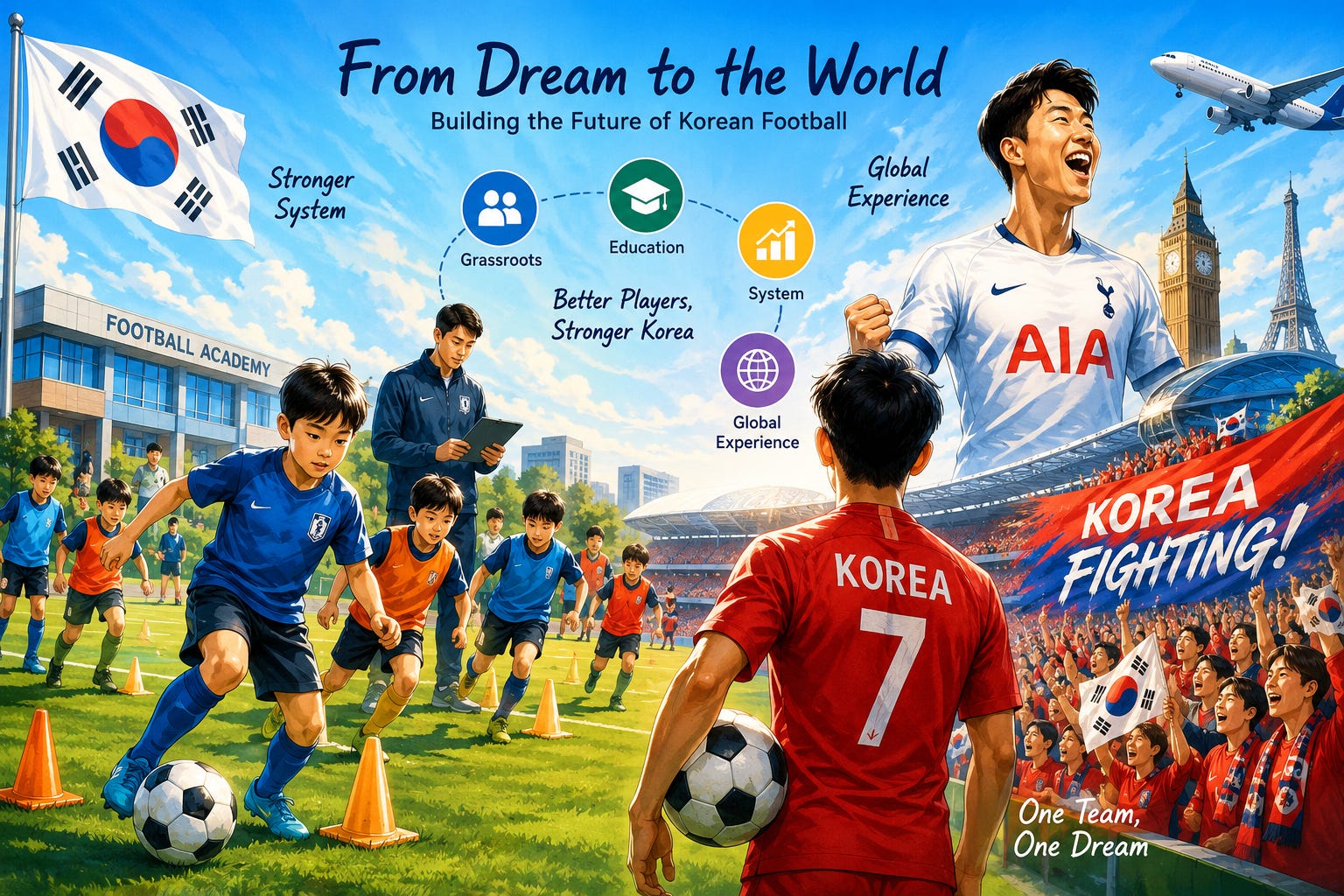
It begins with millions of young dreamers running on fields across Korea.
When that foundation is built, Korean football will move beyond temporary brilliance and become a true 24-karat gold standard on the world stage.
Reference Note:
This essay is adapted from the key arguments of The Dong-A Ilbo opinion article regarding Korea’s “Golden Generation” and its competitiveness under global football standards, expanded into an analysis focusing on long-term development, global competitiveness, and the future of football in the AI era. +++
{Solti}
July 28, 2026
‘황금 세대’의 착시를 넘어
한국 축구가 진짜 세계 무대로 가기 위한 조건
“황금은 빛나는 순간보다 순도가 중요하다.”
축구에서 ‘황금 세대(Golden Generation)’라는 표현은 언제나 희망과 기대를 담고 있다. 뛰어난 재능을 가진 선수들이 한 시대에 함께 등장하면 팬들은 그들이 국가 축구의 새로운 역사를 만들 것이라고 믿는다. 그러나 진정한 황금은 단순히 빛나는 외형이 아니라 높은 순도를 가진 금이다. 한국 축구의 최근 세대를 바라볼 때도 우리는 같은 질문을 던져야 한다. 우리의 황금 세대는 세계 축구 기준에서 어느 정도의 순도를 가지고 있는가?
동아일보 칼럼은 2026 FIFA 월드컵을 기준으로 한국 축구의 현실을 냉정하게 분석한다. 세계 정상권 팀들과 비교할 때 유럽 5대 리그에서 뛰는 선수 비율, 선수 시장 가치, 축구 저변 측면에서 한국은 아직 격차가 있음을 지적한다. 특히 월드컵 상위권 팀일수록 유럽 최고 리그 경험을 가진 선수 비중이 높았으며, 한국 대표팀은 이러한 기준에서 세계 평균에 미치지 못했다는 분석이다.
그러나 이 분석은 한국 축구의 실패 선언이 아니다. 오히려 미래를 위한 중요한 출발점이다. 왜냐하면 진정한 발전은 환상에서 시작되지 않고 현실을 정확하게 바라보는 데서 시작되기 때문이다.
1. 스타 선수보다 중요한 것은 축구 생태계이다
한국 축구는 오랫동안 뛰어난 몇 명의 선수에게 의존해 왔다.
차범근, 박지성, 손흥민 같은 선수들은 한국 축구의 위상을 세계에 알렸다. 그러나 한두 명의 세계적인 선수가 등장한다고 해서 국가 축구 수준 전체가 올라가는 것은 아니다.
세계적인 축구 강국들은 특정 선수의 재능보다 축구 생태계 자체가 강하다.
유럽 강국들은 어린 시절부터 수많은 아이들이 축구를 즐기고, 학교·지역 클럽·프로 구단 아카데미가 연결되는 구조를 갖추고 있다. 반면 한국은 지나치게 엘리트 중심 시스템에 의존해 어린 선수층이 좁다는 문제가 있다. 동아일보 역시 한국의 12세 이하 등록 축구 선수 규모가 일본과 비교해 크게 적다는 점을 지적하며, 축구 저변 확대의 필요성을 강조한다.
축구 강국은 천재를 기다리는 나라가 아니라 천재가 나타날 가능성을 높이는 나라이다.
2. 유럽 무대 경험은 세계 축구 언어를 배우는 과정이다
현대 축구는 단순한 기술 경쟁이 아니다.
전술 이해력, 경기 속도, 압박 대응 능력, 신체 능력, 심리적 안정감까지 모두 요구하는 종합 스포츠다.
유럽 5대 리그는 이러한 능력을 가장 높은 수준에서 시험하는 무대다. 세계 최고 선수들과 매주 경쟁하면서 선수들은 자연스럽게 국제적 기준을 익힌다.
한국 선수들이 더 많은 유럽 무대에 진출해야 하는 이유는 단순히 유명해지기 위해서가 아니다.
그것은 세계 축구의 속도와 사고방식을 배우기 위해서이다.
일본 축구가 최근 국제 경쟁력을 높인 배경 중 하나도 많은 선수가 유럽 무대에서 경험을 쌓고 있다는 점이다. 한국 역시 더 많은 선수가 세계 최고 수준의 환경에서 성장할 수 있도록 지원해야 한다.
3. 학교 운동장에서 시작되는 축구 혁명
세계적인 축구 선수는 대부분 어린 시절 공과 함께 성장했다.
브라질의 거리 축구, 영국의 지역 클럽, 독일의 유소년 시스템은 축구를 생활문화로 만들었다.
한국 축구가 진정한 도약을 이루려면 “축구를 잘하는 아이를 찾는 시스템”에서 “모든 아이가 축구를 즐기는 문화”로 변화해야 한다.
학교 운동장에서 자유롭게 공을 차는 경험은 단순한 놀이가 아니다.
그 속에서 창의성, 공간 감각, 협력 능력, 경쟁 정신이 자란다.
인공지능 시대에도 인간의 창의성과 판단력은 반복 훈련만으로 만들어지지 않는다. 축구 역시 마찬가지다. 자유로운 경험 속에서 예상하지 못한 플레이를 만들어 내는 능력이 세계 최고 선수를 만든다.
4. 한국 축구가 배워야 할 것은 일본이 아니라 세계이다
한국과 일본 축구 비교는 자주 등장한다.
하지만 목표는 일본을 넘어서는 것이 아니라 세계 정상과 경쟁하는 것이다.
아시아 내부 경쟁에 머무르면 발전의 한계가 생긴다.
독일, 프랑스, 스페인, 아르헨티나 같은 축구 강국들은 수십 년 동안 축적된 시스템과 문화를 가지고 있다. 한국이 진정한 축구 강국이 되려면 단기적인 성적보다 장기적인 구조 개혁이 필요하다.
좋은 감독 한 명보다 중요한 것은 좋은 시스템이다.
좋은 세대 하나보다 중요한 것은 계속해서 좋은 세대를 만들어 내는 환경이다.
5. AI 시대의 축구: 데이터와 인간 창의성의 결합
미래 축구는 기술과 더욱 가까워질 것이다.
인공지능은 선수 분석, 부상 예방, 전술 개발, 유소년 발굴 등 축구의 모든 영역에 활용될 것이다.
그러나 AI가 모든 것을 해결할 수는 없다.
축구의 본질은 여전히 인간의 판단과 창의성이다.
어느 순간 패스를 할 것인가, 언제 위험을 감수할 것인가, 팀을 위해 자신을 희생할 것인가 하는 결정은 인간만이 할 수 있다.
따라서 미래의 강팀은 AI를 활용하는 인간 중심 축구 시스템을 가진 팀이 될 것이다.
14K에서 24K를 향하여
한국 축구의 황금 세대가 세계 기준에서 아직 완성된 황금이 아니라는 평가는 아프지만 의미 있는 메시지를 준다.
그러나 역사적으로 위대한 변화는 항상 현실 인식에서 시작되었다.
한국은 이미 월드컵 본선에 꾸준히 진출하는 아시아 최고의 축구 국가 중 하나가 되었다. 이제 다음 단계는 세계 정상권과 경쟁할 수 있는 구조를 만드는 것이다.
진정한 황금 세대는 어느 날 갑자기 나타나는 것이 아니다.
수많은 어린이가 운동장에서 뛰고, 좋은 지도자가 성장하며, 세계 무대를 경험한 선수가 늘어날 때 비로소 만들어진다.
한국 축구의 미래는 한 명의 슈퍼스타가 아니라 수십만 명의 꿈꾸는 어린 선수들 속에서 시작된다.
그리고 그때 한국 축구는 14K의 빛나는 금이 아니라, 세계 무대에서 빛나는 24K 순금에 가까워질 것이다.
참고:
본 글은 동아일보 황규인 칼럼 「한국 축구 ‘황금 세대’, 월드컵 기준에선 14K 미달」의 핵심 논점을 바탕에 대한 해석과 미래 비전을 추가하여 작성했습니다. +++
2026년 7월 28일
{솔티}

Prof. Dr. Young Choi (Editor in Chief) — Regent University
Young B. Choi is a Professor in the Department of Engineering & Computer Science at Regent University. He published 38 books with ‘Selected Readings in Cybersecurity’ (2018) (over 800 copies archived globally at university/college libraries around the world) and ‘Cybersecurity Applications and Artificial Intelligence’ (2023) available in seven major world languages. He proposed the world’s first global and universal telecommunications “Service Order Handling (SOH)” Model (T-SOH Model) (1995) with Dr. Adrian Tang. With this innovative research work, he received the IEEE NOMS ’96 Best Paper Award and became the first recipient of the Outstanding Contribution Award of the TeleManagement Forum in 1998. His research areas include Natural Language Processing-focused AI, AI-applied cybersecurity, network and telecom service management, and Korean studies on Gani Choi Rip’s Jeonggwan (靜觀: Quiet Contemplation) philosophy and Shilhak ( 實學: Practical Learning).