


Executive Summary
The history of great sports teams demonstrates that sustained excellence depends not only on talented athletes but also on the quality of leadership provided by their coaches (감독). This article develops a 2×2 framework based on strategic competence and leadership character to distinguish Legendary Coaches from Tactical Tyrants, Beloved Caretakers, and Failed Coaches, illustrating how these dimensions influence team culture, performance, and long-term legacy. Drawing on examples from football, baseball, and other sports, the analysis highlights why enduring success emerges when strategic vision, talent development, adaptability, and character-driven leadership are integrated to build strong institutions, resilient cultures, and sustainable sports ecosystems.
Keywords: Coaching Leadership, Strategic Competence, Leadership Character, Organizational Culture, K-Sports Ecosystem
1. Introduction
Recent performances of the South Korean national football team have reignited a familiar debate among fans, media commentators, and football experts regarding the relationship between talent and leadership. Despite fielding world-class players such as Son Heung-min, Lee Kang-in, and Kim Min-jae, questions persist regarding coaching decisions, team cohesion, and organizational direction. Consequently, public attention increasingly focused on the leadership role of the head coach.
The debate is not unique to South Korea. Throughout sports history, teams filled with exceptional athletes have often failed to achieve their potential, while less talented teams have exceeded expectations under outstanding leadership. The difference frequently lies in the ability of coaches to create a shared vision, build trust, maximize collective performance, and adapt effectively under pressure. The contrasting experiences of Japan and South Korea in international football provide a useful illustration. Both nations possess talented players, advanced training infrastructures, and passionate supporters, yet differences in organizational continuity, player development systems, tactical discipline, and coaching leadership have often produced different outcomes. Research on football performance suggests that resources and talent alone cannot fully explain competitive outcomes, highlighting the importance of leadership and organizational effectiveness (Kuper & Szymanski, 2022).
This article argues that legendary sports coaches combine two critical dimensions: strategic competence and leadership character. Strategic competence refers to the ability to formulate effective game plans, develop talent, make timely adjustments, and respond to changing competitive conditions, while leadership character reflects the capacity to build trust, communicate vision, maintain accountability, and place team success above personal recognition. Using examples from football, baseball, and other major sports, this article develops a 2×2 framework of coaching leadership that distinguishes legendary leaders from other coaching types. The framework provides a useful lens for understanding leadership effectiveness not only in sports but also in business, government, education, and other organizational settings. Ultimately, enduring success is achieved not through tactical brilliance alone but through the integration of competence, character, culture, and long-term stewardship.
2. The Strategic Importance of the Coach
The difference between ordinary and extraordinary teams often lies not in player talent alone but in the ability of the coach to align strategy, culture, and human potential toward a common purpose.
2.1. Beyond Tactics: The Multiple Roles of a Coach
Many people view a sports coach primarily as a tactician responsible for selecting lineups, designing game plans, and making in-game adjustments. While these functions remain important, the responsibilities of a modern coach extend far beyond tactical decision-making. The head coach serves simultaneously as strategist, teacher, communicator, motivator, culture builder, talent developer, and organizational leader. In elite sports, where differences in player talent are often marginal, leadership effectiveness frequently becomes the decisive factor separating championship teams from unsuccessful ones.
Great coaches create systems that maximize collective performance rather than relying solely on individual stars. They establish standards of accountability, reinforce shared values, manage internal conflicts, and help players perform under pressure while aligning individual efforts toward a common purpose. As a result, successful teams often reflect the discipline, culture, and philosophy of their leaders. The influence of a coach therefore extends beyond the field and becomes embedded in the culture, identity, and long-term success of the organization (Schein & Schein, 2021).
2.2. Japan and South Korea as Contrasting Leadership Cases
Japan and South Korea offer an instructive comparison of how leadership influences the development of national football programs. Japan has increasingly emphasized long-term planning, organizational continuity, youth development, and systematic talent integration. This approach reflects a leadership philosophy that prioritizes collective execution, tactical discipline, and institutional learning while building a national sports ecosystem capable of sustaining competitiveness across generations (Porter, 1998; Adner, 2017). South Korea, by contrast, has traditionally relied on exceptional athletic talent, competitive intensity, and national passion, producing many world-class players and memorable international performances.
The South Korean experience also highlights the challenge of evaluating leadership in changing circumstances. Hong Myung-bo earned a respected place in Korean football history by leading the national team to a bronze medal at the 2012 London Olympic Games, the nation’s greatest Olympic football achievement. Yet past success does not necessarily guarantee future effectiveness. As public debate intensified over coaching decisions, player relationships, and team performance, many questioned why the Korea Football Association continued to support a leader whose style had become increasingly controversial. The broader lesson extends beyond football: organizations must continually assess whether leaders can adapt, unite talented individuals, and deliver future results rather than relying solely on past accomplishments.
Figure 1.
The Legendary Coach Framework: From Leadership to Legacy
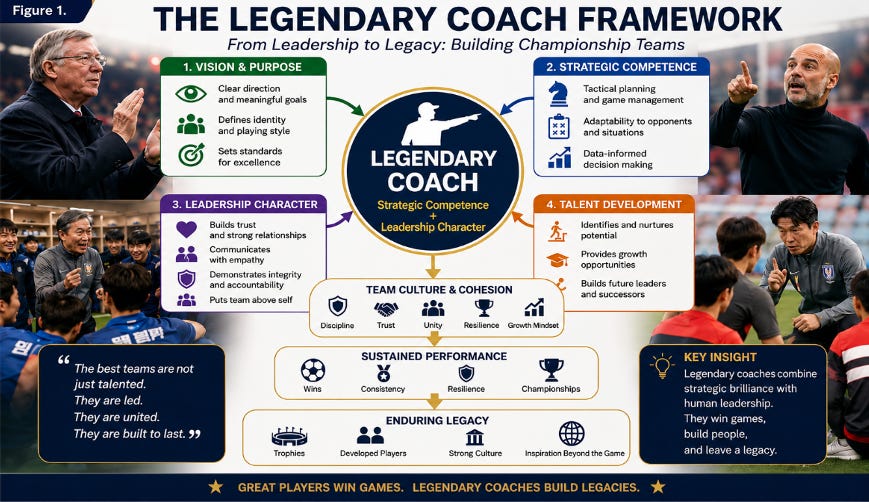
Source: Author-developed conceptual framework based on leadership, organizational culture, and sports management literature. Figure visualization created using generative artificial intelligence based on framework design, content specification, and editorial direction developed by Paul C. Hong (2026).
2.3. A Framework for Understanding Legendary Coaches
To understand why some coaches achieve enduring success while others struggle, this article proposes a two-dimensional framework based on strategic competence and leadership character. Strategic competence refers to a coach’s ability to formulate effective plans, adapt to changing circumstances, develop players, and make sound decisions under pressure. Leadership character reflects the capacity to build trust, communicate a compelling vision, demonstrate integrity, foster accountability, and place collective goals above personal interests.
The interaction of these two dimensions produces four distinct leadership types: Legendary Coaches, Tactical Tyrants, Beloved Caretakers, and Failed Coaches. Legendary coaches excel in both dimensions by combining tactical excellence with strong character and people-centered leadership, while the other three categories illustrate the limitations that arise when one or both dimensions are absent. This framework provides a useful lens for examining leadership not only in sports but also in business, government, education, and other organizational settings, where enduring success similarly depends on the integration of competence, character, culture, and long-term stewardship.
Leadership begins with winning trust and ends with leaving a legacy.
3. The Four Types of Sports Coaches: A 2×2 Framework
Not all coaches lead in the same manner; their effectiveness can be understood through the combined influence of strategic competence and leadership character, which together shape performance and legacy.
3.1. Legendary Coaches: Strategic Competence and Leadership Character
Legendary coaches emphasize character development and personal growth alongside competitive performance (Wooden & Jamison, 2005). They formulate effective game plans, adapt to changing competitive environments, develop talent, and make sound decisions under pressure, while simultaneously building trust, communicating a compelling vision, and fostering accountability. Alex Ferguson’s long-term emphasis on culture, discipline, succession planning, and institutional development demonstrates how legendary leaders create organizations that endure beyond individual victories and leadership transitions (Ferguson & Moritz, 2015). Carlo Ancelotti’s leadership philosophy demonstrates the importance of calm authority, relationship building, and trust-based management in elite sports environments (Ancelotti & Alciato, 2016).
Examples such as Sir Alex Ferguson, Joe Torre, Guus Hiddink, Carlo Ancelotti, and John Wooden illustrate that sustained success depends on more than tactical expertise. These leaders aligned individuals around shared purposes, cultivated strong organizational cultures, and elevated collective performance beyond what talent alone could achieve. Their achievements suggest that enduring excellence emerges when leadership, culture, and collective engagement reinforce one another to create lasting competitive advantages and meaningful legacies (Park et al., 2025).
3.2. Tactical Tyrants and Beloved Caretakers
Not all successful coaches achieve legendary status. Some coaches possess extraordinary strategic capabilities but lack the leadership character necessary to sustain long-term success. These Tactical Tyrants often produce short-term victories through discipline, control, and tactical brilliance, yet their leadership style may generate internal conflicts, player dissatisfaction, and organizational instability. While such coaches can win championships, their success is often difficult to sustain because trust and commitment gradually erode.
Conversely, Beloved Caretakers possess strong character and excellent interpersonal skills but lack strategic sophistication. These coaches are respected by players, maintain positive team environments, and often serve as effective mentors. However, they may struggle to compete against opponents with superior tactical preparation or organizational discipline. Their teams frequently display high morale but inconsistent competitive results. Both categories reveal the limitations of one-dimensional leadership. Strategic competence without character may produce fear rather than commitment, while character without competence may create harmony without excellence. Sustainable success requires both dimensions operating simultaneously.
3.3. Failed Coaches and Leadership Lessons
The final category consists of Failed Coaches who exhibit deficiencies in both strategic competence and leadership character. These individuals often lack clear direction, make inconsistent decisions, communicate poorly, and struggle to gain the confidence of players and stakeholders. Without either tactical effectiveness or trusted leadership, organizational performance typically deteriorates rapidly.
Although sports history tends to remember championship-winning coaches, failed coaches provide equally important lessons. Their shortcomings demonstrate the consequences of inadequate preparation, weak communication, poor adaptability, and ineffective relationship management. Teams under such leadership frequently experience declining morale, fragmented cultures, and disappointing results despite possessing significant talent. The broader lesson extends well beyond sports. Whether leading corporations, universities, military organizations, or governments, leaders must combine competence with character. Strategic expertise determines an organization’s ability to compete, but character determines whether people willingly follow. The most enduring leaders are therefore those who integrate both dimensions to create organizations capable of sustained performance, resilience, and long-term impact.
Table 1.
Leadership Lessons from Legendary Coaches: Comparative Insights from FIFA and MLB
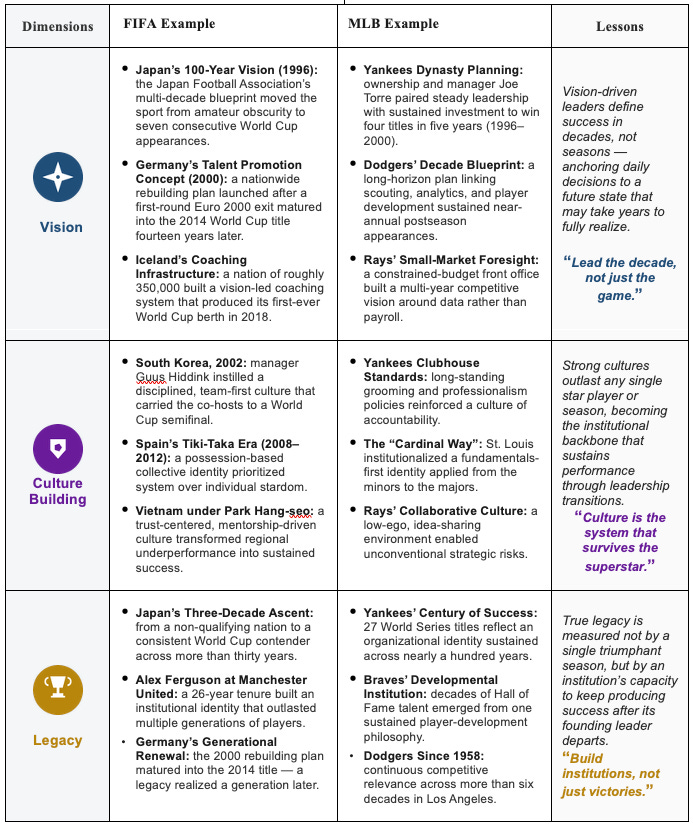
Source: Author’s compilation, illustrative case studies drawn from publicly documented football (FIFA) and Major League Baseball (MLB) leadership history.
4. Sports Illustrations of Legendary and Poor Coaches
The practical value of the framework becomes clearer when examined through real-world examples of successful and unsuccessful leadership across international football and professional baseball.
4.1. FIFA Leadership Lessons: Japan and South Korea
The experiences of Japan and South Korea provide valuable insights into the role of managerial leadership in international football. Both countries possess talented players, advanced training infrastructures, and passionate fan bases, yet their developmental paths have often differed. Japan has increasingly emphasized long-term planning, organizational continuity, youth development, and systematic talent integration, reflecting a leadership philosophy that prioritizes collective execution and sustainable performance over dependence on individual stars.
South Korea, by contrast, has frequently demonstrated exceptional determination, athleticism, and competitive spirit while producing numerous world-class players and memorable international performances. The nation’s historic semifinal appearance at the 2002 FIFA World Cup under Guus Hiddink demonstrated how effective leadership can elevate team confidence, discipline, preparation, and collective identity beyond conventional expectations. As a result, that achievement remains one of the most celebrated examples of transformational leadership in Korean sports history.
The comparison between Japan and South Korea suggests that sustainable success requires both strong systems and effective leadership. While structures, academies, and development programs provide the foundation for competitiveness, legendary coaches possess the ability to unite talented individuals around a shared vision and translate potential into performance. More broadly, successful national football programs are built over decades through the development of cultures, institutions, and ecosystems that align talent, organizations, and stakeholders toward sustained excellence (Porter, 1998; Adner, 2017).
4.2. MLB Leadership Lessons: Building Dynasties
Major League Baseball offers some of the clearest examples of how managerial leadership shapes organizational success. Among the most respected figures is Joe Torre, who guided the New York Yankees through one of the most successful periods in franchise history. Torre’s leadership combined strategic competence with emotional intelligence, enabling him to manage superstar athletes, maintain organizational stability, and sustain performance under intense public scrutiny.
Other successful baseball managers illustrate different leadership styles. Tony La Russa became known for tactical innovation and analytical preparation, while Sparky Anderson emphasized player empowerment and team chemistry. Tommy Lasorda inspired players through passion, loyalty, and organizational commitment. Despite their differences, these managers shared an ability to align individual talents toward collective goals.
Baseball demonstrates that championships rarely result from talent alone. Teams with superior payrolls and star players frequently underperform, while well-led organizations often exceed expectations. The manager’s ability to create trust, accountability, and resilience frequently determines whether talent is converted into sustained success.
4.3. Leadership Beyond Sports
The lessons of legendary coaches extend far beyond athletic competition. Similar patterns can be observed among business leaders, military commanders, university presidents, nonprofit executives, and political leaders. In each context, leaders must balance strategic competence with leadership character to achieve lasting success.
Organizations led solely by technically competent leaders may achieve short-term results but often struggle with trust, commitment, and sustainability. Conversely, leaders who are admired personally but lack strategic capability frequently create positive cultures without achieving meaningful performance improvements. Sustainable excellence emerges when competence and character reinforce one another.
The sports arena provides a particularly visible laboratory for leadership because results are immediate, measurable, and publicly observed. Yet the underlying principles remain universal. Legendary leaders build cultures rather than merely manage operations, develop people rather than merely direct them, and create enduring institutions rather than simply pursue short-term victories. Their ultimate achievement lies not in individual championships but in the lasting legacy they leave behind through the people, values, and organizations they help shape.
5. Discussion and Implications
Beyond sports, the lessons of legendary coaches offer broader insights into how leaders build trust, sustain performance, and create enduring institutions in an increasingly complex world.
5.1. Why Character and Competence Must Coexist
One of the central insights emerging from this study is that neither strategic competence nor leadership character alone is sufficient for sustained success. Coaches who possess tactical brilliance but lack integrity, trustworthiness, or emotional intelligence may achieve short-term victories but often undermine long-term organizational stability and commitment (Goleman, 1998). Conversely, coaches who are admired for their character yet lack strategic expertise frequently struggle to translate positive team cultures into consistent competitive performance.
Legendary coaches distinguish themselves by integrating both dimensions simultaneously. Their strategic competence enables effective decision-making, adaptability, and performance improvement, while their leadership character fosters trust, commitment, and organizational cohesion. The interaction of competence and character therefore serves as a multiplier rather than an additive effect, creating environments where athletes are motivated not only to perform but also to grow, collaborate, and contribute to collective goals. When both dimensions are present, teams achieve levels of resilience, sustainability, and excellence that neither dimension can produce independently.
5.2. Implications for Leadership Beyond Sports
Although this article focuses on sports coaches, its lessons extend across a wide range of organizational settings. In business, CEOs must combine strategic vision with ethical leadership to navigate competitive and technological disruptions. In higher education, university presidents must balance institutional strategy with the ability to inspire faculty, students, and stakeholders, while leaders in government and public service must integrate policy competence with credibility and public trust. Across these contexts, many leadership failures arise when organizations overemphasize either technical expertise or personal popularity while neglecting the complementary importance of the other dimension.
Effective leadership development therefore requires the cultivation of both competence and character. Technical skills, analytical capabilities, communication effectiveness, ethical judgment, emotional intelligence, and stewardship should be viewed as mutually reinforcing leadership attributes rather than separate capabilities. Leadership ultimately depends on influence rather than formal authority, making trust and credibility essential to sustained effectiveness (Maxwell, 2007). Organizations that intentionally develop both dimensions are more likely to build resilient cultures, strengthen institutional performance, and achieve enduring success.
5.3. Leadership in the AI Era: Lessons from Legendary Coaches
The emergence of artificial intelligence, advanced analytics, and digital technologies is transforming both sports and organizational leadership. Modern coaches increasingly rely on performance data, predictive analytics, injury monitoring systems, and AI-assisted decision tools to improve team performance, while similar technologies are reshaping decision-making processes across industries. These developments demonstrate how technology can enhance strategic competence by providing leaders with unprecedented analytical capabilities and real-time insights.
However, the rise of AI also highlights the continuing importance of uniquely human leadership capabilities. While algorithms can process information and generate recommendations, they cannot fully replace vision, trust-building, inspiration, moral judgment, empathy, or culture creation. The most effective future leaders will not be those who rely exclusively on technology, but those who combine technological competence with human wisdom, strategic insight with ethical responsibility, and performance management with people development. In this sense, the lessons of legendary coaches may be more relevant than ever for leaders seeking to build resilient, adaptive, and enduring organizations in the twenty-first century.
Great Players Win Matches. Legendary Coaches Shape History.
6. Conclusion
The history of sports demonstrates that championships are rarely won by talent alone, as sustained success emerges when leadership transforms individual abilities into a shared culture of discipline, trust, learning, and collective purpose. Legendary coaches do more than manage games; they develop people, strengthen institutions, and create environments in which excellence can be sustained across generations. Their greatest achievement lies not merely in winning trophies but in building systems and cultures that continue to produce success long after they have departed.
Looking ahead, Korea has the opportunity to develop K-Sports as another pillar of national excellence alongside K-Pop, K-Drama, K-Food, K-Defense, and advanced technology industries. Achieving this vision will require the transformation of the broader K-Sports ecosystem through investments in youth development, coaching education, sports science, data analytics, professional leagues, corporate partnerships, and governance innovation that continuously cultivate talent and leadership (Adner, 2017; Park et al., 2025; Porter, 1998). As global competition intensifies in the AI era, the future of K-Sports will depend not only on exceptional athletes but also on the leaders, institutions, and ecosystems that transform talent into enduring excellence and extend Korea’s reputation for sporting achievement on the global stage.
References
Adner, R. (2017). Ecosystem as structure: An actionable construct for strategy. Journal of Management, 43(1), 39–58.
Ancelotti, C., & Alciato, A. (2016). Quiet leadership: Winning hearts, minds and matches. Penguin.
Ferguson, A., & Moritz, M. (2015). Leading: Learning from life and my years at Manchester United. Hachette Books.
Goleman, D. (1998). Working with emotional intelligence. Bantam Books.
Kuper, S., & Szymanski, S. (2022). Soccernomics (2022 World Cup edition): Why European men and American women win and billionaire owners are destined to lose. Bold Type Books.
Maxwell, J. C. (2007). The 21 irrefutable laws of leadership: Follow them and people will follow you. HarperCollins Leadership.
Park, D. S. H., Kim, S. C., & Hong, P. (2025). Empowering leadership and socio-technological practices: An empirical investigation of BTS’s success. Arts and the Market, 15(2–3), 128–145.
Porter, M. E. (1998). Clusters and the new economics of competition. Harvard Business Review, 76(6), 77–90.
Schein, E. H., & Schein, P. A. (2021). Organizational culture and leadership (6th ed.). Wiley.
Wooden, J., & Jamison, S. (2005). Wooden on leadership: How to create a winning organization. McGraw-Hill.
Original Article:

Citation: Paul C. Hong (June 30, 2026). Beyond the Scoreboard: The Leadership of Legendary Sports Coaches. K-GSP Forum, pp. 1–12.
About the Author

Distinguished Professor, Dr. Paul Hong (Editor in Chief) — University of Toledo
Paul C. Hong is a Distinguished University Professor at the University of Toledo. His research, teaching, and writing examine leadership, innovation, institutional transformation, and global competitiveness, with particular emphasis on how individuals, organizations, and societies adapt to change in an increasingly complex world. Through interdisciplinary inquiry spanning management, history, strategy, technology, and philosophy, he explores the roles of character, culture, relationships, purpose, and human flourishing in shaping enduring leadership and sustainable excellence in the AI Era.
© K-Global Scholars and Professionals Forum. All rights reserved. Content published in the K-GSP Forum may not be reproduced, distributed, or transmitted in any form without prior written permission from the K-GSP Forum, except for brief quotations with full attribution.
As a Brazilian and a football fan by nature, I have always believed that a coach must see beyond strategy and tactics. Great coaches recognize qualities and potential that players may not yet see in themselves. More importantly, they understand how those individual strengths interact: when properly aligned, they multiply one another; when poorly managed, they can cancel one another out. Perhaps this ability to see, combine, and elevate human potential is what truly distinguishes a legendary coach.
Dear Dr. Hong, it's interesting to draw a connection between the leadership of the sports world and that of the AI era. It's insightful to say that leaders should have a strategic vision with ethical leadership in the AI era. As ethical leadership becomes more important, business studies should provide opportunities for business students to discuss ethics in class. Thanks.