

Bifurcated Jobs in the Age of AI: Why HRD Matters More Than Ever
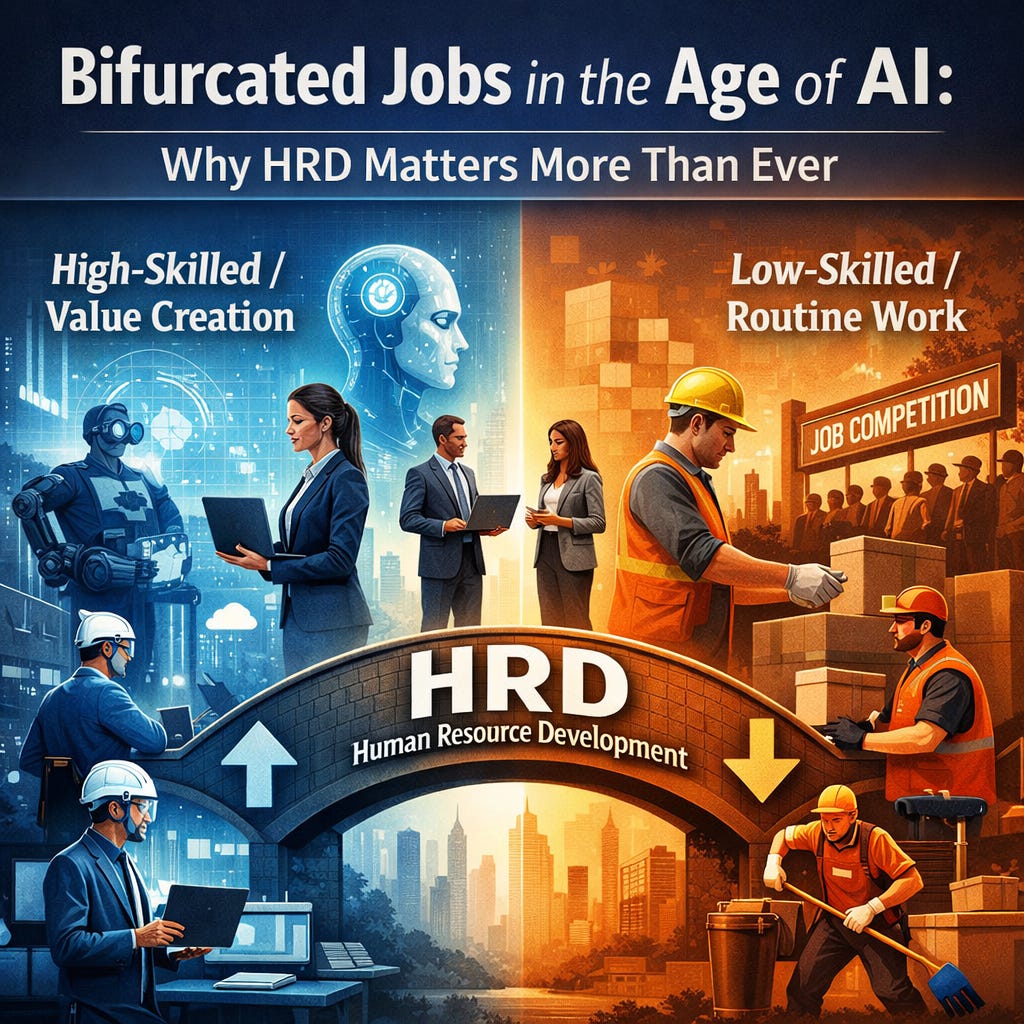
Recently, HR scholars and practitioners have advanced the notion of “democratizing” or “normalizing” job characteristics as AI and digital technologies continue to evolve. In contrast, I suggest that technological advancement—particularly AI—may instead drive a bifurcation of jobs, insofar as AI functions less as a neutral equalizer and more as an amplifier of existing human competencies.
In my view, recent technological advances—particularly the rapid diffusion of LLM-based artificial intelligence—appear to be pushing the labor market toward an increasingly bifurcated job structure. AI is less a neutral tool than a kind of amplifier that magnifies existing human capabilities. As a result, differences in individual capacity are more likely to widen than to narrow.
In such an environment, a relatively small group of individuals with strong judgment, contextual understanding, and creative problem-solving abilities can leverage AI to generate disproportionately greater value creation. High-quality jobs, therefore, are likely to become increasingly concentrated among these workers. By contrast, jobs that are easily standardized or automated, routine and repetitive tasks, or roles that still require human labor but remain highly substitutable may face oversupply and intensified competition. In this process, “middle-level” jobs may gradually erode, raising the risk of a more entrenched structural polarization between high-end and low-end work.
Against this backdrop, I believe the role of Human Resource Development (HRD) is becoming more critical than ever. HRD can no longer be confined to teaching people how to use AI effectively. Rather, we have reached a point where HRD must engage a more fundamental question: what kind of human beings should we become as we work alongside AI? Technical proficiency is certainly necessary, but it is far from sufficient.
Going forward, HRD needs to expand its focus to cultivating the capacity to reflect on the meaning of life and work, the sensibility to exercise balanced judgment in complex situations, empathy toward others and society, and ethical discernment that allows individuals to critically evaluate the direction in which technology is being used. Only then can AI function not as a force that replaces humans, but as a tool that supports a more humane and authentic world.
This perspective may sound idealistic. Yet precisely because technology is advancing so rapidly, I believe it is both realistic and necessary for HRD to take on the core mission of systematically nurturing the foundations of human dignity and humanity itself.

Dr. Jerry Choi is an Associate Professor of Business at the University of Maine at Presque Isle and Program Director for MAOL and MSB. With over 25 years of industry and consulting experience, he specializes in leadership, HRM, and organizational development. His research focuses on workforce resilience and organizational health, bridging rigorous scholarship with practical insight to develop future leaders.
Original source: https://leadershipcenter.tistory.com/801
© K-Global Schoalrs and Professionals Forum. All rights reserved. Content published in the K-GSP Forum may not be reproduced, distributed, or transmitted in any form without prior written permission from the K-GSP Forum, except for brief quotations with full attribution.