

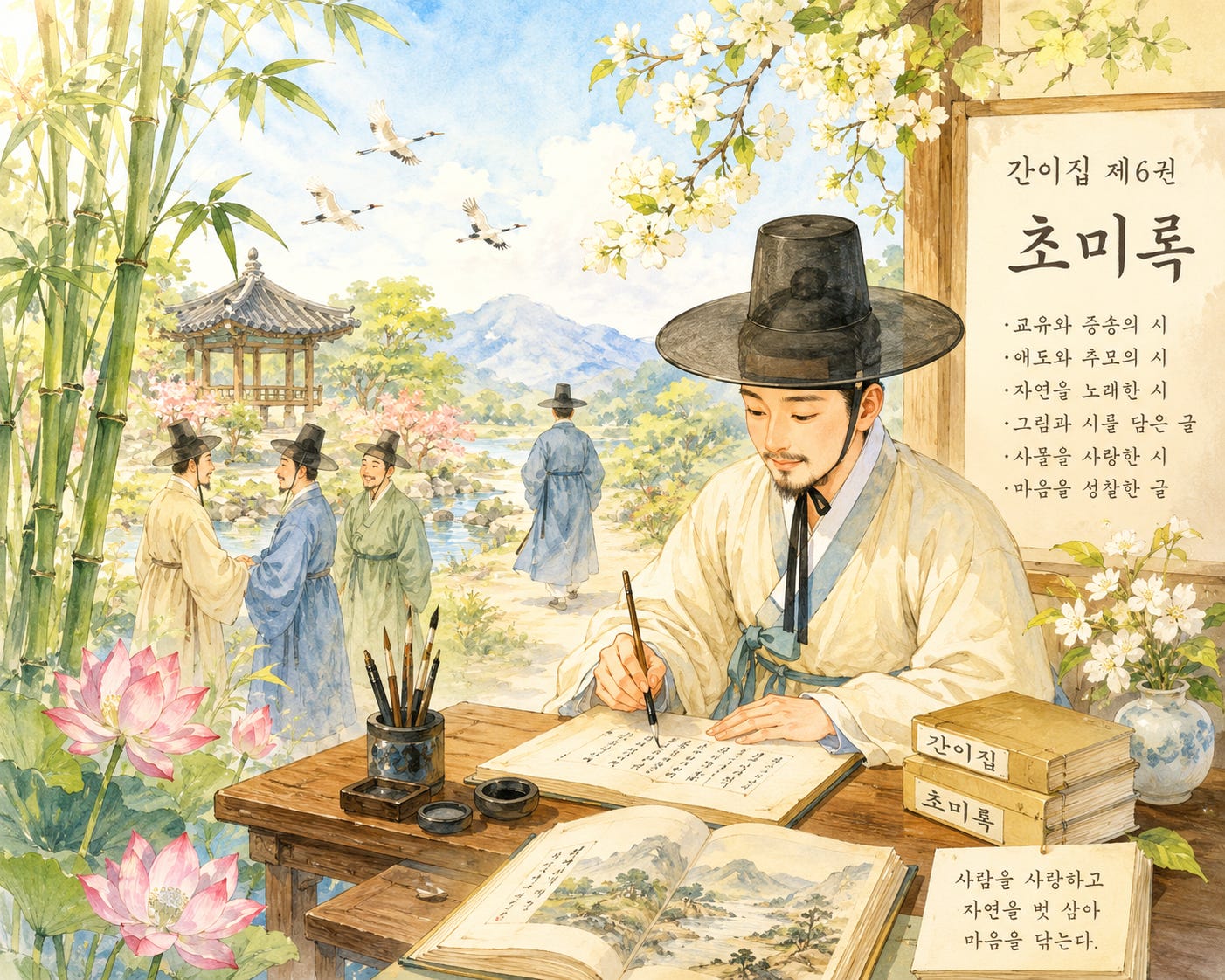
There are moments when reading a classical work feels like meeting a person from centuries ago. As I read Chomirok (焦尾錄), the sixth volume of The Gani Collection by Choi Rip, I experienced exactly that feeling. At first, I expected it to be merely a collection of poems and prose written by a scholar of the Joseon Dynasty. Yet as I turned the pages, I discovered something much more profound—a window into the heart and mind of a thoughtful human being whose wisdom still speaks to us today.
This volume differs somewhat from the earlier parts of The Gani Collection. Instead of focusing primarily on political affairs, official memorials, or administrative matters, it centers on friendships, farewells, reflections on nature, artistic appreciation, and meditations on life and death. Reading it felt less like studying a historical document and more like opening the personal journal of a wise and compassionate friend.
One of the most memorable aspects of this volume is Choi Rip’s deep affection for people. He wrote poems to friends embarking on distant journeys, to colleagues assuming new responsibilities, and to companions pursuing important missions. These were not simple farewell messages. Each poem conveyed sincere respect, encouragement, and heartfelt hopes for the recipient’s future. In an age when many of us communicate through brief text messages and emails, Choi Rip reminds us that genuine friendship involves taking the time to express our appreciation and concern for others.
The poems of mourning are equally moving. Choi Rip wrote elegies for friends, colleagues, and acquaintances who had passed away. His words reveal not merely a sense of duty but a profound understanding of human loss. He recognized the fragility of life and cherished relationships because he knew they were temporary. Through these writings, he teaches us to value the people around us while we still have the opportunity to do so.
Another remarkable feature of Chomirok is its celebration of nature. Choi Rip did not simply admire bamboo, lotus flowers, pine trees, or autumn leaves for their beauty. He saw moral and spiritual lessons within them. Bamboo symbolized integrity, pine trees represented steadfastness, and lotus flowers embodied purity. Nature, for him, was not merely scenery; it was a teacher.
I was particularly fascinated by his series of poems on bamboo. He wrote separately about young bamboo, old bamboo, bamboo in the wind, bamboo in the rain, and even withered bamboo. Most people would regard bamboo as a single object, but Choi Rip perceived countless meanings within it. His observations reveal how deeply he looked at the world around him. He reminds us that wisdom often comes not from seeing more things, but from seeing familiar things more carefully.
This volume also highlights Choi Rip’s remarkable sensitivity as an art critic. He composed poems inspired by paintings and reflected thoughtfully on the works of other writers and artists. He did not view art as a mere object of visual pleasure; he sought to understand the spirit behind it. His approach encourages modern readers to engage more deeply with art, literature, and music—not simply to consume them, but to converse with them.
Perhaps the most important theme running throughout the entire volume is what Choi Rip called Jeonggwan (靜觀), or “contemplative observation.” It is the practice of quietly observing the world and reflecting deeply upon its meaning. Choi Rip observed nature to understand himself. He valued friendships as a means of understanding humanity. He appreciated art as a path toward understanding beauty and truth. Rather than rushing to conclusions, he cultivated patience, attentiveness, and reflection.
This message feels especially relevant today. We live in an era overflowing with information, where speed is often valued more than depth. We are encouraged to react quickly, decide quickly, and move on quickly. Yet Chomirok gently invites us to slow down. It reminds us to look more carefully at the people we love, the natural world around us, and our own inner lives.
Ultimately, Chomirok is far more than a collection of poems and essays from the Joseon Dynasty. It is the record of a scholar who loved people, appreciated beauty, and sought wisdom through contemplation. It is a book that speaks across centuries with surprising warmth and relevance.
Long after I finished reading it, its quiet message remained with me. It prompted me to ask myself: How deeply do I value the people around me? How carefully do I observe nature? How often do I pause to reflect on my own life?
Perhaps this is the greatest gift Choi Rip offers modern readers. Across more than four hundred years, he reminds us that a meaningful life is built not only through achievement, but also through friendship, appreciation, contemplation, and an attentive heart. +++
{Solti}
July 1, 2026
[독후감] 사람과 자연을 품은 한 권의 책
『간이집』 제6권 「초미록」을 읽고
고전을 읽다 보면 때때로 수백 년 전의 인물이 갑자기 우리 곁에 다가오는 순간이 있다. 『간이집』 제6권 「초미록」을 읽으며 나는 바로 그런 경험을 했다. 처음에는 조선 중기의 한 문인이 남긴 시문집 정도로 생각했지만, 책장을 넘길수록 그 안에는 관료도, 외교관도 아닌 한 인간 최립의 따뜻한 마음과 깊은 성찰이 담겨 있음을 알게 되었다.
제6권은 앞선 권들과 분위기가 다소 다르다. 상소문이나 정치적 논의보다 사람을 만나고 보내며 쓴 시, 자연을 바라보며 느낀 생각, 그리고 세상을 떠난 벗을 추모하는 글들이 중심을 이룬다. 그래서 이 책을 읽는 동안 마치 한 사람의 일기장을 들여다보는 듯한 느낌을 받았다.
가장 인상 깊었던 부분은 사람을 향한 최립의 따뜻한 시선이었다. 그는 친구가 먼 길을 떠날 때 송별시를 지어 주었고, 벗이 승진하거나 새로운 임지로 떠날 때도 축하와 격려의 마음을 담아 글을 남겼다. 오늘날처럼 문자메시지 한 통으로 안부를 전하는 시대와는 달리, 그는 한 편의 시에 우정과 존경, 그리고 상대방의 앞날에 대한 기대를 담았다. 그 글들을 읽으며 진정한 우정이란 단순히 자주 만나는 것이 아니라 상대의 삶을 진심으로 응원하는 것임을 다시 생각하게 되었다.
또한 이 책에는 죽은 이를 추모하는 작품들이 적지 않다. 최립은 세상을 떠난 친구와 동료들을 위해 애도의 시를 남겼다. 그의 글에서는 형식적인 슬픔이 아니라 인간에 대한 깊은 애정이 느껴진다. 인생이 유한하다는 사실을 알고 있었기에 그는 만남을 소중히 여기고, 이별 앞에서는 더욱 진실한 마음을 표현했던 것 같다. 이러한 작품들은 오늘날 바쁘게 살아가는 우리에게도 사람의 소중함을 일깨워 준다.
제6권에서 특히 눈길을 끄는 부분은 자연을 노래한 작품들이다. 그는 대나무와 연꽃, 소나무와 단풍을 바라보며 단순히 아름답다고 말하지 않았다. 대나무에서는 절개를, 소나무에서는 굳은 의지를, 연꽃에서는 맑은 품성을 발견했다. 자연은 그에게 단순한 풍경이 아니라 삶의 스승이었다.
나는 대나무를 노래한 여러 편의 시가 특히 흥미로웠다. 어린 대나무, 늙은 대나무, 비를 맞는 대나무, 바람에 흔들리는 대나무를 각각 따로 노래했다는 사실은 놀라웠다. 대부분의 사람들은 대나무를 그저 하나의 식물로 보지만, 최립은 그 안에서 인생의 여러 모습을 발견했다. 같은 사물을 바라보더라도 얼마나 깊이 관찰하느냐에 따라 전혀 다른 세계가 펼쳐질 수 있음을 보여준다.
이 책을 읽으며 나는 최립이 단순한 문장가가 아니라 뛰어난 예술 비평가였다는 사실도 새롭게 알게 되었다. 그는 그림을 보고 시를 짓고, 다른 사람의 작품을 감상하며 자신의 생각을 더했다. 예술 작품을 눈으로만 보는 것이 아니라 마음으로 읽어 내려고 노력했던 것이다. 오늘날 우리가 전시회를 찾아가거나 음악을 들을 때도 이러한 자세를 배운다면 더욱 풍요로운 감상을 할 수 있을 것이다.
무엇보다도 제6권 전체를 흐르는 정신은 ‘정관(靜觀)’이라고 생각한다. 조용히 바라보고 깊이 생각하는 태도 말이다. 최립은 자연을 바라보며 자신을 돌아보았고, 사람을 만나며 삶의 의미를 찾았으며, 예술을 통해 세상을 이해하려 했다. 그는 빠르게 결론을 내리기보다 천천히 관찰하고 깊이 성찰했다.
오늘날 우리는 너무 많은 정보 속에서 살아간다. 무엇이든 빨리 판단하고 빠르게 소비하는 데 익숙해져 있다. 그러나 『초미록』은 우리에게 잠시 걸음을 늦추라고 말하는 듯하다. 한 사람을 깊이 이해하고, 자연을 천천히 바라보며, 자신의 마음을 성찰하는 시간이 필요하다고 일깨워 준다.
『간이집』 제6권 「초미록」은 단순한 옛 시문집이 아니다. 그것은 사람을 사랑한 한 선비의 기록이며, 자연과 예술 속에서 삶의 지혜를 찾으려 했던 한 사상가의 정신세계이다. 책을 덮고 난 뒤에도 마음속에는 오래도록 잔잔한 여운이 남는다. 그리고 문득 생각하게 된다. 오늘 나는 얼마나 사람을 소중히 여기고 있는가, 얼마나 자연을 깊이 바라보고 있는가, 그리고 얼마나 진지하게 나 자신을 성찰하고 있는가를.
아마도 이것이 수백 년의 시간을 뛰어넘어 최립이 오늘의 우리에게 전하는 가장 귀한 메시지일 것이다. +++
{솔티}
2026년 7월 1일

Prof. Dr. Young Choi (Editor in Chief) — Regent University
Young B. Choi is a Professor in the Department of Engineering & Computer Science at Regent University. He published 38 books with ‘Selected Readings in Cybersecurity’ (2018) (over 800 copies archived globally at university/college libraries around the world) and ‘Cybersecurity Applications and Artificial Intelligence’ (2023) available in seven major world languages. He proposed the world’s first global and universal telecommunications “Service Order Handling (SOH)” Model (T-SOH Model) (1995) with Dr. Adrian Tang. With this innovative research work, he received the IEEE NOMS ’96 Best Paper Award and became the first recipient of the Outstanding Contribution Award of the TeleManagement Forum in 1998. His research areas include Natural Language Processing-focused AI, AI-applied cybersecurity, network and telecom service management, and Korean studies on Gani Choi Rip’s Jeonggwan (靜觀: Quiet Contemplation) philosophy and Shilhak ( 實學: Practical Learning).