

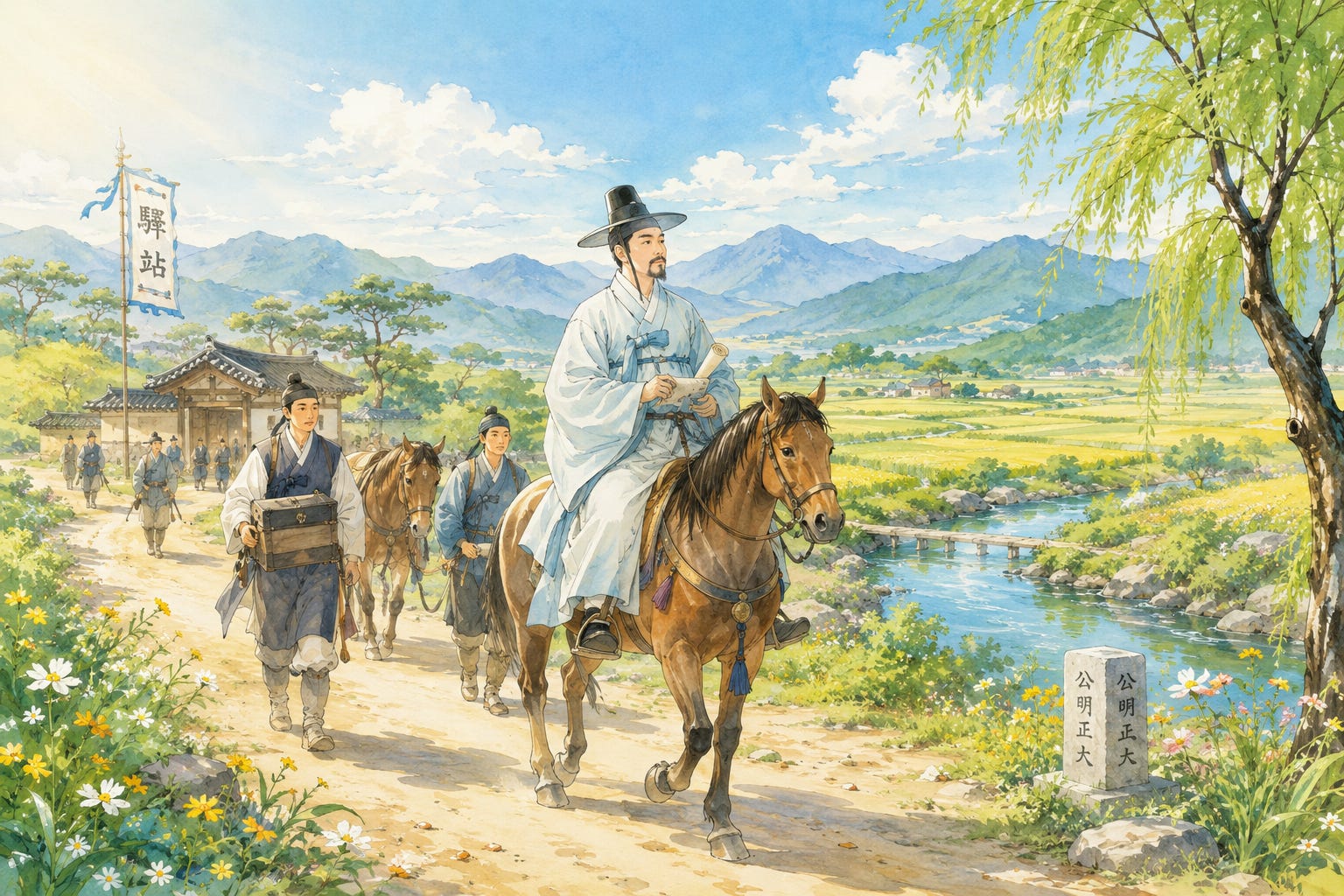
When reading Hohaengnok, Volume 6 of Gani-jip, the first impression is not one of ornate literary flourish, but rather that of a “moving record.” This is not a text composed in stillness and contemplation, but a living document written while accompanying the flow of state affairs. The sentences are restrained, yet within them lie layered traces of the era of Joseon—its tensions, responsibilities, and the quiet mind of a Confucian scholar-official.
At its core, Hohaengnok records the experiences of accompanying the king or government missions during official journeys. However, it is far more than a simple travel or duty log. Along these journeys, politics is ever-present, administration is in motion, and at times military tension and national anxiety quietly surface. Choi Rip does not place himself at the center of the narrative. Instead, he remains a person who “sees precisely what must be seen.” He neither exaggerates events nor foregrounds emotion; rather, he records faithfully along the grain of reality.
As one reads, one naturally comes to feel the weight of responsibility carried by officials in the Joseon Dynasty. Each royal procession or official mission was not merely a physical journey but an act that sustained the political and administrative order of the state. In this structure, the scholar-official was not simply an attendant, but someone required to observe, judge, and record simultaneously. Hohaengnok reveals precisely this tense and demanding position.
Particularly striking are the descriptions of movement. Mountains, rivers, post stations, and roads are not merely background scenery but appear as operational spaces of governance itself. Roads are not simply paths; they are channels of administration and authority. Space becomes the medium through which state power flows. Choi Rip describes all of this with calm precision, yet the fatigue and tension embedded in these movements are never fully concealed. Rather, the restraint of his prose allows the weight of the era to emerge even more strongly.
Another notable aspect is the relationships among people. Officials encountered during the journeys, local magistrates, and various bureaucratic figures appear not as individual personalities but as parts of a functioning system. Yet within this system, subtle negotiations and tensions still exist. Choi Rip does not dissect these dynamics aggressively; instead, he observes them with balance and composure. This restraint paradoxically deepens the credibility of his record.
What remains most vivid after reading is not dramatic events but a sense of “quiet responsibility.” Within the larger flow of the state, the individual may appear small, yet it is precisely through accurate observation and faithful execution of duties in such positions that the whole system is sustained. Hohaengnok silently reveals this truth.
Ultimately, Volume 6 of Gani-jip, Hohaengnok, is not merely a historical record. It is a reflective document of how a scholar-official perceived and maintained his position within the moving field of state power. What lingers after reading is not events but attitude, not information but responsibility.
In this sense, the text becomes not only a record of the past but also a question for the present:
“How accurately am I observing what I am responsible for within my own position?” +++
{Solti}
July 20, 2026
Hohaeng (扈行) is a Sino‑Korean term meaning to accompany and attend a king or a person of high status during their movement or procession.
扈 (ho): to follow — to guard or attend
行 (haeng): to go — to move or proceed
Therefore, 扈行 refers to following the king’s procession, that is, accompanying and guarding him during his movement.
간이집 제6권 호행록(扈行錄) 독후감
조용한 책임감
『간이집』 제6권 호행록(扈行錄)을 읽으면, 먼저 눈에 들어오는 것은 화려한 문장이 아니라 “움직이는 기록”이라는 인상이다. 이 책은 한 자리에 머물러 사유하는 글이 아니라, 국가의 흐름을 따라 함께 이동하며 써 내려간 살아 있는 기록에 가깝다. 문장은 절제되어 있지만, 그 안에는 조선이라는 시대의 긴장과 책임, 그리고 한 문인의 조용한 마음이 겹겹이 쌓여 있다.
호행록은 기본적으로 임금이나 관부를 수행하며 겪은 일들을 기록한 글이다. 그러나 단순한 동행 보고서는 아니다. 그 길 위에는 항상 정치가 있었고, 행정이 있었으며, 때로는 군사적 긴장과 불안이 함께 흐르고 있었다. 최립은 그 중심에서 자신을 드러내기보다, “보아야 할 것을 정확히 보는 사람”으로 남는다. 그는 상황을 과장하지 않고, 감정을 앞세우지도 않으며, 대신 사실의 결을 따라 조용히 기록한다.
이 글을 읽다 보면, 조선 시대 관료의 삶이 얼마나 무거운 책임 위에 놓여 있었는지를 자연스럽게 느끼게 된다. 한 번의 행차, 한 번의 명령 수행이 단순한 이동이 아니라 국가 질서를 유지하는 중요한 행위였다. 그 속에서 문인은 단순한 수행자가 아니라, 판단과 기록을 동시에 요구받는 존재였다. 호행록은 바로 그 긴장된 위치를 보여준다.
특히 인상적인 점은 이동의 장면들이다. 산과 강, 역참과 들판이 단순한 배경이 아니라, 국가 운영의 실제 공간으로 나타난다. 길은 단순한 길이 아니라 행정의 통로이고, 공간은 곧 권력의 흐름이다. 최립은 이 모든 것을 담담하게 묘사하면서도, 그 속에서 느껴지는 피로와 긴장을 완전히 숨기지는 않는다. 오히려 그 절제된 문장 사이로 당시의 무게가 더 크게 전달된다.
또 하나 주목할 부분은 사람과 사람 사이의 관계이다. 호행 과정에서 만나는 관료들, 지방 관리들, 그리고 여러 명령 체계 속 인물들은 단순한 등장인물이 아니라 하나의 시스템처럼 움직인다. 그러나 그 시스템 속에서도 미묘한 긴장과 조정이 존재한다. 최립은 그 틈을 날카롭게 파고들기보다는, 균형 있게 관찰한다. 그 태도는 오히려 더 깊은 신뢰감을 준다.
이 책을 읽으며 가장 오래 남는 것은 화려한 사건이 아니라 “조용한 책임감”이다. 국가의 큰 흐름 속에서 개인은 작아 보이지만, 그 작은 위치에서의 정확한 기록과 성실한 수행이 결국 전체를 유지한다는 사실이 드러난다. 호행록은 바로 그 점을 말없이 보여준다.
결국 『간이집』 제6권 호행록은 단순한 역사 기록이 아니다. 그것은 이동하는 권력의 현장에서 한 문인이 어떻게 자신의 자리를 지키고, 어떻게 세상을 바라보았는지를 보여주는 조용한 성찰의 기록이다. 읽고 나면 남는 것은 사건이 아니라 태도이며, 정보가 아니라 책임감이다.
그래서 이 책은 과거의 기록이면서 동시에 오늘의 질문이 된다.
“나는 내가 속한 자리에서 무엇을 얼마나 정확하게 보고 있는가.” +++
2026년 7월 20일
{솔티}
扈行(호행)은 한자어로 임금이나 높은 지위를 가진 사람을 따라 수행하며 함께 이동함을 뜻함.
扈: 따를 호 — 호위하다, 수행하다
行: 갈 행 — 이동하다, 행차하다
따라서 扈行 = 임금의 행차를 따라가는 것, 즉 수행·호위하며 동행하는 행위를 말함.

Prof. Dr. Young Choi (Editor in Chief) — Regent University
Young B. Choi is a Professor in the Department of Engineering & Computer Science at Regent University. He published 38 books with ‘Selected Readings in Cybersecurity’ (2018) (over 800 copies archived globally at university/college libraries around the world) and ‘Cybersecurity Applications and Artificial Intelligence’ (2023) available in seven major world languages. He proposed the world’s first global and universal telecommunications “Service Order Handling (SOH)” Model (T-SOH Model) (1995) with Dr. Adrian Tang. With this innovative research work, he received the IEEE NOMS ’96 Best Paper Award and became the first recipient of the Outstanding Contribution Award of the TeleManagement Forum in 1998. His research areas include Natural Language Processing-focused AI, AI-applied cybersecurity, network and telecom service management, and Korean studies on Gani Choi Rip’s Jeonggwan (靜觀: Quiet Contemplation) philosophy and Shilhak ( 實學: Practical Learning).