

There are books that age like milk, and then there are those that age like a well-mannered lie—growing more persuasive with every passing year. Mark Twain’s Pudd’nhead Wilson belongs firmly to the latter category. Though it first set foot in a small Missouri town long before the electric hum of machines began thinking on our behalf, it now returns—uninvited, yet entirely appropriate—to sit in judgment over our present age of artificial intelligence.
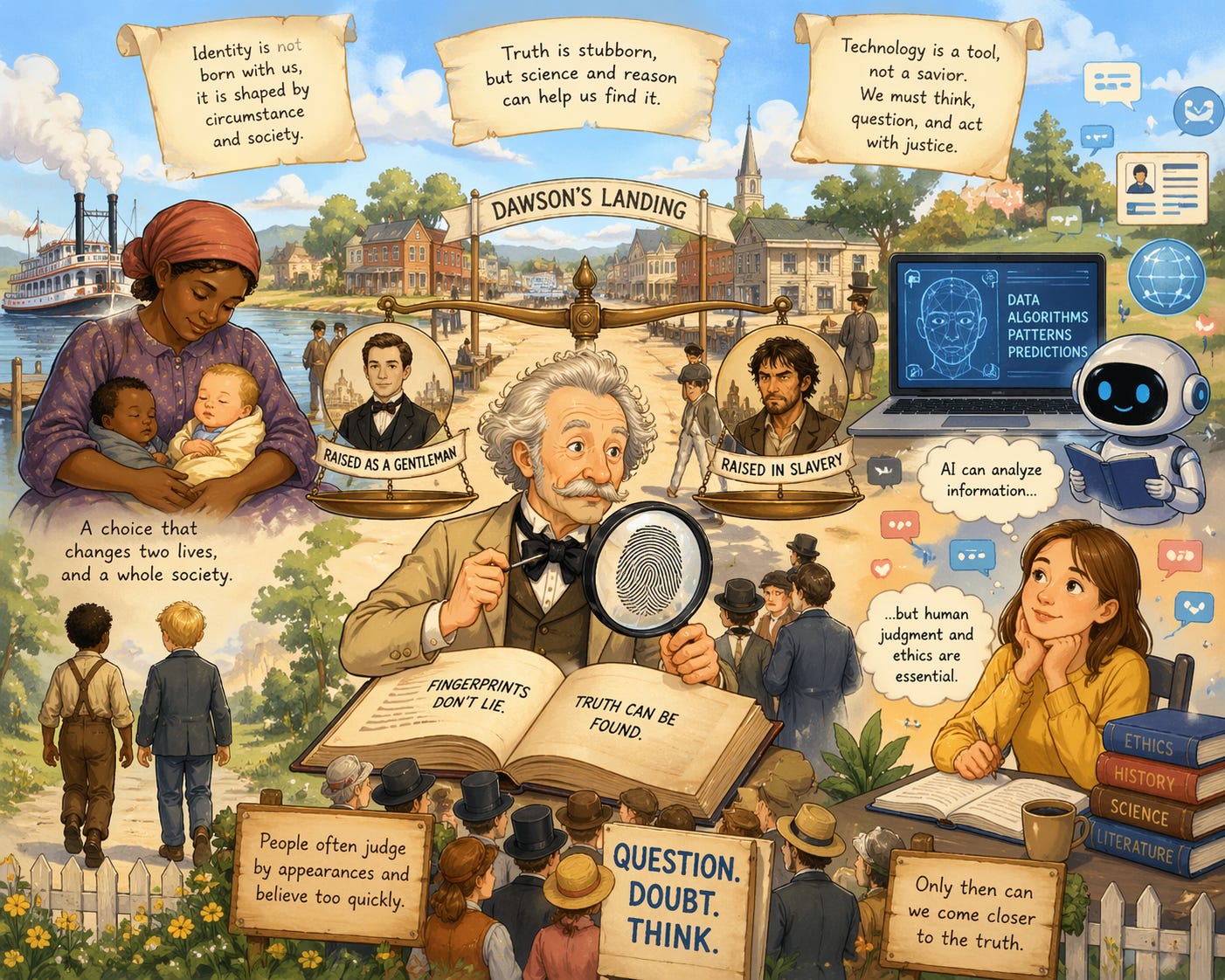
At its heart, the tale turns upon a most delicate mischief: a child exchanged, a destiny rewritten, and a society none the wiser. One might say that Roxy, in her maternal desperation, performed the earliest known experiment in data manipulation. She altered the “original record,” and the entire system—social, moral, and legal—proceeded to calculate its conclusions upon that false premise. If this strikes the modern reader as familiar, it is only because we have grown accustomed to calling such things “training data.”
The consequences, as Mr. Twain so kindly demonstrates, are not merely academic. The boy raised as a gentleman acquires the habits of one; the boy raised in bondage learns submission—though neither has earned nor deserved his station. Thus, the author quietly robs blood of its authority and hands the matter over to circumstance. It is a dangerous idea, and therefore a true one.
Now, enter Pudd’nhead Wilson himself—a man dismissed as a fool for the simple crime of thinking ahead of his neighbors. He amuses himself with fingerprints, those small, stubborn signatures of identity that refuse to lie, flatter, or negotiate. In time, this trivial hobby becomes the instrument of justice. It is, if you will permit the comparison, a 19th-century cousin to our modern artificial intelligence: a tool that promises to rise above human prejudice and deliver truth in its purest form.
But here, one must proceed with caution. For while machines may lack prejudice, they are not above inheriting it. An algorithm, much like a Missouri jury, can only judge according to what it has been given—and if what it has been given is crooked, it will render a crooked verdict with admirable efficiency. Thus, the grand hope that technology might rescue us from our own biases proves to be, at best, a half-truth—and at worst, a well-dressed illusion.
The matter of identity, too, refuses to sit quietly. In Mr. Twain’s tale, identity is a garment easily changed but not so easily understood. In our own time, we have multiplied such garments beyond counting. A man may now possess not only a name and a face, but a collection of data—preferences, patterns, predictions—that follow him more faithfully than his shadow. The question then arises, with some urgency: which of these is the man?
Modern contrivances can imitate a voice, compose a letter, even counterfeit a thought with alarming competence. The distinction between the genuine and the artificial grows thinner by the day, until one suspects that truth itself may soon require identification papers. In this respect, Mr. Twain’s swapped infants seem less like fiction and more like prophecy written in simpler ink.
Meanwhile, society, as ever, continues its favorite pastime: judging by appearances and calling it wisdom. The good citizens of Dawson’s Landing accept what they see, believe what they are told, and resist any notion that might inconvenience their certainty. It is a habit that has survived the centuries remarkably well. Today, we have only improved its speed and scale, allowing errors to travel faster and farther than ever before—assisted, no less, by the very machines we trust to enlighten us.
And so, what lesson does this sly and smiling book offer to an age that prides itself on intelligence, artificial or otherwise? Perhaps only this: that truth is a stubborn creature, easily obscured but rarely destroyed; that identity is more fragile than we suppose; and that no machine, however clever, can absolve us of the responsibility to think, to question, and—when necessary—to doubt.
In the end, Pudd’nhead Wilson does not so much answer our questions as expose their persistence. We stand, as Mr. Twain once did, in a world eager to label, to classify, and to conclude. Yet the old uncertainties remain, quietly defiant: Who are we? And by what authority do we claim to know? +++
{Solti}
April 25, 2026

Young Choi, PhD is a Professor at Regent University bringing a rare combination of technical expertise and creative spirit to everything he does. A scholar in AI, cybersecurity, network and telecommunications service management, he has published 38 books including AI and cybersecurity areas, over 200 refereed articles, and over 20 book chapters. Beyond the academy, Dr. Choi is a passionate poet, essayist, and wooden block engraving artist whose reflective writing invites readers to rediscover life’s beauty in quiet contemplation. He lives under the motto: “Study hard and give generously without holding back! (열심히 공부해서 아낌없이 남주자 !)”
Published books: https://www.amazon.com/stores/Young-Choi/author/B0DMZ5S6R7?ref=ap_rdr&shoppingPortalEnabled=true