

Pudd’nhead Wilson and Human Identity in the Age of Generative AI
What Mark Twain’s Nineteenth-Century Novel Can Teach Us About Race, Algorithms, and Human Dignity
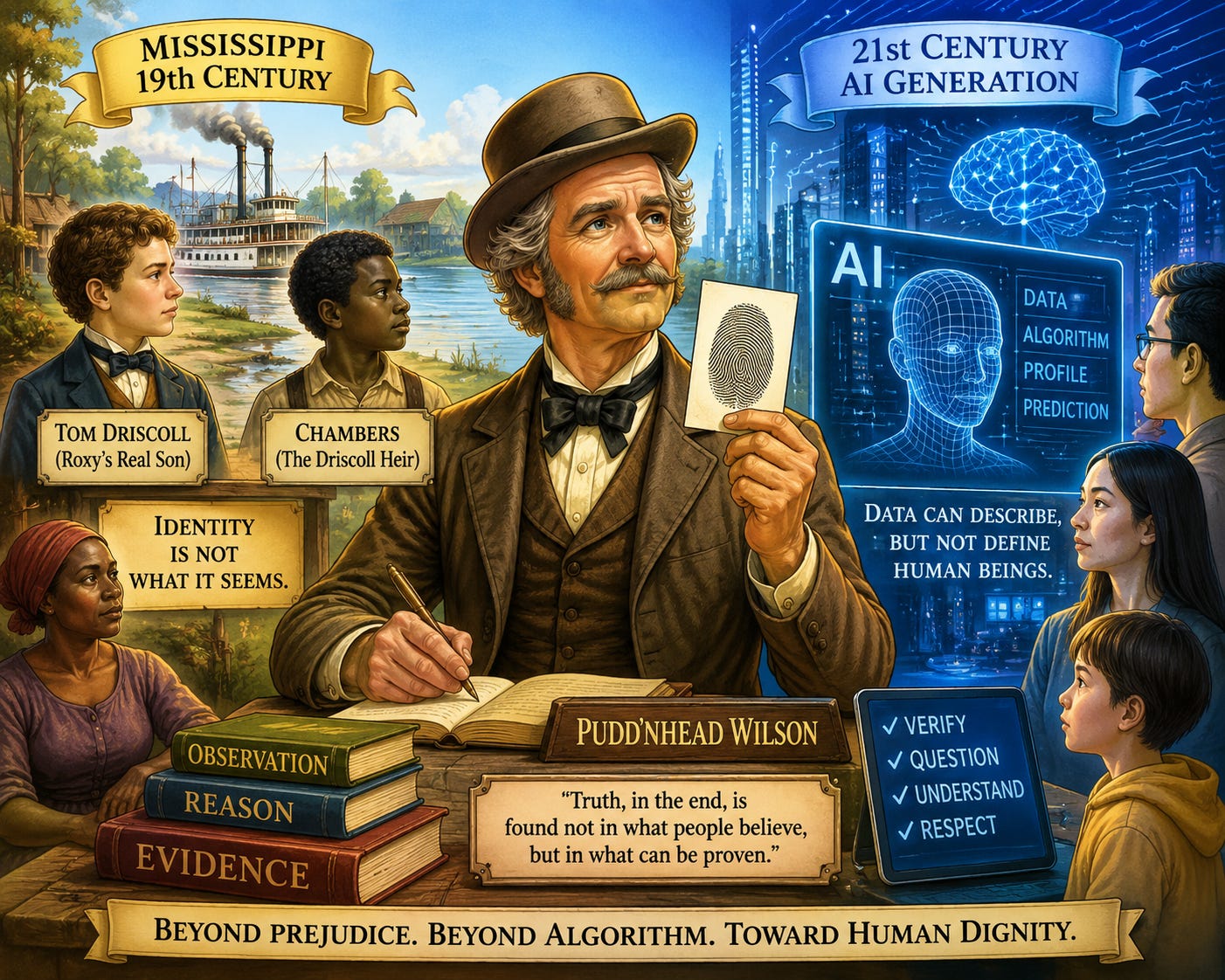
A Novel That Refuses to Become Old
Some books belong to a particular historical period. Others continue to ask questions that every new generation must answer.
Mark Twain’s Pudd’nhead Wilson, published in 1894, belongs to the second category. Pudd’nhead is a variation of pudding-head, a mocking nickname meaning “fool,” “idiot,” or “simpleton.”
At first glance, the novel appears to be a story of mistaken identity, murder, courtroom drama, and scientific detection. Two infants are switched at birth. One grows up as a privileged white aristocrat, while the other is raised as a Black enslaved person. A murder follows, suspicion falls upon several characters, and David Wilson—ridiculed by his neighbors as “Pudd’nhead Wilson”—eventually uses fingerprints to uncover the truth.
Yet the deeper subject of Twain’s novel is neither murder nor detection.
It is human identity.
Who decides who we are?
Is identity determined by blood, ancestry, skin color, social status, family, law, memory, or society’s collective belief?
And if a society can misidentify a person for an entire lifetime, what happens when modern technologies acquire the power to classify, predict, and even shape human identity?
These questions make Pudd’nhead Wilson unexpectedly relevant to the age of generative artificial intelligence.
The nineteenth-century world of Twain was beginning to use scientific techniques to identify individuals. The twenty-first-century world is using artificial intelligence to analyze enormous quantities of data, construct profiles, generate narratives, and make increasingly sophisticated predictions about human beings.
The technology has changed.
The fundamental question has not.
What happens when society mistakes its representation of a human being for the human being himself or herself?
The Child Who Was Really Tom Driscoll
The central irony of Pudd’nhead Wilson begins with Roxy.
Roxy is an enslaved woman whose physical appearance is sufficiently white that her racial identity is not obvious to others. She gives birth to a son, Tom, who is the biological child of Roxy.
At the same time, a white infant, Chambers, is born into the Driscoll family.
Roxy switches the two babies.
The consequences are extraordinary.
Roxy’s biological son, Tom, is raised as a white member of the Driscoll family. He receives the privileges of white social status, inheritance, education, and authority.
The biological son of the Driscoll family, Chambers, is raised as a Black enslaved person.
Nothing about their biological ancestry has changed.
What changes is the social identity assigned to them.
Tom is treated as white.
Chambers is treated as Black.
Their society therefore gives two human beings completely different lives based upon an identity that is socially constructed and falsely assigned.
Twain turns this mistaken identity into a devastating experiment.
If society believes that Tom is white, Tom enjoys the privileges associated with whiteness.
If society believes that Chambers is Black, Chambers suffers the restrictions imposed upon Blackness and slavery.
The novel consequently exposes a profound contradiction:
The social meaning of identity can become more powerful than the biological reality of identity.
Tom and Chambers: When Society Gets Identity Backward
Tom Driscoll is particularly important because his life demonstrates that social privilege does not necessarily correspond to moral worth.
Although Tom is Roxy’s biological son, he is accepted as a white aristocrat. He grows up surrounded by privilege, but his behavior becomes increasingly selfish, irresponsible, and morally corrupt.
Chambers experiences the opposite fate.
Although Chambers is biologically the son of a white Driscoll family, he is raised as an enslaved Black man. His social environment denies him the opportunities and dignity that should have accompanied his actual ancestry.
The contrast is brutal.
The person society identifies as white does not become morally superior because of that identity.
The person society identifies as Black does not become morally inferior because of that identity.
Twain exposes the absurdity of a social order that transforms racial classification into a measure of human worth.
In this sense, Pudd’nhead Wilson is not merely a novel about racial prejudice. It is a novel about the dangerous human tendency to confuse classification with reality.
From Skin Color to Data Profiles
This is where Twain’s nineteenth-century story begins to speak directly to the twenty-first century.
The racial classifications of Twain’s America were created and enforced through law, custom, social perception, and inherited prejudice.
Today, human beings are increasingly classified through data.
A person may become a statistical profile.
A consumer profile.
A credit profile.
A health profile.
A professional profile.
A political profile.
A risk score.
An educational prediction.
An algorithmic recommendation.
A generative AI system may also construct an apparent portrait of a person based upon the information available to it.
These representations can be useful. They can help us recognize patterns and make decisions.
But a representation is not the person.
A probability is not a human being.
A data profile is not a human life.
And an algorithmic prediction is not destiny.
The danger begins when society forgets the distinction.
The New Pudd’nhead Problem
The central irony of the novel is that the person called “Pudd’nhead” is not actually the fool.
David Wilson initially becomes the object of ridicule because of an unfortunate joke. The community dismisses him.
Yet Wilson ultimately proves to be one of the most rational people in the story.
He does not rely merely on reputation.
He does not accept social assumptions as evidence.
He looks for something more reliable.
He uses fingerprints to establish identity.
This is enormously significant.
Twain was writing at a moment when fingerprint identification was emerging as a powerful method of forensic identification. In the novel, scientific evidence becomes a means of challenging socially constructed identity.
The community says one thing.
The evidence says another.
Wilson chooses the evidence.
This creates a powerful intellectual principle for the AI era:
When social assumptions conflict with reliable evidence, we must examine the assumptions rather than manipulate the evidence to protect the assumptions.
Yet the twenty-first century adds another complication.
Today, algorithms themselves can become sources of classification.
The question is no longer simply whether humans can use technology to discover truth.
The question is also whether technological systems can reproduce the biases of the societies that created them.
When the Algorithm Becomes the New Social Judge
Generative AI systems learn from enormous bodies of human-produced information. That information contains extraordinary knowledge, creativity, history, and cultural diversity.
It also contains prejudice.
Human history contains racism, sexism, stereotypes, propaganda, misinformation, exclusion, and unequal representations.
Consequently, an AI system can potentially reproduce patterns that existed in its training environment.
UNESCO has documented evidence of gender and racial stereotyping in large language models and has emphasized the need for human-centered AI governance. (UNESCO)
This creates a striking parallel with Twain.
In Pudd’nhead Wilson, society assigns identity according to inherited racial assumptions.
In the AI era, algorithms may assign categories according to patterns learned from historical data.
The mechanism is different.
The danger is remarkably similar.
A historical bias can become a technological bias.
And once embedded in an automated system, a bias can become more difficult to see precisely because it appears to be objective.
A human being saying, “I think this person is suspicious,” sounds subjective.
A computer producing a numerical risk score may sound scientific.
But if the data, variables, assumptions, or design encode historical prejudice, the numerical output can give old discrimination a new technological appearance.
This is one of the most important lessons that Pudd’nhead Wilson can offer the AI age.
The Difference Between Identification and Identity
Fingerprints help identify a person.
But a fingerprint does not explain the whole person.
DNA can reveal biological ancestry.
But DNA does not explain a person’s character.
A résumé can describe professional experience.
But a résumé does not capture a person’s imagination.
A social-media profile may reveal interests.
But it does not contain the entirety of a human consciousness.
A large language model can generate a remarkably convincing description of a person.
But a generated description remains a representation.
This distinction is becoming increasingly important as generative AI becomes capable of producing highly personalized text, images, voices, and digital personas.
The more convincing the representation becomes, the easier it may be to confuse representation with reality.
The danger is not that AI will necessarily “discover” who we truly are.
The danger is that humans may begin to accept AI-generated representations as authoritative definitions of who we are.
From Racial Identity to Algorithmic Identity
Roxy’s decision demonstrates how powerful a social label can become.
She changes the babies’ social identities, and society then changes their lives.
Generative AI introduces a new possibility.
Instead of society simply assigning identities to people, AI systems can increasingly construct, infer, predict, and reinforce identities from data.
Imagine an AI system that infers that a student is unlikely to succeed.
A hiring system that predicts that an applicant is a poor fit.
A financial system that classifies a customer as risky.
A healthcare system that predicts a particular outcome.
A security system that identifies someone as suspicious.
The prediction may be statistically useful.
But the ethical question remains:
What happens when a prediction becomes a self-fulfilling identity?
If a student is labeled “low potential,” the institution may provide fewer opportunities.
If an applicant is labeled “high risk,” the person may never receive an interview.
If a community is labeled “high risk,” it may receive greater surveillance.
The algorithm may therefore cease merely to describe reality.
It may begin to create reality.
That is where the lesson of Pudd’nhead Wilson becomes particularly powerful.
The Social Construction of Human Worth
Twain understood that identity is not merely an individual matter.
Identity is also a social process.
A society tells us what categories matter.
It determines which categories are privileged.
It creates rules for inclusion and exclusion.
It then treats those categories as if they were natural and permanent.
The racial hierarchy of the American South was one such system.
The danger in the AI age is not that algorithms will necessarily recreate the exact same categories.
The danger is that we may create new categories and give them similar power.
“High potential.”
“Low risk.”
“Trustworthy.”
“Untrustworthy.”
“Employable.”
“Unemployable.”
“Normal.”
“Abnormal.”
“Desirable.”
“Undesirable.”
These categories may look more scientific than nineteenth-century racial classifications.
But the moral question remains the same:
Who created the category, what assumptions does it contain, and who benefits or suffers from it?
Generative AI and the Problem of the Self
There is another dimension to the problem.
Generative AI does not merely classify people.
It can increasingly speak for them.
It can write biographies.
Compose letters.
Create portraits.
Generate voices.
Produce résumés.
Summarize personal histories.
Simulate conversations.
Construct digital personalities.
This raises a deeper philosophical question:
If an AI system can produce an increasingly convincing representation of me, where does my own identity reside?
Is identity what the AI says about me?
Is it what other people believe about me?
Is it what my data reveals about me?
Or is there something about human identity that cannot be reduced to data?
The answer matters because human beings are not static datasets.
We remember.
We forget.
We change.
We regret.
We forgive.
We imagine.
We make moral choices.
We sometimes act against our own statistical tendencies.
A person is not merely the sum of past behaviors.
Human beings possess the capacity for transformation.
This may be one of the deepest differences between a human life and an algorithmic profile.
Human Agency Must Survive the Age of AI
UNESCO’s global framework on AI ethics places human dignity, human rights, fairness, transparency, privacy, and human oversight at the center of responsible AI. It explicitly emphasizes that AI systems should not replace ultimate human responsibility and accountability. (UNESCO)
This principle is crucial.
The objective of AI should not be to eliminate human judgment.
It should be to improve human judgment.
Generative AI should expand human imagination, not replace human responsibility.
It should help people think more deeply, not encourage them to stop thinking.
It should make knowledge more accessible without making critical judgment obsolete.
UNESCO’s guidance on generative AI in education similarly emphasizes a human-centered approach built around human agency, inclusion, equity, cultural diversity, and responsible use. (UNESCO)
This is precisely where the spirit of Pudd’nhead Wilson becomes relevant.
Wilson does not surrender judgment to technology.
He uses technology as evidence.
The technology assists his reasoning.
It does not replace his responsibility to interpret the evidence.
That distinction should become one of the foundational principles of the AI age.
The University in the Age of Generative AI
The implications for higher education are especially profound.
For centuries, universities have defined education partly through reading, writing, memorization, analysis, and independent thought.
Generative AI now performs many of these tasks extraordinarily well.
The educational challenge, therefore, is not simply to prevent students from using AI.
The deeper challenge is to redefine what it means to learn.
If a student can ask AI to produce an essay, the value of education cannot remain limited to producing essays.
If AI can summarize a book in seconds, students must learn how to interpret the book.
If AI can generate arguments, students must learn how to evaluate them.
If AI can write code, students must understand what the code means and whether it should be trusted.
If AI can produce answers, education must place greater emphasis on questions, judgment, verification, creativity, and ethical reasoning.
The new ideal student should not be the student who knows how to avoid AI.
Nor should it be the student who blindly delegates intellectual work to AI.
The ideal student should be the student who knows when to use AI, how to use it, how to challenge it, and when not to trust it.
That is the spirit of Pudd’nhead Wilson.
From Fingerprints to Prompt Literacy
There is an intriguing connection between Wilson’s fingerprints and today’s prompt engineering.
Wilson knows that the quality of an investigation depends upon asking the right question of the right evidence.
AI users face a related challenge.
A poorly formulated prompt can produce a shallow or misleading answer.
A sophisticated prompt can ask an AI system to compare sources, identify uncertainty, test assumptions, generate counterarguments, and expose possible biases.
Thus, prompt engineering should not be understood merely as a technical trick for obtaining better text.
At its highest level, it is a form of intellectual questioning.
The important question is not simply:
“What should I ask AI?”
It is:
“What assumptions should I challenge before I ask?”
This is the deeper form of AI literacy.
The New Definition of Intelligence
The story of Pudd’nhead Wilson also forces us to reconsider what intelligence means.
The townspeople appear confident because they share a common belief.
Wilson appears foolish because he challenges that belief.
But history often demonstrates that the person who questions conventional wisdom may be more intelligent than the person who confidently repeats it.
The same principle applies to generative AI.
AI can generate millions of plausible sentences.
But plausibility is not truth.
Fluency is not wisdom.
Speed is not understanding.
Prediction is not judgment.
Information is not knowledge.
Knowledge is not wisdom.
And intelligence is not merely computational capacity.
The most important human intelligence in the age of AI may therefore be the ability to recognize when an apparently intelligent answer deserves skepticism.
The Ethical Lesson of Roxy
Roxy herself also deserves deeper consideration.
Her decision to switch the infants is morally troubling.
She deceives the society around her.
Yet her action emerges from a brutal social system in which the racial classification of her child can determine whether he will live as a privileged person or as an enslaved person.
Her choice therefore reveals the moral corruption of the system itself.
When a society creates unbearable conditions, individuals may make desperate choices within those conditions.
This raises another contemporary question.
What happens when people begin manipulating their digital identities because algorithmic systems determine access to opportunity?
People may alter résumés to satisfy automated screening.
Modify online identities.
Curate social-media behavior.
Optimize themselves for recommendation systems.
Learn how to “game” algorithms.
In other words, if algorithms become powerful gatekeepers, human beings may begin changing themselves to fit the algorithm.
That would be a profound reversal.
Technology would no longer simply serve human beings.
Human beings would begin serving the categories created by technology.
The Danger of Becoming Our Own Algorithmic Profiles
This possibility deserves serious reflection.
Imagine a generation that grows up knowing that everything it does may become data.
Students may wonder how their academic behavior affects future predictions.
Workers may wonder how productivity metrics affect promotion.
Consumers may wonder how every click affects recommendation systems.
Citizens may wonder how online behavior affects political profiling.
Young people may eventually ask not:
“Who am I?”
but:
“What does the algorithm think I am?”
That would be a dangerous cultural transformation.
Human identity would become externally optimized.
Instead of discovering one’s possibilities, individuals might conform to predicted possibilities.
Instead of becoming who they want to become, they might become what the system expects them to become.
The tragedy of Chambers would then acquire a twenty-first-century echo.
Chambers was trapped by an identity society imposed upon him.
Future generations must not become trapped by identities imposed by algorithms.
Beyond the Binary of Human Versus Machine
The solution is not to reject technology.
That would misunderstand Twain’s message.
Pudd’nhead Wilson does not reject science.
He uses it.
The lesson is therefore not “technology is dangerous.”
The deeper lesson is:
Technology must remain a means of discovering and improving truth rather than becoming an unquestionable authority over human beings.
The future should not be a competition between humans and machines.
It should be a partnership in which machines extend human capabilities while human beings retain moral agency.
AI can analyze more data than an individual human.
It can detect patterns humans miss.
It can generate possibilities at extraordinary speed.
But humans must remain responsible for deciding what those possibilities mean and whether they should be pursued.
A K-GSP Perspective: Human Dignity Across Cultures
This question is particularly important in a globally connected society.
Korean American scholars and professionals live at an intersection of cultures, languages, technologies, and historical experiences.
The Korean experience offers an especially rich perspective on rapid technological transformation.
Korea moved within a few generations from a largely agrarian society to one of the world’s most digitally connected and technologically sophisticated societies.
Yet technological advancement alone does not answer the question of what kind of society we should build.
The future requires a synthesis of technological competence and humanistic wisdom.
The K-GSP tradition can contribute to this synthesis by bringing together science, engineering, literature, history, philosophy, education, culture, and ethics.
That interdisciplinary perspective is precisely what Pudd’nhead Wilson invites.
A nineteenth-century literary work can illuminate twenty-first-century artificial intelligence.
A novel about slavery can inform contemporary debates about algorithms.
A fingerprint can become a metaphor for data identity.
A fictional courtroom can become a laboratory for examining AI accountability.
This is the power of interdisciplinary scholarship.
Rediscovering Twain in the AI Renaissance
The age of generative AI is often described as a technological revolution.
But it may also be a humanistic revolution.
AI is forcing humanity to reconsider concepts that once seemed stable:
What is intelligence?
What is creativity?
What is authorship?
What is memory?
What is knowledge?
What is identity?
What makes human judgment valuable?
What distinguishes a person from a machine-generated representation of that person?
These are not merely engineering questions.
They are literary, philosophical, historical, legal, ethical, and cultural questions.
That is why Twain matters.
Literature can sometimes ask questions that technology cannot answer.
A machine may identify a pattern.
A novel can ask whether the pattern should matter.
A machine may classify a person.
Literature can ask whether the classification is just.
A machine may predict behavior.
A humanistic tradition can ask whether people should be allowed to change.
This is why the humanities are not becoming irrelevant in the age of AI.
They may be becoming more important than ever.
The Real Pudd’nhead Is the Person Who Stops Questioning
Perhaps the deepest irony of the novel is that the label “Pudd’nhead” eventually points back toward the society that created it.
The community mocked Wilson because it misunderstood him.
But the community itself was trapped inside assumptions it never seriously questioned.
That is the warning for our time.
The real fool in the age of AI will not necessarily be the person who knows little about artificial intelligence.
It may be the person who knows a great deal about AI but never questions what AI tells him.
It may be the person who mistakes statistical probability for truth.
It may be the institution that treats an algorithmic score as more important than human context.
It may be the educator who values AI-generated fluency over genuine learning.
It may be the organization that automates decisions simply because automation is possible.
And it may be the individual who gradually allows an algorithm to define who he or she is.
From Pudd’nhead Wilson to the Human Future
More than a century after Twain wrote Pudd’nhead Wilson, humanity has developed technologies that would have seemed unimaginable to him.
We can identify people through biometrics.
Analyze genomes.
Search billions of documents.
Generate humanlike language.
Create synthetic images and voices.
And build artificial systems capable of reasoning across enormous bodies of information.
Yet our fundamental responsibility remains remarkably simple.
We must never confuse the map with the territory.
We must never confuse data with the person.
We must never confuse prediction with destiny.
We must never confuse algorithmic classification with human identity.
And we must never allow technological sophistication to become an excuse for moral laziness.
Pudd’nhead Wilson teaches us that truth sometimes requires looking beyond what everyone already believes.
The age of generative AI requires precisely the same intellectual courage.
We need people who can use technology without worshiping it.
We need scholars who can combine computation with conscience.
We need engineers who understand history.
We need humanists who understand technology.
We need educators who teach students not only how to prompt machines but how to challenge them.
And above all, we need a culture that remembers that every dataset represents human lives.
The Human Being Beyond the Algorithm
The ultimate lesson of Pudd’nhead Wilson is not about fingerprints.
It is not even primarily about race.
It is about the danger of allowing a social definition to become a substitute for a human being.
Tom was treated as white.
Chambers was treated as Black.
But neither label captured the full reality of either person.
That insight becomes even more important in the age of generative AI.
Tomorrow’s human beings may be surrounded by increasingly sophisticated descriptions of themselves—digital profiles, behavioral predictions, AI-generated biographies, reputation scores, personalized recommendations, and synthetic representations.
But no representation should be allowed to become the final definition of a human life.
A human being is always more than the data collected about that person.
That should be one of the foundational principles of the AI Renaissance.
Technology should help us see more deeply, not reduce human beings to what machines can measure.
AI should expand human possibility, not imprison people within algorithmic expectations.
And intelligence should never be measured only by the ability to produce answers.
The highest form of intelligence may be the courage to ask whether the answer itself is worthy of belief.
Mark Twain gave his supposedly foolish character a name that history has transformed into an irony.
In the twenty-first century, the question is no longer simply who Pudd’nhead Wilson is.
The question is whether we will become Pudd’nheads—people who unquestioningly accept the identities, predictions, and categories that our machines produce.
Or whether we will become something better:
human beings capable of using artificial intelligence without surrendering human intelligence, human dignity, and human freedom.
That is the choice before us.
And in the age of generative AI, it may be the most important identity question of all. +++
{Solti}
August 7, 2026
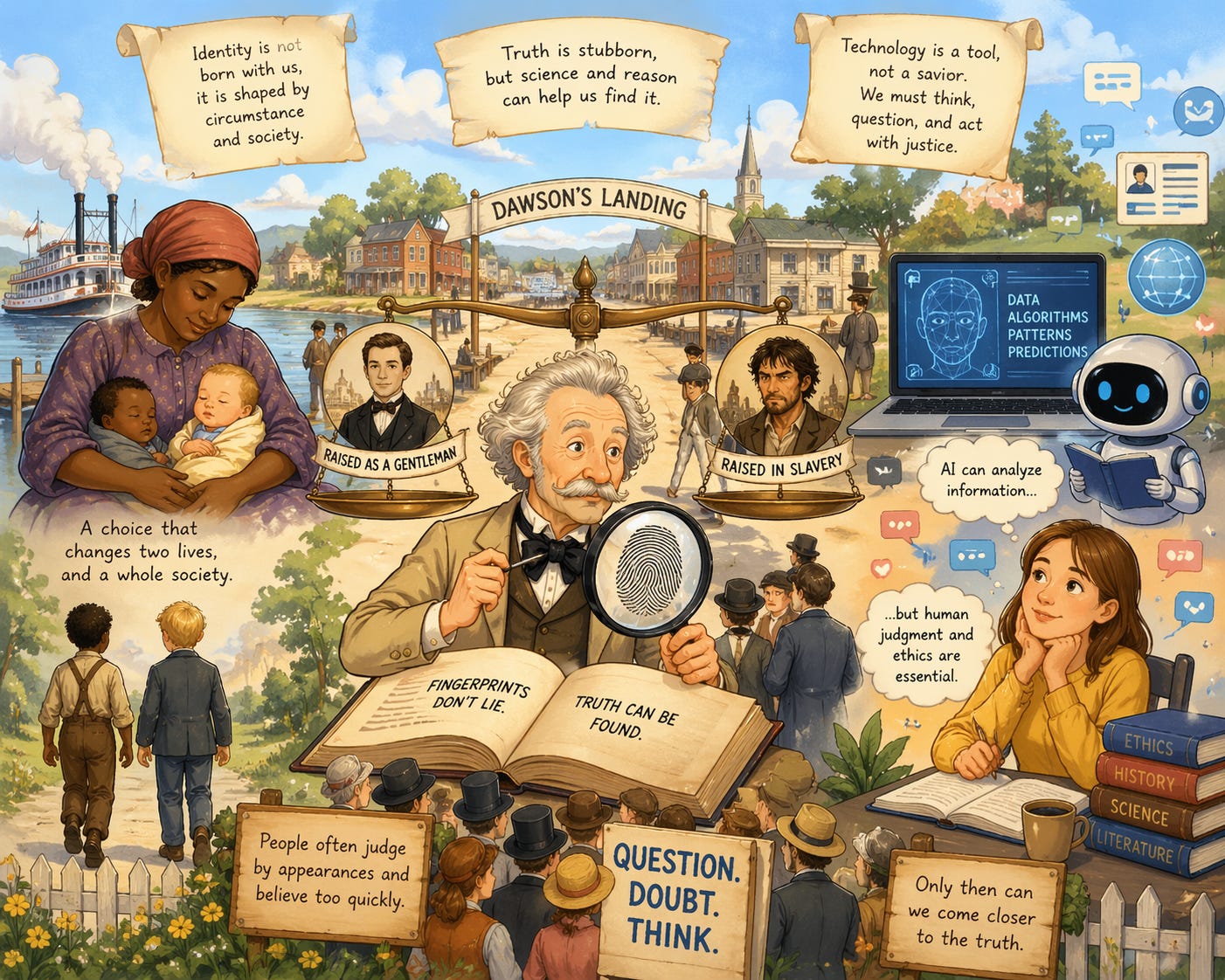
『Pudd’nhead Wilson』과 생성AI 시대의 인간 정체성
마크 트웨인의 19세기 소설이 인종, 알고리즘, 인간 존엄성에 던지는 질문
낡지 않는 소설
어떤 책은 특정한 역사적 시대에 속한다. 그러나 어떤 책은 새로운 세대가 등장할 때마다 다시 답해야 하는 질문을 던진다.
마크 트웨인의 『Pudd’nhead Wilson』(1894)은 후자에 속한다. Pudd’nhead는 Pudding-head를 변형한 말로, “얼간이”, “멍청이”, “바보”라는 조롱 섞인 별명입니다.
처음 이 소설을 읽으면 한 편의 흥미로운 신원 착각 이야기, 살인 미스터리, 법정 드라마, 과학적 수사의 결합처럼 보인다. 태어날 때 두 아기가 뒤바뀐다. 한 아이는 특권을 누리는 백인 귀족으로 성장하고, 다른 아이는 흑인 노예로 살아간다. 살인 사건이 발생하고 여러 사람이 의심받으며, 마을 사람들에게 ‘Pudd’nhead Wilson’이라는 조롱 섞인 별명으로 불리던 데이비드 윌슨이 결국 지문이라는 과학적 증거를 통해 진실을 밝혀낸다.
그러나 트웨인이 진정으로 탐구한 것은 살인이나 수사가 아니다.
그것은 인간의 정체성이다.
우리는 누가 결정하는가?
정체성은 혈통으로 결정되는가, 조상으로 결정되는가, 피부색으로 결정되는가, 사회적 지위로 결정되는가, 가족으로 결정되는가, 법으로 결정되는가, 기억으로 결정되는가, 아니면 사회 전체의 믿음으로 결정되는가?
그리고 사회가 한 인간을 평생 잘못 규정할 수 있다면, 현대 기술이 인간을 분류하고 예측하며 심지어 인간의 정체성까지 형성할 수 있는 시대에는 어떤 일이 일어날 것인가?
바로 이 질문 때문에 『Pudd’nhead Wilson』은 생성AI 시대에 놀라울 정도로 현재적인 작품이 된다.
트웨인의 19세기 미국은 과학적 방법을 이용하여 개인을 식별하기 시작했다. 21세기의 우리는 방대한 데이터를 분석하고, 인간에 대한 프로파일을 만들고, 이야기를 생성하고, 인간의 행동을 점점 더 정교하게 예측하는 인공지능을 사용하고 있다.
기술은 달라졌다.
그러나 근본적인 질문은 달라지지 않았다.
사회가 인간을 표현하는 방식과 그 인간 자체를 혼동할 때 어떤 일이 일어나는가?
사실은 Tom Driscoll이었던 아이
『Pudd’nhead Wilson』의 중심적인 역설은 Roxy에서 시작된다.
Roxy는 노예 여성이다. 그녀는 외모가 백인과 거의 구별되지 않을 정도로 백인에 가까운 외모를 가지고 있지만, 당시 사회에서는 흑인 혈통 때문에 노예로 취급된다. 그녀가 낳은 아들이 바로 Tom이다.
동시에 백인 Driscoll 가문에는 또 다른 아들 Chambers가 태어난다.
Roxy는 두 아기를 서로 바꿔 놓는다.
그 순간부터 두 아이의 운명은 완전히 달라진다.
Roxy의 친아들 Tom은 백인으로 인정받으며 Driscoll 가문의 일원으로 성장한다.
Driscoll 가문의 친아들 Chambers는 흑인 노예로 성장한다.
그러나 두 아이의 생물학적 혈통은 바뀌지 않았다.
유전적 정체성도 바뀌지 않았다.
바뀐 것은 사회가 그들에게 부여한 정체성이었다.
Tom은 백인으로 취급된다.
Chambers는 흑인으로 취급된다.
그리고 사회는 그 두 사람에게 완전히 다른 삶을 부여한다.
트웨인은 이 잘못된 신원 확인을 하나의 거대한 사회적 실험으로 만든다.
사회가 Tom을 백인이라고 믿으면 Tom은 백인에게 주어지는 특권을 누린다.
사회가 Chambers를 흑인이라고 믿으면 Chambers는 흑인과 노예에게 부과된 제약을 받는다.
따라서 트웨인은 다음과 같은 심각한 모순을 폭로한다.
사회적 정체성의 힘이 생물학적 현실보다 더 강력해질 수 있다는 것이다.
Tom과 Chambers — 사회가 정체성을 거꾸로 판단했을 때
Tom Driscoll은 사회적 특권이 반드시 인간의 도덕적 가치와 일치하지 않는다는 사실을 보여주는 핵심 인물이다.
Tom은 Roxy의 친아들이지만 백인 귀족으로 받아들여진다. 그는 특권과 교육, 재산, 사회적 권위를 누리며 성장한다.
그러나 그는 점점 이기적이고 무책임하며 도덕적으로 타락한 모습을 보인다.
반면 Chambers는 정반대의 운명을 경험한다.
그는 실제로 백인 Driscoll 가문의 친아들이지만 흑인 노예로 성장한다. 그의 사회적 환경은 그의 혈통에 따라 마땅히 누려야 할 기회와 존엄을 박탈한다.
그 대비는 잔혹하다.
사회가 백인이라고 규정한 사람이 그 정체성 때문에 도덕적으로 우월해지는 것은 아니다.
사회가 흑인이라고 규정한 사람이 그 정체성 때문에 도덕적으로 열등해지는 것도 아니다.
트웨인은 인종적 분류를 인간의 가치에 대한 판단으로 바꾸어 버린 사회 질서의 부조리를 폭로한다.
그런 의미에서 『Pudd’nhead Wilson』은 단순히 인종차별을 비판하는 소설이 아니다.
이 작품은 인간에게 부여된 분류와 실제 인간을 혼동하는 위험한 인간의 습성을 비판한다.
피부색에서 데이터 프로파일로
바로 이 지점에서 트웨인의 19세기 이야기는 21세기와 직접 연결된다.
트웨인의 미국에서는 인종적 분류가 법과 관습, 사회적 인식, 세대를 이어온 편견을 통해 만들어지고 강제되었다.
오늘날 인간은 점점 더 데이터를 통해 분류되고 있다.
개인은 통계적 프로파일이 될 수 있다.
소비자 프로파일이 될 수 있다.
신용 프로파일이 될 수 있다.
건강 프로파일이 될 수 있다.
직업적 프로파일이 될 수 있다.
정치적 프로파일이 될 수 있다.
위험 점수가 될 수도 있다.
교육적 예측의 대상이 될 수도 있다.
알고리즘이 만들어낸 추천 대상이 될 수도 있다.
생성AI 시스템 역시 자신이 이용할 수 있는 정보를 바탕으로 한 인간의 모습을 구성할 수 있다.
이러한 표현은 유용할 수 있다. 패턴을 발견하고 의사결정을 지원할 수 있기 때문이다.
그러나 표현은 인간 그 자체가 아니다.
확률은 인간이 아니다.
데이터 프로파일은 인간의 삶 그 자체가 아니다.
알고리즘의 예측은 운명이 아니다.
위험은 우리가 이 차이를 잊는 순간 시작된다.
새로운 ‘Pudd’nhead’의 문제
소설의 핵심적인 역설은 ‘Pudd’nhead’라고 불리던 사람이 실제로는 바보가 아니었다는 데 있다.
데이비드 윌슨은 불행한 농담 하나 때문에 마을 사람들의 조롱거리가 된다. 사람들은 그를 무시한다.
그러나 결국 그는 작품 속에서 가장 합리적인 사람 가운데 한 명임을 증명한다.
그는 평판에만 의존하지 않는다.
사회적 통념을 증거로 받아들이지도 않는다.
그는 보다 신뢰할 수 있는 것을 찾는다.
그것이 바로 지문이다.
이것은 매우 중요한 의미를 갖는다.
트웨인이 이 작품을 쓸 당시 지문 식별은 개인을 과학적으로 식별하는 강력한 방법으로 발전하고 있었다. 소설에서 과학적 증거는 사회가 만들어낸 정체성에 도전하는 수단이 된다.
마을 사람들은 한 가지를 말한다.
증거는 다른 것을 말한다.
Wilson은 증거를 선택한다.
여기서 우리는 AI 시대를 위한 중요한 원칙을 발견한다.
사회적 통념과 신뢰할 만한 증거가 충돌할 때, 우리는 증거를 왜곡하기보다 먼저 우리의 통념을 의심해야 한다.
그러나 21세기에는 또 다른 문제가 등장한다.
오늘날에는 알고리즘 자체가 인간을 분류하는 주체가 될 수 있기 때문이다.
이제 질문은 단순히 인간이 기술을 이용하여 진실을 발견할 수 있는가가 아니다.
기술 시스템이 그것을 만든 사회의 편견을 재생산할 수 있는가?
라는 질문도 함께 던져야 한다.
알고리즘이 새로운 사회적 심판자가 될 때
생성AI 시스템은 인간이 만들어 낸 방대한 정보에서 학습한다. 그 정보에는 놀라운 지식과 창의성, 역사, 문화적 다양성이 담겨 있다.
그러나 인간의 역사에는 동시에 인종차별, 성차별, 고정관념, 선전, 허위정보, 배제, 불평등한 표현도 존재한다.
따라서 AI 시스템은 학습 환경에 존재했던 일부 편향된 패턴을 재생산할 가능성이 있다.
이것은 트웨인의 소설과 놀라운 평행선을 이룬다.
『Pudd’nhead Wilson』에서는 사회가 인종적 통념을 통해 인간에게 정체성을 부여한다.
AI 시대에는 알고리즘이 역사적 데이터에서 학습한 패턴을 통해 사람을 분류할 수 있다.
작동 방식은 다르다.
그러나 위험은 놀랍도록 비슷하다.
역사적 편견이 기술적 편견으로 변할 수 있다.
그리고 일단 자동화된 시스템 속에 들어가면, 편견은 오히려 객관적인 것처럼 보이기 때문에 더 발견하기 어려워질 수 있다.
사람이 “나는 이 사람이 의심스럽다고 생각한다”고 말하면 주관적인 판단처럼 들린다.
그러나 컴퓨터가 숫자로 위험 점수를 제시하면 과학적인 것처럼 보인다.
하지만 데이터와 변수, 가정 또는 시스템 설계 자체에 역사적 편견이 들어 있다면 숫자로 표현된 결과는 과거의 차별에 새로운 기술적 외관을 입혀 줄 뿐이다.
이것이 『Pudd’nhead Wilson』이 AI 시대에 주는 가장 중요한 교훈 가운데 하나다.
식별과 정체성은 다르다
지문은 사람을 식별하는 데 도움을 준다.
그러나 지문 하나가 인간 전체를 설명하지는 못한다.
DNA는 생물학적 혈통을 보여줄 수 있다.
그러나 DNA가 인간의 성격을 설명하지는 못한다.
이력서는 직업적 경험을 보여준다.
그러나 한 사람의 상상력 전체를 담을 수는 없다.
소셜미디어 프로필은 관심사를 보여줄 수 있다.
그러나 인간 의식 전체를 담고 있지는 않다.
대규모 언어 모델은 한 사람에 대해 매우 설득력 있는 설명을 만들어낼 수 있다.
그러나 그 설명 역시 하나의 표현일 뿐이다.
이 차이는 생성AI가 인간의 글과 이미지, 목소리, 디지털 페르소나를 점점 더 정교하게 만들어가는 시대에 더욱 중요해지고 있다.
표현이 실제처럼 보일수록 우리는 표현을 현실과 혼동하기 쉽다.
AI가 반드시 인간의 진정한 정체성을 발견하는 것이 가장 큰 위험은 아니다.
오히려 더 큰 위험은 인간이 AI가 생성한 인간의 표현을 그 인간의 권위 있는 정의로 받아들이는 것이다.
인종적 정체성에서 알고리즘적 정체성으로
Roxy의 행동은 사회적 라벨이 얼마나 강력한지를 보여준다.
그녀는 두 아이의 사회적 정체성을 바꾸었고, 사회는 그 정체성을 바탕으로 두 아이의 삶을 바꾸었다.
생성AI 시대에는 새로운 가능성이 등장한다.
AI 시스템은 단순히 인간에게 정체성을 부여하는 것이 아니라 데이터를 통해 정체성을 구성하고, 추론하고, 예측하고, 강화할 수 있다.
어떤 AI가 학생에게 성공 가능성이 낮다고 판단한다고 생각해 보자.
어떤 채용 시스템이 지원자를 적합하지 않은 인물로 예측할 수도 있다.
금융 시스템이 고객을 위험한 사람으로 분류할 수도 있다.
의료 시스템이 특정 결과를 예측할 수도 있다.
보안 시스템이 어떤 사람을 의심스러운 대상으로 식별할 수도 있다.
그 예측은 통계적으로 유용할 수 있다.
그러나 윤리적 질문은 여전히 남는다.
예측이 정체성이 되어 버리면 어떻게 되는가?
학생이 ‘잠재력이 낮다’고 분류되면 학교가 그 학생에게 더 적은 기회를 제공할 수 있다.
지원자가 ‘고위험’으로 분류되면 면접조차 받지 못할 수 있다.
어떤 지역이 ‘위험 지역’으로 분류되면 더 강한 감시를 받을 수 있다.
이렇게 되면 알고리즘은 현실을 단순히 설명하는 데 그치지 않는다.
알고리즘이 현실을 만들어내기 시작한다.
바로 이 지점에서 『Pudd’nhead Wilson』의 교훈은 매우 강력해진다.
인간 가치의 사회적 구성
트웨인은 정체성이 단순히 개인적인 문제가 아니라는 사실을 이해하고 있었다.
정체성은 사회적 과정이기도 하다.
사회는 어떤 범주가 중요한지를 결정한다.
어떤 범주에 특권을 부여할지를 결정한다.
누가 포함되고 누가 배제되는지를 결정하는 규칙을 만든다.
그리고 결국 그 범주를 자연스럽고 영구적인 것처럼 받아들인다.
미국 남부의 인종적 위계질서가 바로 그러한 체계였다.
AI 시대의 위험도 이와 완전히 무관하지 않다.
알고리즘이 과거의 인종 범주를 그대로 재현한다는 의미가 아니다.
더 큰 위험은 우리가 새로운 범주를 만들고 그 범주에 과거와 비슷한 힘을 부여하는 것이다.
‘높은 잠재력.’
‘낮은 위험.’
‘신뢰할 만한 사람.’
‘신뢰할 수 없는 사람.’
‘고용 가능.’
‘고용 불가능.’
‘정상.’
‘비정상.’
‘선호.’
‘비선호.’
이러한 범주는 19세기의 인종적 분류보다 훨씬 과학적으로 보일 수 있다.
그러나 질문은 같다.
누가 그 범주를 만들었는가? 그 범주에는 어떤 가정이 들어 있는가? 그리고 그 범주를 통해 누가 혜택을 받고 누가 불이익을 받는가?
생성AI와 자아의 문제
이 문제에는 또 하나의 차원이 있다.
생성AI는 인간을 분류할 뿐만 아니라 점점 더 인간을 대신하여 말할 수 있다.
AI는 전기를 쓸 수 있다.
편지를 작성할 수 있다.
초상화를 만들 수 있다.
목소리를 생성할 수 있다.
이력서를 작성할 수 있다.
개인의 삶을 요약할 수 있다.
대화를 모방할 수 있다.
디지털 인격을 구성할 수도 있다.
그렇다면 더욱 근본적인 철학적 질문이 등장한다.
AI가 나를 점점 더 설득력 있게 표현할 수 있다면, 나의 정체성은 어디에 존재하는가?
AI가 나에 대해 말하는 것이 나인가?
다른 사람들이 나를 믿는 모습이 나인가?
데이터가 나에 대해 보여주는 것이 나인가?
아니면 인간의 정체성에는 데이터로 환원할 수 없는 무엇인가가 존재하는가?
이 질문은 중요하다.
인간은 정적인 데이터셋이 아니기 때문이다.
우리는 기억한다.
잊는다.
변한다.
후회한다.
용서한다.
상상한다.
도덕적 선택을 한다.
때로는 자신의 통계적 경향과 반대로 행동한다.
인간은 과거의 행동을 단순히 합산한 결과가 아니다.
인간에게는 변화할 능력이 있다.
이것은 인간의 삶과 알고리즘적 프로파일 사이의 가장 중요한 차이 가운데 하나일 수 있다.
AI 시대에도 인간의 주체성은 살아 있어야 한다
UNESCO의 AI 윤리 논의는 인간 존엄성, 인권, 공정성, 투명성, 프라이버시, 인간의 감독과 책임을 AI 거버넌스의 핵심으로 강조한다.
이 원칙은 매우 중요하다.
AI의 목표는 인간의 판단을 없애는 것이 되어서는 안 된다.
AI의 목표는 인간의 판단을 향상시키는 것이어야 한다.
생성AI는 인간의 상상력을 확대해야지 인간의 책임을 대신해서는 안 된다.
사람이 더 깊이 생각하도록 도와야지 생각 자체를 포기하게 만들어서는 안 된다.
지식을 더 쉽게 접근하도록 만들어야지 비판적 판단을 불필요하게 만들어서는 안 된다.
이것이 바로 Pudd’nhead Wilson의 정신과 연결되는 지점이다.
Wilson은 기술에 판단을 맡기지 않는다.
그는 기술을 증거로 활용한다.
기술은 그의 추론을 돕는다.
그러나 증거를 해석하고 책임지는 일은 여전히 그의 몫이다.
이 구분은 AI 시대의 기본 원칙 가운데 하나가 되어야 한다.
생성AI 시대의 대학
이 문제는 고등교육에서 특히 중요하다.
수세기 동안 대학 교육은 읽기, 쓰기, 암기, 분석, 독립적 사고 등을 통해 이루어졌다.
그러나 생성AI는 이제 이러한 작업의 상당 부분을 놀라운 수준으로 수행한다.
따라서 교육의 과제는 단순히 학생들이 AI를 사용하지 못하도록 하는 데 있지 않다.
더 근본적인 과제는 배움의 의미를 다시 정의하는 것이다.
학생이 AI에게 에세이를 작성하게 할 수 있다면, 교육의 가치는 더 이상 에세이를 작성하는 행위 자체에만 머물 수 없다.
AI가 책을 몇 초 만에 요약할 수 있다면 학생은 책을 해석하는 법을 배워야 한다.
AI가 논리를 만들어낼 수 있다면 학생은 그 논리를 평가할 수 있어야 한다.
AI가 코드를 작성할 수 있다면 학생은 그 코드가 무엇을 의미하며 신뢰할 수 있는지를 이해해야 한다.
AI가 답을 만들어낼 수 있다면 교육은 질문, 판단, 검증, 창의성, 윤리적 사고에 더욱 큰 비중을 두어야 한다.
새로운 시대의 이상적인 학생은 AI를 사용하지 않는 학생이 아니다.
그렇다고 지적 작업을 무조건 AI에게 맡기는 학생도 아니다.
이상적인 학생은 언제 AI를 사용해야 하는지, 어떻게 사용해야 하는지, 어떻게 AI에 질문하고 도전해야 하는지, 그리고 언제 AI를 믿지 말아야 하는지를 아는 학생이다.
그것이 Pudd’nhead Wilson의 정신이다.
지문에서 프롬프트 리터러시로
Wilson의 지문 활용과 오늘날의 프롬프트 엔지니어링 사이에는 흥미로운 연결이 있다.
Wilson은 올바른 질문을 올바른 증거에 던지는 것이 수사의 질을 결정한다는 사실을 알고 있다.
AI 사용자도 비슷한 도전에 직면한다.
잘못 구성된 프롬프트는 피상적이거나 오해를 불러일으키는 답을 만들어낼 수 있다.
정교한 프롬프트는 AI에게 자료를 비교하고, 불확실성을 확인하고, 가정을 검증하고, 반론을 만들고, 편향 가능성을 찾아내도록 요구할 수 있다.
따라서 프롬프트 엔지니어링은 단순히 더 좋은 문장을 얻기 위한 기술적 요령으로 이해해서는 안 된다.
가장 높은 수준에서 프롬프트 엔지니어링은 지적으로 질문하는 능력이다.
중요한 질문은 단순히
“AI에게 무엇을 물어볼 것인가?”
가 아니다.
더 중요한 질문은
“AI에게 묻기 전에 어떤 가정을 의심해야 하는가?”
이다.
이것이 AI 리터러시의 더 깊은 의미다.
지능의 새로운 정의
Pudd’nhead Wilson의 이야기는 지능이 무엇인지 다시 생각하게 한다.
마을 사람들은 자신들이 공유하는 믿음 때문에 자신감을 가지고 있다.
Wilson은 그 믿음에 의문을 제기하기 때문에 오히려 어리석은 사람처럼 보인다.
그러나 역사는 기존의 통념을 의심하는 사람이 그것을 자신 있게 반복하는 사람보다 더 지적일 수 있음을 보여준다.
생성AI에도 같은 원칙이 적용된다.
AI는 수백만 개의 그럴듯한 문장을 만들어낼 수 있다.
그러나 그럴듯함은 진실이 아니다.
유창함은 지혜가 아니다.
속도는 이해가 아니다.
예측은 판단이 아니다.
정보는 지식이 아니다.
지식은 지혜가 아니다.
그리고 지능은 단순한 계산 능력이 아니다.
따라서 AI 시대에 인간에게 가장 중요한 지능은 어쩌면 겉보기에 지적인 답변을 의심할 줄 아는 능력일 것이다.
Roxy가 보여주는 윤리적 교훈
Roxy 역시 더 깊은 성찰이 필요한 인물이다.
그녀가 두 아기를 바꾼 행동은 도덕적으로 문제가 있다.
그녀는 주변 사회를 속인다.
그러나 그녀의 행동은 인종적 분류가 아이의 삶을 결정하는 잔혹한 사회제도에서 비롯된다.
그녀의 선택은 따라서 그 사회 자체의 도덕적 타락을 드러낸다.
사회가 견딜 수 없는 조건을 만들면 개인은 그 조건 안에서 극단적인 선택을 할 수 있다.
이 문제는 오늘날에도 새로운 형태로 등장한다.
알고리즘이 기회에 접근하는 문을 결정하기 시작한다면 사람들은 알고리즘에 맞추어 자신의 디지털 정체성을 조작하기 시작할 수 있다.
자동화된 채용 시스템에 맞추기 위해 이력서를 수정할 수도 있다.
온라인 정체성을 바꿀 수도 있다.
소셜미디어 행동을 조정할 수도 있다.
추천 시스템에 최적화된 행동을 배울 수도 있다.
다시 말해 알고리즘이 강력한 문지기가 된다면 인간은 알고리즘에 맞추어 자신을 변화시키기 시작할 수 있다.
그것은 매우 심각한 역전이다.
기술이 인간을 위해 존재하는 것이 아니라 인간이 기술이 만든 범주를 위해 살아가기 시작하는 것이다.
우리 자신이 알고리즘적 프로파일이 될 위험
이 가능성은 깊이 생각해 볼 필요가 있다.
모든 행동이 데이터가 될 수 있다는 사실을 알고 성장하는 세대를 상상해 보자.
학생은 자신의 학업 행동이 미래의 예측에 어떤 영향을 미치는지 걱정할 수 있다.
직장인은 생산성 지표가 승진에 어떤 영향을 미치는지 생각할 수 있다.
소비자는 자신의 클릭 하나하나가 추천 시스템에 어떤 영향을 주는지 생각할 수 있다.
시민은 온라인 행동이 정치적 프로파일에 어떤 영향을 미치는지 걱정할 수 있다.
젊은 세대는 결국
“나는 누구인가?”
라고 묻는 대신
“알고리즘은 나를 어떤 사람이라고 생각하는가?”
라고 묻게 될지도 모른다.
그것은 위험한 문화적 변화다.
인간의 정체성이 외부 시스템에 맞추어 최적화되기 시작하기 때문이다.
자신이 어떤 사람이 되고 싶은지를 발견하는 대신 시스템이 예측한 가능성에 자신을 맞추게 될 수 있다.
자신이 원하는 사람이 되는 대신 시스템이 기대하는 사람이 될 수 있다.
그렇게 된다면 Chambers의 비극은 21세기에 새로운 모습으로 반복될 것이다.
Chambers는 사회가 강요한 정체성에 갇혔다.
미래 세대는 알고리즘이 강요하는 정체성에 갇혀서는 안 된다.
인간과 기계의 대립을 넘어서
해답이 기술을 거부하는 것일 필요는 없다.
그것은 Twain의 메시지를 오해하는 것이다.
Pudd’nhead Wilson은 과학을 거부하지 않는다.
그는 과학을 사용한다.
따라서 교훈은 “기술은 위험하다”가 아니다.
더 깊은 교훈은 다음과 같다.
기술은 인간에 대한 최종적이고 의심할 수 없는 권위가 되어서는 안 되며, 진실을 발견하고 인간의 삶을 개선하기 위한 수단으로 남아 있어야 한다.
미래는 인간과 기계의 경쟁이 되어서는 안 된다.
인간의 능력을 확장하는 기계와, 도덕적 주체성을 유지하는 인간이 협력하는 미래가 되어야 한다.
AI는 개인보다 더 많은 데이터를 분석할 수 있다.
인간이 발견하지 못하는 패턴을 찾을 수 있다.
엄청난 속도로 가능성을 만들어낼 수 있다.
그러나 그 가능성이 무엇을 의미하는지, 그리고 그것을 추구해야 하는지를 결정하는 책임은 인간에게 남아 있어야 한다.
K-GSP의 관점에서 본 인간 존엄성
이 질문은 세계적으로 연결된 사회에서 특히 중요하다.
한인 글로벌 학자와 전문가들은 문화, 언어, 기술, 역사적 경험이 교차하는 지점에 서 있다.
한국의 경험은 빠른 기술적 변화를 이해하는 데 특히 풍부한 시각을 제공한다.
한국은 불과 몇 세대 만에 농업 중심 사회에서 세계에서 가장 디지털화되고 기술적으로 발전한 사회 가운데 하나로 변화했다.
그러나 기술적 발전만으로 어떤 사회를 만들어야 하는지에 대한 답을 얻을 수는 없다.
미래에는 기술적 역량과 인문학적 지혜의 결합이 필요하다.
K-GSP의 전통은 과학, 공학, 문학, 역사, 철학, 교육, 문화, 윤리를 연결함으로써 이러한 통합에 기여할 수 있다.
바로 이러한 학제적 관점이 『Pudd’nhead Wilson』이 우리에게 요구하는 것이다.
19세기의 문학작품이 21세기의 인공지능을 이해하는 데 도움을 줄 수 있다.
노예제에 관한 소설이 알고리즘의 공정성 논쟁에 기여할 수 있다.
지문이 데이터 정체성의 은유가 될 수 있다.
허구의 법정이 AI 책임성의 실험실이 될 수 있다.
이것이 학제적 연구의 힘이다.
AI 르네상스 시대에 다시 읽는 Twain
생성AI 시대는 흔히 기술혁명이라고 불린다.
그러나 이것은 동시에 인간학적 혁명일 수도 있다.
AI는 우리가 오랫동안 안정적이라고 생각했던 개념들을 다시 생각하게 만들고 있다.
지능이란 무엇인가?
창의성이란 무엇인가?
저작권과 저자성은 무엇인가?
기억이란 무엇인가?
지식이란 무엇인가?
정체성이란 무엇인가?
인간의 판단이 중요한 이유는 무엇인가?
인간과 인간을 모방하여 만들어진 기계를 구분하는 것은 무엇인가?
이것들은 단순한 공학적 질문이 아니다.
문학적 질문이며, 철학적 질문이고, 역사적 질문이며, 법적·윤리적·문화적 질문이다.
그래서 Twain이 중요하다.
문학은 때때로 기술이 대답할 수 없는 질문을 던진다.
기계는 패턴을 식별할 수 있다.
그러나 그 패턴이 중요한 것인지 문학은 질문할 수 있다.
기계는 인간을 분류할 수 있다.
그러나 문학은 그 분류가 정의로운지 질문할 수 있다.
기계는 인간의 행동을 예측할 수 있다.
그러나 인문학적 전통은 인간이 변화할 자유를 가져야 하는지 질문할 수 있다.
따라서 AI 시대에 인문학이 무의미해지는 것이 아니다.
오히려 그 중요성이 더욱 커질 수 있다.
진짜 Pudd’nhead는 질문을 멈춘 사람이다
소설의 가장 깊은 역설은 ‘Pudd’nhead’라는 이름이 결국 그 이름을 만든 사회를 향해 되돌아온다는 데 있다.
마을 사람들은 Wilson을 오해했기 때문에 그를 조롱했다.
그러나 정작 마을 사람들 자신이 한 번도 진지하게 질문하지 않았던 통념 속에 갇혀 있었다.
이것이 우리 시대에 주는 경고다.
AI 시대의 진짜 바보는 인공지능에 대해 아는 것이 적은 사람이 아닐 수 있다.
오히려 AI에 대해 많이 알면서도 AI가 말하는 것을 의심하지 않는 사람일 수 있다.
통계적 확률을 진실로 착각하는 사람일 수도 있다.
알고리즘 점수를 인간의 상황보다 중요하게 생각하는 기관일 수도 있다.
AI가 만들어낸 유창한 문장을 진정한 학습보다 높이 평가하는 교육자일 수도 있다.
자동화가 가능하다는 이유만으로 모든 판단을 자동화하는 조직일 수도 있다.
그리고 결국 알고리즘이 자신이 누구인지 결정하도록 서서히 허용하는 개인일 수도 있다.
Pudd’nhead Wilson에서 인간의 미래로
Twain이 『Pudd’nhead Wilson』을 쓴 지 100년이 훨씬 넘은 지금, 인류는 그가 상상하기조차 어려웠을 기술을 개발했다.
생체정보를 이용하여 사람을 식별할 수 있다.
유전체를 분석할 수 있다.
수십억 개의 문서를 검색할 수 있다.
인간과 유사한 언어를 생성할 수 있다.
합성 이미지와 음성을 만들 수 있다.
방대한 정보를 바탕으로 추론하는 인공지능 시스템도 만들 수 있다.
그러나 우리의 근본적인 책임은 놀라울 정도로 단순하다.
지도와 영토를 혼동해서는 안 된다.
데이터와 인간을 혼동해서는 안 된다.
예측과 운명을 혼동해서는 안 된다.
알고리즘적 분류와 인간의 정체성을 혼동해서는 안 된다.
그리고 기술적 정교함을 도덕적 게으름의 변명으로 사용해서도 안 된다.
Pudd’nhead Wilson은 모든 사람이 이미 믿고 있는 것 너머를 바라보아야 진실을 발견할 수 있음을 보여준다.
생성AI 시대 역시 바로 그러한 지적 용기를 요구한다.
우리는 기술을 사용할 수 있지만 기술을 숭배하지 않는 사람이 필요하다.
계산 능력과 양심을 결합할 수 있는 학자가 필요하다.
역사를 이해하는 엔지니어가 필요하다.
기술을 이해하는 인문학자가 필요하다.
학생들에게 단순히 기계에 프롬프트를 입력하는 법만 가르치는 것이 아니라, 그 기계의 답에 질문하는 법을 가르치는 교육자가 필요하다.
무엇보다 중요한 것은 모든 데이터셋이 인간의 삶을 나타낸다는 사실을 잊지 않는 문화다.
알고리즘 너머에 존재하는 인간
『Pudd’nhead Wilson』의 궁극적인 교훈은 지문에 관한 것이 아니다.
심지어 인종에 관한 것만도 아니다.
그것은 사회가 만든 정의가 인간 자체를 대신하게 만드는 위험에 관한 것이다.
Tom은 백인으로 취급되었다.
Chambers는 흑인으로 취급되었다.
그러나 어느 쪽의 라벨도 그 사람 전체를 설명하지 못했다.
이 통찰은 생성AI 시대에 더욱 중요해진다.
미래의 인간은 자신에 관한 점점 더 정교한 표현들에 둘러싸여 살아갈 것이다.
디지털 프로파일, 행동 예측, AI가 생성한 전기, 평판 점수, 개인화된 추천, 합성된 인간 표현 등이 그것이다.
그러나 어떤 표현도 한 인간의 삶을 최종적으로 정의하도록 허용해서는 안 된다.
인간은 자신에 대해 수집된 데이터보다 언제나 더 큰 존재다.
이것은 AI 르네상스의 가장 중요한 원칙 가운데 하나가 되어야 한다.
기술은 인간을 측정할 수 있는 것의 범위로 축소시키는 것이 아니라 인간을 더 깊이 이해하도록 도와야 한다.
AI는 인간의 가능성을 확대해야지 인간을 알고리즘적 기대 속에 가두어서는 안 된다.
그리고 지능은 단순히 답을 만들어내는 능력으로 측정되어서는 안 된다.
가장 높은 형태의 지능은 어쩌면 그 답 자체가 믿을 만한 것인지 질문할 수 있는 용기일 것이다.
마크 트웨인은 사람들이 어리석다고 부르던 인물에게 ‘Pudd’nhead’라는 이름을 붙였다. 그러나 역사는 그 이름을 아이러니로 바꾸어 놓았다.
21세기의 질문은 더 이상 단순히 “Pudd’nhead Wilson은 누구인가?”가 아니다.
더 중요한 질문은 이것이다.
우리는 우리 기계가 만들어내는 정체성, 예측, 분류를 아무런 질문 없이 받아들이는 새로운 Pudd’nhead가 될 것인가?
아니면 그보다 더 나은 존재가 될 것인가.
인공지능을 사용할 수 있으면서도 인간의 지능과 인간의 존엄성, 인간의 자유를 포기하지 않는 인간.
바로 이것이 우리 앞에 놓인 선택이다.
그리고 생성AI 시대에 이것은 어쩌면 가장 중요한 정체성의 질문일 것이다. +++
2026년 8월 7일
{솔티}
Source Paper:


Prof. Dr. Young Choi (Editor in Chief) — Regent University
Young B. Choi is a Professor in the Department of Engineering & Computer Science at Regent University. He published 38 books with ‘Selected Readings in Cybersecurity’ (2018) (over 800 copies archived globally at university/college libraries around the world) and ‘Cybersecurity Applications and Artificial Intelligence’ (2023) available in seven major world languages. He proposed the world’s first global and universal telecommunications “Service Order Handling (SOH)” Model (T-SOH Model) (1995) with Dr. Adrian Tang. With this innovative research work, he received the IEEE NOMS ’96 Best Paper Award and became the first recipient of the Outstanding Contribution Award of the TeleManagement Forum in 1998. His research areas include Natural Language Processing-focused AI, AI-applied cybersecurity, network and telecom service management, and Korean studies on Gani Choi Rip’s Jeonggwan (靜觀: Quiet Contemplation) philosophy and Shilhak ( 實學: Practical Learning).
© K-GSP (K-Global Scholars and Professionals) Forum. All rights reserved. August 2026.