
Book Review of “Huinnyeonrok (稀年錄)” in Gani-jip Volume 9
The Wisdom Gained from Reflecting on Seventy Years of Life
1.
While reading “Huinnyeonrok (희년록(稀年錄))” in Volume 9 of Gani-jip, the first thought that came to my mind was that a person’s life is not merely a record of passing time, but a great work created through countless experiences of learning, relationships, efforts, and self-reflection. At the age of seventy, Choi Rip looked back on his journey and expressed gratitude for the past while reflecting on the attitude he should maintain for the future.
2.
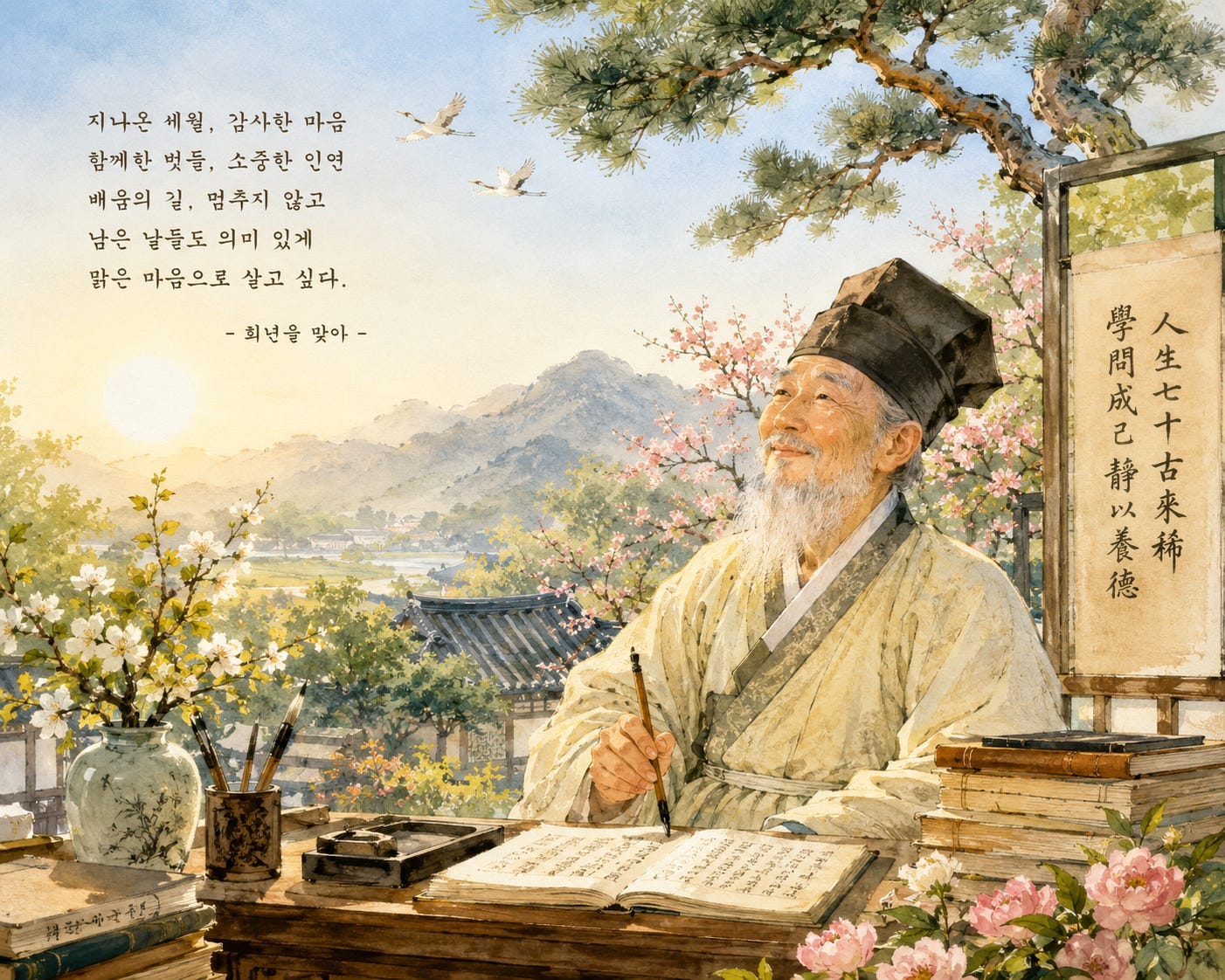
In ancient Korea, the age of seventy was called “Huinnyeon (희년(稀年)),” meaning a rare and precious age because reaching such an age was not common in those times. However, Choi Rip did not simply take pride in having lived a long life. Instead, he quietly reflected on the value of the years he had spent studying, writing, and building meaningful relationships with others.
3.
The image of Choi Rip presented in “Huinnyeonrok” is that of a humble scholar. Although he was a distinguished writer, he did not emphasize his own achievements. Rather, he valued the attitude of continuously learning and improving himself. This lesson remains meaningful today: a true intellectual is not someone who knows everything, but someone who continues to learn throughout life.
4.
One of the most impressive aspects of this work is Choi Rip’s appreciation for human relationships. He understood that his life was not achieved alone, but was shaped by the support, friendship, and encouragement of many colleagues, friends, and students. For him, the greatest treasures of life were not fame or status, but trust and friendship built with others.
5.
“Huinnyeonrok” also reveals the beauty of old age. Growing older does not simply mean losing strength; it is a process of gaining deeper wisdom through accumulated experiences. Choi Rip viewed his past not with regret but with gratitude. His positive attitude toward life provides valuable encouragement and lessons for people today.
6.
Choi Rip’s life demonstrates that knowledge and practice must go together. He did not pursue learning merely through books; he also tried to live a righteous life by caring about society and contributing to the nation. “Huinnyeonrok” conveys the message that the value of a person’s life is more important than personal success or achievements.
7.
Reading this work also led me to reconsider the meaning of “success” in modern society. Today, people often focus on rapid achievement and visible results. However, Choi Rip’s life teaches us that consistent effort, sincerity, and perseverance are the values that remain meaningful over time. True evaluation of a person is revealed gradually through the passage of years.
8.
“Huinnyeonrok” is not merely a record celebrating a seventieth birthday; it is a beautiful reflection of a person reviewing and understanding his own life. It contains the passion of youth, the responsibilities of adulthood, and the wisdom of old age. Therefore, this work transcends the boundaries of Joseon-era literature and speaks to universal human experiences.
9.
Especially in today’s rapidly changing world, Choi Rip’s way of life carries even greater significance. His commitment to lifelong learning, respect for others, and quiet dedication to his own path represent timeless values. “Huinnyeonrok” encourages readers to ask themselves what kind of life is truly meaningful.
10.
Ultimately, “Huinnyeonrok” is not simply the record of a scholar who reached seventy years of age; it is a wise and beautiful confession of a person who loved and appreciated his life. Choi Rip showed a path toward being remembered by future generations through accumulated knowledge, integrity, and character. This work encourages me to reflect on my own journey and consider what kind of legacy I hope to leave behind.
“Huinnyeonrok” is not merely the story of someone who lived a long life; it is the profound reflection and wisdom of someone who lived a meaningful one. +++
{Solti}
July 29, 2026
『간이집』 제9권 「희년록(稀年錄)」 독후감
일흔 해의 삶을 돌아보며 얻는 지혜
1.
『간이집』 제9권의 「희년록 (稀年錄)」을 읽으며 가장 먼저 느낀 것은 한 사람의 삶이 단순히 지나간 시간의 기록이 아니라, 수많은 배움과 만남, 노력과 성찰이 쌓여 만들어지는 하나의 큰 작품이라는 점이다. 최립은 칠순이라는 인생의 중요한 순간에 자신의 삶을 돌아보며, 지나온 길에 대한 감사와 앞으로의 마음가짐을 담았다.
2.
옛사람들은 일흔 살을 ‘희년(稀年)’이라 불렀다. 오래 살기가 쉽지 않았던 시대에 칠순은 큰 축복이었다. 그러나 최립은 단순히 오래 산 것을 자랑하지 않았다. 그는 평생 학문을 닦고, 글을 쓰고, 사람들과 교류하며 살아온 시간이 얼마나 가치 있었는지를 조용히 되돌아보았다.
3.
「희년록」에서 느껴지는 최립의 모습은 겸손한 학자의 모습이다. 그는 뛰어난 문장가였지만 자신의 재능을 내세우기보다 끊임없이 배우는 자세를 중요하게 여겼다. 이러한 태도는 오늘날에도 큰 가르침을 준다. 진정한 지식인은 많이 아는 사람이 아니라 계속 배우는 사람이라는 생각이 들었다.
4.
이 작품에서 특히 인상 깊은 부분은 사람과 사람 사이의 관계를 소중히 여기는 모습이다. 최립은 혼자 이룬 삶이 아니라 많은 벗과 동료, 제자들의 도움 속에서 자신의 길을 걸어왔다고 생각했다. 그에게 있어 인생의 가장 큰 보물은 명예나 지위보다 함께했던 사람들과의 신뢰와 우정이었다.
5.
또한 「희년록」은 노년의 아름다움을 보여 준다. 나이가 든다는 것은 단순히 힘이 약해지는 것이 아니라, 경험을 통해 더 깊은 지혜를 얻는 과정이다. 최립은 지나온 세월을 후회하기보다 감사하는 마음으로 바라보았다. 이러한 긍정적인 삶의 태도는 현대인에게도 큰 위로와 교훈을 준다.
6.
최립의 삶은 학문과 실천이 함께해야 한다는 점을 보여 준다. 그는 책 속의 지식만을 추구한 것이 아니라, 나라와 사회를 생각하고 올바른 삶을 살기 위해 노력했다. 「희년록」은 한 사람의 성공보다 한 사람의 올바른 삶이 더 중요하다는 메시지를 전한다.
7.
이 글을 읽으며 오늘날의 ‘성공’에 대해서도 다시 생각하게 되었다. 현대 사회에서는 빠른 성취와 눈에 보이는 결과를 중요하게 여기지만, 최립의 삶은 꾸준한 노력과 성실함이 결국 가장 오래 남는 가치임을 알려 준다. 인생의 진정한 평가는 시간이 지나면서 드러나는 것이다.
8.
「희년록」은 단순한 칠순 기념 기록이 아니라 한 인간이 자신의 삶을 정리하는 아름다운 성찰의 글이다. 젊은 시절의 열정, 중년의 책임, 노년의 지혜가 모두 담겨 있어 한 사람의 인생 여정을 바라보게 한다. 그래서 이 작품은 조선 시대 문학을 넘어 인간 보편의 이야기로 다가온다.
9.
특히 오늘날처럼 빠르게 변화하는 시대에는 최립의 삶의 자세가 더욱 의미 있게 느껴진다. 평생 배우고, 사람을 존중하며, 자신의 길을 묵묵히 걸어가는 자세는 시대가 변해도 변하지 않는 가치이다. 「희년록」은 우리에게 어떤 삶이 의미 있는 삶인지 질문하게 한다.
10.
결국 「희년록」은 일흔 살을 맞은 한 학자의 기록이 아니라, 한 인간이 자신의 삶을 사랑하고 감사하는 아름다운 고백이다. 최립은 긴 세월 동안 쌓은 학문과 인품으로 후대에 기억되는 길을 보여 주었다. 이 작품을 통해 나 역시 지나온 시간을 돌아보고, 앞으로 어떤 흔적을 남길 것인지 생각하게 되었다.
「희년록」은 오래 산 사람의 기록이 아니라, 의미 있게 살아온 사람이 남긴 인생의 지혜로운 성찰이다. +++
2026년 7월 30일
{솔티}
Prof. Dr. Young Choi (Editor in Chief) — Regent University
Young B. Choi is a Professor in the Department of Engineering & Computer Science at Regent University. He published 38 books with ‘Selected Readings in Cybersecurity’ (2018) (over 800 copies archived globally at university/college libraries around the world) and ‘Cybersecurity Applications and Artificial Intelligence’ (2023) available in seven major world languages. He proposed the world’s first global and universal telecommunications “Service Order Handling (SOH)” Model (T-SOH Model) (1995) with Dr. Adrian Tang. With this innovative research work, he received the IEEE NOMS ’96 Best Paper Award and became the first recipient of the Outstanding Contribution Award of the TeleManagement Forum in 1998. His research areas include Natural Language Processing-focused AI, AI-applied cybersecurity, network and telecom service management, and Korean studies on Gani Choi Rip’s Jeonggwan (靜觀: Quiet Contemplation) philosophy and Shilhak ( 實學: Practical Learning).