
Lee, Chang-rae. Native Speaker. Riverhead Books, 1995. ISBN 978-1-57322-531-1. 349 pages, $16.00.
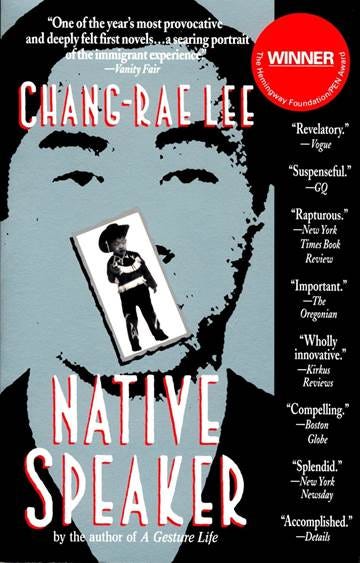
Chang-rae Lee is a Korean American novelist who serves as the Ward W. and Priscilla B. Woods Professor of English at Stanford University. He is the author of six novels to date, including Native Speaker (1995), A Gesture Life (1999), Aloft (2004), The Surrendered (2010), Such a Full Sea (2014), and My Year Abroad (2021). His forthcoming novel, A Tender Age, is scheduled for publication on August 11, 2026. Throughout his career, Lee has received numerous honors, including the PEN/Hemingway Award, the American Book Award, the Anisfield-Wolf Book Award, the Gustavus Myers Outstanding Book Award, and the Dayton Literary Peace Prize. The Surrendered was a finalist for the Pulitzer Prize, and in 2021 Lee received an Award of Merit from the American Academy of Arts and Letters and was elected to the American Academy of Arts and Sciences.
Lee is widely regarded as one of the most influential Korean American writers of his generation, particularly for his exploration of race, class, immigration, and cultural identity in the United States. Critics have praised his work for its stylistic elegance and psychological depth, describing him as a “spellbinder” and a “master craftsman” (Penguin Random House Speakers Bureau). His characters are rendered with remarkable complexity and nuance, while his portrayals of both first- and second-generation immigrants reveal a profound understanding of displacement, belonging, and cultural alienation. The relationship between language and identity occupies a central place throughout his fiction. Through language, Lee examines the psychological consequences of living between cultures, the burden of inherited silence, and the complexities of racial and national identity in contemporary America.
In Lee’s fiction, language functions not merely as a means of communication but also as a marker of social status, cultural belonging, and personal identity. His novels repeatedly demonstrate how linguistic fluency and accent shape an immigrant’s experience of acceptance or exclusion within American society. This concern with language, assimilation, and the persistent influence of racial hierarchies provides an essential framework for understanding Native Speaker, a novel that offers one of the most incisive examinations of immigrant identity in contemporary American literature.
Native Speaker, Lee’s debut novel, is a landmark work of Asian American literature. It explores the psychological consequences of living between cultures, the burden of inherited silence, and the complexities of racial and national identity in contemporary America. Through the deeply personal story of its protagonist, Henry Park, Lee crafts a broader meditation on the immigrant experience and the universal search for belonging. Although Henry is fully fluent in English, his linguistic mastery does not guarantee acceptance. As a Korean American, he continues to experience the persistent sense of being an outsider, revealing that cultural fluency alone cannot overcome the barriers of race, identity, and social perception.
One of the most innovative aspects of Native Speaker is the way it uses espionage as a metaphor for the immigrant experience and the politics of language. Henry Park works as a spy for a private intelligence firm that gathers information on individuals and organizations. His occupation is far more than a conventional plot device; it serves as a powerful means of exploring assimilation and the complex identities immigrants often assume in American society. Henry spends his life observing others, adapting to different situations, concealing aspects of himself, and adopting multiple identities depending on his surroundings. As the son of Korean immigrants and the husband of a white American woman, Lelia, he inhabits two cultural worlds without ever feeling fully accepted by either. His divided existence results in persistent failures of communication as he struggles to define himself through his work, his marriage, and his relationship with the Korean American community.
Lee’s adaptation of espionage conventions to explore immigrant identity is both original and compelling. Henry’s work requires disguise, surveillance, code-switching, and continual role-playing—activities that closely parallel the experiences of many immigrants and racial minorities as they navigate different cultural and social environments. Rather than simply reflecting Henry’s fractured identity, his role as a spy intensifies it. He already finds it difficult to express himself honestly to those closest to him—his wife, his son, and even his father—and his work demands an additional layer of secrecy and emotional concealment. The result is a life in which authentic communication becomes increasingly elusive.
Henry’s “multivalent” existence creates a situation in which the different personas he presents to others generate profound contradictions within his relationships. Consequently, it becomes nearly impossible for others to understand who he truly is. This ambiguity is especially painful for Lelia. She leaves him a list of accusatory labels, including “illegal alien,” “Yellowperil,” “poppa’\’s boy,” and “stranger,” among others (5). Later, Henry discovers another scrap of paper bearing the phrase “[f]alse speaker of language,” a deceptively simple description that captures one of the novel’s central concerns (6). The phrase suggests not only his emotional inability to speak honestly but also the larger predicament of immigrants who possess linguistic fluency yet remain perceived as outsiders. In Lee’s novel, language becomes both a means of communication and a marker of belonging, exposing the gap between speaking English fluently and being fully accepted as an American.
Lelia coins another term for Henry—“Henryspeak”—particularly when she tries to get him to talk about his work. The label captures his tendency to be evasive, using language to conceal the truth about his profession. Ironically, Lelia is a speech therapist who works for a relief agency serving immigrants who simply want someone to talk to. Within that community, she is known as the “English lady.” The contrast between Henry’s guarded use of language and Lelia’s vocation reinforces one of the novel’s central themes: language is a primary means through which identity is expressed and negotiated. Although language itself is neither moral nor immoral, it can be manipulated and exploited by its users, often in the name of survival.
Through Henry’s early experiences, Lee shows that certain patterns of speech and an enduring awareness of cultural difference can never be entirely unlearned, despite Henry’s determined efforts to assimilate. English, in this reading, is not a culturally neutral language but one whose structures reinforce the social dominance of whiteness while marginalizing those perceived as outsiders. Henry’s fluency in English therefore does not erase his status as an outsider; instead, it continually exposes the limits of assimilation in a society that measures belonging through linguistic and cultural norms.
Native Speaker is a complex novel because it functions simultaneously as a political novel, a meditation on language, and a spy story. At the same time, it is a family drama in which the relationships between generations are essential to understanding the identity struggles of immigrants. Lee also complicates common assumptions about a monolithic immigrant culture through Henry’s family. Early in the novel, immediately after his wife leaves him with her list of grievances, Henry reflects that his father would have approved of his silence about his profession because of an unwavering belief in family loyalty: “For him, all of life was a rigid matter of family. I know all about that fine and terrible ordering, how it variously casts you as the golden child, the slave-son or daughter, the venerable father, the long-dead god” (6-7). Henry recognizes both the appeal and the burden of this rigid hierarchy. Such clearly defined familial roles provide stability and a secure sense of identity, but they also demand conformity and suppress individuality. This inherited system becomes increasingly untenable for a man married to a white American woman, employed as a spy whose livelihood depends on concealment and shifting identities, and attempting to navigate assimilation into a culture that often regards him as an outsider. It is therefore unsurprising that, after his wife’s persistent questioning, Henry arrives at the unsettling conclusion: “The truth is, finally, who can tell it” (7). The statement captures not only his personal evasiveness but also the novel’s broader argument that identity, language, and belonging resist simple or definitive explanations.
As suggested earlier, Henry’s profession as a spy serves as a particularly effective metaphor for the impossible balancing act faced by many immigrants. He inhabits a kind of no-man’s-land, existing between two cultural worlds without fully belonging to either. He is neither wholly Korean nor wholly American. While his father’s generation remains firmly rooted in Korean traditions, second-generation immigrants occupy a far more ambiguous space.
As Henry is pulled in opposing directions in his search for belonging, his fractured existence exacts a profound psychological toll. His identity becomes increasingly divided as he is forced to negotiate multiple selves simultaneously. Struggling to remain loyal to his family while seeking acceptance within American society, he ultimately calls into question the very notion of assimilation as an immigrant’s highest aspiration. Henry’s journey is therefore less about becoming American than about reconciling the competing identities that define him.
So, Henry’s profession requires him to maintain a precarious existence between the world of his Korean parents and that of his American family. Yet he gradually discovers that the habits of concealment required by his work make genuine intimacy with his wife, Lelia, impossible. Although many first-generation Korean immigrants seek stability through clearly defined and enduring family roles, Henry finds these expectations too rigid to sustain healthy relationships with either Lelia or his son, Mitt. He comes to realize that his new family requires far more nuanced, emotionally responsive, and flexible forms of love than simply fulfilling the role of the dutiful “golden child” or “slave-son” (7). In this way, Native Speaker challenges stereotypes of immigrant families by showing that even the most traditional households are marked by complexity, contradiction, and emotional uncertainty. Henry’s memories of the “fine and terrible order” imposed by his parents collide with the expectations of his American family, leaving him with competing models of what family should be. Caught between these conflicting visions, he finds it increasingly difficult to establish a coherent sense of identity and belonging.
A key component of the novel is Henry’s assignment to spy on John Kwang, a city councilman running for mayor who hopes to mobilize support within New York’s Korean American community. Kwang is one of the novel’s most compelling characters, ambitious, charismatic, and unapologetically ethnic. Unlike Henry, he refuses to diminish his Korean identity in order to conform to mainstream American culture. Henry describes Kwang’s speech as beautiful and formal, while his commanding presence seems to embody the promise of a more inclusive political future.
Kwang’s political movement offers a vision of multicultural democracy that challenges conventional assumptions about power, citizenship, and belonging. Yet Lee deliberately resists presenting him as an uncomplicated hero. Kwang’s rise and eventual downfall reveal the precarious position of minority leaders in a society that celebrates diversity in principle while often recoiling from its implications in practice. His trajectory exposes the limits of acceptance and the fragility of success for those who remain visibly outside the cultural mainstream.
Native Speaker demonstrates how quickly someone marked as “Other” can fall under suspicion. Lee shows that language itself can become a weapon against minorities, sometimes wielded even by members of their own communities who are eager to assimilate into the dominant culture. As the novel suggests, the dominant culture does more than construct the Other; it also “dissipates” that identity (Chow 8), rendering it politically and socially invisible. Even those who, like Kwang, have earned public recognition and influence can be silenced and effectively made to disappear.
At first, Henry believes Kwang embodies an authentic multicultural identity. As his investigation progresses, however, he discovers that Kwang’s confidence and popularity are sustained, at least in part, by a carefully cultivated public persona. Henry’s work as a spy requires him to listen for the hidden flaw, the subtle fracture beneath an apparently flawless exterior, and he eventually uncovers the vulnerabilities that threaten Kwang’s political ascent. Despite his eloquence, confidence, and the secure ethnic identity that Henry himself envies, Kwang ultimately proves to have feet of clay. Through Henry’s relationship with Kwang, Lee illustrates that no degree of achievement or apparent perfection can fully overcome the barriers imposed by a society unwilling to regard immigrants and their descendants as true “native speakers.” At the same time, Henry’s investigation gradually becomes an inward journey, forcing him to confront his own fractured identity and redefining his understanding of belonging.
Ultimately, Native Speaker resists the comforting narrative that assimilation inevitably produces acceptance or belonging. Instead, Chang-rae Lee demonstrates that identity is not something immigrants simply acquire by mastering English, achieving professional success, or embracing American customs. Henry Park’s journey reveals that the deepest divisions are often internal rather than external. His struggle is not merely to reconcile Korean and American identities but to recover an authentic voice after years of emotional concealment and self-surveillance. By the novel’s conclusion, Lee suggests that belonging cannot be achieved through performance or imitation. It emerges only through vulnerability, honest communication, and the difficult willingness to acknowledge the many selves that coexist within a single individual.
What makes Native Speaker especially remarkable is the sophistication with which Lee intertwines the conventions of the espionage novel with profound questions of race, language, family, and cultural identity. Henry’s work as a spy becomes an enduring metaphor for the emotional labor demanded of many immigrants, who often find themselves translating, adapting, and performing different versions of themselves depending on the expectations of those around them. Lee refuses to reduce this experience to either triumph or tragedy. Instead, he presents identity as fluid, unstable, and continually negotiated, shaped as much by private memory and family history as by the social pressures of contemporary America. The novel’s psychological depth and stylistic precision elevate it beyond a story of one Korean American family, transforming it into a meditation on the universal human desire to be recognized, understood, and accepted without sacrificing one’s essential self.
More than thirty years after its publication, Native Speaker remains one of the defining works of contemporary American fiction. Its exploration of immigration, multiculturalism, racial identity, and the politics of language has only grown more relevant in an increasingly diverse yet deeply divided society. Lee’s nuanced portrayal of cultural hybridity challenges simplistic notions of assimilation while exposing the emotional costs of living between worlds. Rather than offering easy resolutions, he leaves readers with difficult but enduring questions about who has the authority to define what it means to be a “native speaker” and who is permitted to belong. In doing so, Lee created not only a landmark of Asian American literature but also one of the most insightful novels about identity, language, and the complexities of modern American life.
Works Cited
Chow, Ryan. “Hiding and Speaking in Chang-rae Lee’s Native Speaker.” eScholarship, 2023, https://escholarship.org/uc/item/0zr425mz. Accessed 29 June 2026.
Lee, Chang-rae. Penguin Random House Speakers Bureau, https://prhspeakers.com/speaker/chang-rae-lee. Accessed 29 June 2026.
About the Author

C. Clark Triplett is Emeritus Dean of Graduate Studies and Professor of Psychology at Missouri Baptist University. He served as co-editor of The Final Crossing: Death and Dying in Literature (Peter Lang, 2015), a co-editor of Worlds Gone Awry: Essays on Dystopian Fiction (McFarland, 2018), a co-editor of Certainty and Ambiguity in Global Mystery Fiction: Essays on the Moral Imagination (Bloomsbury Academic, 2024), and co-editor of Echoes from the Hills: Critical Essays on Ozarks Literature (forthcoming, University of Arkansas Press). Triplett’s poems have appeared in Cantos, Fireflies’ Light, and the Asahi Haikuist Network. He earned a BA from Southwest Baptist University, an MDiv from Covenant Theological Seminary, an MSEd from Southern Illinois University at Edwardsville, and a PhD from Saint Louis University.
© K-Global Scholars and Professionals Forum. All rights reserved. Content published in the K-GSP Forum may not be reproduced, distributed, or transmitted in any form without prior written permission from the K-GSP Forum, except for brief quotations with full attribution.