
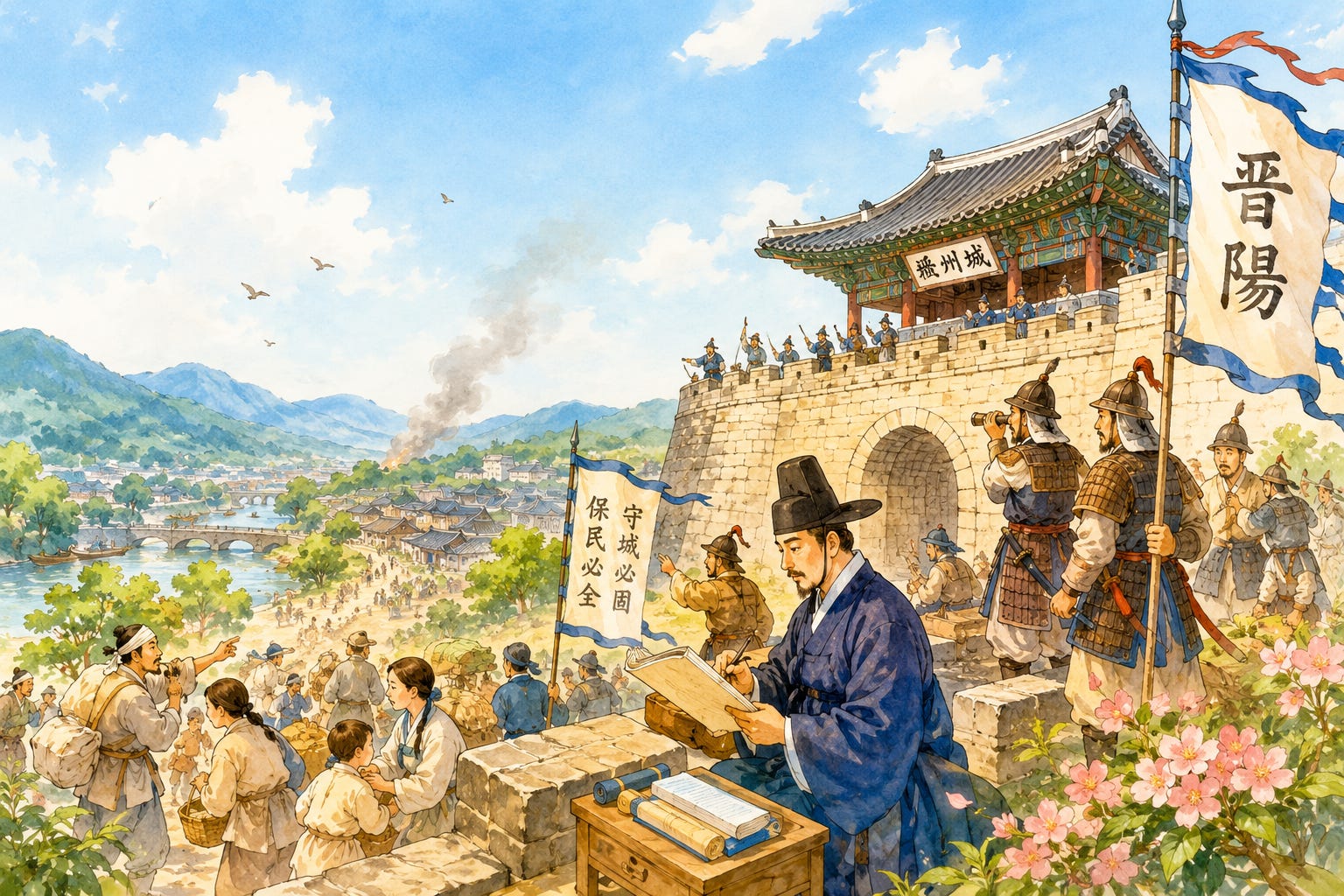
Jinnyangnok, included in Volume 6 of Gani-jip, is not merely a record of battles. It is a historical narrative in which the breath of an era, human suffering, and the will to sustain a nation are deeply intertwined. As we read it, we no longer view war as a distant “event,” but encounter it as the lived reality of people who endured it.
The first impression Jinnyangnok gives is one of chaos and urgency. News of war is not conveyed in orderly sentences. Instead, collapsing fortresses, urgent military orders, and scattered civilians appear in fragmented scenes that vividly convey the intensity of crisis. Yet, the recorder remains composed. He does not exaggerate emotions but calmly describes events as they are. Paradoxically, this restraint allows the reader to feel an even deeper sense of tension and realism.
What stands out in this text is the depiction of people involved in the defense of Jinju Fortress. Some obey commands, others rise as volunteer soldiers (ui-gun), and still others remain at their posts to protect their families and hometowns until the very end. These diverse choices reveal how humans respond under extreme conditions of war. Ultimately, Jinnyangnok records not only the outcome of battles, but more importantly, the attitudes and moral choices of individuals within them.
The text also highlights the fragility of national governance during wartime. Central government orders fail to fully reach local authorities, and survival often depends on decisions made on the spot. This is not merely an administrative issue, but a reflection of a state system under severe stress. The author neither criticizes nor glorifies this situation; he simply records it as fact.
Most strikingly, the suffering of ordinary civilians is deeply felt throughout the record. Families losing their homes outside the fortress, refugees fleeing in haste, and common people enduring daily uncertainty under constant fear—all these images, though briefly described, carry heavy emotional weight. The text reminds us that war is not made only of heroes, but also of countless unnamed lives.
Another important insight from Jinnyangnok is the meaning of recording itself. It is not simply about preserving the past, but about accumulating historical memory so that such tragedies may not be repeated. By avoiding emotional exaggeration, the recorder delivers a stronger message: truth itself becomes the lesson.
In the end, Jinnyangnok is not just a chronicle of war. It is a reflection on humanity, the state, and the meaning of memory. Even within the turmoil of war, people make choices, endure responsibilities, and struggle to survive. These moments collectively become history.
As we close the text, one question naturally arises:
“Do we read historical records merely as the past, or do we allow them to reflect our present?”
Jinnyangnok quietly, yet profoundly, leaves us with that question. +++
{Solti}
July 11, 2026
역사는 사람들의 선택으로 쓰인다 :『간이집』 제6권 「진양록」을 읽고
『간이집』 제6권의 「진양록(晉陽錄)」은 단순한 전투 기록이 아니라, 한 시대의 숨결과 인간의 고통, 그리고 국가를 지탱하려는 의지가 함께 응축된 역사적 기록이다. 이 글을 읽다 보면 우리는 과거의 전쟁을 “사건”으로 보는 것이 아니라, 그 속을 살아간 사람들의 현실로 마주하게 된다.
처음 「진양록」이 전하는 인상은 혼란과 긴박함이다. 전란의 소식은 질서 있는 언어로 전달되지 않는다. 무너진 성, 급박한 군령, 흩어진 백성들의 모습이 단편적으로 이어지면서 당시의 위기감이 그대로 전달된다. 그러나 그 속에서도 기록자는 흔들리지 않는다. 그는 감정을 과장하지 않고, 상황을 있는 그대로 담담하게 서술한다. 오히려 그 절제가 독자로 하여금 더 깊은 긴장과 현실감을 느끼게 한다.
이 글에서 특히 눈에 띄는 것은 진주성 방어를 둘러싼 사람들의 모습이다. 어떤 이는 명령을 따르고, 어떤 이는 스스로 의병이 되어 나서며, 또 어떤 이는 가족과 고향을 지키기 위해 마지막까지 자리를 지킨다. 이 다양한 선택들은 전쟁이라는 극한 상황 속에서 인간이 어떤 결정을 내리는지를 보여준다. 결국 「진양록」은 전투의 승패보다, 그 속에서 드러난 인간의 태도와 마음을 기록하고 있는 셈이다.
또한 이 기록은 국가의 질서가 얼마나 위태로운 상태였는지도 보여준다. 중앙의 명령은 지방까지 온전히 전달되지 못하고, 현장의 판단이 생존을 결정하는 순간들이 이어진다. 이 과정은 단순한 행정의 문제가 아니라, 국가 시스템 전체가 시험대에 놓여 있던 시대적 상황을 상징한다. 기록자는 이를 비판하거나 미화하지 않고, 그 자체를 사실로 남긴다.
무엇보다 깊은 인상을 주는 부분은 전쟁이 남긴 백성들의 고통이다. 성 밖에서 삶의 터전을 잃은 사람들, 피난길에 오른 가족들, 그리고 반복되는 불안 속에서 하루하루를 견디는 민초들의 모습은 짧은 문장 속에서도 무겁게 다가온다. 이 기록은 영웅의 이야기만이 아니라, 이름 없는 사람들의 삶이 함께 전쟁을 구성하고 있음을 일깨운다.
「진양록」을 읽으며 느끼는 또 하나의 중요한 지점은 ‘기록’이라는 행위의 의미이다. 이 글은 단순히 과거를 남기는 것이 아니라, 다시는 같은 비극이 반복되지 않기를 바라는 역사적 기억의 축적이다. 기록자는 감정을 드러내지 않음으로써 오히려 더 강한 메시지를 남긴다. 그것은 “사실을 잊지 않는 것이 곧 교훈이 된다”는 조용한 선언처럼 느껴진다.
결국 「진양록」은 전쟁을 묘사한 글이 아니라, 인간과 국가, 그리고 기억의 의미를 함께 묻는 작품이다. 전쟁의 소용돌이 속에서도 사람들은 각자의 방식으로 살아남고, 선택하고, 책임을 짊어진다. 그리고 그 모든 순간이 모여 역사가 된다.
이 글을 덮으며 우리는 자연스럽게 한 가지 질문을 떠올리게 된다.
“우리는 과거의 기록을 단순한 역사로 읽고 있는가, 아니면 현재를 비추는 거울로 받아들이고 있는가?”
「진양록」은 바로 그 질문을 조용히, 그러나 깊게 남기는 기록이다. +++
{솔티}
2026년 7월 11일

Prof. Dr. Young Choi (Editor in Chief) — Regent University
Young B. Choi is a Professor in the Department of Engineering & Computer Science at Regent University. He published 38 books with ‘Selected Readings in Cybersecurity’ (2018) (over 800 copies archived globally at university/college libraries around the world) and ‘Cybersecurity Applications and Artificial Intelligence’ (2023) available in seven major world languages. He proposed the world’s first global and universal telecommunications “Service Order Handling (SOH)” Model (T-SOH Model) (1995) with Dr. Adrian Tang. With this innovative research work, he received the IEEE NOMS ’96 Best Paper Award and became the first recipient of the Outstanding Contribution Award of the TeleManagement Forum in 1998. His research areas include Natural Language Processing-focused AI, AI-applied cybersecurity, network and telecom service management, and Korean studies on Gani Choi Rip’s Jeonggwan (靜觀: Quiet Contemplation) philosophy and Shilhak ( 實學: Practical Learning).