

Chang, Leonard. The Fruit ‘N Food. Black Heron Press, 1996. ISBN 978-0-930773-79-3. 226 pages.
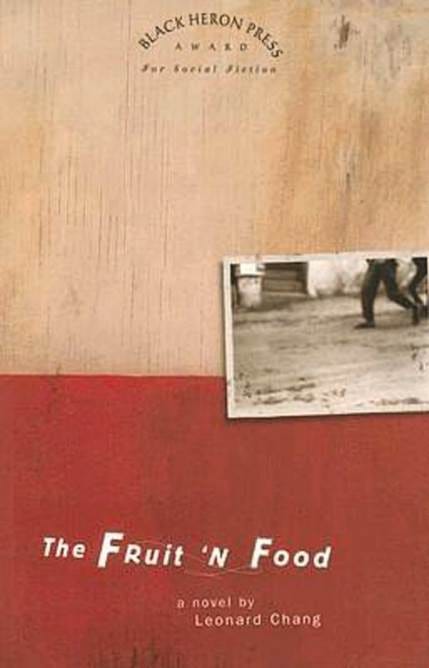
Cover image: The Fruit ‘N Food by Leonard Chang. Image reproduced for purposes of review and commentary.
The Fruit ’N Food is Leonard Chang’s debut novel that centers on the difficult lives, precarious circumstances, and despair experienced by Korean Americans in the late twentieth century. Unlike many other Korean American novels, which offer both the positive and negative aspects of Korean life in the United States, one has a hard time finding anything positive in the storyline.
The author was born in 1968 in Harlem, New York, and grew up on Long Island. He attended Dartmouth College and Harvard University before earning an MFA in Creative Writing from the University of California, Irvine. When this novel was published, he resided near San Francisco; according to his current biography, he now lives in South Los Angeles. His subsequent novels include Dispatches from the Cold (1998), Over the Shoulder: A Novel of Intrigue (2001), Underkill: An Allen Choice Novel (2003), Fade to Clear: An Allen Choice Novel (2004), Crossings (2009), Triplines (2014), and The Lockpicker (2017). Chang taught creative writing at Antioch University and served as a Visiting Distinguished Writer at Mills College.
The Fruit ’N Food can be considered a realistic, urban, and sociological novel because Chang places his characters within recognizable economic, racial, and cultural circumstances rather than treating their problems as purely personal. The novel is especially concerned with the lives of working-class Korean Americans and with the difficult environment in which immigrant businesses sometimes operated in New York City during the late twentieth century.
The novel revolves around a young, destitute Korean American man, Tom Pak, who returns to his hometown of Kasdan, Queens, and takes a job as a clerk at the Fruit ’N Food, a grocery store owned by first-generation Korean immigrants, Mr. and Mrs. Rhee. The store provides Tom with employment but little sense of purpose, placing him in the middle of an increasingly tense neighborhood marked by theft, harassment, threats, and racial tension. Busy with their daily backbreaking work and guided by cultural values from the old world, the Rhees do not understand the emotional struggles of their daughter, June, for whom they have high hopes. Tom and June become romantically involved out of loneliness, depression, and hopelessness. As racial tensions in the neighborhood intensify, violence eventually erupts, culminating in race riots. The violence is not simply an unexpected event but the culmination of tensions that have been building throughout the novel. Tom’s affair with June, his uncertain position within the Rhee family, and his encounters with the neighborhood’s violence all contribute to his psychological deterioration. One day, while Tom and June are having sex, Mrs. Rhee is robbed at the store. By the end of the story, Tom is hospitalized and slips into delirium. The novel offers no conventional resolution: Tom does not discover a way to reconcile his Korean American identity with American society, and his relationship with June does not provide the emotional refuge he seeks.
The epilogue of The Fruit ’N Food is saturated with expressions of despair, confusion, and mental exhaustion, captured in words such as “distraught,” “awful,” “miserable,” “tired,” “sad,” “ashamed,” “meaningless,” “unclear,” and “pain” (218 to 226). In the wake of Black-Korean American violence in the inner city, Tom Pak is left questioning the very purpose of his existence. His brief romance with June ultimately collapses into nothingness. The novel’s pervasive unhappiness reflects its larger theme of the futility of the American Dream. The Rhees miss Korea, feeling that they should not have left it in the first place, although they might have left anyway. Life was and still is difficult in Korea, and it is easy for immigrants to sentimentalize their native countries. Tom likewise suffers from insomnia and depression and feels miserable.
In the novel’s final paragraph, Tom lies delirious, envisioning himself walking into the ocean, a striking image that recalls the ending of Kate Chopin’s The Awakening (1899), in which Edna Pontellier dies by drowning. For Tom, the ocean offers a paradoxical sense of solace; his imagined immersion symbolizes not only a death wish but also a yearning for release and perhaps the possibility of starting anew, even if that renewal comes only through death.
The Rhee family represents the working-class immigrant experience. Mr. and Mrs. Rhee are hardworking immigrants who devote themselves to keeping their business alive. As June tells Tom, they have sacrificed almost everything for their work and have virtually no life outside the store (71). Their long hours and constant concerns about the store leave little room for emotional communication within the family. Like many first-generation Korean immigrants, they live as expatriates, reading Korean newspapers, speaking Korean, associating with fellow Korean immigrants for their business ventures, and pushing their child to excel in her studies so that she can attend an elite university.
Running a business in an urban center is not for the faint of heart. The Rhees are used to watching for thieves, who often run away after stealing goods from the store. Early in the novel, Mrs. Rhee scolds Tom for allowing thieves to escape, reminding him that his responsibility is to prevent customers from leaving without paying: “Why you let them go? Stop them! You sit here to stop them! You let them go! This your job when you sit here. You make sure no one go without pay! You don’t let no one go without pay! Aigoo, no take easy! You—” (52). Tom is both baffled and angry by her demand. What was he supposed to do? Fight the thieves? He wonders why she does not simply call the police. He does not seem to realize that he should have caught the thieves himself before the police arrived.
Meanwhile, their sixteen-year-old daughter, June, is caught between two worlds: her parents’ traditional expectations and her own desire for affection and freedom. A high school junior, she is under constant pressure to study. At one point, Tom hears Mrs. Rhee admonish June about her studies, and June responds that she has already been studying all morning. When her mother continues, June quietly shakes her head and retreats to the back room. The parents’ hope is for her to attend an Ivy League school so that their hard work can be vindicated. In Korea, Mr. Rhee studied electrical engineering, but he could not find a job in his field in the United States. Mrs. Rhee was a nursing student in Korea but did not finish her schooling because she married him. As a result, they were running a grocery business in a crime-ridden area. Their only hope was to make enough money, buy a good house, and see their daughter attend a prestigious university. However, June has a mind of her own. She smokes, drinks, and eventually has sex with Tom. Sadly, her parents are too busy to know about her inner thoughts, her lifestyle, or her relationship with Tom.
Tom’s case is a little different from that of a traditional Korean immigrant family. He was born to Korean parents in the United States. His mother died when he was five, and his father also died years later. He was sent to Korea, where he was brought up by his grandmother before he returned to America. His memory of Korea in childhood is faint and unpleasant, consisting of disturbing images of his grandmother, an old rusty taxicab, and a family meal during which he sat on Bibles that hurt his bottom (59). Unlike the Rhees, Tom has little attachment to Korea and recalls few happy memories of his childhood there. He does, however, remember happy moments with his mother at the beach. Neither Tom nor June seems capable of offering the other a genuine solution to their problems. Their intimacy is less a story of romantic fulfillment than an expression of two lonely people looking for an escape.
The store itself functions as a microcosm of the larger neighborhood. Tom encounters customers whose behavior ranges from ordinary to threatening, and he gradually understands how vulnerable the Rhee family is. The novel portrays the tension between Korean American shopkeepers and African American residents without reducing the conflict to a simple struggle between good and evil. Economic inequality, racial suspicion, fear, and personal resentment all contribute to the deteriorating relationship between the communities. The neighborhood is fictional, but Kasdan resembles the kinds of multiethnic Queens communities in which Korean American immigrants established small businesses during this period.
Korean American life as portrayed in Chang’s novel captures the dilemma of Koreans who live in a culture where they look and feel different. America is still a land of freedom and opportunity, where people can at least make a living through hard work and persistence. There is no perfect life in this world, and wise immigrants learn to appreciate the chance or second chance this country offers while accepting the fact that Koreans do not constitute the mainstream of American society. By lowering their expectations somewhat, they can find happiness in America.
The country they cherish in their hearts has changed considerably, and they now feel more at home in the United States than in Korea. Korea is now much more respected worldwide for its economic growth, technological advancement, and K-pop. Thousands of Korean American immigrants have returned to Korea permanently, but some have regretted doing so. In addition to the culture shock they experience upon returning, they often encounter hostility and contempt from Koreans who consider those who left Korea for a better life in the United States to be betrayers of their motherland. They may discover that the Korea they once knew no longer exists and that the United States has become the place they now call home.
About the Author

Professor of English and Creative Writing and Associate Dean of the School of Humanities and Theology, Missouri Baptist University
John J. Han, PhD, is the author, editor, co-editor, or translator of 38 books. His forthcoming book, Echoes from the Hills: Critical Essays on Ozarks Literature (co-edited with C. Clark Triplett), will be published by the University of Arkansas Press. He has also published more than 3,000 poems, primarily haiku, in a wide range of journals and anthologies. In addition to his long tenure at Missouri Baptist University, he has taught at Kansas State University, the University of Nebraska–Lincoln, Nebraska Wesleyan University, and Washington University in St. Louis. He has also served as a visiting scholar at Georgia College & State University and the University of Ljubljana in Slovenia.
© K-Global Scholars and Professionals Forum. All rights reserved. Content published in the K-GSP Forum may not be reproduced, distributed, or transmitted in any form without prior written permission from the K-GSP Forum, except for brief quotations with full attribution.