

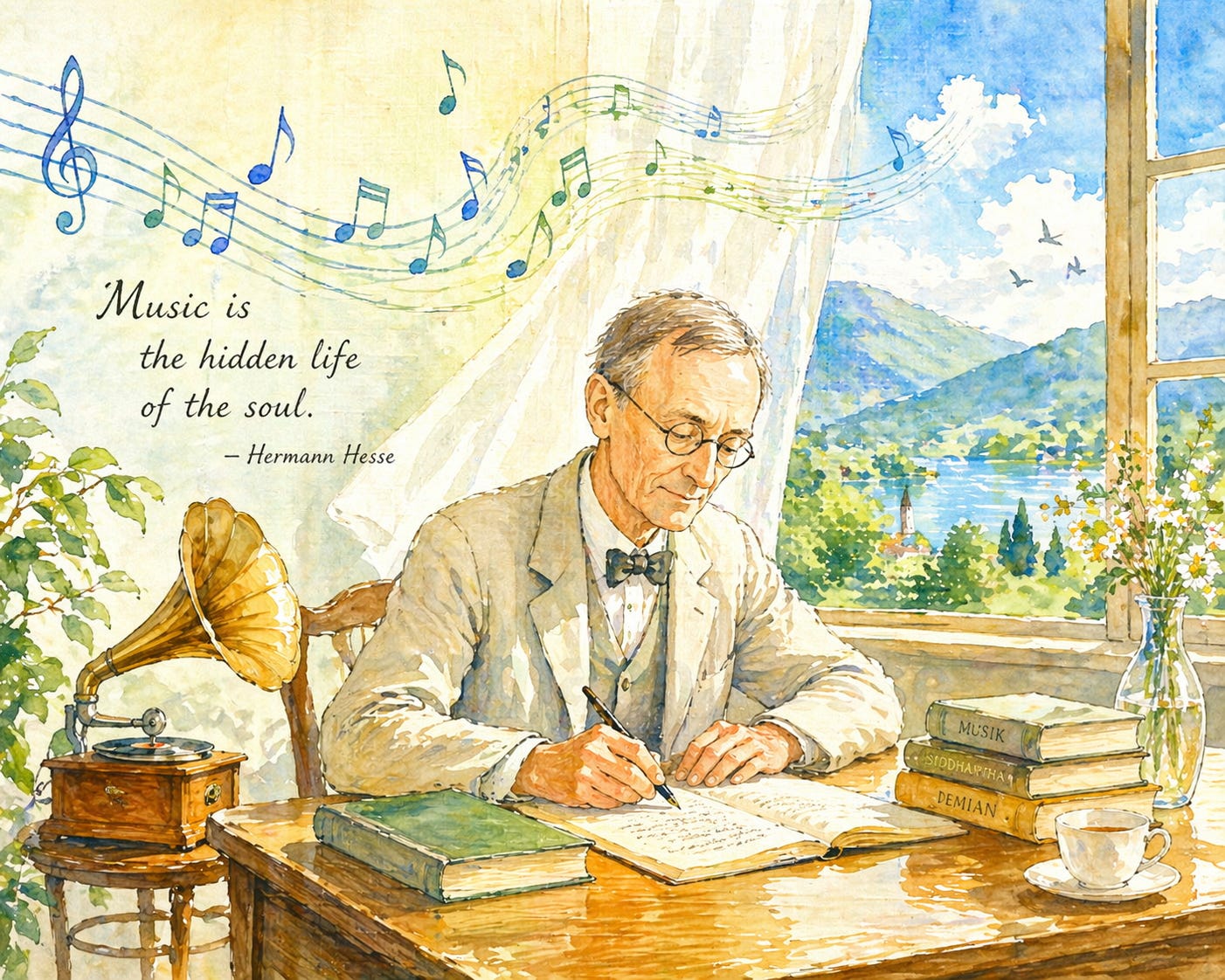
We live surrounded by countless sounds in the rush of daily life, yet those sounds often empty us rather than fill us. In such a world, Hermann Hesse’s Musik reminds us that music is not merely sound, but a mirror of the inner self and a quiet passage toward reflection. As I read, I came to feel that music is not something we simply hear—it is something we encounter, almost as one encounter a hidden part of one’s own being.
There are moments when our emotions sink beyond the reach of language. In those moments, music speaks for us. Hesse saw music as “another language of the soul.” It does not argue, it does not explain—yet it leads us into the deepest understanding. Music moves not by logic, but by intuition, awakening something that lies beneath thought. For Hesse, when one listens to music, the inner self becomes both listener and reflection; the sound we hear is not outside us, but within. “In music, I meet myself.” Such a thought reveals that music is not an act of passive reception, but a journey toward self-discovery. It draws us inward, guiding us gently toward the quiet center of our own existence.
In the ceaseless noise and hurried pace of modern life, the human spirit is often worn thin. Hesse believed that art alone possesses the power to heal the wounded soul. “Art is a quiet remedy for a suffering spirit.” When we listen to music, we do not simply escape the world—we step into a wider one. This is not evasion, but restoration. Music does not take away our pain; rather, it deepens our understanding of it. It allows us to dwell with our sorrow without being consumed by it. For Hesse, music was a bridge over the fractures of life, restoring a sense of wholeness to the human being.
In Hesse’s world, solitude is not a deficiency, but a necessity. Only in solitude can true reflection arise. “Music heard in solitude is the purest.” When the noise of the world falls silent, a more essential resonance begins to emerge. In the presence of others, music may remain external; in solitude, it becomes one’s own. “Only when I am alone do I become one with music.” Solitude, then, is not separation, but union—a quiet merging of the self with something greater. It is a doorway through which one passes to encounter one’s truest self, and music is the key that opens it.
There is also, in Hesse’s thought, a profound affinity with Eastern philosophy. Through music, he approached a state akin to meditation. “Music flows, yet cannot be held.” This echoes the notion of impermanence—the understanding that all things pass, and cannot be grasped. In listening, Hesse sought to quiet the mind and simply be. In that stillness, thought recedes, and existence itself comes forward. “By becoming nothing in music, I become everything.” In this paradox lies the essence of self-transcendence, a movement toward the dissolution of the self into a larger unity. For Hesse, music was not merely an art—it was a form of spiritual practice, a way of dwelling within the mystery of being.
When I closed the book, I found that I could no longer let music pass me by as background sound. It had become something else entirely—a path, a quiet illumination, a mirror held before the soul. Through music, Hermann Hesse explored the depths of human existence, and his reflections remain as meaningful now as ever. In the end, this is not a book about music alone, but about life, about the soul, and about the silent, enduring dialogue between them. +++
April 23, 2026
At Sungsunjae (崇善齋)
{Solti}
한국어 번역: 헤르만 헤세, 음악 위에 쓰다 (김윤미 옮김, 북하우스, 2022)
Translation book: Hermann Hesse, Musik (Shurkamp, Verlag, 2019)
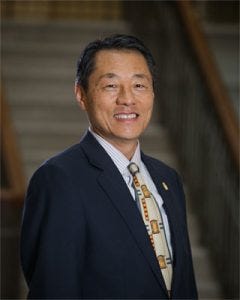
Young Choi, PhD is a Professor at Regent University bringing a rare combination of technical expertise and creative spirit to everything he does. A scholar in AI, cybersecurity, network and telecommunications service management, he has published 37 books including AI and cybersecurity areas, over 200 refereed articles, and over 20 book chapters. Beyond the academy, Dr. Choi is a passionate poet, essayist, and wooden block engraving artist whose reflective writing invites readers to rediscover life’s beauty in quiet contemplation. He lives under the motto: “Study hard and give generously without holding back! (열심히 공부해서 아낌없이 남주자 !)”
Published books: https://www.amazon.com/stores/Young-Choi/author/B0DMZ5S6R7?ref=ap_rdr&shoppingPortalEnabled=true