

Allen, Nancy. A Killing at the Creek: An Ozarks Mystery. Witness Impulse, 2015. ISBN 9780062325976. 320 pages, $11.99.
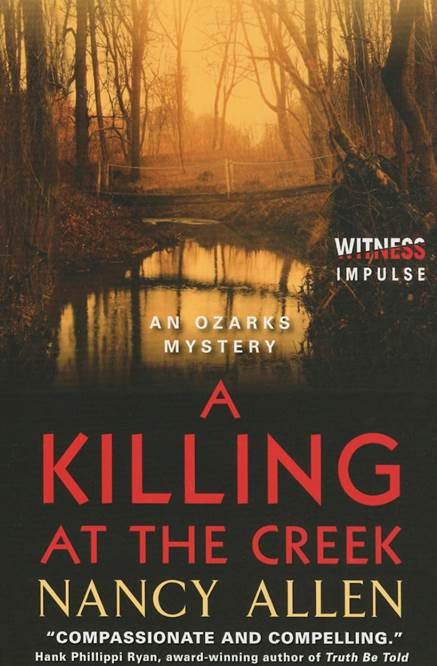
Cover image: A Killing at the Creek by Nancy Allen. Image reproduced for purposes of review and commentary.
The title of the novel immediately suggests its genre: it is a murder mystery. A Killing at the Creek is the second novel in Nancy Allen’s four-book Ozarks mystery series. It was published one year after the author’s debut novel, The Code of the Hills, which centers on a case involving incest. This novel focuses on a murder case. A bus driver traveling from Detroit to Rogers in northwestern Arkansas was murdered by a fifteen-year-old boy outside the city limits; her throat was cut, and her body was dumped under a bridge. The protagonist of Allen’s Ozarks series, Assistant Prosecutor Elsie Arnold, is both appalled by the crime and excited about the opportunity to handle a murder case for the first time: “All in the world Elsie Arnold wanted was a murder case” (5). Madeline Thompson, her boss who does not have full confidence in her ability, allows her to participate in the case only after Elsie insists that she needs experience and is willing to work as an assistant to Chuck Harris, Madeline’s chief assistant.
A Killing at the Creek follows a typical template for a mystery novel: a sensational murder occurs, the murderer is shrouded in mystery (hence the term “mystery novel”), law enforcement officers pore over the case to solve the mystery, and the crime is finally solved. As expected of a crime novel, there are visits to the crime scene, the capture of the suspected murderer, and the eventual prosecution of the case. Along the way, there are tensions and even competition among law enforcement officials, and although the suspect is captured early, it takes time to build the case and bring him to trial, and it is often difficult to convince reluctant witnesses to take the stand. The novel also highlights the stress involved in the lives of law enforcement officers.
Not all passages in the novel concern crime and punishment. Occasional digressions lighten the narrative’s darker subject matter. Chuck Harris, the new chief assistant from Kansas City, looks down on the Ozarks, which he considers a place inhabited by unsophisticated “hicks” (17). When Elsie teases him by calling Kansas City a “cow town,” he boasts about the Kansas City Plaza, a claim she grudgingly acknowledges (17). Meanwhile, as Ashlock, Elsie, and Chuck travel to Oklahoma for the investigation, they encounter a quintessential Ozark landscape, with Queen Anne’s lace and black-eyed Susans covering the roadside (89). Elsie enjoys the trip so much that she feels almost as if she were skipping school. After they arrive in Oklahoma, Chuck relies on his big-city charm to persuade a female trooper to give him and Elsie a free ride to a casino (93).
Well-crafted storylines, especially those involving murder, can sustain readers’ interest, but all stories follow some variation of the same structure: exposition, inciting incident, rising action, climax, falling action, and resolution. That structure is expected. Some authors, however, execute it better than others, which helps explain the success of bestsellers and award-winning novels. What makes a mystery novel even more interesting, however, is its characterization. The novelist Flannery O’Connor argued that characterization is more important than plot in fiction writing, a compelling point. Readers are drawn to fictional characters as human beings. We are naturally curious about others, including those who inhabit fictional worlds, and we often find in them reflections of ourselves or people we know. After all, fiction mirrors life in many ways, and readers often turn to stories to explore how people think, feel, and experience the world through imagined realities.
In this regard, Allen has created in Elsie an interesting character—both likable and dislikable. Unlike most of the other characters in the novel, who are flat figures, she is a round character who evolves over the course of the story. Parents with a daughter like Elsie may have mixed feelings about her. On the one hand, they would be proud of her: she is bright, ambitious, self-confident, and devoted to her vocation. On the other hand, she often fails to hold her tongue, easily uttering cuss words or blunt remarks. Elsie also lacks diplomatic skills in her interactions with others. Although Madeline, her supervisor, is incompetent and bossy, Elsie shows little respect for her or her office. In Chapter 5, for example, Madeline makes a demanding request, and Elsie has an urge to kill her: “Elsie was glad she wasn’t holding a gun, because if she had one, her boss would be dead” (24). Although she does not verbalize this thought, even harboring such an idea reveals a troubling aspect of her character. A workplace is not a home, and everyone should try to remain positive and cooperative for the sake of the common good. Elsie comes across as someone who easily alienates her colleagues and bosses through her excessive honesty. Professionals who have spent many years in corporate environments would easily remember colleagues like her—competent but difficult to work with.
An important subplot involves Elsie’s romantic relationship with Detective Bob Ashlock, “her current flame” (12). As a relatively young, unmarried woman, she is attracted to handsome, physically tough men, while Ashlock, more self-controlled and traditional in his values, is drawn to her physical charm. Elsie’s judgment is often clouded by passion, and even at work she has difficulty controlling her attraction to him. While in Oklahoma, for example, she teases Ashlock about being more affectionate toward a seemingly uncooperative witness, suggesting that such an approach works on her. Although his feelings are mutual, his responses are usually more subdued. Their differences extend beyond their romantic temperaments. Elsie loves hash browns, whereas Ashlock avoids them because they are deep-fried and processed. She also angers another driver by texting while driving, and during their investigative trip to Oklahoma, she and Chuck gamble and drink, much to the displeasure of the always-upright Ashlock. Although the evolving relationship between Elsie and Ashlock provides comic relief from the murder mystery, their contrasting personalities suggest that it may not lead to marriage, as becomes apparent by the end of Allen’s final Ozarks mystery, A Wolf in the Woods (2018).
Perhaps it was Allen’s authorial intention to portray Elsie this way so that she would come across as a genuine person who is both professional and prone to making mistakes in her personal life. Some readers will find her personality fascinating and realistic. At the very least, Elsie helps humanize law enforcement officers, allowing readers to see that they are more than impersonal and unemotional enforcers of the law. They have personal lives, are often influenced by their emotions, and experience drama related to their work. In addition to providing a crime story filled with suspense and thrills, Allen offers insights into the legal profession that may not be known to outsiders.
Overall, A Killing at the Creek is an engaging murder mystery despite the grim nature of the crime. Allen makes the story compelling by weaving in an entertaining love story between Elsie and Ashlock, observations about the work environment in a rural county where resources are scarce and supervisors do not always provide effective leadership, and comments on some residents’ resistance to progressive social ideas. Readers are also given an opportunity to see how the legal system works, how law enforcement officers collaborate, and what kinds of challenges they face as they investigate a case. The way the young murderer behaves after committing the crime may seem somewhat hyperbolic, but it is often difficult to fathom the mind of a criminal, even that of a teenage boy who has killed someone. The novel is a page-turner, enabling fast readers to finish it in a single day.
About the Author

Professor of English and Creative Writing and Associate Dean of the School of Humanities and Theology, Missouri Baptist University
John J. Han, PhD, is the author, editor, co-editor, or translator of 36 books. His forthcoming book, Echoes from the Hills: Critical Essays on Ozarks Literature (co-edited with C. Clark Triplett), will be published by the University of Arkansas Press. He has also published more than 3,000 poems in a wide range of journals and anthologies. In addition to his long tenure at Missouri Baptist University, he has taught at Kansas State University, the University of Nebraska–Lincoln, Nebraska Wesleyan University, and Washington University in St. Louis. He has also served as a visiting scholar at Georgia College & State University and the University of Ljubljana in Slovenia.
© K-Global Scholars and Professionals Forum. All rights reserved. Content published in the K-GSP Forum may not be reproduced, distributed, or transmitted in any form without prior written permission from the K-GSP Forum, except for brief quotations with full attribution.