

Allen, Nancy. The Code of the Hills: An Ozarks Mystery. Witness Impulse, 2014. ISBN 9780062325952. 480 pages, $7.99.
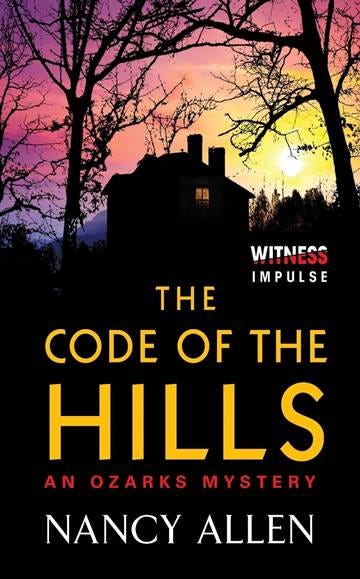
Cover image: The Code of the Hills by Nancy Allen. Image reproduced for purposes of review and commentary.
The Code of the Hills is the first in Nancy Allen’s series of four crime novels set in the Ozarks, the other three being Killing at the Creek (2015), The Wages of Sin (2016), and A Wolf in the Woods (2018). As a prosecutorial mystery novel, it centers on the investigation of a crime—in this case, forced incest—and the successful administration of justice. The drama unfolds both in and outside the courtroom of fictional McCown County in southwestern Missouri. Police officers, deputy sheriffs, detectives, defense attorneys, and prosecutors all play roles in the criminal investigation and prosecution. As the novel progresses, the case reaches a neat resolution: the perpetrator is sentenced to life imprisonment for raping his two underage stepdaughters, and the victims are freed. The protagonist in this legal drama is Elsie Arnold, a thirty-one-year-old unmarried woman who has been working as an assistant prosecutor for four years.
The novel begins with an epigraph from 1 Timothy 2:11-12: “Let the woman learn in silence with all subjection. / But I suffer not a woman to teach, nor to usurp authority / over the man, but to be in silence” (line breaks added). It is part of the Apostle Paul’s instruction to his young mentee, Timothy. This passage is often used in conservative Christian circles to support male authority over women in church settings. By using this quotation from the New Testament, Allen shows how traditional Ozarks culture silences women’s voices both in churches and at home. Even in cases of sexual abuse, such as incest and rape, women are often forced to remain silent, while communities can become accomplices to the crime in the name of harmony and honor.
In the “Prologue” of the novel, readers quickly encounter a home marked by violence, menace, and sexual abuse. Daddy, whose name is Kris Taney, and his older brother, Al, arrive home with a bottle in hand and enjoy themselves until a fight breaks out between them. Daddy beats Al until he bleeds. With blood dripping from his face, Al leaves the house, promising revenge. The next day, Daddy asks his wife where one of their daughters, Charlene, is. He wants her to give him a rubdown. When his wife says that Charlene does not like to do it, Daddy stares at her until she calls for Charlene. Daddy then rapes fifteen-year-old Charlene while the youngest daughter, six-year-old Tiffany, sneaks into her bedroom, blocking her ears. The scene makes it clear that Daddy’s sexual violence has occurred repeatedly and that no one puts up a fight. His frightened wife seems to have no control over the family situation, and his daughters are too young to resist.
After the disturbing prologue, Chapter 1 introduces the novel’s main character, Elsie Arnold. She wakes up with a hangover from the night before, making her characterization immediately interesting: she may be a competent lawyer with a “bulldog instinct” (117), but her drinking habit often seems out of control. She is in a relationship with Noah Strong, a local patrolman whom she finds desirable. Another character, Detective Bob Ashlock, is also introduced. Almost ten years older than Elsie, he becomes an important supporting character in Allen’s Ozarks mystery series. He is “an old-fashioned law-and-order pro, a straight arrow” (9). A former Marine Corps member, he commands admiration for his toughness and no-nonsense manner. As Elsie gradually develops a romantic interest in him, readers naturally become curious about how their relationship will evolve.
The first chapter also introduces another female character: Madeline Thompson, the county’s top prosecutor. A former lawyer, she obtained her position through a political kickback. Madeline tries to act professionally and assert her authority over her supervisees, yet she remains a somewhat one-dimensional character whom Elsie secretly despises. Elsie finds her Botox-enhanced forehead, collagen-filled lips, and poorly done facial surgery “scary” (13). More importantly, Madeline lacks Elsie’s investigative instincts; it is hard for an employee to respect a supervisor who sounds tough but lacks professional acumen. Throughout the rest of the novel and the series, Madeline becomes the butt of Elsie’s ridicule. In a way, she serves as a tragicomic foil in the drama of Elsie’s legal and personal life.
Despite imperfections in her personal life, Elsie has a noble motivation for becoming a lawyer while attending the University of Missouri. Her dream is to serve as “the Ozarks’ avenging angel” (45), inspired by the tragic fate of her childhood friend Angela. Angela became a victim of incest in the seventh grade. Her mother reported the case to the police, and her stepfather was charged with statutory rape. Under pressure from the community, however, the traumatized Angela recanted her testimony, and the charge against the perpetrator was reduced to misdemeanor assault. Years later, while Elsie was in college, she learned from Angela’s mother that Angela had committed suicide. The professionalism Elsie displays at work reflects her enduring commitment to Angela’s memory and to her determination to prevent similar tragedies from happening to others.
Some portions of The Code of the Hills address the culture of the Ozarks. As her relationship with Noah Strong wanes and she turns thirty-one, Elsie begins to worry about how she might be viewed in her native Ozarks, where a woman past thirty is considered “over the hill” (33). While frequenting a bar named the Baldknobbers, she hopes that she is not descended from the local vigilantes who, more than a century earlier, began with good intentions but eventually became terrorists. Allen also depicts the challenging working conditions faced by prosecutors in the Ozarks. The old-fashioned community has resisted modernizing the century-old courthouse with updated technology and security. With her meager salary, Elsie cannot afford a new car. Her 2001 Ford Escort lacks GPS, so she carries a paper map when traveling to conduct investigations. When she seeks information from residents about a pending case, they often refuse to cooperate.
As a female prosecutor, Elsie also becomes aware of the gender inequity in the legal profession. Most leadership positions in the Ozarks are held by men. Madeline is the first woman to serve as the top prosecutor in McCown County, having obtained the position through her political connections. None of the local judges are women, and the nearest female circuit or associate circuit judge is 120 miles away, halfway to St. Louis. Unsurprisingly, Elsie has had to “battle for respect” (36) to become an assistant prosecutor. For Breeon Johnson, a Black prosecutor from St. Louis, the struggle has been even greater. A visiting attorney from Purdy, Missouri, mistakes her for a secretary and asks her to make copies and bring him coffee.
The brief but passionate romance between Elsie and Noah Strong is described in graphic detail. Soon, however, the romance ends, and Elsie becomes attracted to Detective Ashlock, who is as muscular as Strong. Elsie’s attraction to handsome and physically powerful men occasionally distracts her, even in the courtroom. It is easy to assume that legal professionals always keep their emotions in check, but Allen’s novel clearly shows that this is not always the case. The novel’s realism is further enhanced by the author’s occasional use of vulgar language in her narration. Such language, however, also helps readers enter Elsie’s mind as a woman in her early thirties who is still uncertain about her emotions.
Allen’s characterization of Elsie Arnold reflects a broader trend in contemporary crime fiction, where investigators and legal professionals are portrayed not as infallible heroes but as psychologically complex individuals. Allen is in the company of writers such as Patricia Cornwell (the Kay Scarpetta series), Kathy Reichs (the Temperance Brennan series), and Elizabeth George (the Inspector Lynley series). Like the modern protagonists of these authors, Elsie combines professional competence with personal vulnerabilities, making her both believable and sympathetic. Her commitment to prosecuting sexual abuse stems not only from professional duty but also from the lasting emotional impact of her childhood friend’s victimization and suicide.
In this regard, Allen and other contemporary crime writers depart from classical detective fiction, whose investigators were often intellectually sharp but emotionally distant or largely static. Sherlock Holmes, Hercule Poirot, and Miss Marple are classic examples. Although these detectives have distinctive personalities, their private lives generally remain secondary to the mysteries they solve. By contrast, contemporary crime fiction emphasizes psychological realism by presenting protagonists as multidimensional characters whose personal struggles shape—but do not overshadow—their professional lives.
Allen’s choice of a female assistant prosecutor as the protagonist extends this emphasis on psychological realism while also placing The Code of the Hills within a small but growing tradition of legal mysteries featuring women in positions of authority. Unlike the traditional detective figure, who usually uncovers crimes through investigation alone, Elsie Arnold combines the roles of investigator and courtroom advocate as she pursues justice. Similar examples include Alexandra Cooper, the Manhattan sex crimes prosecutor in Linda Fairstein’s legal mystery series, as well as other female prosecutors in contemporary legal thrillers. Like Elsie, these characters combine legal expertise with investigative skills, expanding the traditional boundaries of the detective figure while allowing writers to explore the emotional and moral challenges involved in the pursuit of justice.
Overall, The Code of the Hills is an intriguing read that offers a window into the sociopolitical realities of the contemporary Ozarks. The novel centers on a female prosecutor’s dedication to pursuing justice in her native region. Incest is not unique to the Ozarks, although in earlier times, inbreeding often occurred because of geographical isolation. Reliable data on incest are difficult to obtain regardless of region, and popular culture has often portrayed the Ozarks as a place of crime and secrecy, sometimes for the sake of sensationalism. The region today is far more open and diverse than it was in the past, and the type of incest depicted in Allen’s novel is not widespread. Yet fiction can represent reality—or at least plausible realities—and The Code of the Hills will interest readers curious about the Ozarks. Beyond its compelling legal drama, the novel offers valuable insights into the region’s culture and social dynamics.
About the Author

Professor of English and Creative Writing and Associate Dean of the School of Humanities and Theology, Missouri Baptist University
John J. Han, PhD, is the author, editor, co-editor, or translator of 35 books. His forthcoming book, Echoes from the Hills: Critical Essays on Ozarks Literature (co-edited with C. Clark Triplett), will be published by the University of Arkansas Press. He has also published more than 3,000 poems in a wide range of journals and anthologies. In addition to his long tenure at Missouri Baptist University, he has taught at Kansas State University, the University of Nebraska–Lincoln, Nebraska Wesleyan University, and Washington University in St. Louis. He has also served as a visiting scholar at Georgia College & State University and the University of Ljubljana in Slovenia.
© K-Global Scholars and Professionals Forum. All rights reserved. Content published in the K-GSP Forum may not be reproduced, distributed, or transmitted in any form without prior written permission from the K-GSP Forum, except for brief quotations with full attribution.