Kim, Nancy Jooyoun. The Last Story of Mina Lee. Park Row Books, 2021. ISBN 978-0-7783-8803-6. 416 pages, $18.99.
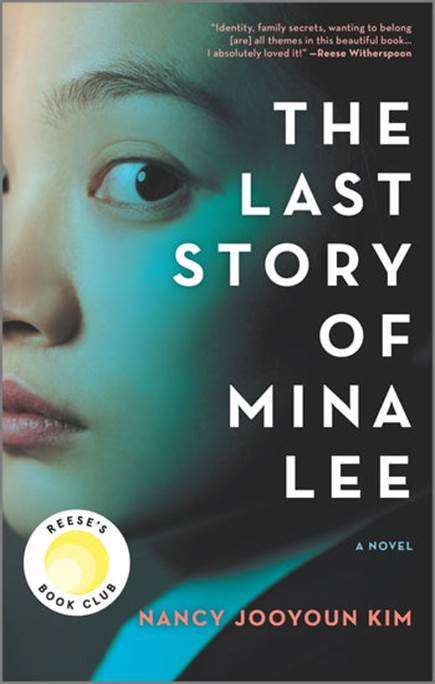
Cover image: The Last Story of Mina Lee by Nancy Jooyoun Kim. Image reproduced for purposes of review and commentary.
The Last Story of Mina Lee begins with twenty-six-year-old Margot Lee driving from Seattle to Los Angeles with her friend Miguel. She has become increasingly worried because her mother, Mina, has stopped answering her phone calls. They have always experienced tension with each other, but this silence is different. When she arrives at her mother’s apartment, she finds Mina lying dead on the floor. Although the police conclude that her mother died from a fall, Margot is unconvinced. After sorting through her mother’s apartment, she realizes that she never really knew anything about her mother. The investigation therefore becomes not only a search for the truth about Mina’s death but, perhaps more importantly, a journey toward understanding the mother she never truly knew.
This story is certainly a literary mystery, but it is also a dramatic exploration of the emotional divide between the first-generation and second-generation Korean American immigrant experience. The novel is therefore not primarily about solving a crime but about recovering a life that has largely been invisible. Through oscillating timelines, the novel gradually reveals how history, war trauma, and immigration shape one woman’s life while at the same time creating an emotional divide between two generations. There are really two stories in the novel, two lives that remain separate but now engage in a different kind of conversation as the past and present come together in the life of Mina Lee.
Nancy Jooyoun Kim is a New York Times bestselling author of The Last Story of Mina Lee: A Novel and What We Kept to Ourselves: A Novel (2023). She was born and raised in Los Angeles and teaches at the University of San Francisco. Kim is a graduate of UCLA and earned a master’s degree from the University of Washington, Seattle. Her essays and short fiction have appeared in numerous journals and publications, including the Los Angeles Review of Books, Guernica, The Rumpus, Electric Literature, The Offing, and the Asian American Writers’ Workshop’s The Margins. The Last Story of Mina Lee, her debut novel, was selected as a Reese’s Book Club pick. Her subsequent novel, What We Kept to Ourselves, also became a New York Times bestseller. It tells the story of a missing mother and the discovery of a stranger’s body in the family’s backyard, accompanied by a letter addressed to the missing woman.
The emotional center of this novel is the relationship between Mina and Margot. Although there is a strong bond of love between them, they consistently misunderstand each other. Neither is portrayed as right or wrong; rather, their differences result from their vastly different cultures and life experiences. Because of her experiences, Mina is emotionally restrained. Having endured war, widowhood, poverty, and immigration, she expresses her love through the sacrifices she makes rather than through words.
Margot, on the other hand, has been raised in American culture, where emotional openness and individual fulfillment are essential to relationships. Their generational differences arise from the collision of two different understandings of love itself. Consequently, Margot interprets her mother’s restraint as rejection or indifference. Unfortunately, neither woman possesses the language necessary to bridge the chasm between them. Mina’s limited English isolates her socially, while Margot’s halting Korean separates her from her mother’s emotional world.
Kim places significant emphasis on Mina’s historical background before she arrives as an immigrant in America. Her experiences during the war continue to shape her life as an immigrant. Economic hardships and repeated personal losses create wounds that never completely heal. While Kim avoids dramatic flashbacks, Mina reveals her trauma through behaviors such as caution, emotional restraint, and a reluctance to trust others. Kim thus illustrates how trauma survives not only through memory but also through behavior. Her wounds are embodied in daily habits and ordinary activities. Unfortunately, Margot inherits the consequences of Mina’s trauma without ever fully grasping its meaning or origin. This intergenerational transmission of suffering is one of the most important insights of Kim’s work.
Throughout the novel, Kim demonstrates that identity cannot be understood solely through a collection of facts. As Margot investigates what happened to Mina, her mother’s identity gradually begins to take shape. She finds letters and photographs, and after speaking with neighbors, she revises her understanding of her mother. Over time, fragmented bits of information come together to form a more complete portrait. The piecemeal narrative mirrors Margot’s own fragmented memory of her mother. Yet that image gradually changes as the many disconnected pieces, like a nearly completed puzzle, finally come together to reveal their full meaning.
Kim’s portrayal of immigration in this story is somewhat like Ralph Ellison’s Invisible Man. The picture is not the typical image of the person who arrives on the shores of America with only grit and determination to their name and eventually achieves success. Instead, Mina’s life is one of hard work and drudgery that helps sustain her community, but her own concerted efforts are largely ignored. She works demanding jobs, struggles with the English language, and continually deals with financial instability. These are not merely obstacles on the way to ultimate success; rather, they are aspects of her existence that never change.
The important truth that Kim attempts to convey in Mina’s story is that her sacrifice is unseen and unappreciated. Margot has certainly benefited from her mother’s commitment, but she understands very little about the emotional cost required to provide those benefits. It is only upon Mina’s death that Margot realizes the many sacrifices behind her mother’s ordinary acts. In this sense, the story is a clear critique of the idea that hard work inevitably produces upward mobility, the American Dream. Unfortunately, life for most immigrants is much more complicated than that.
The story of Mina Lee is truly a tragic one. Through the double narrative, the reader experiences a lifetime of suffering that shapes most of her life. Margot eventually discovers that Mina lost her parents during the war and became an orphan. Later, she marries and appears to build a modest life as a fashion designer in Seoul. Tragically, her husband and eight-year-old daughter are struck down in an automobile accident. Emotionally shattered, Mina accepts an opportunity to immigrate to the United States. Since her immigration is illegal and she has to work menial jobs in Koreatown in Los Angeles, she quickly learns that life in America is far from what she expected.
While living in Koreatown, Mina finds employment stocking shelves at a Korean grocery store. Although her work is exhausting, she develops friendships with Mrs. Baek, a housemaid, and Mr. Kim. Eventually, she develops a deeper relationship with Mr. Kim, a quiet and compassionate man who treats her with kindness and respect. Mina slowly allows herself to imagine happiness once again. Unfortunately, their relationship is interrupted by violence from the grocery store owner, whose abuse of vulnerable employees forces Mr. Kim to disappear for his own safety. As the story develops, Mina gives birth to Margot and ends up raising her by herself.
As a result of the split narrative, readers discover the reality of Mina’s life even before Margot does. However, as her investigation unfolds, Margot slowly discovers that much of her mother’s life existed outside her knowledge and awareness. She learns, for instance, that Mina reconnected with Mr. Kim many years after losing him. By then, however, he is dying of stomach cancer and has returned primarily to help Mina search for family members separated during the war. The discoveries Margot makes during her search lead her to reconsider all her assumptions about her mother. She begins to recognize the extraordinary burdens her mother carried alone.
Throughout the novel, Kim leads readers to suspect that Mina’s death was the result of murder. Eventually, the truth proves both simpler and even more tragic. Mina’s death was an accident that occurred during an emotional interaction with Mrs. Baek, her closest friend at the time. During a discussion involving a gun that Mina kept for protection, Mrs. Baek, triggered by memories of domestic abuse, reacts in panic and pushes Mina away. Mina trips and falls, strikes her head, and dies. Thus, the investigation ends with another devastating accident, echoing the tragic randomness that shaped Mina’s entire life.
This sequence of events, revealed through the alternating narrative of Mina’s life, provides an important framework for Kim’s central point in the novel: immigration often creates emotional distances that are even more significant than geographical ones. Parents and children may genuinely love each other while remaining unable to communicate because they inhabit different languages, cultures, and historical experiences. This is the experience of many immigrant families caught between the first and second generations in America. The story also demonstrates that second-generation children often inherit the consequences of trauma without understanding its origins.
This story by Nancy Jooyoun Kim is an important contribution to Korean American literature. Instead of focusing on the success stories of immigrants, it honors the sacrifices of ordinary people whose struggles are often ignored. Kim emphasizes that immigration is more than simply migrating from one country to another; it is also a struggle involving memory, identity, and belonging. The relationship between Mina and her daughter, Margot, whose lives are divided by generation and culture yet bound together by love, provides a different perspective on the sacrifices of assimilation and the enduring influence of family history. Ultimately, The Last Story of Mina Lee reminds readers that understanding another person’s life requires patience, empathy, and a willingness to listen to stories that are too often left untold. It is a moving and compassionate novel that gives voice to those whose quiet perseverance has helped shape both families and communities.
About the Author

C. Clark Triplett is Emeritus Dean of Graduate Studies and Professor of Psychology at Missouri Baptist University. He served as co-editor of The Final Crossing: Death and Dying in Literature (Peter Lang, 2015), a co-editor of Worlds Gone Awry: Essays on Dystopian Fiction (McFarland, 2018), a co-editor of Certainty and Ambiguity in Global Mystery Fiction: Essays on the Moral Imagination (Bloomsbury Academic, 2024), and co-editor of Echoes from the Hills: Critical Essays on Ozarks Literature (forthcoming, University of Arkansas Press). Triplett’s poems have appeared in Cantos, Fireflies’ Light, and the Asahi Haikuist Network. He earned a BA from Southwest Baptist University, an MDiv from Covenant Theological Seminary, an MSEd from Southern Illinois University at Edwardsville, and a PhD from Saint Louis University.
© K-Global Scholars and Professionals Forum. All rights reserved. Content published in the K-GSP Forum may not be reproduced, distributed, or transmitted in any form without prior written permission from the K-GSP Forum, except for brief quotations with full attribution.