
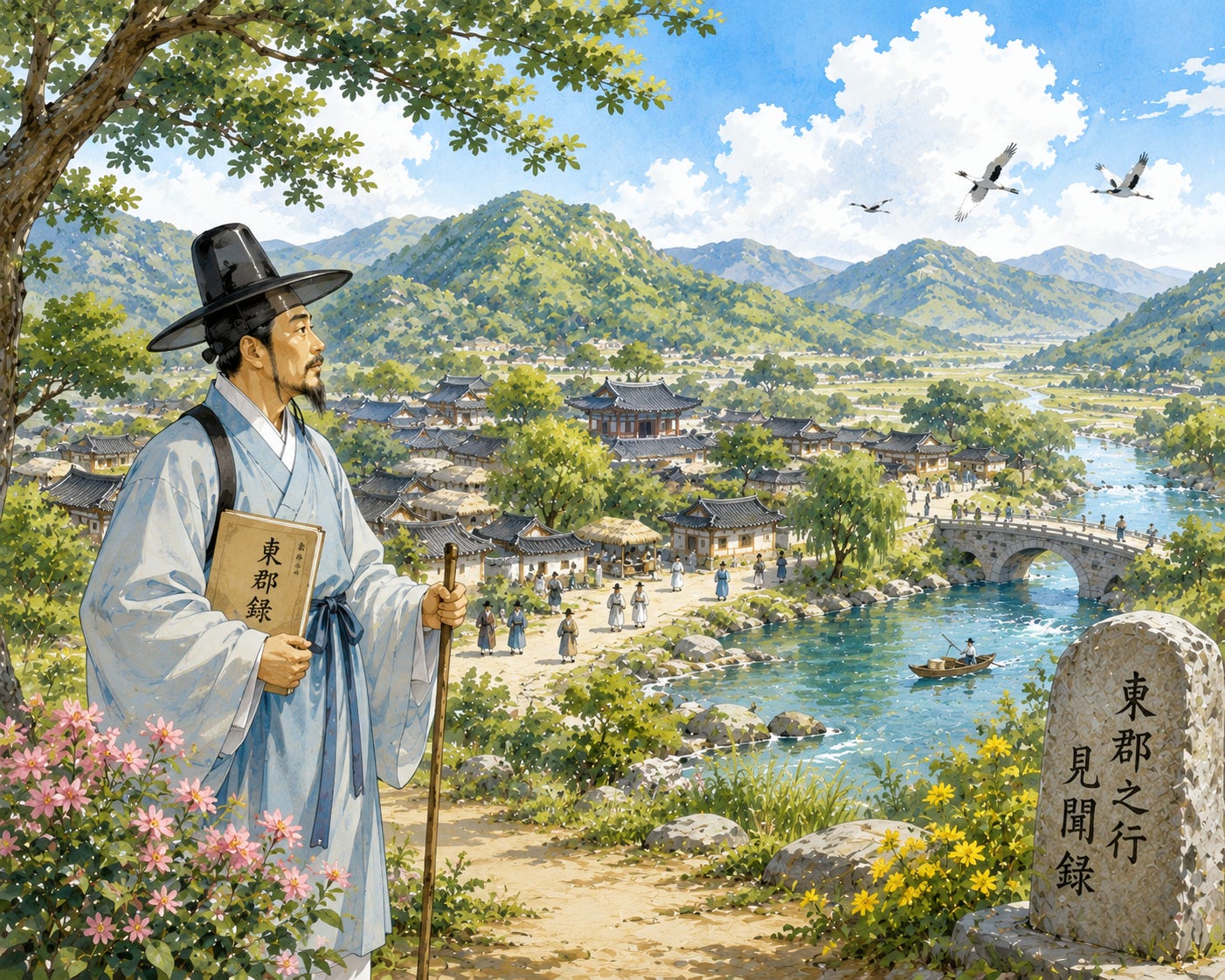
Reading “Donggunnok (동군록(東郡錄))” (Record of the Eastern Districts) in Volume 8 of Gani-jip reminded me that travel is not simply about visiting new places. It is also a journey of discovering new people, new cultures, and new ways of thinking. As the author travels through several eastern districts, he carefully observes the landscapes, local customs, and the lives of the people. His vivid descriptions make readers feel as though they are walking alongside him through the beautiful countryside of the Joseon Dynasty.
The first thing that impressed me was the author’s remarkable ability to observe. He does more than describe mountains, rivers, forests, and fields. He also pays close attention to the atmosphere of each village and the daily lives of its people. Through his careful observations, readers can vividly imagine the harmony between nature and the communities that lived within it.
Another memorable aspect of the book is the author’s warm concern for ordinary people. Rather than treating local residents as part of the scenery, he sincerely tries to understand both their joys and their hardships. His compassion reflects the ideal qualities of a responsible public official who values the well-being of the people above personal recognition.
Donggunnok also reveals the author’s open-minded attitude toward regional diversity. Instead of judging unfamiliar customs by his own standards, he respects the unique traditions and cultural characteristics of each community. His willingness to learn from different regions offers an important lesson for today’s increasingly interconnected world, where understanding and respecting cultural diversity are more valuable than ever.
While reading this work, I was reminded that the beauty of nature is timeless. The mountains, rivers, forests, and fields that inspired the author centuries ago continue to inspire people today. Nature remains a source of peace, comfort, and renewed strength for anyone willing to appreciate its quiet beauty.
The author also viewed travel as an opportunity for continuous learning. Every destination became a classroom where he expanded his knowledge of history, geography, local culture, and notable individuals. Through conversations with fellow scholars, he deepened his understanding of both the world and him. His journey demonstrates that travel is one of life’s greatest forms of education.
In today’s world, we can easily access information about distant places through the Internet. However, Donggunnok reminds us that firsthand experience has a value that no technology can replace. Meeting people in person, observing local life, and experiencing nature directly provide lessons that cannot be fully learned from books or digital media alone.
The book also serves as an important historical document. It offers readers a vivid picture of local administration, regional customs, and everyday life during the Joseon Dynasty. In this way, Donggunnok is both an engaging travel narrative and a valuable record of Korean history and culture.
Perhaps the greatest lesson I learned from this work is the importance of approaching unfamiliar places with curiosity rather than fear. By keeping an open mind and a willingness to learn, the author gained not only knowledge but also wisdom and compassion. His journey encourages readers to broaden their own perspectives through meaningful experiences.
In conclusion, Donggunnok is far more than a travel diary describing beautiful landscapes. It is a thoughtful record of personal growth through encounters with nature, people, and diverse cultures. Even today, its message remains deeply relevant. It teaches us that a fulfilling life is built upon a love of nature, respect for others, intellectual curiosity, and a lifelong commitment to learning. These timeless values continue to make Donggunnok an inspiring and rewarding classic for modern readers. +++
{Solti}
July 27, 2026
「동군록 (東郡錄)」 독후감
새로운 고을에서 만난 사람과 자연의 아름다움
『간이집』 제8권의 「동군록 (東郡錄)」을 읽으며 여행은 새로운 장소를 찾아가는 일만이 아니라, 새로운 사람과 새로운 생각을 만나는 과정이라는 사실을 다시 한번 느끼게 되었다. 저자는 동쪽 여러 고을을 순행하며 자연과 사람, 그리고 그 지역의 문화를 세심하게 관찰하고 기록하였다. 덕분에 독자인 나도 함께 길을 따라 걸으며 조선 시대의 풍경을 바라보는 듯한 기분을 느낄 수 있었다.
가장 먼저 마음에 남은 것은 저자의 뛰어난 관찰력이다. 그는 산과 강, 숲과 들판을 아름답게 묘사할 뿐 아니라, 마을의 분위기와 사람들의 생활 모습까지 세심하게 기록하였다. 이러한 기록을 통해 자연과 인간이 서로 조화를 이루며 살아가는 모습을 생생하게 상상할 수 있었다.
저자가 여러 고을을 방문하며 만난 백성들을 따뜻한 시선으로 바라보는 모습도 깊은 인상을 남겼다. 그는 사람들의 생활을 단순한 구경거리로 여기지 않고, 그들의 기쁨과 어려움을 이해하려고 노력하였다. 이러한 애민정신은 좋은 관리가 갖추어야 할 가장 중요한 덕목 가운데 하나임을 보여 준다.
또한 「동군록」에서는 지역마다 다른 풍속과 문화를 배우려는 저자의 열린 마음을 엿볼 수 있다. 그는 익숙한 기준으로 다른 지역을 판단하기보다 각 지역이 지닌 특징과 전통을 존중하였다. 이러한 자세는 오늘날 다양한 문화를 이해하고 존중하는 데에도 큰 교훈을 준다.
이 작품을 읽으며 자연의 아름다움은 시대를 초월한다는 생각이 들었다. 수백 년 전 저자가 바라본 산과 강은 오늘날에도 많은 사람들에게 감동을 주고 있을 것이다. 자연은 변함없이 사람의 마음을 편안하게 하고 새로운 힘을 준다는 사실을 다시 느낄 수 있었다.
저자는 여행을 통해 학문도 함께 넓혀 갔다. 새로운 지역을 방문할 때마다 역사와 지리, 문화와 인물을 배우고, 선비들과 교류하며 자신의 생각을 더욱 깊게 만들었다. 여행은 단순한 이동이 아니라 살아 있는 배움의 과정이라는 점을 깨닫게 해 준다.
현대 사회에서는 인터넷을 통해 세계의 정보를 쉽게 얻을 수 있지만, 직접 보고 느끼며 배우는 경험은 여전히 특별하다. 「동군록」은 현장을 찾아가 사람을 만나고 자연을 체험하는 일이 얼마나 소중한지를 다시 생각하게 만든다.
또한 이 작품은 조선 시대 지방 사회의 모습을 이해하는 귀중한 역사 자료이기도 하다. 당시의 행정과 지역 문화, 사람들의 생활과 풍습을 자연스럽게 엿볼 수 있어 여행기와 역사 기록이라는 두 가지 가치를 함께 지니고 있다.
무엇보다도 「동군록」은 세상을 넓게 바라보는 마음을 길러 준다. 낯선 곳을 두려워하기보다 배우려는 자세로 다가갈 때 더 큰 지혜와 풍요로운 경험을 얻을 수 있다는 사실을 저자의 여정을 통해 배울 수 있었다.
결국 「동군록」은 아름다운 자연을 감상하는 여행기인 동시에 사람을 이해하고 세상을 배우는 성장의 기록이다. 이 작품은 자연을 사랑하는 마음, 사람을 존중하는 태도, 그리고 끊임없이 배우려는 자세가 행복한 삶의 바탕이 된다는 사실을 조용하지만 깊이 있게 전해 주는 훌륭한 고전이라고 생각한다. +++
2026년 6월 27일
{솔티}

Prof. Dr. Young Choi (Editor in Chief) — Regent University
Young B. Choi is a Professor in the Department of Engineering & Computer Science at Regent University. He published 38 books with ‘Selected Readings in Cybersecurity’ (2018) (over 800 copies archived globally at university/college libraries around the world) and ‘Cybersecurity Applications and Artificial Intelligence’ (2023) available in seven major world languages. He proposed the world’s first global and universal telecommunications “Service Order Handling (SOH)” Model (T-SOH Model) (1995) with Dr. Adrian Tang. With this innovative research work, he received the IEEE NOMS ’96 Best Paper Award and became the first recipient of the Outstanding Contribution Award of the TeleManagement Forum in 1998. His research areas include Natural Language Processing-focused AI, AI-applied cybersecurity, network and telecom service management, and Korean studies on Gani Choi Rip’s Jeonggwan (靜觀: Quiet Contemplation) philosophy and Shilhak ( 實學: Practical Learning).