
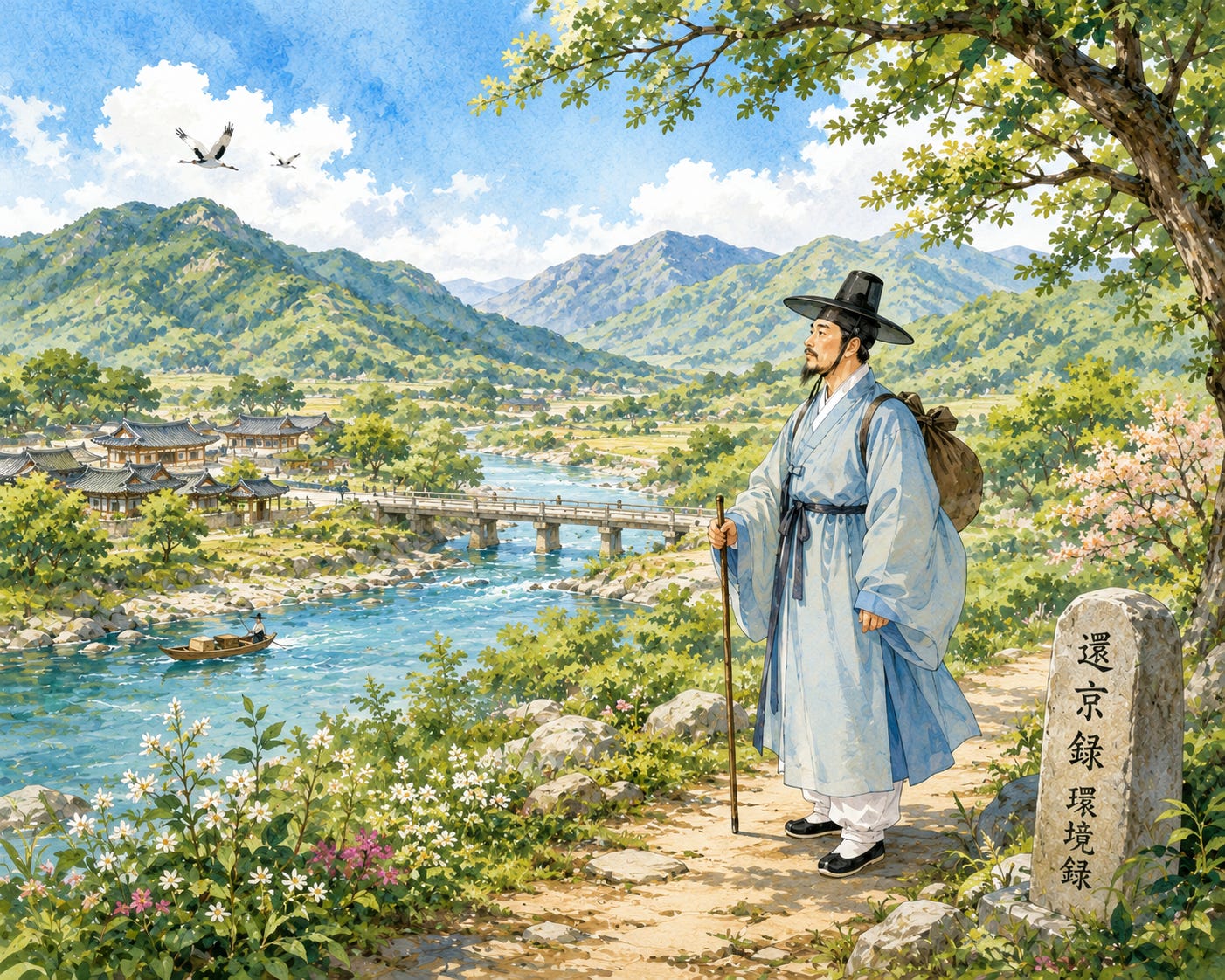
Reading “Hwangyeongnok (환경록(還京錄))” (Record of Returning to the Capital) in Volume 8 of Gani-jip reminded me that the journey home is also an important part of every journey. People often focus only on reaching their destination, but this work beautifully demonstrates that the return trip can offer just as many opportunities for reflection, learning, and personal growth.
After completing his official duties in the provinces, the author begins his journey back to the capital. Along the way, he carefully observes the mountains, rivers, fields, and villages that he passes. Even familiar roads appear different depending on the season, the weather, and one’s state of mind. His thoughtful observations encourage readers to see ordinary places with fresh eyes.
One of the most memorable aspects of this work is the author’s deep appreciation of nature. The clear sky, flowing rivers, green mountains, and wide-open fields are not presented merely as beautiful scenery. Instead, they become sources of comfort, peace, and quiet reflection. The author reminds us that nature has the remarkable ability to heal the human spirit and restore inner strength.
Although he is returning home, the author never forgets the people he encounters along the way. He pays close attention to the lives of local residents and reflects on their daily struggles. His compassion demonstrates that a responsible public official should not only fulfill administrative duties but also genuinely care for the well-being of the people. This spirit of public service remains meaningful even today.
Another valuable lesson from Hwangyeongnok is that learning does not end when a journey is over. As the author looks back on his experiences, he carefully reflects on what he has learned and considers how those lessons should shape his future life. His reflections suggest that the true value of travel continues long after we return home.
While reading this work, I found myself thinking about how often I rush through everyday life. Because of busy schedules, I sometimes overlook the beauty and meaning hidden in ordinary moments. The author encourages us to slow down, observe more carefully, and appreciate the simple blessings that surround us each day.
The author’s humility also left a deep impression on me. Rather than boasting about his experiences, he values every journey as another opportunity to learn. He remains humble before both nature and humanity, reminding readers that lifelong learning begins with an open and teachable heart.
Hwangyeongnok also serves as an important historical record. Through the author’s vivid descriptions, readers gain insight into the roads, villages, landscapes, and daily life of the Joseon Dynasty. In this way, the book offers not only an engaging travel narrative but also a valuable window into Korean history and culture.
Perhaps the most meaningful lesson of this work is its understanding of what it means to “return.” Going home is not simply arriving where we started. It means bringing back new experiences, greater wisdom, and a deeper appreciation of life. The journey changes the traveler, making the return itself a new beginning.
In conclusion, Hwangyeongnok is far more than a record of traveling back to the capital. It is a thoughtful reflection on life, nature, learning, and public responsibility. Even though it was written centuries ago, its message remains timeless. It encourages us to cherish every stage of our journey, care for others with compassion, and continue growing through reflection and experience. That is why Hwangyeongnok continues to inspire modern readers with its quiet wisdom and enduring humanity. +++
{Solti}
July 27, 2026
「환경록 (還京錄)」 독후감
돌아오는 길에서 찾은 더 큰 배움
『간이집』 제8권의 「환경록 (還京錄)」을 읽으며 가장 먼저 떠오른 생각은 “돌아오는 길도 또 하나의 여행이다.”라는 말이었다. 사람들은 흔히 목적지에 도착하는 것만 중요하게 생각하지만, 이 작품은 돌아오는 길에서도 새로운 깨달음과 감동을 얻을 수 있음을 보여 준다.
저자는 지방에서의 임무를 마치고 한양으로 돌아오면서 지나가는 산과 강, 들판과 마을을 세심하게 바라본다. 익숙한 길이라도 계절과 날씨, 그리고 마음가짐에 따라 전혀 다른 모습으로 다가온다는 사실을 아름답게 표현하고 있다.
특히 인상 깊었던 점은 자연을 바라보는 저자의 따뜻한 시선이다. 맑은 하늘과 흐르는 강물, 푸른 산과 넓은 들판은 단순한 풍경이 아니라 마음을 위로하고 삶을 돌아보게 하는 존재로 그려진다. 자연은 언제나 사람에게 쉼과 용기를 준다는 사실을 다시 생각하게 되었다.
여행을 마무리하는 과정에서도 저자는 백성들의 삶을 잊지 않는다. 길을 따라 만나는 사람들의 생활과 지역의 모습을 관심 있게 살피며, 공직자는 백성을 이해하고 그들의 어려움을 함께 고민해야 한다는 책임감을 보여 준다. 이러한 애민정신은 오늘날에도 변함없이 소중한 가치라고 생각한다.
또한 「환경록」은 여행이 끝나는 순간에도 배움은 끝나지 않는다는 사실을 일깨워 준다. 저자는 지나온 길을 되돌아보며 자신이 경험한 일들을 차분히 정리하고, 앞으로 어떻게 살아가야 할지를 깊이 생각한다. 진정한 여행은 발걸음이 멈춘 뒤에도 계속된다는 점이 인상 깊었다.
이 작품을 읽으며 나 역시 일상 속에서 지나쳐 버리는 소중한 순간들이 많다는 생각이 들었다. 늘 바쁘다는 이유로 주변의 아름다움을 놓치고 살아가는 것은 아닌지 스스로를 돌아보게 되었다. 저자처럼 천천히 바라보고 깊이 생각하는 시간이 우리에게도 필요하다는 것을 느꼈다.
저자의 겸손한 태도도 큰 감동을 주었다. 그는 자신의 경험을 자랑하기보다 여행을 통해 배운 점을 소중히 여기며, 사람과 자연 앞에서 늘 배우는 자세를 유지하였다. 이러한 태도야말로 평생 학습자의 모습이라고 생각한다.
「환경록」은 조선 시대의 길과 마을, 자연과 사람들의 모습을 생생하게 전해 주는 역사 기록이기도 하다. 덕분에 당시의 생활과 문화를 자연스럽게 이해할 수 있었고, 여행기를 읽으면서 역사 공부도 함께 하는 즐거움을 느낄 수 있었다.
무엇보다 이 작품은 ‘돌아온다’는 의미를 새롭게 생각하게 만들었다. 집으로 돌아오는 일은 단순히 출발점으로 되돌아가는 것이 아니라, 새로운 경험과 더 깊어진 마음을 가지고 삶을 이어 가는 과정이라는 사실을 깨닫게 되었다.
결국 「환경록」은 귀경의 기록을 넘어 삶을 성찰하는 아름다운 수필과도 같은 작품이다. 이 글은 우리에게 자연을 사랑하는 마음, 사람을 배려하는 자세, 그리고 여행과 삶 속에서 끊임없이 배우려는 태도의 중요성을 일깨워 준다. 그래서 오늘을 살아가는 우리에게도 여전히 깊은 울림을 전해 주는 소중한 고전이라고 생각한다. +++
2026년 7월 27일
{솔티}

Prof. Dr. Young Choi (Editor in Chief) — Regent University
Young B. Choi is a Professor in the Department of Engineering & Computer Science at Regent University. He published 38 books with ‘Selected Readings in Cybersecurity’ (2018) (over 800 copies archived globally at university/college libraries around the world) and ‘Cybersecurity Applications and Artificial Intelligence’ (2023) available in seven major world languages. He proposed the world’s first global and universal telecommunications “Service Order Handling (SOH)” Model (T-SOH Model) (1995) with Dr. Adrian Tang. With this innovative research work, he received the IEEE NOMS ’96 Best Paper Award and became the first recipient of the Outstanding Contribution Award of the TeleManagement Forum in 1998. His research areas include Natural Language Processing-focused AI, AI-applied cybersecurity, network and telecom service management, and Korean studies on Gani Choi Rip’s Jeonggwan (靜觀: Quiet Contemplation) philosophy and Shilhak ( 實學: Practical Learning).