
Executive Summary
Min Jin Lee’s new novel, American Hagwon, follows a Korean family whose faith in education carries them from Seoul to Sydney to Orange County. The new novel alongside Lee’s recent interview, this review takes a human resource development (HRD) perspective. It argues that Korean diaspora families often outsource both learning and career choice, and that the cost surfaces later, when young professionals must build an identity of their own. In an age of AI, that self-built identity matters more than ever.
Keywords: hagwon, korean diaspora, professional identity, career self-leadership, artificial intelligence
New Books Arrives
On September 29, 2026, Min Jin Lee, the Korean American author of Pachinko (2017) and Free Food for Millionaires (2007), published her third novel, American Hagwon. Cardinal, an imprint of Hachette Book Group, published the 656-page book.
It follows the Koh family from 1992 to 2007. After the 1997 Asian financial crisis, in Korea it is known as IMF crisis, wrecks their comfortable middle-class life in Seoul, they move to Sydney and then to Orange County, California, still trusting education to secure their children’s future.
The novel is the third book in Lee’s planned “Diaspora Quartet,” four stand-alone novels linked by the experience of being scattered across borders. Its title uses the Korean word hagwon, the private learning centers where much of Korean education takes place outside the classroom. Through that word, Lee asks what a good life looks like when a family puts everything into schooling, work and sacrifice in a new country.

Source: BigLittleReads’s Facebook, https://www.facebook.com/BigLittleReads/posts/min-jin-lees-latest-novel-american-hagwon-is-officially-releasing-today-septembe/122219050160433264/
1. A Novel About Where Learning Happens
“A hagwon is a learning center,” Min Jin Lee explained on Radio Atlantic. “Anytime you pay somebody to teach you something that’s not in regular school, that’s a hagwon” (Rosin, 2026, 05:46). Her new novel, American Hagwon, released on September 29, 2026, follows the Koh family from Seoul through the 1997 Asian financial crisis to Sydney and Southern California, where education remains the family’s plan for survival (Lee, 2026).
Dialogue with Min Jin Lee
Source: Rosin, H. (Host). (2026, October). Min Jin Lee’s underdog morality [Audio podcast episode]. In Radio Atlantic. The Atlantic.
As an HRD scholar, I sense the book as a story about who owns learning. In Korea, much of it is paid for outside the school. In Korean America, much of it is arranged by parents and the immigrant community. That arrangement often works well through college. It becomes harder when a young adult enters professional life and must answer a question no hagwon can answer for them: who am I at work? With AI now able to take over much of our routine thinking, that question carries new weight.
2. Three Lines an HRD Scholar Should Underline
Three passages from Lee’s interview speak directly to learning, career development, and identity. Each opens a different part of the problem.
2.1 Learning Outsourced, From Seoul to the Taekwondo Studio
“If you’re a working parent and you have kids, hagwons are a kind of childcare. And also because you can’t help the kids with homework, so then parents will actually outsource this, and it becomes a low-cost way to get tutoring.” (Rosin, 2026, 07:47)
Lee names the mechanism plainly: outsourcing. In Korea, this produces a paradox. Admission to elite schools is presented as proof of merit, yet much of the learning behind that merit is purchased outside school. Lee describes education in Korea as “almost a faith,” a token families believe will make everything work out (Rosin, 2026, 14:38). The paradox is real, and families live inside it every day.
The same logic travels to America in a different form. In many Korean American communities I have observed, the taekwondo studio functions as more than a martial arts school. Children arrive after school, finish homework, practice, and wait for working parents. Where affordable after-school care is hard to find, the dojang quietly does two jobs: learning center and childcare center.
"How Korean Taekwondo's Character-Building Childcare System Won Over American Parents"
There is a Korean educational model that has taken American parents by storm: the Korean-style Taekwondo dojang.
In the United States, parents typically shoulder the entire burden of after-school childcare, making the Korean concept of an academy (hagwon) relatively unfamiliar. However, once traditional Korean Taekwondo academies established a presence in the U.S., local parent communities were completely won over.
They do not merely instruct students in kicks and punches. True to Korea’s cultural tradition of decorum and respect, they focus heavily on character education—effectively shaping children into disciplined, well-mannered individuals.
Furthermore, they offer comprehensive childcare coverage until parents finish work at 6:00 PM. By fully burning off the children’s boundless energy, parents pick up calm, well-behaved kids for a stress-free transition home.
The step-by-step belt progression—from white belt all the way to black belt—provides clear milestones and intrinsic motivation. Children genuinely enjoy the tangible progression of earning each belt, leading to voluntary, near-perfect attendance.
Currently, Taekwondo studios across the United States have extensive waiting lists. International media outlets are frequently reporting on this model, advocating for the global adoption of such integrated educational systems, recognizing Korean Taekwondo not merely as a martial art, but as an educational innovation.
Vidoe Source: https://youtube.com/shorts/ksas2yii2dM?si=40Gl72W0RbduEPt6
2.2 Careers Outsourced: The Parachute Child Reconsidered
“These young kids, they don’t feel heard. They’re told a lot of things, but they’re not heard. So when you have this magical person who went to the famous school that your parents want you to go to, and they really listen to you and they ask you questions like, ‘So why do you want to go to college? Maybe it’s not a good time,’ and the kid’s like, ‘What do you mean I have a choice?’” (Rosin, 2026, 19:00)
Lee describes “parachute children,” young students sent abroad to live with a guardian so they can access a foreign education (Rosin, 2026, 09:24). It is tempting to see them as immature. I see them differently. Their career choices were outsourced, first to parents and then to an immigrant community with clear expectations about which schools and professions count.
For many, this arrangement holds through college, because the path is clearly marked. Lee notes a harder outcome too: some students “crash” after their first year, exhausted by years of overload (Rosin, 2026, 19:00). Even those who succeed meet the real test later, when a professional career asks them to lead themselves without a script.
2.3 Given Identity Meets Earned Identity in the Age of AI
“I think diaspora is now the modern person’s permanent condition... we are being scattered by modern society, so we have to study the subject.” (Rosin, 2026, 13:01)
Diaspora professionals carry a double burden. They negotiate a social and ethnic identity within an immigrant society, the kind of group membership that social identity theory treats as central to how people see themselves (Tajfel & Turner, 1979). At the same time, they must build a professional identity in workplaces that reward self-direction (Hall, 2004).
AI sharpens this tension. In my forthcoming Human Resource Development Review article, I describe technology-mediated identity formation: where AI narrows traditional entry pathways, individuals must actively construct identities around their distinctive human contributions (Choi, in press). AI makes it easy to outsource thinking. What it cannot supply is self-determination. A “given” identity, handed down by family and community, will increasingly collide with an “earned” identity built through one’s own choices. Diaspora professionals, whose given identities often arrived with the strongest expectations, may feel that collision first.
3. Toward a Healthy Identity for the Next Generation
Lee warns that Asian parenting “often becomes pathologized. It’s decontextualized” (Rosin, 2026, 12:31). Outsiders see the outcomes and the data, but not the sacrifice or the logic behind them. I take her point seriously. The families in her novel, and in our own communities, made reasonable decisions under real constraints. Outsourcing learning was often the best option available.
Her warning also reminds us how easily diaspora experience is pushed to the margins of public conversation. If we do not study our own experience, others will interpret it for us, usually without context.
Figure 4
Human-AI Career Integration (HACI) Framework
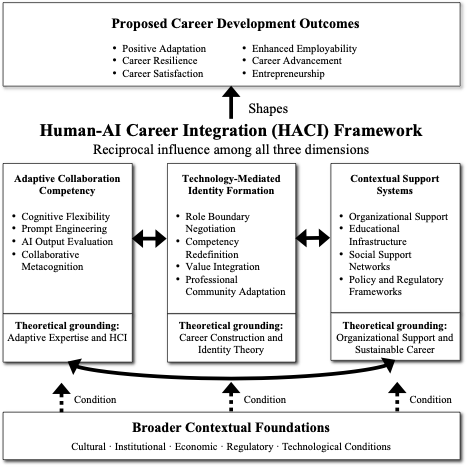
Note. Excerpted from Yoo & Choi (2026), From career ladders to digital jungle gyms. The HACI framework proposes that adaptive collaboration competency, technology-mediated identity formation, and contextual support systems interact reciprocally over time to shape career development outcomes.
That responsibility falls on Korean diaspora scholars and professionals. The next generation does not need less ambition. It needs help moving from a given identity to an earned one: mentors who listen, as Lee’s best hagwon teachers do, career education that asks “why” before “where,” and workplaces that treat self-direction as a skill to be developed rather than assumed. In an age when machines can do more of our thinking, a healthy identity may be the most important thing we help our children build for themselves. No hagwon can sell it.
References
Hall, D. T. (2004). The protean career: A quarter-century journey. Journal of Vocational Behavior, 65(1), 1–13. https://doi.org/10.1016/j.jvb.2003.10.006
Lee, M. J. (2026). American hagwon. Cardinal.
Rosin, H. (Host). (2026, October). Min Jin Lee’s underdog morality [Audio podcast episode]. In Radio Atlantic. The Atlantic.
Tajfel, H., & Turner, J. C. (1979). An integrative theory of intergroup conflict. In W. G. Austin & S. Worchel (Eds.), The social psychology of intergroup relations (pp. 33–47). Brooks/Cole.
Yoo, S. J., & Choi, J. (2026). From career ladders to digital jungle gyms: An HRD theoretical framework for understanding human-AI interaction in career development. Human Resource Development Review. Advance online publication. https://doi.org/10.1177/15344843261491397
About the Author
Note. This 10-second video was created with support from Google Gemini, using Nano Banana-generated imagery, for illustrative purposes.
Jeonghwan (Jerry) Choi, PhD, MBA, ME · Managing Editor of K-GSP
Jeonghwan (Jerry) Choi, PhD, MBA, ME, is Managing Editor of K-GSP. With more than 25 years of industry and consulting experience, he specializes in leadership development, human resource management and development, and organizational behavior. His research focuses on workforce resilience, self-directed leadership, and career development in AI-mediated workplaces. Full list of his K-GSP columns: https://www.k-gsp.org/t/columnist_jerry_choi
Suggested Citation
Choi, J. (2026, October [Day]). Outsourced learning, unfinished identity: Min Jin Lee’s American Hagwonthrough an HRD lens. K-GSP Forum.
Original Article:

한글요약
맡겨진 배움, 미완의 정체성: HRD의 눈으로 읽은 이민진의 『American Hagwon』
이민진 작가의 새 소설 『American Hagwon』은 교육에 모든 것을 건 한 한국 가족이 서울에서 시드니, 그리고 캘리포니아 오렌지카운티로 옮겨 가는 이야기입니다. 이 글은 소설과 작가의 최근 인터뷰를 인적자원개발(HRD)의 관점에서 읽습니다.
이민진 작가는 학원을 “정규 학교 밖에서 돈을 내고 무언가를 배우는 모든 곳”이라고 설명하며, 일하는 부모에게 학원은 일종의 돌봄이자 숙제를 대신 맡기는 곳이라고 말합니다. 한국에서는 명문 학교 입학이 실력의 증거로 여겨지지만, 그 실력의 상당 부분은 학교 밖에서 사들인 것입니다. 역설처럼 들리지만 현실입니다. 미국의 한인 사회에서는 태권도 도장이 배움터이자 방과 후 돌봄의 역할을 함께 맡기도 합니다.
조기유학생, 이른바 ‘파라슈트 키즈’는 미성숙해서가 아니라, 진로 선택을 부모와 이민 사회에 맡겨 온 경우가 많습니다. 대학까지는 길이 분명해서 버틸 수 있지만, 진짜 직업 세계에 들어서면 스스로 길을 찾고 새로운 정체성을 세워야 하는 어려움을 겪습니다.
AI가 생각까지 대신해 주는 시대일수록, 주어진 정체성과 스스로 얻어 가는 정체성은 더 자주 부딪힙니다. 민족 정체성과 직업 정체성이라는 이중의 짐을 진 디아스포라에게는 더 큰 도전입니다. 한인 학자와 전문가들이 다음 세대의 건강한 정체성 형성에 더 많은 관심을 기울여야 할 때입니다.
© K-Global Scholars and Professionals Forum. All rights reserved. Content published in the K-GSP Forum may not be reproduced, distributed, or transmitted in any form without prior written permission from the K-GSP Forum, except for brief quotations with full attribution.