Kwon, R. O. The Incendiaries: A Novel. Riverhead Books, 2018. ISBN 978-0-7352-1390-6. 240 pages, $18.00.
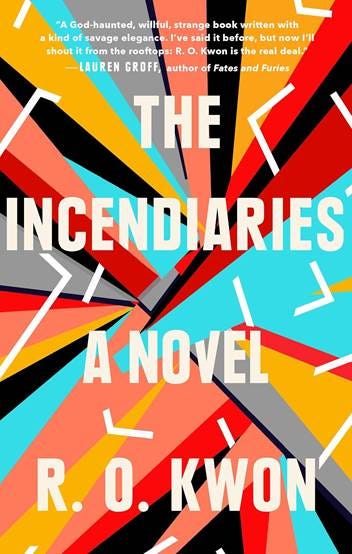
Cover image: The Incendiaries: A Novel by R. O. Kwon. Image reproduced for purposes of review and commentary.
R. O. Kwon was born in Seoul and immigrated to the United States with her family when she was three years old. Raised in a devout Christian household, she once intended to become a Christian pastor. At the age of seventeen, however, she experienced a profound crisis of faith that led her to abandon her belief in God. Kwon has frequently described this loss not as a moment of liberation but as an enduring grief, one that continues to shape her life and writing. Her debut novel, The Incendiaries, tells the story of Phoebe Lin, a gifted college student who becomes entangled in an extremist Christian movement whose members ultimately commit acts of terrorism. The novel required nearly a decade to complete and draws heavily upon Kwon’s own spiritual struggles, although it is neither autobiographical nor a simple fictional retelling of her experiences.
Kwon studied economics at Yale University before earning an MFA in Creative Writing from Brooklyn College. Since the publication of The Incendiaries, she has established herself as one of the most compelling contemporary voices in American fiction. Her second novel, Exhibit, appeared in 2024 and further demonstrated her interest in questions of desire, identity, and the complexities of human relationships. Kwon has received numerous honors for her writing. The Incendiaries was selected as the American Booksellers Association’s Indie Next #1 Great Read, won the Housatonic Book Award, and was a finalist for the National Book Critics Circle John Leonard Prize. She also co-edited the bestselling anthology Kink, which was named a New York Times Notable Book in 2021.
Kwon’s personal struggle with belief lies at the heart of The Incendiaries. Reflecting on the novel’s origins, she explained, “I wished to write a book that could convey what it’s like to lose and gain faith. Losing God was devastating. I miss him all the time. I’m starting to understand that this will never end, that I will keep grieving as long as I live” (“Debut”). This confession provides an essential lens through which to understand the novel. Rather than attacking religious belief, Kwon examines the emotional vacuum created when deeply held convictions collapse and the desperate human desire to replace them with something equally absolute. The charismatic cult leader John Leal understands this vulnerability all too well. Speaking of suffering, he observes that pain can “open what’s closed,” making wounded people receptive to possibilities they might otherwise reject (Kwon 149). His insight reveals how grief, loneliness, and spiritual longing can become fertile ground for manipulation, transforming genuine faith into fanaticism.
Although The Incendiaries has often been described as a novel about religious extremism, terrorism, or cults, such descriptions capture only one dimension of its remarkable complexity. At its deepest level, the novel explores the universal human longing for certainty in the aftermath of catastrophic loss. Every major character is searching for something capable of replacing what has vanished: faith, love, identity, home, or meaning itself. Phoebe seeks transcendence after unimaginable personal tragedy; Will searches for emotional stability after losing both his religious convictions and the woman he loves; and John Leal exploits the yearning for purpose that exists in those wounded by suffering. Consequently, the novel transcends the conventions of a thriller about religious violence and becomes a profound meditation on grief, belief, identity, and the dangerous allure of absolute certainty. Psychological, philosophical, theological, and political in equal measure, The Incendiaries asks not simply why people embrace extremism, but why the human heart so persistently seeks something worthy of complete devotion.
Although each character responds to loss in a different way, all are driven by the same longing: the desire for absolute certainty and the complete extinguishing of the grief that continues to haunt them. Kwon thus presents extremism not primarily as a political or ideological commitment but as an emotional and existential response to unbearable suffering. The cult’s promises become attractive precisely because they offer clear answers where ambiguity and pain persist. By the novel’s conclusion, Kwon leaves readers with unsettling questions rather than easy resolutions: Is absolute certainty ever attainable? Can grief truly be eliminated, or must it instead be endured, confronted, and gradually integrated into one’s life? In this sense, The Incendiaries ultimately suggests that the longing to escape grief altogether may itself become one of the most dangerous forms of self-deception.
Perhaps the novel’s most profound and intellectually provocative contrast is not between belief and unbelief, but between faith and certainty. Kwon carefully distinguishes these two concepts, revealing that they are not synonymous. Traditional religious faith, at its best, acknowledges the limits of human understanding. It accepts mystery, ambiguity, and unanswered questions as essential aspects of the human condition. Certainty, however, seeks to eliminate ambiguity altogether. It promises complete knowledge and absolute assurance, replacing trust with unquestionable conviction.
John Leal’s cult cannot tolerate mystery because mystery leaves room for doubt, competing interpretations, and the possibility that suffering may never receive a satisfying explanation. For people whose lives have been shattered by profound grief and loss, such uncertainty becomes almost unbearable. Leal offers his followers what they crave most: a comprehensive system in which every tragedy has meaning, every question has an answer, every doubt can be silenced, and every sacrifice contributes to a transcendent purpose. In effect, he attempts to transform religious belief into something resembling mathematical certainty. His theology functions less as an act of faith than as a closed logical system in which every variable has already been solved.
Will’s story provides an equally compelling counterpoint. Although he has abandoned Christianity after his own crisis of faith, relinquishing religion has not freed him from the deeply human need to believe in something larger than himself. Instead, he transfers that impulse almost entirely onto Phoebe. His love becomes absolute, consuming, and unquestioned. He interprets his identity, purpose, and future through her, allowing his devotion to become another kind of creed. In this sense, Will’s obsession functions as a form of faith, illustrating that belief itself is not confined to organized religion. Human beings continually direct their deepest commitments toward people, ideologies, institutions, or causes that promise meaning.
This insight is one of The Incendiaries‘ greatest achievements. Kwon refuses to portray belief as either inherently virtuous or inherently destructive. Rather, she suggests that the decisive issue is how belief is held. Faith that leaves room for humility, mystery, and self-questioning can nurture compassion and resilience. Belief that demands absolute certainty, by contrast, becomes rigid and coercive. Once uncertainty is no longer permitted, dissent becomes betrayal, complexity becomes an obstacle, and violence can be justified as the inevitable consequence of unquestionable truth.
Ultimately, Kwon argues that certainty, not faith itself, is the true danger. Extremism flourishes wherever individuals become convinced that every question has already been answered and every moral dilemma resolved. By contrasting authentic faith’s embrace of mystery with the cult’s obsession for absolute certainty, The Incendiaries offers a penetrating meditation on why wounded people are so often drawn to ideological absolutes and why the refusal to live with uncertainty can become one of the most destructive forces in human life.
Perhaps the novel’s greatest achievement is its refusal to divide its characters into simple categories of heroes and villains. John Leal, the charismatic cult leader, is undeniably manipulative, yet he is also deeply wounded, driven by his own unresolved grief and longing for significance. Phoebe becomes complicit in acts of violence, but Kwon never allows her to become merely a perpetrator; she remains a profoundly sympathetic figure whose vulnerability and search for meaning invite both compassion and sorrow. Will, who desperately seeks truth amid the movement’s intense religious fervor, often recognizes its dangers, yet his own actions are frequently marked by selfishness, jealousy, and emotional paralysis. No character possesses moral purity or complete innocence. Instead, Kwon presents evil not as the product of monstrous individuals but as something that develops gradually through ordinary human desires, for belonging, certainty, love, and purpose. In doing so, The Incendiaries offers a sobering reminder that the boundary between compassion and cruelty is often far more fragile than some would like to believe.
Although religion, and the devastating consequences of religious extremism, has dominated much of the critical discussion surrounding The Incendiaries, the novel also deserves recognition as an important contribution to the broader tradition of Korean American literature. Like the fiction of Susan Choi, Chang-rae Lee, and Richard E. Kim, R. O. Kwon explores the fractured identities that emerge from inhabiting two worlds simultaneously. Yet Korean identity in the novel rarely appears through familiar cultural markers such as language, food, or family customs. Instead, it is embedded within a deeper historical and psychological landscape shaped by inherited trauma, displacement, competing religious traditions, and the unresolved legacy of a divided Korean peninsula. These forces operate quietly beneath the narrative, influencing the characters even when they remain unspoken. John Leal, for example, embodies the lingering wounds of Korea’s national division. In his imagination, North Korea becomes more than a geopolitical reality; it functions as a powerful psychological metaphor for ideological absolutism, a place where rigid certainty annihilates ambiguity, compassion, and ultimately individual humanity. By weaving these historical currents into an intensely personal story, Kwon demonstrates that the burdens of history continue to shape identity across generations, even for those geographically removed from the events themselves.
Like the Korean American novels Native Speaker, The Foreign Student, and The Interpreter, trauma serves as one of the central organizing principles of The Incendiaries. It is the hidden force shaping the lives and decisions of every major character. Phoebe is haunted by the death of her mother, carrying a crushing burden of survivor’s guilt that leaves her vulnerable to John Leal’s promises of meaning and transcendence. Will’s abandonment of Christianity leaves him spiritually homeless, searching for a coherent identity after the collapse of the faith that once defined his life. John Leal’s experiences in North Korea forge an identity rooted almost entirely in suffering, deprivation, and the conviction that pain can be transformed into a higher purpose. Rather than finding ways to confront, grieve, and ultimately heal from their wounds, each character gradually incorporates trauma into the very core of his or her identity. Their suffering becomes more than a painful memory; it becomes a source of purpose, belonging, and self-definition. For some, that process ultimately provides a moral rationale for violence, as destructive acts are recast as necessary sacrifices in the pursuit of redemption. In this way, Kwon arrives at one of the novel’s darkest psychological insights: people do not always seek healing. Sometimes they cling to their wounds because those wounds have become inseparable from their sense of self. Trauma, once endured, can become the foundation upon which an entire identity is constructed.
Kwon’s novel occupies a distinctive place within the tradition of Korean American literature, representing an important evolution in the genre. Earlier Korean American novels often employed relatively conventional realism to explore themes of war, immigration, cultural identity, and family conflict. Kwon, however, adopts a far more elliptical and lyrical style. She trusts implication more than explanation, allowing silence, omission, and fragmentation to carry much of the novel’s emotional and psychological weight. This narrative strategy mirrors the instability of both memory and belief, requiring readers to inhabit uncertainty rather than simply observe it. Instead of providing clear answers or complete narratives, Kwon invites readers to fill in the gaps, actively participating in the construction of meaning. In this sense, the reader’s own horizon of experience becomes an essential lens through which the novel is understood, making interpretation a collaborative act between text and reader.
The Incendiaries is a remarkable debut that rewards careful and reflective reading. Rather than presenting a conventional story about religious fanaticism, R. O. Kwon explores the emotional landscape from which extremism often emerges. Her characters are not driven primarily by ideology but by grief, loneliness, fractured identities, and an overwhelming desire for meaning. The novel suggests that dangerous certainty frequently grows from unresolved loss rather than intellectual conviction. In doing so, Kwon transforms what might have been a political or religious novel into a profound meditation on human vulnerability.
At the same time, the novel occupies an important place within the continuing development of Korean American literature. Although Kwon draws upon themes of immigration, divided histories, inherited trauma, and cultural displacement, she refuses to treat Korean identity as a fixed set of cultural markers. Instead, identity becomes fluid, fragmented, and inseparable from questions of faith, memory, and personal history. Her innovative narrative structure, lyrical prose, and psychological depth demonstrate how Korean American fiction has expanded beyond traditional immigrant narratives into increasingly complex explorations of contemporary experience.
Kwon also displays remarkable confidence as a stylist. Her restrained, elliptical prose requires readers to participate in constructing the story’s emotional meaning. Silences often speak more powerfully than exposition, and ambiguity becomes an essential part of the novel’s artistic vision. The result is a work that lingers in the reader’s imagination long after the final page, inviting repeated reflection rather than offering easy answers.
Ultimately, The Incendiaries is less interested in explaining why people believe than in examining what happens when belief itself becomes intertwined with loss, longing, and the search for identity. It is an unsettling, intellectually demanding, and emotionally resonant novel whose questions remain relevant long after its conclusion. As both an accomplished literary achievement and an important contribution to contemporary Korean American fiction, The Incendiaries establishes R. O. Kwon as one of the most original and perceptive voices of her generation.
Work Cited
“Debut Author Spotlight: R. O. Kwon.” Goodreads, 2 July 2018, https://goodreads.com/interviews/show/1377.R_O_Kwon.
About the Author

C. Clark Triplett is Emeritus Dean of Graduate Studies and Professor of Psychology at Missouri Baptist University. He served as co-editor of The Final Crossing: Death and Dying in Literature (Peter Lang, 2015), a co-editor of Worlds Gone Awry: Essays on Dystopian Fiction (McFarland, 2018), a co-editor of Certainty and Ambiguity in Global Mystery Fiction: Essays on the Moral Imagination (Bloomsbury Academic, 2024), and co-editor of Echoes from the Hills: Critical Essays on Ozarks Literature (forthcoming, University of Arkansas Press). Triplett’s poems have appeared in Cantos, Fireflies’ Light, and the Asahi Haikuist Network. He earned a BA from Southwest Baptist University, an MDiv from Covenant Theological Seminary, an MSEd from Southern Illinois University at Edwardsville, and a PhD from Saint Louis University.
© K-Global Scholars and Professionals Forum. All rights reserved. Content published in the K-GSP Forum may not be reproduced, distributed, or transmitted in any form without prior written permission from the K-GSP Forum, except for brief quotations with full attribution.