

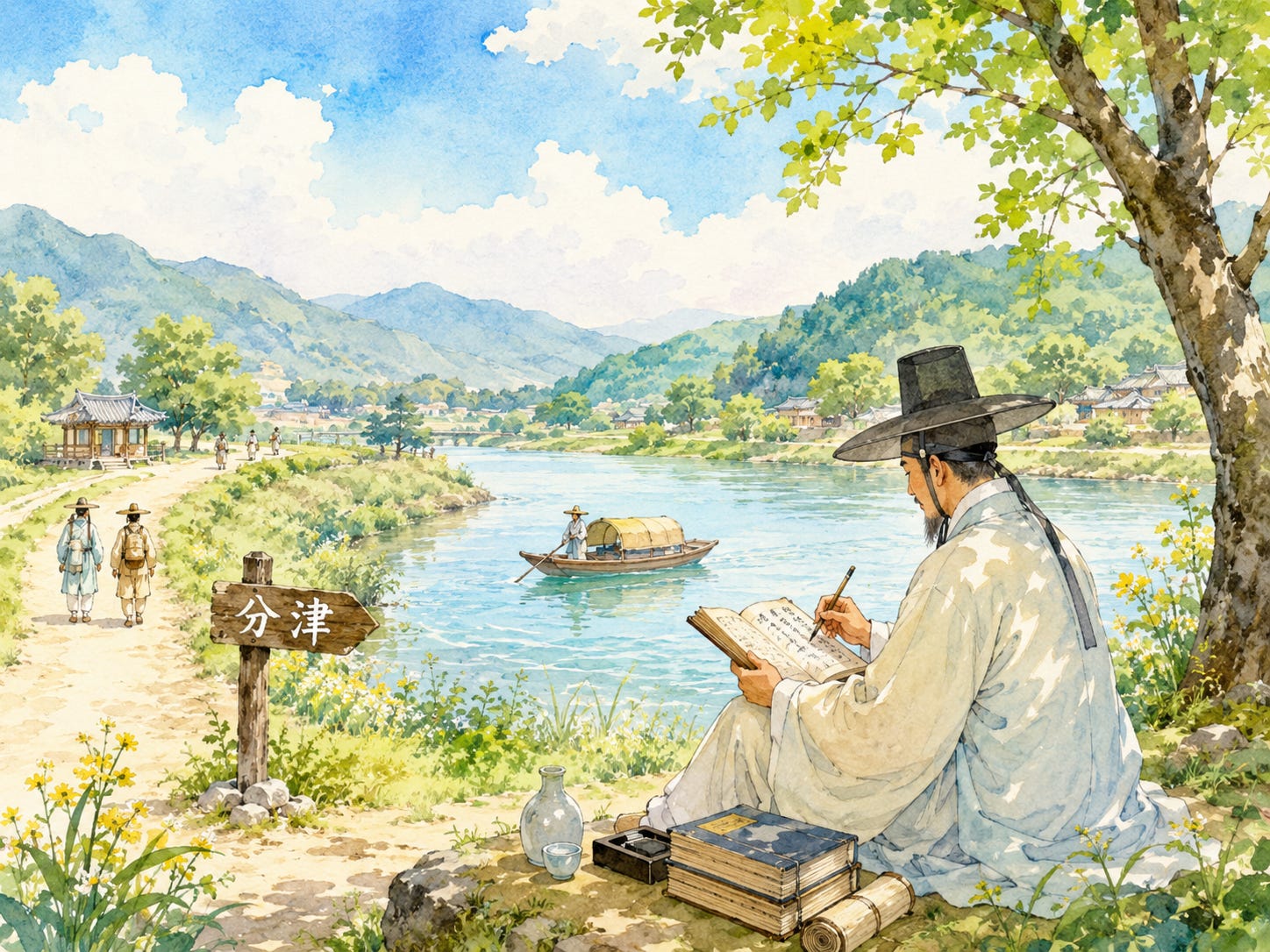
Reading Volume 6, “Bunjinrok” of the Gani-jip, feels less like opening a scholarly text and more like unfolding a personal travel journal written along the road of life. These writings are not merely records of journeys; they are traces of moments when the author quietly observes people and nature, and reflects inwardly on his own existence.
Choi Rip appears not only as a government official or literary figure, but as a human being walking through the world. He crosses rivers, passes ferry crossings, travels through mountains and villages, and records each moment with calm attention. Yet within these simple descriptions lies something deeper than scenery: a reflection on life itself and the meaning of human existence.
One of the most striking impressions while reading is the sense of “slow time.” Unlike today’s world of rapid movement and instant information, the time in these writings flows gently. The author pauses by riversides to watch the water, greets people he meets on the road, and fully experiences the changing seasons. In this slowness, the reader is invited to think more deeply and attentively.
Another notable feature is the inseparable relationship between nature and humanity. Rivers, mountains, wind, and clouds are not mere background settings; they feel like living companions. Nature becomes a mirror of emotion, and human feelings are reflected through its changes. Rain carries sadness, while still waters at dusk embody quiet reflection. In this way, nature becomes a philosophical language of life itself.
The people encountered in “Bunjinrok” also carry significant meaning. Friends met briefly, passersby, and traveling companions all appear as fleeting yet meaningful moments of human connection. These relationships are not elaborated in detail, yet their brevity creates a deeper resonance. They remind us that the essence of human relationships lies not in long explanations, but in sincere moments shared along the way.
This work is both a record of observation and a record of reflection. The author does not stop at what he sees; he continually asks what these moments mean and why they appear before him. Thus, “Bunjinrok” becomes not only a map of the external world but also a map of the inner self.
After reading, one naturally wonders whether our own lives are also a form of “bunjin”—a series of crossings, encounters, departures, and new directions. What matters most is not the destination, but what we observe along the way, whom we meet, and what we come to understand.
“Bunjinrok” is not a book of dramatic events or grand narratives. Yet within its quiet tone lies a profound resonance. Like a gently flowing river, it slowly permeates the reader’s mind.
In the end, one simple thought remains:
“Life is ultimately a record written along the road, and each of us is writing our own Bunjinrok.” +++
{Solti}
July 11, 2026
간이집 제6권 「분진록」 독후감 — 길 위에서 만난 삶의 얼굴들
『간이집』 제6권 「분진록」을 읽으면, 한 권의 책이라기보다 한 사람의 “길 위의 일기장”을 펼쳐보는 느낌이 든다. 이 글들은 단순히 여행의 기록이 아니라, 길을 걸으며 마주한 사람과 자연, 그리고 그 속에서 조용히 자신을 되돌아보는 사유의 흔적이다.
저자 최립은 관료이자 문인이었지만, 「분진록」 속에서는 직함보다 “길을 걷는 한 인간”으로 다가온다. 그는 강을 건너고, 나루를 지나고, 산과 마을을 오가며 순간순간의 장면을 담담하게 기록한다. 그러나 그 기록 속에는 단순한 풍경 묘사 이상의 것이 있다. 눈에 보이는 세계를 통해 삶의 무게와 인간 존재의 의미를 함께 바라보고 있기 때문이다.
책을 읽다 보면 가장 먼저 느껴지는 것은 “느림의 시간”이다. 오늘날처럼 빠르게 이동하고 즉각적으로 정보를 소비하는 시대와 달리, 그의 글 속 시간은 천천히 흐른다. 강가에서 잠시 멈춰 서서 물결을 바라보고, 길에서 만난 사람과 짧은 인사를 나누며, 계절의 변화를 온몸으로 받아들이는 시간이다. 이 느린 흐름 속에서 독자는 오히려 더 깊은 생각을 하게 된다.
또 하나 인상적인 점은 자연과 인간이 분리되지 않는다는 것이다. 강과 산, 바람과 구름은 단순한 배경이 아니라 함께 호흡하는 존재처럼 묘사된다. 자연은 감정의 거울이 되고, 인간의 마음은 자연의 변화 속에서 드러난다. 슬픔은 비가 되고, 고요함은 저녁 강물처럼 번진다. 이러한 표현은 자연을 단순한 경관이 아니라 삶의 철학적 언어로 바꾸어 놓는다.
「분진록」에서 만나는 사람들도 중요한 의미를 가진다. 벗과의 짧은 만남, 스쳐 지나가는 백성들, 함께 길을 걷는 동행자들은 모두 하나의 “인연의 장면”으로 기록된다. 그 관계들은 길게 설명되지 않지만, 오히려 그 짧음 때문에 더 깊은 여운을 남긴다. 인간관계의 본질은 길고 화려한 설명이 아니라, 순간의 진심이라는 것을 보여준다.
이 책은 또한 관찰의 기록이면서 동시에 성찰의 기록이다. 저자는 단순히 “무엇을 보았는가”에 머물지 않고, “왜 이것을 보게 되었는가”, “이 순간이 내게 무엇을 의미하는가”를 끊임없이 묻는다. 그래서 「분진록」은 외부 세계의 기록이면서 동시에 내면 세계의 지도이기도 하다.
읽고 나면 자연스럽게 이런 생각이 남는다. 우리의 삶도 사실은 하나의 긴 “분진”이 아닐까. 계속 선택하고, 만나고, 떠나고, 다시 길을 찾는 과정 속에서 우리는 끊임없이 자신을 만들어 간다. 결국 중요한 것은 목적지보다 그 길 위에서 무엇을 보고, 누구를 만나며, 어떤 마음을 품었는가일 것이다.
「분진록」은 화려한 사건이나 극적인 서사가 있는 책은 아니다. 그러나 그 담담함 속에서 오히려 더 깊은 울림이 있다. 조용히 흐르는 강물처럼, 이 글은 읽는 사람의 마음을 천천히 적셔 들어온다.
마지막으로 이 책을 덮으며 남는 생각은 단순하다.
“삶은 결국 길 위의 기록이며, 우리는 모두 각자의 분진록을 써 내려가고 있다.” +++
{솔티}
2026년 7월 11일

Prof. Dr. Young Choi (Editor in Chief) — Regent University
Young B. Choi is a Professor in the Department of Engineering & Computer Science at Regent University. He published 38 books with ‘Selected Readings in Cybersecurity’ (2018) (over 800 copies archived globally at university/college libraries around the world) and ‘Cybersecurity Applications and Artificial Intelligence’ (2023) available in seven major world languages. He proposed the world’s first global and universal telecommunications “Service Order Handling (SOH)” Model (T-SOH Model) (1995) with Dr. Adrian Tang. With this innovative research work, he received the IEEE NOMS ’96 Best Paper Award and became the first recipient of the Outstanding Contribution Award of the TeleManagement Forum in 1998. His research areas include Natural Language Processing-focused AI, AI-applied cybersecurity, network and telecom service management, and Korean studies on Gani Choi Rip’s Jeonggwan (靜觀: Quiet Contemplation) philosophy and Shilhak ( 實學: Practical Learning).