
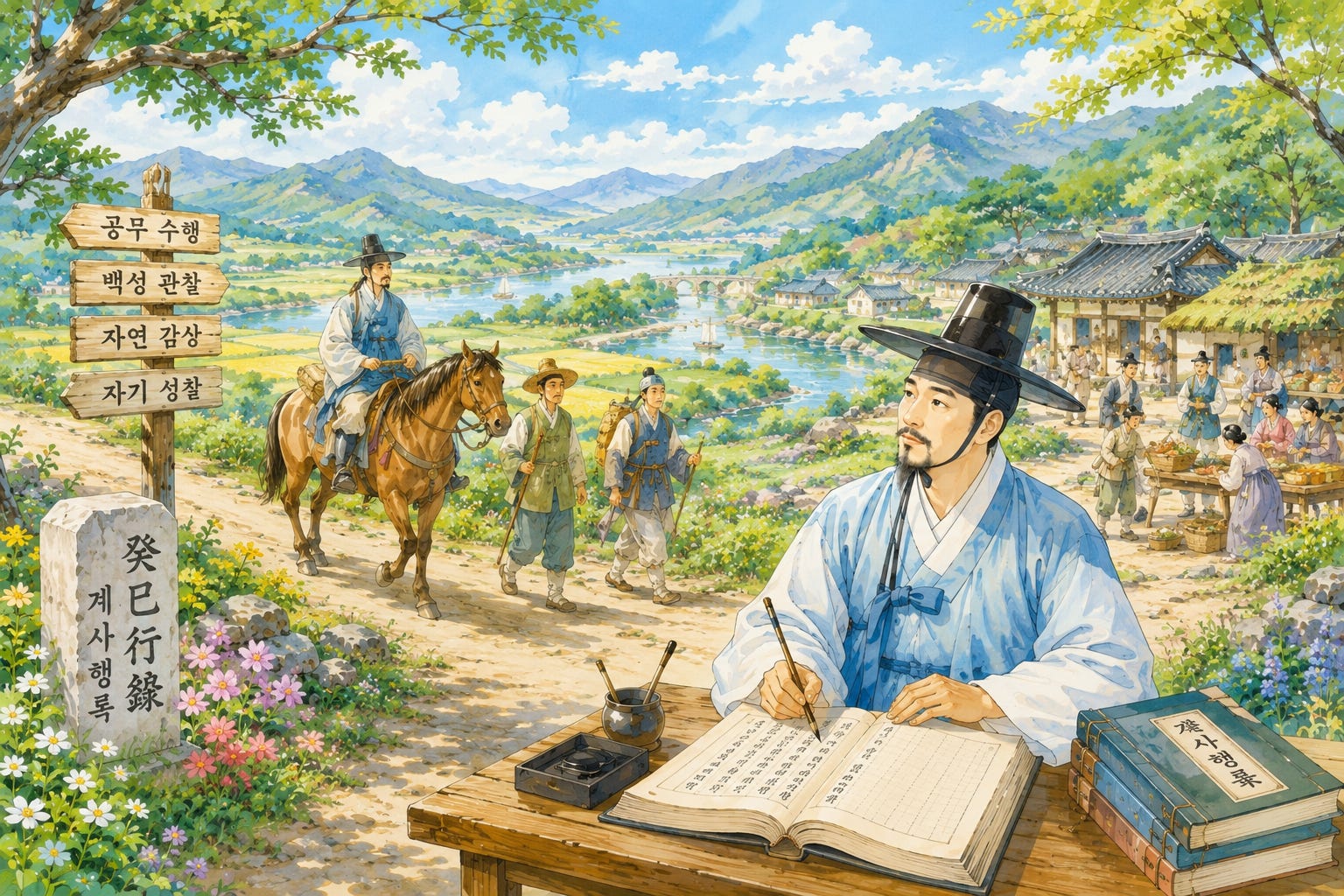
As I read Gyesahaengnok (Record of the Journey in the Gyesa Year) in Volume 6 of Gani-jip, the first thought that came to mind was that a journey is not merely a path to a destination, but a school where one learns about the world. Today, we travel quickly by car or airplane, but in the Joseon era, travel was a process of encountering people, landscapes, and new ideas. Gyesahaengnok is a record of the observations and reflections gained through such a journey.
At first, I expected the work to be a simple travel diary. However, as I continued reading, I realized that it was much more than a record of movement. It is the story of a scholar-official who viewed the world while carrying out the responsibilities of the state. As Choi Rip traveled, he observed mountains and rivers, met local officials, examined the lives of ordinary people, and carefully recorded his thoughts. More than emotional expression, what stands out in his writing is the depth of his observation.
What impressed me most was his concern for the lives of common people. He did not merely admire beautiful scenery. He paid close attention to farmers working in the fields, the atmosphere of local markets, and the daily lives of residents. Through these observations, he sought to understand the realities of the nation. This reminded me that a true scholar is not simply someone who reads books, but someone who understands the lives of the people and cares about society.
Another remarkable aspect of Gyesahaengnok is its vivid portrayal of nature. Majestic mountains, clear rivers, endless roads, and the changing seasons bring a sense of peace to the reader. The landscapes are not merely backgrounds to the journey; they seem to reflect the author’s inner thoughts and emotions. Surrounded by nature, Choi Rip appears to find moments of quiet reflection amid the complexities of public life.
Reading this work also made me think about modern life. We move quickly from one task to another, often too busy to notice the world around us. In our focus on reaching destinations, we sometimes overlook the valuable experiences found along the way. Gyesahaengnok teaches us that the journey itself can be a source of learning. By slowing down, meeting people, and observing nature, we gain a deeper understanding of the world and ourselves.
Another lesson that resonated with me was Choi Rip’s humility. He never boasts about his knowledge or social position. Instead, he presents himself as someone who continues to learn and reflect throughout his travels. This attitude remains relevant today. No matter how much we think we know, the world always offers new opportunities for growth and understanding.
The work also highlights a strong sense of public responsibility. While carrying out official duties, Choi Rip never loses sight of the people he serves. He carefully records the conditions of society and reflects on the responsibilities of government. Through his example, readers are encouraged to think about what it means to be a responsible leader and a conscientious citizen.
Ultimately, Gyesahaengnok is far more than a travel journal or an official report. It is a record of personal growth through travel—a journey of learning about the world, understanding people, and reflecting upon oneself. Although written more than four centuries ago, its message continues to resonate with modern readers.
After finishing the book, one question remained in my mind:
“Where am I going in life, and what am I learning along the way?”
Perhaps this is the most valuable lesson that Gyesahaengnok offers to readers today—a reminder that every journey, whether physical or spiritual, is an opportunity for discovery, wisdom, and self-reflection. +++
{Solti}
July 21, 20026
『간이집』 제6권 「계사행록」을 읽고
『간이집』 제6권에 수록된 「계사행록(癸巳行錄)」을 읽으며 가장 먼저 느낀 것은 “길은 단순히 목적지로 가는 공간이 아니라 세상을 배우는 학교”라는 점이었다. 오늘날 우리는 자동차나 비행기를 타고 빠르게 이동하지만, 조선 시대의 여행은 수많은 사람과 풍경, 그리고 생각을 만나는 과정이었다. 「계사행록」은 바로 그러한 여정 속에서 얻은 관찰과 성찰의 기록이다.
처음에는 이 글이 단순한 여행기일 것이라고 생각했다. 그러나 읽을수록 그것은 단순한 이동 기록이 아니라 한 선비가 국가의 일을 수행하면서 세상을 바라본 이야기라는 것을 알게 되었다. 최립은 길을 걸으며 산과 강을 바라보고, 지방의 관리들을 만나고, 백성들의 생활을 살피며 자신이 느낀 바를 차분하게 기록한다. 그의 글에서는 화려한 감정보다 깊은 관찰력이 더 크게 느껴진다.
특히 인상적이었던 것은 백성들의 삶에 대한 관심이었다. 그는 단순히 아름다운 풍경만을 감상하지 않았다. 농부들이 일하는 모습, 시장의 분위기, 지방 사람들의 생활상을 세심하게 살펴보며 나라의 현실을 이해하려고 노력했다. 이를 통해 선비란 단지 글만 읽는 사람이 아니라 백성들의 삶을 이해하고 사회를 살피는 사람이라는 사실을 깨닫게 되었다.
또한 「계사행록」에는 아름다운 자연 풍경이 자주 등장한다. 높은 산과 맑은 강, 끝없이 이어지는 길과 계절의 변화는 읽는 사람의 마음까지 편안하게 만든다. 특히 이동하는 동안 바라본 자연은 단순한 배경이 아니라 최립의 마음을 비추는 거울처럼 느껴졌다. 자연 속에서 그는 세상의 복잡함을 잠시 내려놓고 자신을 돌아보는 시간을 가졌던 것 같다.
이 작품을 읽으며 현대인의 삶도 떠올랐다. 우리는 매일 바쁘게 움직이지만 정작 주변을 자세히 바라볼 여유를 잃고 살아가는 경우가 많다. 목적지만 바라보며 달려가다 보니 길에서 만나는 소중한 경험들을 놓치기도 한다. 그러나 「계사행록」은 이동하는 과정 자체가 배움의 시간이 될 수 있다는 사실을 알려 준다. 천천히 걷고, 사람들을 만나고, 자연을 바라보는 가운데 더 넓은 세상을 이해하게 된다는 것이다.
또 하나 감명 깊었던 점은 최립의 겸손한 태도였다. 그는 자신의 지식이나 지위를 과시하지 않는다. 오히려 여행을 통해 배우고 성찰하는 모습을 보여 준다. 이러한 자세는 오늘날에도 중요한 교훈이 된다. 아무리 많은 것을 알고 있다고 생각해도 세상은 늘 새로운 배움의 기회를 제공하기 때문이다.
「계사행록」은 여행의 즐거움뿐 아니라 공직자로서의 책임감도 함께 보여 준다. 그는 국가의 임무를 수행하면서도 백성을 살피고 현실을 기록하는 일을 잊지 않는다. 이러한 모습에서 진정한 지도자와 지식인의 자세가 무엇인지 생각해 보게 되었다.
결국 「계사행록」은 단순한 출장 기록이나 여행기가 아니다. 그것은 길 위에서 세상을 배우고, 사람을 이해하며, 자신을 돌아보는 성장의 기록이다. 수백 년 전의 이야기이지만 오늘날 독자들에게도 깊은 울림을 준다.
책을 덮고 난 뒤 내 마음속에는 이런 질문이 남았다.
“나는 지금 어디를 향해 가고 있으며, 그 길에서 무엇을 배우고 있는가?”
아마도 이 질문이야말로 「계사행록」이 오늘날 우리에게 전해 주는 가장 소중한 메시지일 것이다. +++
2026년 7월 21일
{솔티}

Prof. Dr. Young Choi (Editor in Chief) — Regent University
Young B. Choi is a Professor in the Department of Engineering & Computer Science at Regent University. He published 38 books with ‘Selected Readings in Cybersecurity’ (2018) (over 800 copies archived globally at university/college libraries around the world) and ‘Cybersecurity Applications and Artificial Intelligence’ (2023) available in seven major world languages. He proposed the world’s first global and universal telecommunications “Service Order Handling (SOH)” Model (T-SOH Model) (1995) with Dr. Adrian Tang. With this innovative research work, he received the IEEE NOMS ’96 Best Paper Award and became the first recipient of the Outstanding Contribution Award of the TeleManagement Forum in 1998. His research areas include Natural Language Processing-focused AI, AI-applied cybersecurity, network and telecom service management, and Korean studies on Gani Choi Rip’s Jeonggwan (靜觀: Quiet Contemplation) philosophy and Shilhak ( 實學: Practical Learning).