
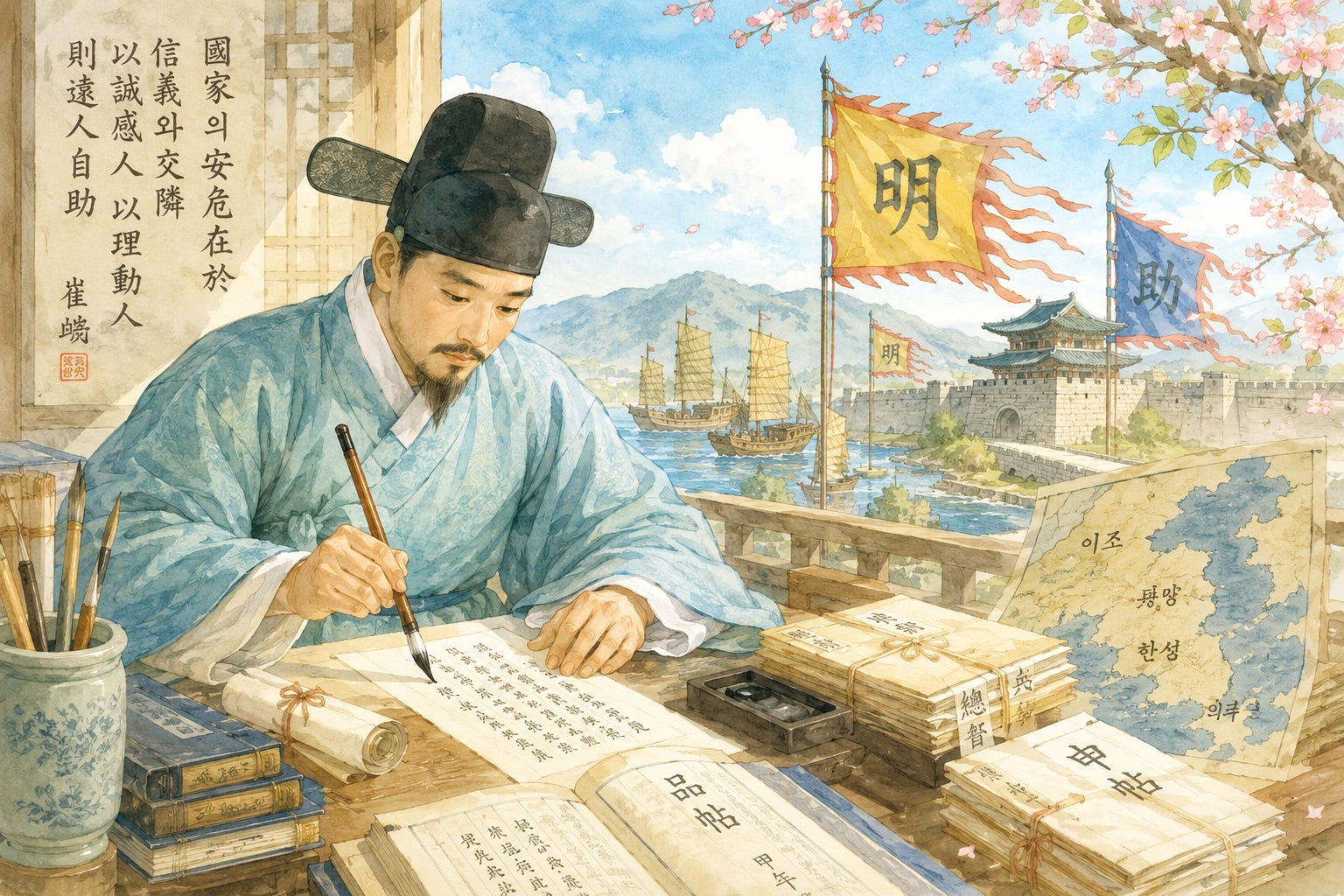
There are moments in reading when one realizes that something can be more powerful than a sword. Volume 4 of Gani-jip (The Collected Works of Choi Rip) offers precisely such a realization. At first glance, the table of contents appears dry and administrative, filled with titles such as “Memorial Submitted to the Ministry of Rites,” “Letter to the Ministry of War,” and various official memoranda and reports. Yet as I read each document within its historical context, I discovered that this was far more than a collection of bureaucratic correspondence. It was the record of an intellectual who fought tirelessly to safeguard his nation during one of the most perilous periods in Korean history.
At the heart of Volume 4 are diplomatic documents exchanged between Choi Rip (1539–1612) and officials of the Ming dynasty. Many of these writings were composed during the years surrounding the Imjin War (1592–1598), when Korea faced a devastating Japanese invasion. The country was ravaged, countless people lost their homes, and even the king was forced to flee. The survival of the nation itself seemed uncertain. In this desperate situation, Joseon depended heavily on military assistance from Ming China. Serving as both scholar and statesman, Choi Rip continually communicated with Ming officials in the Ministry of Rites, the Ministry of War, regional governors, commanders, and military commissioners, explaining Joseon’s plight and requesting aid on behalf of his country.
What impressed me most was Choi Rip’s extraordinary command of language. His writings are not mere reports of facts. They combine courtesy, logic, persuasion, and sincerity. At times he writes with humility; at other moments, with urgency and determination. His prose is elegant yet purposeful, never seeking literary beauty for its own sake. Every sentence is guided by a concern for the welfare of his nation and its people. Through his words, one can sense the heavy burden of responsibility he carried.
Another striking aspect of these documents is Choi Rip’s view of diplomacy. He did not regard diplomacy merely as a transaction between governments. Instead, his writings reveal a deep respect for human relationships, trust, and moral obligation. Rather than relying solely on political calculations, he appealed to principles of justice, loyalty, and mutual responsibility. Rooted in the Confucian values of the Joseon scholar-official, his diplomatic philosophy emphasized ethical conduct as the foundation of international relations. Even in today’s world, where trust remains an essential asset in diplomacy, his approach retains remarkable relevance.
This volume also provides a fresh perspective on the Imjin War itself. When discussing the war, people often think first of military victories such as Admiral Yi Sun-sin’s naval triumphs or General Gwon Yul’s defense at Haengju Fortress. Yet wars are not fought only on battlefields. They are also fought through negotiations, correspondence, and alliances. Choi Rip’s documents illuminate this often-overlooked diplomatic front. They reveal how much persuasion, coordination, and administrative effort were required before Ming troops could be mobilized and dispatched to assist Joseon.
Reading these texts also led me to reflect on the immense psychological pressure Choi Rip must have faced. A single misplaced phrase could have caused diplomatic misunderstandings. One document might influence decisions affecting the fate of an entire nation. Nevertheless, he fulfilled his duties with unwavering dedication. He was not merely a gifted writer; he was a public servant deeply committed to his responsibilities. Though he wielded a brush rather than a sword, his pen was guided by a profound sense of mission.
The volume contains various forms of official communication, including pumcheop (formal reports), sincheop (petitions), byeolcheop (supplementary memoranda), and gyecheop (official notices). At first, these forms seemed repetitive and unfamiliar. Gradually, however, I came to understand them as essential components of the diplomatic and administrative system of the time. Each served a distinct purpose, reflecting the sophisticated network through which Joseon and Ming officials communicated. These documents are not merely historical records; they are living evidence of East Asia’s diplomatic culture in the late sixteenth century.
More than anything else, this volume reminds readers of the enduring power of words. In the modern world, an email, report, or official statement can influence policies and shape organizations. Choi Rip’s writings demonstrate that language is not simply a tool for communication; it can be a force capable of shaping history itself. His documents continue to teach the importance of responsible and thoughtful communication more than four centuries after they were written.
Another source of admiration is the harmonious balance between Choi Rip’s scholarship and practical ability. He was both a distinguished literary figure and an effective problem solver. His writings combine literary refinement with administrative precision, reflecting the highest ideals of Joseon intellectual culture. In many ways, his work foreshadows the spirit of Silhak (Practical Learning), which later emphasized the application of knowledge to real-world challenges.
Today we live in an era defined by artificial intelligence, digital transformation, and rapid technological change. Yet regardless of how advanced technology becomes, the ability to build trust, persuade others, and act responsibly for the common good remains fundamentally human. Choi Rip’s diplomatic writings remind us that technology is merely a tool; wisdom, integrity, and character are what ultimately determine its value. His example demonstrates that human judgment and ethical leadership will always remain indispensable.
Volume 4 of Gani-jip is therefore much more than a collection of diplomatic documents. It is the story of a scholar-statesman who sought to defend his nation through the power of the written word. It is also a vivid record of the diplomatic exchanges between Joseon and Ming China during a time of national crisis. Through this volume, I gained a deeper appreciation for the importance of diplomacy, the responsibility of public service, and the transformative power of language. Choi Rip’s writings transcend their historical moment, offering timeless lessons on communication, leadership, and public responsibility that continue to resonate in our own age. +++
{Solti}
June 14, 2026
《국역 간이집》 제4권을 읽고
전쟁과 외교의 최전선에서 피어난 붓의 힘
책을 읽다 보면 때때로 칼보다 강한 것이 있다는 사실을 깨닫게 된다. 《국역 간이집》 제4권은 바로 그러한 깨달음을 주는 책이다. 처음 목차를 펼쳤을 때는 ‘예부에 올린 글’, ‘병부에 올린 글’, ‘품첩’, ‘신첩’과 같은 제목들이 반복되어 다소 딱딱한 외교 문서집처럼 보였다. 그러나 한 편 한 편의 글이 작성된 시대적 배경을 이해하면서 읽어 나가자, 이것은 단순한 공문서가 아니라 나라의 운명을 지키기 위해 분투한 한 지식인의 기록임을 알게 되었다.
제4권의 중심에는 최립(崔岦)과 명나라 관리들 사이에 오간 외교 문서들이 있다. 특히 임진왜란 전후의 긴박한 상황 속에서 작성된 글들이 많다. 당시 조선은 일본의 침략으로 국토가 유린되고 백성들은 삶의 터전을 잃었다. 국왕은 피난길에 올라야 했고, 나라의 존망 자체가 불확실한 상황이었다. 이러한 위기 속에서 조선은 명나라의 원군과 지원을 절실히 필요로 했다. 최립은 사신과 관료의 위치에서 예부, 병부, 총독, 순무, 제독 등 여러 명나라 관리들에게 끊임없이 글을 보내며 조선의 사정을 설명하고 도움을 요청하였다.
이 책을 읽으며 가장 먼저 느낀 것은 최립의 뛰어난 문장력이다. 그의 글은 단순한 사실 보고가 아니다. 상대방을 존중하는 예의를 갖추면서도 조선의 절박한 상황을 설득력 있게 전달한다. 때로는 정중하게, 때로는 간곡하게, 때로는 논리적으로 상대를 움직이려 한다. 문장은 유려하지만 결코 화려함에 머물지 않는다. 국가의 이익과 백성의 안위를 위한 진심이 글 곳곳에 배어 있다.
특히 인상 깊었던 점은 최립이 외교를 단순히 국가 간의 거래로 보지 않았다는 사실이다. 그의 글에는 인간에 대한 존중과 신뢰가 담겨 있다. 상대를 설득하기 위해 감정을 자극하기보다 도리와 의리를 강조한다. 이는 유교적 가치관을 바탕으로 한 조선 선비의 외교 철학을 잘 보여 준다. 오늘날 국제사회에서도 신뢰와 도덕성이 중요한 외교 자산이라는 점을 생각하면, 최립의 태도는 시대를 초월한 의미를 지닌다.
또한 이 책은 임진왜란이라는 역사적 사건을 새로운 시각에서 보게 만든다. 우리는 흔히 전쟁을 이야기할 때 이순신의 해전이나 권율의 행주대첩과 같은 군사적 승리를 먼저 떠올린다. 그러나 전쟁은 전장(戰場)에서만 치러지는 것이 아니다. 외교의 무대에서도 치열한 전쟁이 계속된다. 최립의 문서들은 바로 그 보이지 않는 전쟁의 기록이다. 명나라의 지원군이 조선에 도착하기까지 얼마나 많은 설득과 협상, 그리고 행정 절차가 필요했는지를 보여 준다.
책을 읽으며 최립이 감당했을 정신적 부담도 상상해 보게 되었다. 한 번의 잘못된 표현이 외교적 오해를 낳을 수 있었고, 한 장의 문서가 국가의 운명에 영향을 미칠 수도 있었다. 그럼에도 그는 흔들림 없이 자신의 역할을 수행했다. 이는 단순한 문장가가 아니라 책임감 있는 공직자의 모습이었다. 그는 붓을 들었지만 그 붓끝에는 나라를 지키려는 사명감이 담겨 있었다.
제4권에는 ‘품첩’, ‘신첩’, ‘별첩’, ‘계첩’과 같은 다양한 형식의 문서가 등장한다. 처음에는 낯설고 반복적으로 보였지만, 차츰 그것들이 당시 외교 행정 체계의 일부임을 이해하게 되었다. 각각의 문서는 목적과 형식이 달랐고, 이를 통해 조선과 명나라가 얼마나 정교한 외교 네트워크를 운영했는지 알 수 있었다. 이러한 문서들은 단순한 기록이 아니라 당시 국제관계의 살아 있는 증거였다.
무엇보다도 이 책은 말과 글의 힘을 다시 생각하게 만든다. 현대 사회에서는 이메일 한 통, 보고서 한 장이 조직의 방향을 바꾸기도 한다. 최립이 남긴 문서들은 글이 단순한 의사소통 수단이 아니라 역사와 사회를 움직이는 힘이 될 수 있음을 보여 준다. 그의 글은 수백 년이 지난 오늘날에도 독자들에게 책임 있는 소통의 중요성을 일깨워 준다.
또 다른 감동은 최립의 학문과 실무 능력이 조화를 이루었다는 점이다. 그는 뛰어난 문인이면서도 현실 문제를 해결하는 실천적 지식인이었다. 문학적 수사와 행정적 정확성을 동시에 갖춘 그의 글은 조선 선비 문화의 높은 수준을 보여 준다. 이는 훗날 실학 정신으로 이어지는 조선 지성사의 중요한 한 단면이라고 생각된다.
오늘날 우리는 인공지능과 디지털 기술이 급속히 발전하는 시대를 살고 있다. 그러나 아무리 기술이 발전하더라도 사람을 설득하고 신뢰를 구축하며 공동체를 위해 책임 있게 행동하는 능력은 여전히 중요하다. 최립의 외교 문서는 이러한 인간적 역량의 가치를 새삼 일깨워 준다. 기술은 도구일 뿐이며, 그것을 사용하는 인간의 지혜와 품격이 더 중요하다는 사실을 보여 준다.
《국역 간이집》 제4권은 단순한 외교 문서집이 아니다. 그것은 국가적 위기 속에서 붓으로 나라를 지키려 했던 한 지식인의 기록이며, 조선과 명나라가 함께 만들어 낸 역사적 교류의 현장이다. 이 책을 통해 나는 전쟁의 또 다른 얼굴인 외교의 중요성을 배우게 되었고, 말과 글이 얼마나 큰 힘을 가질 수 있는지도 깨닫게 되었다. 최립의 문장은 과거의 기록에 머물지 않고 오늘날 우리에게도 책임 있는 소통과 공공정신의 가치를 전하는 살아 있는 메시지로 다가온다. +++
{솔티}
2026년 6월 14일

Young Choi, PhD is a Professor at Regent University bringing a rare combination of technical expertise and creative spirit to everything he does. A scholar in AI, cybersecurity, and network & telecommunications service management, he has published 38 books including AI and cybersecurity area books, over 200 refereed articles, and over 20 book chapters. Beyond the academy, Dr. Choi is a passionate poet, essayist, calligrapher, and wooden block laser engraving artist whose reflective writing invites readers to rediscover life’s beauty in quiet contemplation(靜觀). He lives under the motto: “Study hard and give generously without holding back! (열심히 공부해서 아낌없이 남주자 !: 열공아남!)”
Published books: https://www.amazon.com/stores/Young-Choi/author/B0DMZ5S6R7?ref=ap_rdr&shoppingPortalEnabled=true