Kim, Richard E. The Martyred. 1964. Penguin Books, 2011. ISBN 978-0143106401. 240 pages, $17.00.
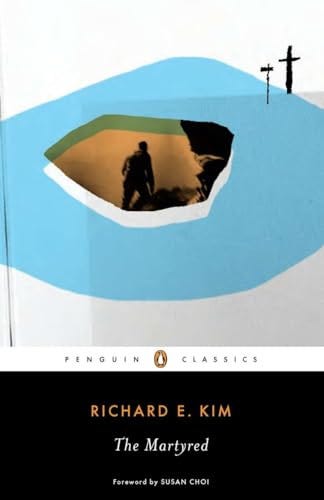
Cover image: The Martyred by Richard E. Kim. Image reproduced for purposes of review and commentary.
Richard E. Kim’s The Martyred occupies a foundational place in Korean American literature. Originally published in 1964, it was Kim’s debut novel and established him as one of the founding figures of the genre. The book has been described in multiple ways. It has been portrayed as a war story, a religious novel, and a philosophical treatise, to name a few. In her 2011 foreword to the book, Susan Choi, author of The Foreign Student, argues: “Richard E. Kim’s The Martyred is no more ‘about’ the Korean War than Antigone is ‘about’ the civil war in Thebes. […] The work of art need not be ‘about’ anything because it is ‘about’ everything. In The Martyred Kim forges a drama of such devastating universality that an electrifying sense of recognition binds us to the page […]” (xiv). Rather than spending time on various battles in the war, Kim transforms this story into an existential struggle so compelling that it captures the reader’s heart and soul.
Born in Hamhung, Korea (now part of North Korea), Richard E. Kim spent his childhood during the final years of the Japanese occupation. He later served in the Republic of Korea Marine Corps before immigrating to the United States in 1955. Kim earned a B.A. in Political Science from Middlebury College, an M.A. in Writing from Johns Hopkins University, an M.F.A. from the University of Iowa Writers’ Workshop, and an M.A. in Far Eastern Languages and Literature from Harvard University. During his distinguished academic career, he taught at several universities, including the University of Massachusetts at Amherst, Syracuse University, San Diego State University, and Seoul National University, where he served as a Fulbright Scholar. Beyond academia, Kim worked as a reporter-narrator for KBS-TV in Seoul and as a columnist for The Korea Herald and The Chosun Ilbo. His literary and scholarly achievements were recognized with numerous honors, including a Ford Foundation Fellowship, a Guggenheim Fellowship, and a National Endowment for the Arts Literary Fellowship.
The story, The Martyred, is set in the early days of the Korean War. Captain Lee, a South Korean army intelligence officer, is ordered to investigate the execution of twelve Christian ministers by Communist forces in North Korea. The government hopes to portray these ministers as heroic martyrs to strengthen public morale. But as Lee delves into the tragedy, he discovers that the situation was much more complicated than it may have initially appeared. He interviews two surviving ministers, including Reverend Shin, who eventually reveals that the ministers were not the flawless heroes they were being portrayed. Shin also confesses that he himself has been struggling with his own faith for a long time. Nevertheless, Shin chooses to continue to preserve the myth of their martyrdom believing that people devastated by war need hope more than factual accuracy.
As indicated earlier, the book is not primarily about the Korean War. Rather, Kim transforms the battlefield into a philosophical arena where questions of truth, faith, and identity are tested under the most extreme circumstances. It can be described as a combination of an existential novel, theological inquiry, and political allegory. However, while all these descriptions are correct, they do not fully capture the book’s complexity. Rather than simply being a historical novel, it is a profound meditation on truth, moral responsibility, and the nature of faith. The setting is not about skirmishes, military maneuvers, or the chaotic back-and-forth movement of the war; it is much more about the interior, existential struggles within the consciences of men.
If there is one organizing principle that is consistent throughout Kim’s story, it is the search for truth. Captain Lee begins his investigation believing that truth is something objective, discovered through evidence, like the German concept of Erklären, which refers to explaining the reasons behind an event. In other words, what really happened to the twelve ministers? Yet he finds that each discovery makes the truth more complicated. Testimonies contradict each other. Some people hide information. Others tell only partial truths. Political leaders manipulate the facts for ideological reasons.
Kim plays with the concept of truth to reveal that it is never just one thing. In fact, Lee discovers multiple layers of truth occurring simultaneously: historical truth, political truth, personal truth, psychological truth, and spiritual truth. These different truths often conflict with one another rather than reinforcing each other. Reverend Shin believes that spiritual truth transcends all others, including factual accuracy. Even if the ministers lost faith at the end, preserving the image of their martyrdom may ultimately save the spiritual foundations of many believers. Lee seeks the truth, but by the end of the novel he realizes that people remember and live by stories rather than facts.
One of the obvious ideas Kim wishes to articulate is the complexity of the Christian faith. Almost every character in the story struggles with some tenuous relationship to faith. Captain Lee considers himself an unbeliever but keeps asking important theological questions. His admiration for Reverend Shin demonstrates Lee’s respect for believers. However, even though Shinn appears to possess a strong faith, he carries overwhelming doubts at times. Rather than portraying faith as certain, Kim presents faith alongside uncertainty. Genuine faith is never without doubt but perseveres despite it.
If there is a particular theology represented in The Martyred, it is part of a tradition associated with theologian-philosophers and writers like Søren Kierkegaard, Fyodor Dostoevsky, and Gabriel Marcel, who argued that faith is subjective, individual, and often paradoxical. Although the novel has deeply Christian subject matter, its philosophical undergirding is profoundly existential. Captain Lee repeatedly confronts questions that have no satisfactory answers: Why do innocent people suffer? Why is God silent? Can morality survive war? These are the kinds of questions also addressed by secular existentialists such as Albert Camus and Jean-Paul Sartre, who explore the ambiguity of human existence. Kim presents existence as morally ambiguous, and his story of the Korean War is less a military conflict than a testing ground for the human soul, where every character must find meaning within a chaotic existence.
Kim’s approach is so evenhanded and candid in the story that it leads to complicated and difficult moral dilemmas. He unveils many secrets and uncovers multiple deceits created by the conflict. He is fair-minded regardless of which side he is considering. This leads to an increased sense of confusion on the part of his main protagonist Captain Lee so that ambiguity becomes a key theme in all his attempts to discover the truth. Each time he asks a question about what might be true or what is the right thing to do, a new level of complexity emerges, and Lee’s confidence slowly dissolves. His intellectual disorientation mirrors his spiritual crisis. By the end, he finally understands that there is no resolution, no comforting answers. Lee begins to realize that moral maturity requires a willingness to live without certainty. The Martyred portrays a journey much like the classical Bildungsroman, a novel of moral and psychological development, found in works such as Jane Eyre by Charlotte Brontë and Great Expectations by Charles Dickens.
Interestingly, Reverend Shin seems more willing to accept ambiguity and misunderstanding. His moral stance is one of sacrificial compassion. Shin is willing to allow others to believe what may not be factually accurate. Yet his silence is neither cowardice nor a lack of moral fortitude. Rather, it is a deliberate act of self-denial, a willingness to sacrifice his own reputation to preserve hope for his congregation. Here Kim deliberately complicates traditional understandings of martyrdom. Ironically, the true martyr in the novel may not be the one who dies for the faith, but the survivor who accepts shame rather than destroy the faith of many. Kim ultimately asks whether dying for the truth is more courageous than living with an unbearable truth.
As has already been mentioned, The Martyred contains little about battlefield actions or images of violence. The real conflict seems to occur within individual consciences. Most references to the war concern the ways it strips away comforting illusions. It exposes fear and, in this novel, reveals hypocrisy. Captain Lee’s investigation uncovers many hidden motives and deceits. For Kim, the Korean War is symbolic of the struggle over moral decisions that ultimately shape an entire way of life. Violence is referenced primarily in terms of its effect on belief. Thus, the battlefield becomes a testing ground for universal philosophical questions about faith, suffering, political responsibility, and moral integrity.
The Martyred, after many years, remains a profound philosophical exploration of the internal struggles of war. It refuses easy answers to the big questions that have troubled theologians and philosophers for centuries. Rather than providing simple resolutions to the tensions between faith and doubt, truth and error, or justice and compassion, Kim makes it clear that moral maturity develops only when individuals choose to live faithfully amid uncertainty. In the end, readers understand that the mystery of the martyred is not whether the twelve ministers kept the faith, but whether flawed human beings can preserve hope and compassion in a world torn by war. More than six decades after its publication, the novel continues to challenge readers because its questions remain as urgent as ever. As one of the foundational works of Korean American literature, The Martyred demonstrates how a story rooted in the Korean War transcends its historical setting to become a timeless meditation on conscience, sacrifice, and the difficult search for truth. It is a novel that rewards careful reading and deserves to remain a central text in discussions of both Korean American literature and twentieth-century existential fiction.
Work Cited
Choi, Susan. Foreword. The Martyred, by Richard E. Kim, 1964, Penguin Books, 2011, pp. xiii-xvi.
About the Author

C. Clark Triplett is Emeritus Dean of Graduate Studies and Professor of Psychology at Missouri Baptist University. He served as co-editor of The Final Crossing: Death and Dying in Literature (Peter Lang, 2015), a co-editor of Worlds Gone Awry: Essays on Dystopian Fiction (McFarland, 2018), a co-editor of Certainty and Ambiguity in Global Mystery Fiction: Essays on the Moral Imagination (Bloomsbury Academic, 2024), and co-editor of Echoes from the Hills: Critical Essays on Ozarks Literature (forthcoming, University of Arkansas Press). Triplett’s poems have appeared in Cantos, Fireflies’ Light, and the Asahi Haikuist Network. He earned a BA from Southwest Baptist University, an MDiv from Covenant Theological Seminary, an MSEd from Southern Illinois University at Edwardsville, and a PhD from Saint Louis University.
© K-Global Scholars and Professionals Forum. All rights reserved. Content published in the K-GSP Forum may not be reproduced, distributed, or transmitted in any form without prior written permission from the K-GSP Forum, except for brief quotations with full attribution.