
Wiley, Soon. When We Fell Apart: A Novel. Dutton, 2022. ISBN 13-978-0593185148. 384 pages, $27.00.
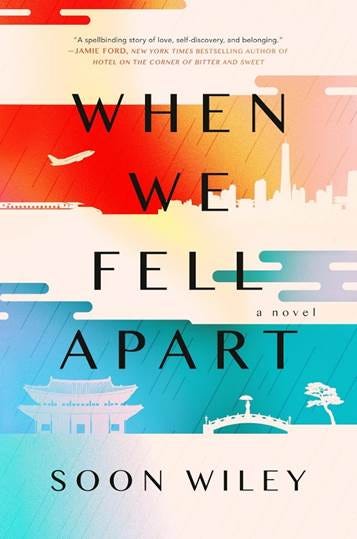
Reviewed by C. Clark Triplett
This debut novel, We Fall Apart, by Soon Wiley is particularly interesting because it combines a literary coming-of-age story with the elements of a mystery and thriller. The novel centers on two characters: Min-jun “Min” Ford, a biracial Korean American living in Seoul, and Kim Yu-jin, a young Korean woman nearing graduation from the prestigious Ewha Womans University. The story begins with a shocking tragedy: Min learns that Yu-jin has died, apparently by suicide. However, Min cannot accept this conclusion. The Yu-jin he thought he knew was intelligent, ambitious, attractive, and seemingly happy. He launches his own investigation to discover what happened to Yu-jin.
Yu-jin’s death becomes not only a tragedy but also a mystery that drives the narrative. Through his investigation, Min discovers many aspects of Yu-jin’s life of which he had been unaware. Wiley employs an effective alternating narrative structure: Yu-jin’s story unfolds largely in reverse, tracing her life back to adolescence, while Min’s story moves forward as he investigates the circumstances surrounding her death. Although the two narratives move in opposing temporal directions, they eventually converge. This structure allows the reader, from a broader perspective, to understand Yu-jin’s life in ways that Min never could. Through this back-and-forth movement between past and present, Wiley explores several significant themes, including bicultural identity, intergenerational expectations, sexuality, belonging, the outsider status associated with inhabiting two cultures, and the difficulty of ever fully knowing another person.
Soon Wiley was born in Nyack, New York, and was raised in a biracial family. Because his family spoke only English at home, he never learned the language of his Korean heritage. Wiley currently serves as chair of the English Department at Greenwich Country Day School in Connecticut. Previously, he taught at the prestigious Sidwell Friends School in Washington, D.C., where the daughters of President Barack Obama attended school. Wiley received a B.A. in English and Philosophy from Connecticut College and an M.F.A. in Creative Writing from Wichita State University. He has received several notable honors, including a nomination for the Pushcart Prize and fellowships in France and Wyoming. He subsequently published another novel, Cece Downing’s Start Over Summer in 2026.
Min is the protagonist of the novel. His father is American and his mother is Korean. Although he grew up in California and is ethnically Korean, he has never felt fully at home in either culture. In America, he often feels too Korean, while in Korea, he discovers that Koreans do not regard him as one of their own. This tension creates an important irony in the novel. Min moves to Korea hoping to discover and affirm his Korean identity, believing that a change in geography might produce a psychological homecoming and provide him with a stronger sense of belonging. Instead, Korea exposes the instability of his identity. He quickly discovers that ethnic identity cannot simply be recovered by returning to one’s so-called homeland. Rather, he finds himself occupying a liminal space between two cultures.
Interestingly, Min’s employment in Korea reinforces this sense of displacement. He works for Samsung as a cultural consultant, helping Koreans understand American culture. Rather than resolving his sense of cultural dislocation, however, his position reinforces his feeling of being caught between the two cultures he is expected to understand. He is valuable to the company precisely because he possesses knowledge of both worlds, yet he does not feel fully at home in either. His return to Korea, therefore, does not resolve his cultural dilemma; instead, it further complicates his struggle to understand his identity.
Min’s relationship with Yu-jin initially appears relatively normal and uncomplicated. The two seem to relate well to one another and develop mutual affection. Yu-jin’s death, however, forces Min to confront how little he actually knew about her. His investigation into the circumstances of her death consequently becomes more than an attempt to solve a mystery. The deeper he investigates, the more he discovers about Yu-jin’s desires, fears, and relationships that she had concealed from him. He is stunned to discover an entire dimension of her life of which he had been completely unaware.
In one sense, Yu-jin’s story constitutes the emotional center of the novel. She has largely lived a successful and privileged life. She attends a prestigious university and comes from a wealthy and politically influential family. Her father eventually becomes South Korea’s minister of national defense. Yet this privilege also becomes a form of confinement because her family, particularly her father, has carefully constructed her life with her future already determined. The issue is not simply that her father is controlling; rather, he has already envisioned the person he wants Yu-jin to become and has organized her life accordingly.
Yu-jin gradually experiences a conflict between achievement and authenticity: What she wants for herself is increasingly at odds with what others expect of her. She has learned to succeed at the things that other people value, but she continually struggles to identify what she herself wants and values. Her secret interest in filmmaking is significant because it provides an alternative way of imagining both the wider world and her own future. This creative world allows her to consider her personal desires rather than simply fulfilling the obligations imposed by her family. In this sense, Yu-jin also inhabits two worlds: the self who attempts to meet the expectations of others and the more authentic self who seeks to determine her own identity.
Perhaps the most significant relationship in the novel is between Yu-jin and her college roommate and friend, So-ra. So-ra’s personality differs considerably from Yu-jin’s, but this difference is also part of what attracts Yu-jin to her. So-ra is more openly rebellious and self-directed, embodying a degree of independence that Yu-jin struggles to achieve. Over time, their friendship develops into a romantic relationship, creating another layer of conflict for Yu-jin. Her sexuality cannot easily be reconciled with the identity that her family and society expect her to maintain. Although her relationship with So-ra places Yu-jin in a potentially dangerous situation, it represents more than a romantic attachment. The relationship becomes an expression of Yu-jin’s desire to determine for herself who she is and who she wants to become.
The novel’s backstory gradually builds a tension that opens the narrative to increasingly complex interpretations. Yu-jin finds herself caught between multiple and competing demands: family duty and individual freedom, academic achievement and artistic aspirations, heterosexual expectations and same-sex attraction, and the identity her father has planned for her and the identity she wishes to construct for herself. Her relationship with Min is complicated by these tensions, even though he remains largely oblivious to them. On one level, Min is someone Yu-jin genuinely cares about. On another, however, their relationship provides a socially acceptable cover for her relationship with So-ra. In this respect, Min becomes part of the carefully constructed public identity that allows Yu-jin to conceal the more authentic self she is struggling to discover.
At the beginning of the novel, the reader knows approximately what Min knows: Yu-jin is dead, but the circumstances surrounding her death are unclear. Wiley’s literary skill, however, allows readers to gradually fill in the missing pieces, with the result that they eventually become more knowledgeable about Yu-jin’s circumstances than Min. In some ways, Min’s investigation is almost tragic because it becomes increasingly clear that his assumptions about Yu-jin are incomplete and, to some extent, misguided. Wiley’s narrative structure provides a unique combination of suspense and social criticism. As the story develops, therefore, the central question shifts for the reader from Why did Yu-jin die? to the more fundamental question, Who was Yu-jin?
In the end, the reader does discover how and why Yu-jin died. She did, in fact, commit suicide. Although the novel initially leads both the reader and Min to question whether she actually killed herself, the later chapters establish that Yu-jin had reached a point of profound despair. The revelation of Yu-jin’s relationship with So-ra is crucial to understanding her situation. She genuinely loved So-ra, and their relationship represented a dimension of Yu-jin’s identity that she could not reconcile with her family’s expectations and the social conventions surrounding her. When Yu-jin’s father eventually discovers the relationship, he strongly disapproves of it. His rejection becomes another source of pressure that, combined with the other demands placed upon her, becomes increasingly unbearable.
There is also a tragic irony in Yu-jin’s relationship with Min. Min believes that he knows Yu-jin, but he does not know about her relationship with So-ra or understand the extent of the conflict between Yu-jin’s private desires and the life her parents expect her to live. The story is ultimately about a young woman whose development of an autonomous identity is constrained by family expectations and other social pressures. It is important, however, to recognize that Yu-jin does not die because of a single isolated event. Rather, she becomes trapped between the person she wants to become and the person her family expects her to be. Her love for So-ra, her father’s rejection of that relationship, and the pressure to conform to rigid social expectations gradually accumulate, producing a profound sense of hopelessness that ultimately contributes to her death.
There are many ironies in When We Fell Apart, but perhaps the most important is the difficulty of ever fully knowing another person and that person’s struggles. This idea can be understood through the philosophy of Emmanuel Levinas, who describes the Other as a human being who is fundamentally separate, unique, and ultimately impossible for the self to completely understand or control. Min believes he knows Yu-jin, but he does not. Her parents believe they know her, but they do not. So-ra believes she knows Yu-jin, but she, too, cannot know her completely. Even Yu-jin herself struggles to discover who she really is. Thus, the mystery of Yu-jin’s identity operates on several levels. There is an external mystery: What happened to Yu-jin? Then there is an existential mystery: Who was Yu-jin? The second question ultimately becomes the more important one. Each character sees the others from a limited perspective, and no one possesses the complete picture. In Yu-jin’s case, these limitations produce profound misunderstandings with tragic consequences.
The structure of the novel as a mystery serves many of its central literary themes. When We Fell Apart, however, is more than a thriller with Korean American themes attached to it. The mystery structure itself embodies the novel’s theory of identity. A mystery assumes that there are answers hidden beneath appearances, and this is precisely the problem that compels Min after learning of Yu-jin’s death. The person he thought he knew was only one version of her. His investigation therefore becomes a metaphor for the search for identity itself: We move beyond appearances in search of the “real” person, only to discover additional layers of experience, desire, and identity.
So, Soon Wiley uses the conventions of mystery to explore the instability of cultural, familial, and sexual identity. Through the parallel stories of Min, a biracial Korean American seeking a sense of belonging in Korea, and Yu-jin, a privileged Korean woman struggling to escape an identity imposed upon her by family and society, Wiley demonstrates that alienation can result both from being excluded from a community and from being forced to conform too completely to one. Min experiences alienation because neither of his cultural identities provides him with a secure sense of belonging. Yu-jin experiences a different form of alienation because her family and social position provide her with belonging at the cost of personal autonomy. Through these contrasting experiences, Wiley offers a distinctive perspective on identity that expands the concerns of contemporary Korean American literature.
Wiley’s perspective is distinctive because it expands the question of identity beyond the more familiar immigrant narrative. Many Korean American novels portray immigrants or second-generation protagonists trying to negote between American and Korean cultures. Wiley, however, sends his protagonist in the opposite direction. Min moves from America to Korea in the hope that his ancestral culture will provide a sense of belonging, but his geographical movement does not resolve his identity crisis. His problem is not simply that he possesses two cultures; it is that neither culture provides a sufficient sense of home. Yu-jin’s problem is almost the reverse. She belongs too securely to a social and familial system that leaves little room for her to define her own identity. By placing these two characters alongside one another, Wiley suggests that alienation can emerge not only from cultural displacement but also from the demands of belonging.
These contrasting identity struggles make When We Fell Apart more than a story about a mysterious death. The novel becomes a meditation on the price of belonging when belonging requires the suppression of the self. Wiley makes this psychological question inseparable from the suspense of the plot, allowing the mystery to deepen rather than merely resolve the novel’s central questions. At the beginning, the reader asks: Who killed Yu-jin, or why did she die? By the end, those questions have given way to a more troubling and universal question: How much of ourselves can we conceal, even from those who love us, before the hidden self begins to destroy the life we are trying to live? In this sense, the novel’s mystery is never simply about discovering what happened to Yu-jin. It is about recognizing how little any person can fully know another human being, and how dangerous the consequences can become when family, culture, and society attempt to define a person more completely than that person can define herself.
About the Author

C. Clark Triplett is Emeritus Dean of Graduate Studies and Professor of Psychology at Missouri Baptist University. He served as co-editor of The Final Crossing: Death and Dying in Literature (Peter Lang, 2015), a co-editor of Worlds Gone Awry: Essays on Dystopian Fiction (McFarland, 2018), a co-editor of Certainty and Ambiguity in Global Mystery Fiction: Essays on the Moral Imagination (Bloomsbury Academic, 2024), and co-editor of Echoes from the Hills: Critical Essays on Ozarks Literature (forthcoming, University of Arkansas Press). Triplett’s poems have appeared in Cantos, Fireflies’ Light, and the Asahi Haikuist Network. He earned a BA from Southwest Baptist University, an MDiv from Covenant Theological Seminary, an MSEd from Southern Illinois University at Edwardsville, and a PhD from Saint Louis University.
© K-Global Scholars and Professionals Forum. All rights reserved. Content published in the K-GSP Forum may not be reproduced, distributed, or transmitted in any form without prior written permission from the K-GSP Forum, except for brief quotations with full attribution.